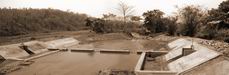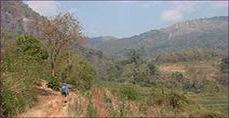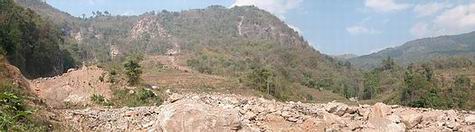
Water
resources will be a key issue this century in SE Asia, and Thailand
is no exception. Changes in the water balance may be climatically
driven but, in Thailand, rapid land use change within the last 40
years may be responsible for inducing change or masking climatic signals.
Within the LINK project new statistical methods are being developed
to study and forecast trends in rainfall and runoff. The software
will be transferred to the RID to aid in water resources prediction
and planning.
In Thailand
there have been historical reports of severe floods and droughts.
About 21 years of mild drought, 35 years of drought and 4 years of
severe drought were reported between 1831 and 1999. In the last 20
years droughts occurred in 1978, 1986, 1987, 1990, 1993, 1999. The
1993 drought extended to every region and caused water shortage for
agriculture, industrial and domestic consumption. Besides drought,
more frequent flooding have been faced by those living and farming
in Thailand especially in the lower part of the Chao Phraya basin.
The LINK project is using data-based mechanistic (DBM) modelling of
time-series of 20 years of rainfall and discharge data for a number
of key catchments. The aim is to objectively identify annual cycle,
extreme events, and to forecast future rainfall and discharge.
Older
records and the influence of land use change are also being considered.
Rapid land use change, which has occurred within the last 40 years,
can be quantified directly using historical air photographs and remote
sensing methods. An indirect method is to analysis changes in the
suspended sediment loads of rivers within catchments that were previously
dominated by virgin forest. Periods, or trends, in forest removal
and agricultural activity may be isolated through time series analysis
of the sediment data. Within the Mae Chaem catchment of NW Thailand,
sedimentological studies of ancient river sediment deposits, coupled
with flood level modelling, are being used to extend the flood record
back in beyond the date of the first gauge record in 1954.