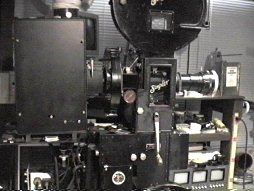
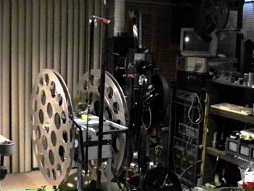
The pictures below are of my Simplex
Standard 35mm Movie projector that is part of the home theater I build
in my enclosed patio. I just found out it is not a Simplex at all, but
a Kaplan projector. Kaplan's were made in NYC and were a Simplex clone.
Kaplan later became Century Projector Corp. They were not the only
ones that copied the Simplex though. At the time the Simplex was
build it was that good. Most copies or variations were made after
some of the Simplex patents ran out. Looks like someone put a Simplex
glass in the door. Almost all the parts were interchangeable and
Kaplan's ran just as good. Probably built in the mid 30's and 40's.
After Century took over they called it a Century K.
The original Simplex Standard had a patent date of
1916. In the early days, the projector was cranked by hand using
the crank shown in the picture. In those days, films were only about
10 minutes in length, and they were silent. This manual crank feature
was also handy when movies were shown in mining camps where there was no
power. Tents were set up on site to show movies.
This model with many minor
changes was the first machine Simplex made. Most all were front shutter
machines and were converted to rear shutter after sound came out to help
cut down
heat to the film. When sound screens came
out with little holes in them for sound, the arc current had to be increased
to keep the same brightness adding more heat to the film. Rear shutters
became desirable.
The Simplex Standard projector
set the standards for the machines we use today. Precision Machine
Co. was probably started sometime in 1909 and production machines were
first sold in fall 1911 starting with serial #100.
The 35mm film format is still the
industry standard, so this projector can show the movies made today
like "Twister", "Perfect Storm", etc. I have seen many projectors
like this one still in use today in small towns across the country.
Many of them still using carbon arc lights, and two projectors in a changeover
system. They seem to be built to last forever.
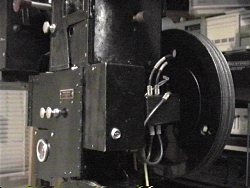
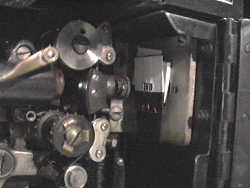
I just added another piece of projection equipment called an Eprad MUT. This stands for Make Up Table. What it does is allows me to assemble all the reels that make up a motion picture on to one big reel. The unit sits next to the projector and provides a supply and take-up reel using film rollers to transport the film to and from the projector. Each reel has it's own motor to pay-out or take-up film. I had to remove the projectors supply and take-up reels and replace them with film guide rollers. Movie theaters use platter systems which take up about 6 feet of horizontal space. This unit only takes up a few feet of vertical space.
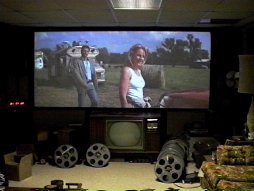
In my enclosed patio I have a 10 foot wide scope screen.
The throw from the projector to the screen is 27 feet.
TELEVISION SECTION
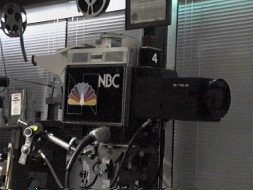
RCA TK-44 COLOR TELEVISION CAMERA
This is my RCA TK-44 Camera built in the
late 60's. This was one of the first fully transistorized
color television cameras. This camera was in service for over
20 years at NBC in Burbank. This camera was used in TV shows
like "Dean Martin Show", "Laugh-in", Tonight Show with Johnny Carson, game
shows, and many more. If you like great old TV cameras like this
one, be sure to go to the "Chuck Pharis" web site. Chuck is a senior
video engineer at ABC in Hollywood. His site is full of old Television
Cameras that he collects and maintains as a hobby! http://www.pharis-video.com/p1464.htm
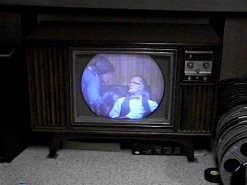
Back in the early 60's I can remember our family going over to my Uncle Bill's house on Sunday night to watch color tv. We would watch the "Wonderful World of Disney", and "Bonanza". My Uncle had one of the first color TV sets, and the picture tube was round. That's right. All color TV sets had round tubes from 1953, when it was invented, up until about 1964 when manufactures finally learned how to make color TV work with a rectangular tube. Back in the 40's, black and white television started out the same way with round picture tubes up until the early 50's.