|
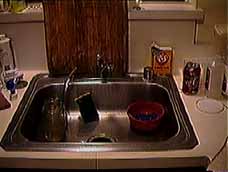
I find peace and quiet when I do the dishes at my house. It's a small enough task, it has a definite stopping point (are the dishes done? are the cupboards full?) and they stay done all night. Although filling the toilet paper dispensers is as important, since they are scattered through the house I do not attain the same tranquility of spirit that the repetitious actions of washing dishes can bring. When I stand at the sink, I am free to ponder. I review the day, I review my Life, I talk to God.
Tonight I pondered why people can't fly. I posed this question at work, during the course of a free-associative conversation which had people drifting in and out of it as they took breaks or happened to pass on their way to somewhere else. We thought about the fact that a newborn can't do any of the things that a child can do, and how much of learning is simply copying what has been seen or heard or felt. So an infant hears people talk, and realizes that talking is a great way to get what you want, and so learns to talk. Walking is similarly learned. A baby notices that everyone else walks. Walking means you can get to toys faster and can grasp things that have been put out of reach. Babies are highly motivated to do the things they see their parents and siblings doing. Sibling rivalry is not learned; it is part of our nature.
What if an infant were raised in an environment where people flew? This sort of question is a favorite with science fiction authors (what if people on a colony ship got to their destination and didn't want to get off? What if homeless people adopted a ghost town?). Never mind the Law of Gravity. There have been plenty of other physical "laws" that turned out to be rules of thumb that even though I am trained as an engineer, I have my doubts that Gravity is an absolute. How would one go about teaching a person how to fly? In sports, there are coaches who can't play, mightn't the same principle be valid in this situation?
I washed another dish. I reached for the next. From upstairs I hear a comic-book like sound: thu-BAM! bump-a-bump. I waited, listening for a cry, trying to decide if an animate or inanimate object fell through the roof. I heard nothing. Just as I decided to start up my reverie, Nicholas (who is a very bold three years old now) lets out a wail. "Oh, oh," I think to myself, "I hate it when there's that much time between the injury and the cry." I begin to imagine hospital trips.
Between sobs, he told me he'd jumped out of his sister's bunkbed. With his mind full of cartoons and TV action dramas, he'd been pretending to be Superman. He'd landed on his hands before his head, so I wasn't too worried about a concussion. As I listened to him, I couldn't tell if he was crying more from the hurt, or from the shock that he couldn't fly. He stopped crying before too long, and we talked about make-believe and what's real...
But he was awfully sure that he ought to be able to fly. |
|||||||
Site of Bob |
||||||||
|
|
||||||||
Professional |
||||||||
|
|
||||||||
| send email to Bob |
||||||||