May 2006
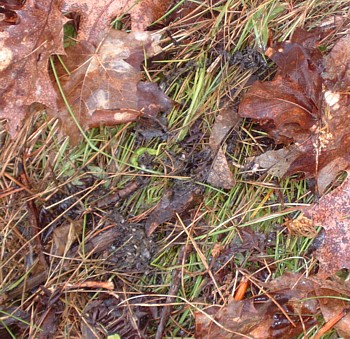
May 19 rain yesterday but this morning clouds soon gave way to sunshine, and despite a cold front moving through the temperature got up to the low 60s. I headed to the otter scent mound along the South Bay trail, and found two fresh piles of otter scats next to that scent mound and tufted grass off to the side but no scats over there.
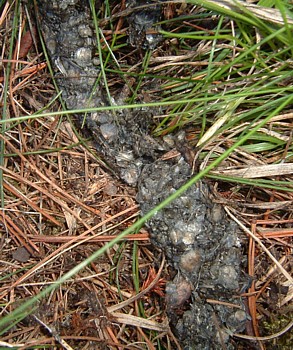
Thanks to the smell, I had no doubt that they were otter scats
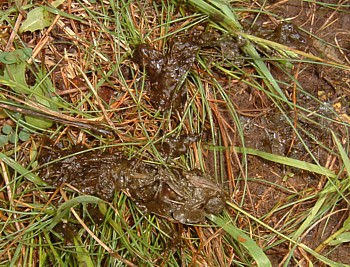
but looking at them closely I saw stringy matter mixed in with the scales that didn't appear to be hairs, fur or feathers. I'm still puzzling over what they might be.
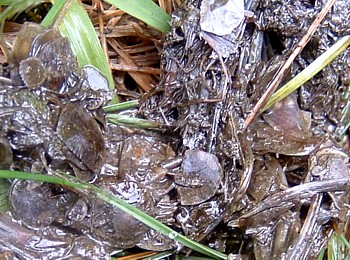
I took a close up of the other pile of scat which appeared just as curious,
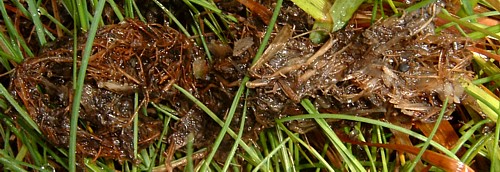
and a foot further on there was a neat pile of fox scat, in which I thought I could see hairs -- and for that reason I don't think a small pet dog left it.
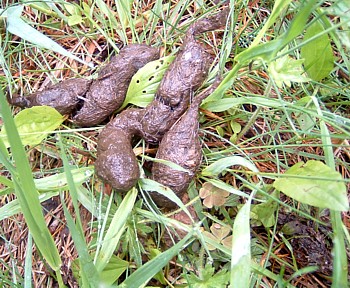
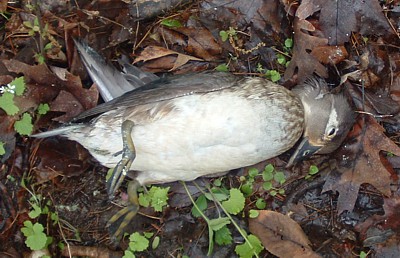
This was a promising start, though not the usual stuff of a spring day. I walked out to the willow latrine on the penisula out in South Bay, expecting to find fresh otter scats there, but I didn't see any nor any signs that otters or beavers had been there. A heron did protest my arrival with groaning squawks. And back in the woods I saw a dead female wood duck, looking quite delicate.
The water level in the river is maybe an inch or two higher and a west wind helped, but I could still negotiate the marsh, usually flooded by now, and get out to the island. I got my camcorder ready, but here too, I found no scats. However, there was one sign that otters had been there, the remains of a large bullhead chewed in two.
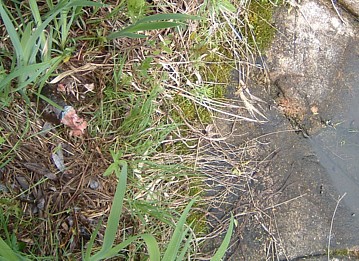
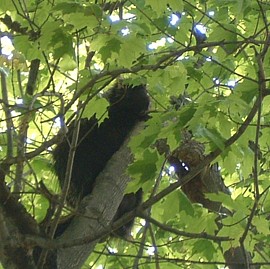
I headed to the New Pond knoll, walking slowly along the shore. Last year there was even an otter rolling area in the woods of the peninsula. Not today, and there were no signs of otters on the New Pond knoll. Thanks to the rain, there was water gushing down the creek into South Bay, a perfect set up for bullheads to run the creek, but I didn't see any. I continued my search for otter scats, but there were none at the old dock, docking rock, nor even at the latrine above the entrance to South Bay. As I walked along the Audubon Pond embankment I saw a groundhog and then down in the woods a porcupine in a crook of a maple tree.
And in a large area of the southeast corner of Audubon Pond there was green scum on the pond.
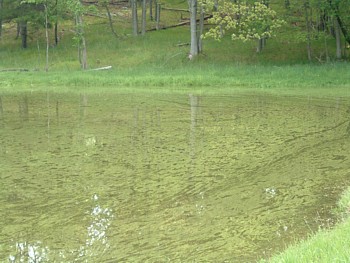
I had planned to check on the beavers at Thicket Pond, but decided I better walk up the creek coming down from the Big Pond to see if the otter left any scats up there. In other years I've noticed scats on both ends of the short creek, and speculated that in those old beaver ponds, with banks well burrowed and empty bank lodges available, a mother otter might find a place to raise pups. Along the South Bay trail, the orioles mounted such a windsection that I had to pay attention, and saw one male who seemed quite exercised,
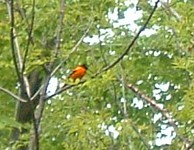
both fluting and complaining and feeding what I first took to be a fledge, but thinking it was too soon for that, thought he might have been trying to impress a female. Going back around South Bay I noticed some splashing from carp, but didn't see any fins. Then as I headed up the creek to the Big Pond, I realized I didn't know what to look for. All the dams are busted here and the water flowing swiftly
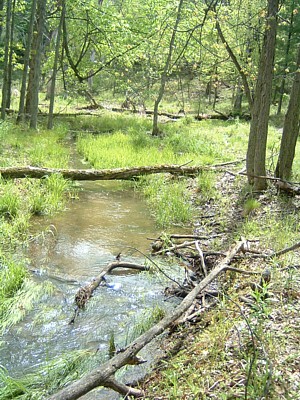
Even the old Middle Pond dam, which had been such a stalwart, had huge gaps in it.
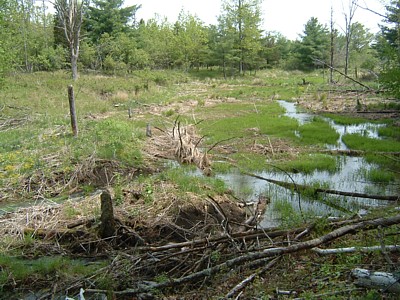
I couldn't see any holes where the old dams and burrows used to be. Five years ago I did track an otter up the valley, but any trail I saw today had obviously been fashioned by deer. Water was overflowing the Big Pond dam
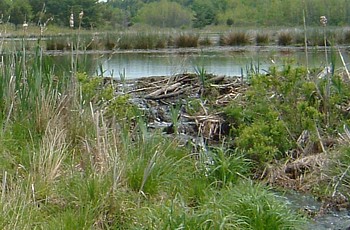
and when I sat on my perch the only excitement I saw, ignoring the blackbirds, came from geese at the upper end of the pond -- I think they had goslings but couldn't see them. The pond right below me was quite muddy, and so spread out that I suspect geese might have foraged there, rather than the muskrats who usually strip the vegetation along a line.
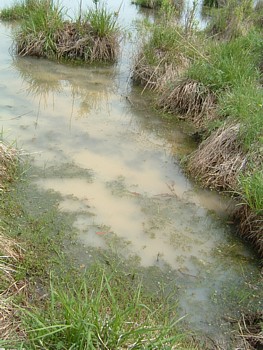
I had glanced at the grass behind me and saw no otter scat, so a cross philosophicl thought entertained me: what if there were no pattern, what if looking for a patterns was a senseless human preoccupation. An otter or two scatted on a bank by the bay and that was that. Then in that smug frame of mind, I turned and saw that a few feet in front of the scent mound I saw two days ago,
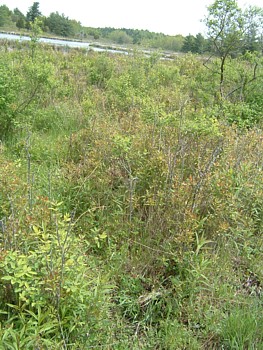
there was a fresh scent mound,
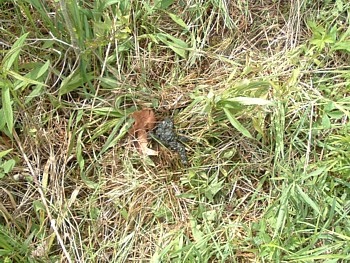
about the same size as the other. The scat on it had more scales, and looked to have been rinsed by the rains,
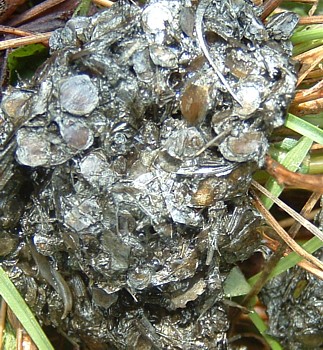
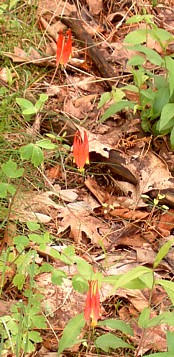
Here was a pattern I had seen before, not that I know what it means. I didn't press on to the Lost Swamp Pond -- I'll do that tomorrow, but I got a hankering to see how an otter moves through this well vegetated quarter of a mile of running water that probably doesn't support many fish. Finally up on the ridge on the way I condescended to recognize the spring, noting a line of columbines.
May 21 more rain yesterday; during the sunny morning we worked on the house at the land, with no time for a hike, then the rains came. By the time we got back to the island, the sun was out and a little before 4 pm I headed off on foot to South Bay. There are flowers I should be catching up to and colorful birds that, with a little more patience, I could see, and if I had had my camera ready I could have gotten a photo of a heron taking off from the end of the cove, but once again freshly flattened grass had me on my knees just beyond the little causeway on the South Bay trail.
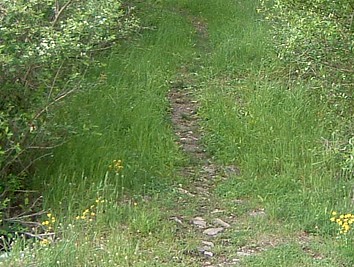
Maybe other people wouldn't notice this but to me it is like the first chapter of an adventure story. Last time I was here the grass was scratched up. Today it seemed pressed down.
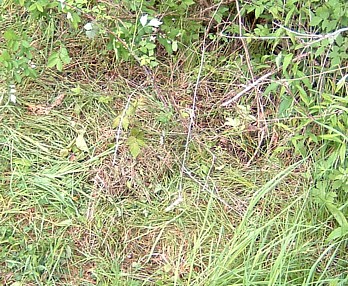
And, of course, there were fresh scats, with once again tubular shapes
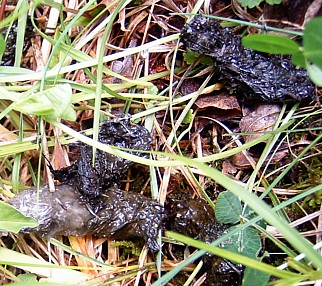
as well as smeared scats
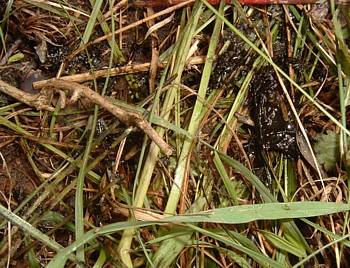
with some undigested fish parts
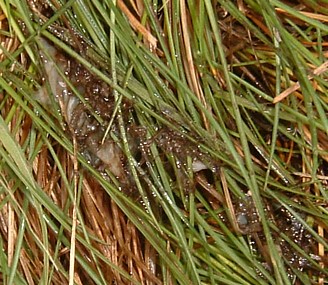
There were more fox scats nearby and then about twenty yards along the trail, there was a pile of skunk poop.
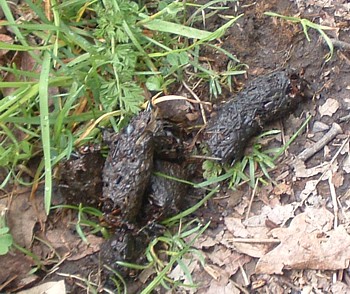
I broke some open with a stick and saw beetles shells and also got a whiff of the characteristics smell of skunk poop, which, having had to clean it out of a garbage can once, I can recognize,
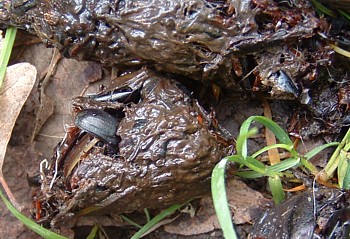
In other years I have bumped into skunks along here, but in those years, I never noticed skunk poop. The other day there were only otter scats here and at the other end of the creek running down from the Big Pond, so I didn't expect to see scats on the New Pond knoll which guards the creek running down from the Second Swamp Pond. But just off from the usual trail up and over this knoll there was a larger swath of crushed, scraped and smeared grass.
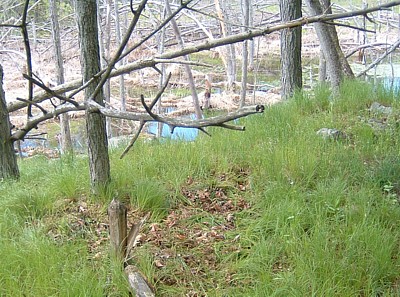
No tubular scats here, just three discreet strokes of the typical otter scats.
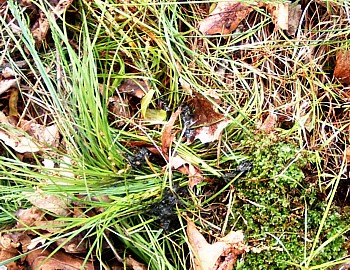
I should add that as I came up to the knoll a heron flew off from the creek. So I paused to look down there and see if any fish were running up stream, but I didn't see any. I continued along, checking the latrines on the north shore of South Bay. There was nothing at the old dock, a nice bit of scraping
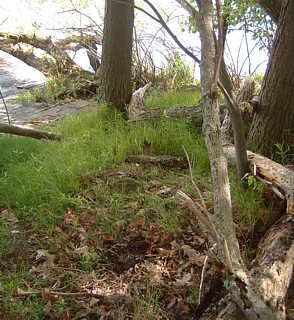
and a bubbling scat
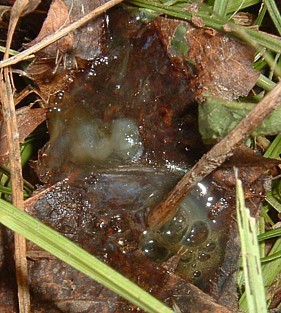
above the docking rock, and more scraping and scent mounds
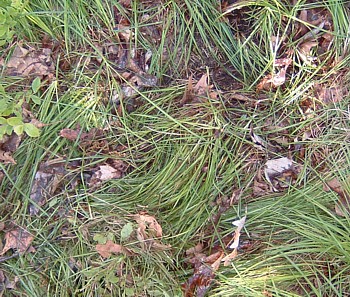
in the latrine overlooking the entrance to South Bay but these were a little to the east of the ones I last found here.
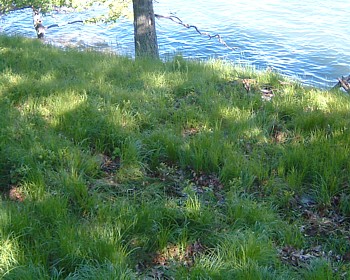
Plus the otters seemed to run out of scat. I had to peak under the scraped up leaves to find any.
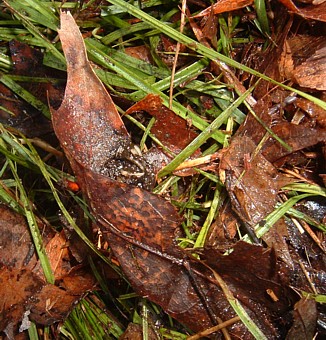
The otter activity here looked much like what I saw on the New Pond knoll, and not like what I saw on the little causeway. Plus it seemed like at least two otters were making these marks. So I decided to do a complete tour of the ponds and check for otter signs at the Lost Swamp Pond. But first I checked on the beavers. The beaver in Audubon Pond saw me before I saw it and promptly and frequently slapped its tail.
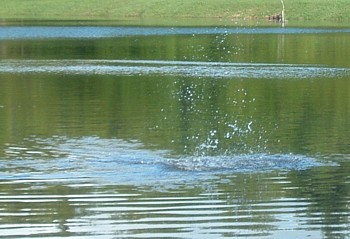
The water level in this pond continues to rise and the long causeway is almost flooded.
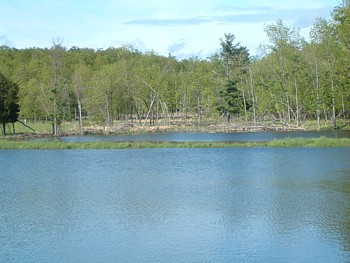
The last time I was here the beaver came out of the lodge in the east end of the pond. Today the beaver greeted me in the west end of the pond. The bank lodge there has been built up,
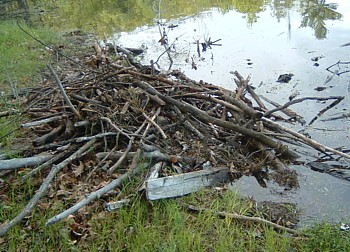
though I think the beaver probably came out of burrows in the embankment on the south side of the pond. The flooding helps the beaver harvest the ash trees it cut down.
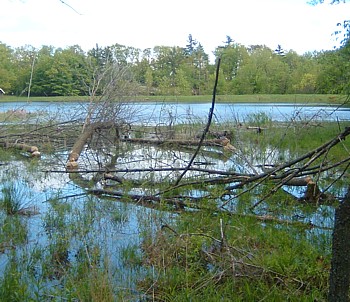
And I think the beaver has added logs to the lodge in the pond. With higher water this lodge should seem much lower, but it doesn't.
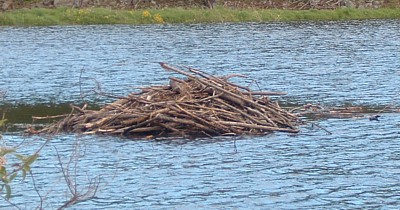
Then I checked on Thicket Pond, after first seeing no beaver signs in or around Meander Pond. Just after I noticed a trail of mud in Thicket Pond, a shower began so I sat under the crown of a maple the beavers had cut. I had a chilling thirty minute sit, warmed by the sight of two beavers. One near me slapped its tail and even looked at me, but I heard other splashes deeper in the thicket, and I began to wonder if two young beavers might also be playing a little game. When another beaver approached the beaver watching me, the latter dove, seemed to goose the former and then followed it up pond -- away from the lodge and safety. I heard one more authoratative thump, so maybe there was a third beaver about. When the rain stopped, I got a photo of a beaver eyeing me.
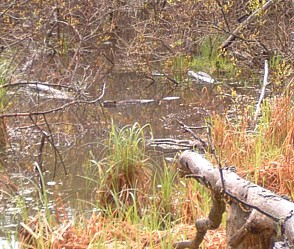
I headed for the East Trail Pond and was surprised at how much water there was,
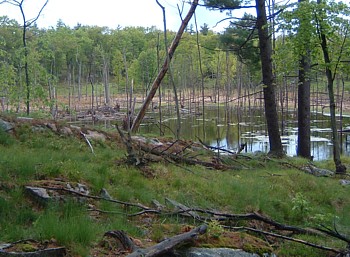
much to the delight of some frisky mallards, but there was no sign of beaver work on the dam, and no sign that any otters had been fooled into looking for fish here. When I got to the Second Swamp Pond dam, I saw something swimming toward the north shore, and not only did it prove to be a beaver, but it made a scent mound at the foot of the rocky knoll where there had been a scent mound two years ago. Needless to say, there was beaver work all along the dam. This beaver got wind of me and I got another slap of the tail. Along the dry end of the dam, I saw some grass dug up as an otter might do it, but instead of scat, I found mud in it, so I suspect the marking beaver did it. The rain had delayed my rounds, so I had time enough only to check the north shore slope of the Lost Swamp Pond. I bet there would be scat and I was right. Two scent mounds
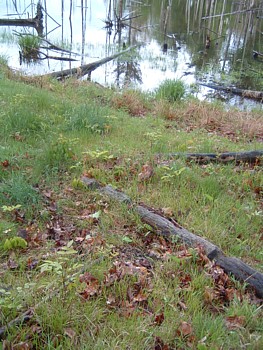
in the fashion of those I saw on the New Pond knoll and at the entrance to South Bay, with a typical smear of scats.
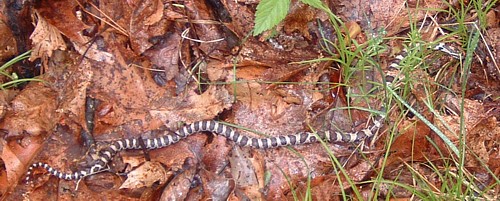
I saw a muskrat here, and then as I hurried along, a milk snake chilled to the bone.
I expected to see the grasses at the south end of the Big Pond dam pressed down, but no, and no new scent mound, though it did look like it had been scraped there a bit. So... I think two otters toured the north part of this range, and that one otter is making its presence known on the south side. This makes sense if it is the mother and two pups from last year. But it is about time I seriously set out to see these otters.
May 23 yesterday and today Ottoleo and I worked on the house at the land, slow going, but since the weather was chilly we didn't miss much
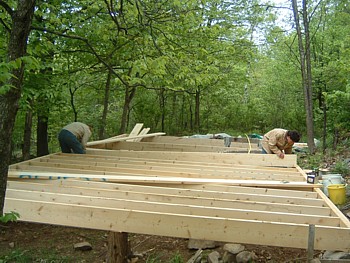
The sun came out at around 3 pm and I took a quick hike to see what I've been missing. The beaver has added more mud to the Deep Pond dam at both the major breech,
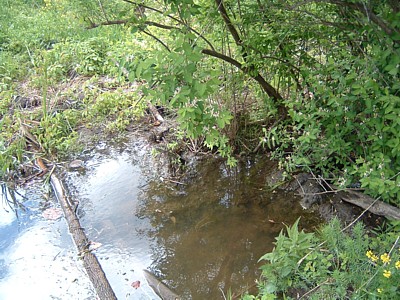
and the original breech.
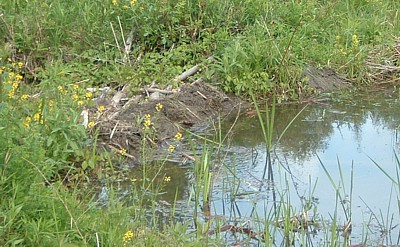
There is also some mud marking around.
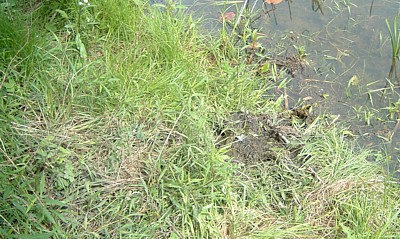
But most curious was an otter like scat
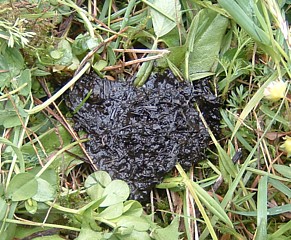
high on the bank of the back of the pond. The grass around it was matted down much like an otter would do,
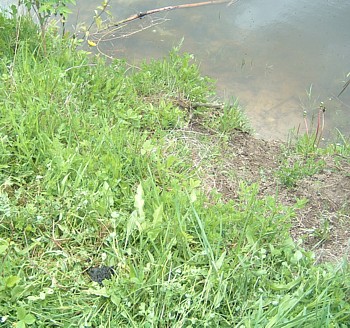
but I couldn't find any other scats; none in the usual places and just one in this odd place. I'll check around the pond again, and think about this. Last year otters did come through in May.
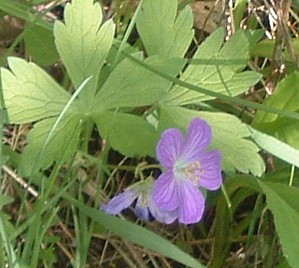
We got home in time for me to check the ponds. I walked to the end of South Bay first, and didn't find any new scat -- somewhat of a relief; I could appreciate the wild geraniums.
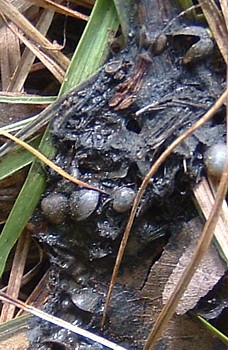
There was nothing new on the New Pond knoll either, but I could get a better look at the scats that had dried out a bit, and I saw that the pod like bits I've been seeing were small shells probably gobbed up as the otter was rooting around in the mud after fish
I sat for awhile on the knoll, but there were no nesting birds to focus on, though plenty to hear, especially a wren. I headed up to the Lost Swamp Pond thinking that was the best place to relax. And I had time to check the trillium patch nestled in the granite rocks forming the south shore of Otter Hole Pond. Some of the trillium was still white, but other vegetation was swallowing up the blooms.
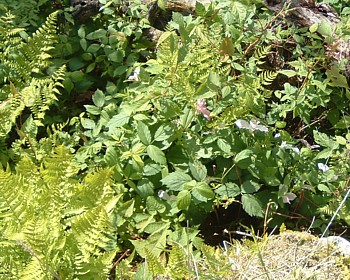
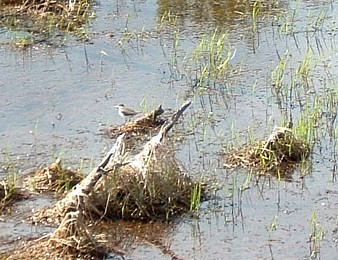
These shallow ponds were quite lively: a score of ducks on what remains of Beaver Point Pond, and ducks, geese, and a sandpiper on Otter Hole Pond.
As I walked up the south shore of the Second Swamp Pond something rippled the water and I first thought it was a nesting blackbird, but as I walked along, I saw a beaver hurrying up to the Upper Second Swamp pond. I saw it climb over the dam, and when it finally achieved the safety of that pond, it began slapping its tail. I thought this was a clear case of a beaver slapping its tail in alarm, because if it was only trying to intimidate me, it would have stayed in the lower pond. Not that the alarm was heeded. As I walked up to the pond, two beavers swam off from the dam. They didn't slap their tails, and they didn't head for the lodge. This pond is quite high now, and they sought refuge in the flooded dogwood bushes along the south shore of the pond.
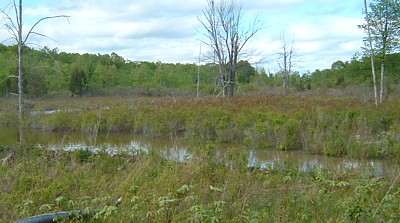
Perhaps there are kits in the lodge, and the mother beaver wants to be alone with them. Of course I checked the otter latrine at the southeast corner of the Second Swamp Pond, and while there was a new scent mound and new scats, all were old, probably made three days ago. So I didn't expect to see otters when I went up to the Lost Swamp Pond dam, and I didn't see them, but I was entertained as I lay on the bank of what I call the old otter rolling area (otters have not been there in about six months) I watched various dramas unfold for about 45 minutes. I first noticed three pairs of geese, uncharacteristically quiet, who swan gently around the pond, one pair picking things to eat out of the pond, another standing up on a log floating in the water. All the while there was frequent duck traffic over head, usually just one duck, or a pair, and once three ducks -- mostly mallards. Then I noticed a fledgling in the hole of a dead tree trunk about 5 meters out in the pond right in front of me. In other years a flicker nested here and the head I saw looked like a flickers, soon I saw two more heads in the hole. Meanwhile about three pairs of swallows were flying about the pond, landing on the dead trunks -- but not in the flicker's hole. In the photo below a tree swallow is on top of the trunk and a fledge almost looking out of a hole.
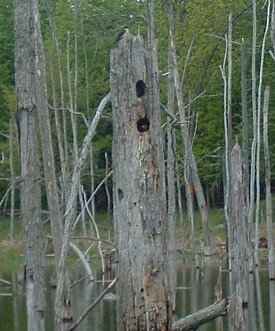
I soon heard a flicker yuk-a-yuking off in the distance, I had camcorder ready to record what would happen when it returned to its nest. Then the muskrats began to distract me. First I saw one humped on a log up in the northeast corner of the pond. Then I saw two swimming out of the old beaver lodge in the middle of the pond, and heading to logs in the northwest corner of the pond. I suspected that the time for muskrat fights had passed, and then I heard the humming whistles of contending muskrats. As best I could make out a muskrat from the west end swam over to the northeast end to splash around with a muskrat there. Then it retreated, and about ten minutes later, the north side muskrat swam toward the west end only to be met by a defending muskrat. For a moment I thought two tree swallows were joining the contest because they seemed to dive bomb a muskrat who swam from the northwest burrows heading to the dam. Then I reasoned that the swimming muskrat scared up midges hovering low over the pond. The midges had not yet begun to form huge swarms -- been too cold for that but I had been running into small Brownian balls of bugs. Meanwhile no adult flicker returned to the hole; I heard one calling off in another directions. The fledges remained quiet, other than the head of one periodically sticking out of the hole. Then that fledge thrust its tail out and pooped down the trunk -- a sure sign of maturing. Just before I left, the fledge stuck its head our for some plaintive peeping. Still no adult. Last year I watched the flickers feed the young in this hole, so I don't think my presence was keeping the adults away. But then, as it begn to drizzle a bit, it was time to go home to dinner anyway. No new scats on the north slope latrine. As I approached the Big Pond, I was amused by a mallard standing on top of the beaver lodge in the pond. Its big dark orange flipper made its whole body looked reddish, and I first thought it was a more exotic duck.
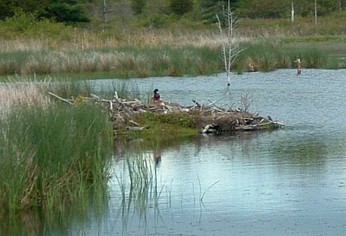
The last time I was here, I saw unattended ducklings, and so I kept expecting them to appear and climb up on the lodge, but no. As I began to cross the pond on the dam, the mallard flew off. At the same time, a muskrat ferrying grasses swam from the dam back to the lodge.
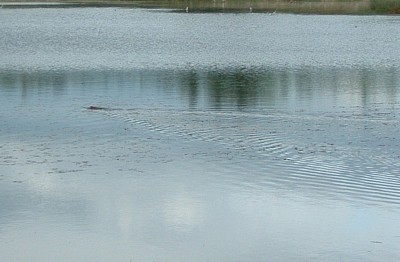
There were no new scats on the south end of the dam. However, once again the water there was very muddy. I've been seeing muskrats more often around here than ducks or geese, so perhaps the muskrats are raising the mud here. All in all, a relaxing hike, and not uninteresting even as my quest to find the mother otter and her pups made no progress. So far, I have just been unable to get up early enough in the morning.
May 25 I headed off in the boat to check the Picton latrine with Ottoleo. On the way, we saw a large dead fish floating between Murray and Grinnel with its marking bleached away. Probably a muskie. As we approached Picton I was glad to see the bold scent mound at the foot of the rock still broadcasting. And indeed when I got close to it, I saw dead grass on top of it.
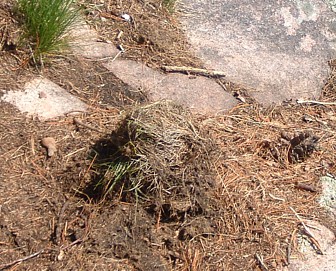
Before it was all mud. Of course maybe the wind did that and not an otter. There was an old scat near it, but the most recent foray of the otters appeared to be at the western end of the point where a good swath of grass was pressed down
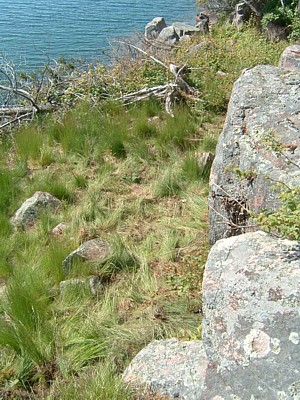
and one smear of a scat, at least, appeared to have some moisture in it.
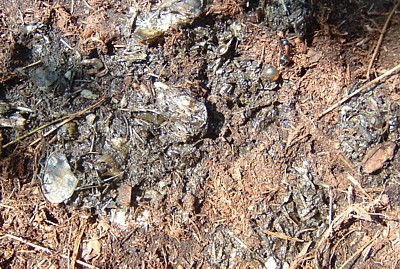
Then I checked the high latrine up near the swinging rope, and here too there was new scat and the dirt seemed dug out more.
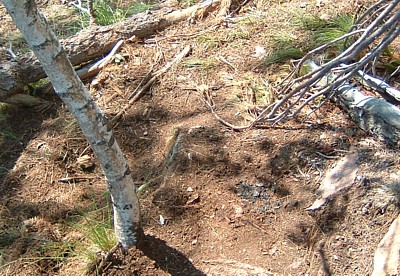
With grass shooting up everywhere it is harder to find scat, and I didn't see any where the otters had left scent mounds before. We eased by the Murray Island rock but there appeared to have been no otter activity there. Then I checked the island in front of the marsh that forms the point of the spit of land in the middle of South Bay. While there were no fresh scats there, otters had been there since my last visit about a week ago.
There was a little bit of digging but nothing to compare to the excavations and rolling on Picton. Then I had Ottoleo let me off at the docking rock, where a beaver had left some mud pats, but there were no otter signs. I walked up to the latrine over the entrance to South Bay. Since the latrine was not grown over with green grass, I wanted to declare that the otters had just visited, but I couldn't find any new scats. Then I went up to Audubon Pond curious to see if the park overseers had tried to drain the pond and restore the trails in time for the Memorial Day weekend. No, but the water level was a few inches lower. As I walked along the embankment something small jumped into the water, not a frog, then I saw a baby muskrat swim back into the embankment. So I sat in the grass and gave the babies ten minutes to come back out,
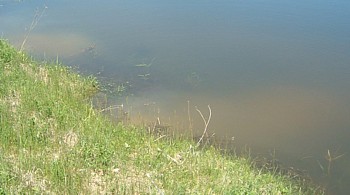
and in seven minutes one did, no bigger than my hand, sniffing the air, and then after I got a little video, diving vigorously into the water and back into the burrow in the embankment. This activity had stained the bottom of the pond there a muddy brown. I thought it remarkable that no adult muskrat seemed to be overseeing this activity. I haven't seen babies this small in years, and I am tempted to come back and spend some time here, even though the cut grass of the embankment is not a very romantic place to sit. I saw two redstarts race across the pond. As I continued down the South Bay trail, I saw a swallow tail butterfly quite in a tizzy over a pat of poop,
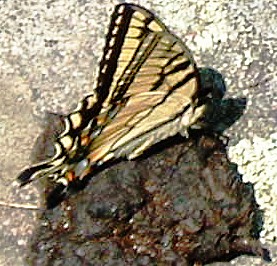
probably from a deer whose intestines were drenched with the soft green grass of spring. The butterfly sucked away -- such is the stuff of beauty. I kept checking the otter latrines as I continued along the trail, and almost walked away from the last one at the little causeway before I saw a fresh scat under the wild geranium
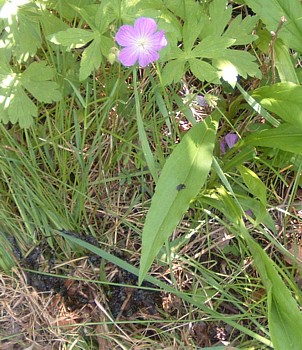
-- I know this was new because when I photographed this bloom before it didn't overlook such an interesting conglomeration of scales and such.
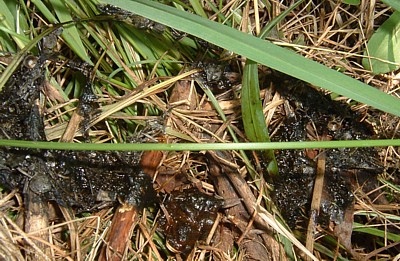
I didn't know what to make of this scat, in the context of my quest to see otters sooner than later, but if I don't get the gumption to get out at dawn, I will at least check the Big Pond dam upstream and the willow latrine out in South Bay.
The day developed with genuine warmth so rather than get back to work on the house in earnest, I toured the land a bit and went down to White Swamp to see what was new. At the First Pond, the grass in places seemed parted in a way to suggest that a muskrat had been foraging, but with great circumspection. I saw at least two small painted turtles with their snouts just out of the water, and shiners swam so they rippled the water. When I approached the Third Pond, I saw one muskrat dive into the bank in back of the pond, and I also saw ripples coming from the bank in front of the pond. Then a muskrat swam into view.
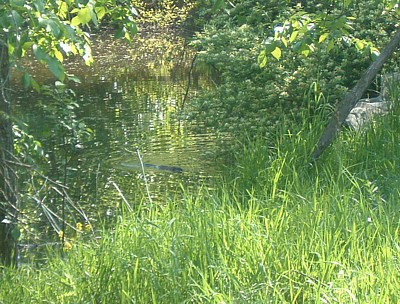
What pleasure they must feel at the sight of so much green. Yet, this muskrat did not wade into the grass but kept swimming in circles feasting on what little plant matter the west wind blew onto the surface of the pond. I've observed beavers swimming around collecting pollen, but this muskrat seemed to be getting matter more substantial than that, including maple seeds, and perhaps petals from the honeysuckle bush on the bank. The muskrat clearly was excited as it swam in circles and heedless of my approach. Down at the Deep Pond I kept looking for a beaver, but scared a muskrat instead. It was nibbling below the steep embankment which the beavers had riddled with burrows over the years. But I soon saw that the muskrat, swimming under water, swam over to and into the negligible pond bank near the inlet creek. Here again there were brown stains in the water outside the burrow.
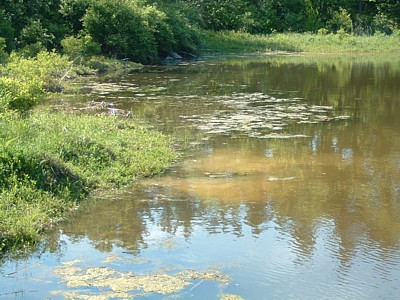
The muskrat came out three times, each time under water, and I saw plainly that this staining of the pond bottom was not from the muskrats eating plants, but from their digging into mud each time they came in and out. This impressed me with how much muskrats like tight places so with every move in and out they are going to raise mud. After the third foray, the muskrat surfaced in the middle of the pond. I lost track of it, but I discovered when I scared it away from the dam embankment where there were more burrows with stained runways. Last I saw of it, the muskrat swam over to the burrows near the inlet. The water level is higher, thanks to more work on the dam by the beaver. However, I saw no freshly cut trees anywhere. The water is muddy so I assume it is eating underwater plants. On the way down to White Swamp I tiptoed around the now yellowing leaves the of the ramps. Few other flowers out now. But out in the huge swamp, there is some green coming up around the clumps of brown vegetation. I checked the beaver scent mound and otter latrine, and both looked unused. Then I as I went back up the slope, I saw a trail getting down to the swamp in another direction
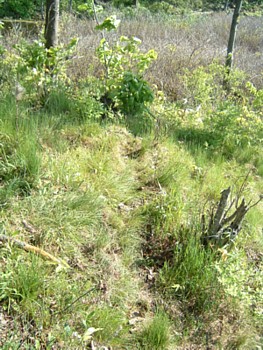
and at the end of the tramped down grass was an otter scat, none too fresh, but new to me. Over at the inlet, there was fresh mud pushed up along the banks of the channel,
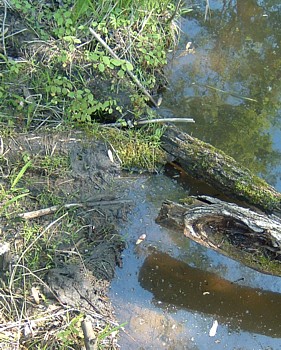
so a beaver is still keeping in touch with the area. I couldn't get to the huge scent mound at the end of this channel, but it looked like it was freshened with black mud.
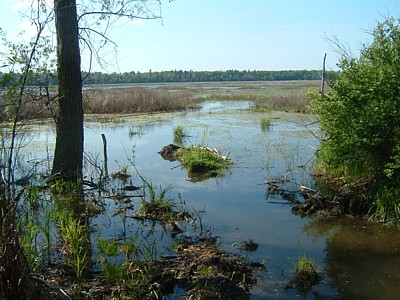
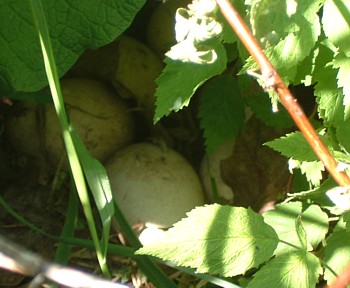
No signs of otters. Up at the dam there was no major beaver work, and it is difficult to tell how recently the sticks floating in the pond were stripped, simply because there are always so few of them. I walked back up along the creek and on the bank opposite where the otters had a winter latrine there appeared to have been some digging and rolling, but no scats. Of course, I also looked at the mysterious scat left on the high bank of the Deep Pond that looked like an otter scat. Not seeing any other signs of otters, I guess I'll have to conclude that this is another raccoon scat that came out rather otterly. This has been a confusing year in that regard and I can't account for it, unless the easy winter allowed more fish to survive and raccoons have been taking advantage of that. A red eyed vireo is nesting near the cabin again, hopefully assuring us of almost two months of melodies. And deep in the viney vegetation near the garden, a turkey left several eggs.
Check out my other web pages: otters; beavers; minks; muskrats;porcupines;Leslie's art