May 2006
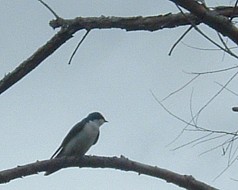
May 2 I went down to the Third Pond and was amazed to find the air just above it crisscrossed by swallows, barn and tree, and I hoped they were eating the black flies that had been biting me. I sat and watched them, enthralled by their close formations. I tried to take a photograph by clicking the camera when one flew in front of me trusting that at least two others would zoom into view behind it. That worked once, in fact I caught the blur of three swallows, two tree one barn. There were two tree swallows not amused by the show -- the ones trying to nest in the box by the pond.
I went down to the pond to see what the muskrats and beaver might be up to, and at first look thought I would just be chronicling their nibblings. But a muskrat nosed up out of the water right in front of me, then nosed down and swam over to the grass lodge built last fall. It sat beside it and ate some grass, and then it swam into a hole at the base of the lodge. I actually rarely see muskrats around these tall beehive shaped lodges, and they are supposed to enter from below. But this hole on the side certainly seemed convenient.
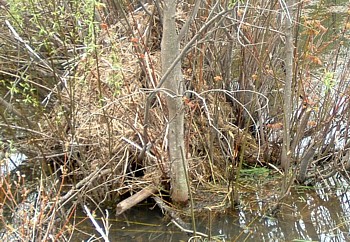
It is built in a clump of willow saplings, and a couple of the bigger ones were cut. I assume by the beaver. The beaver has added more brush to the dam.
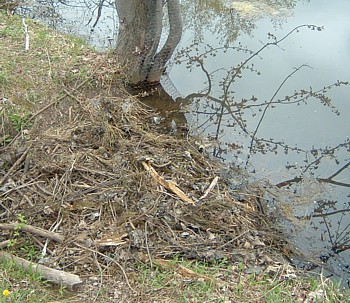
I looked for larger trees it might have cut, but saw none. There are five willow clumps for it to enjoy.
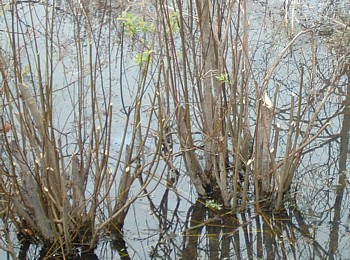
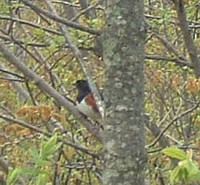
Topping off the activity at this little pond was a contest between two towhees, matching each other call for call.
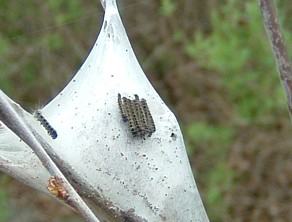
Finally tent caterpilars are breaking out already, just in time for hungry birds.
I took a brief tour of the ponds on the island before dinner, not with the best conditions -- once again there was a brisk east wind. While that would make it easier to keep my scent away from any otters in the pond, this is not the season for otters in the pond. It's muskrat time and the wind whipped waves would obscure their doings. Of course, I approached the pond head bent religiously looking for otter scat, when it crossed my mind that I should at least look up and see if there were otters in the pond. Right in front of me were two muskrats, fighting. I saw two kinds of exertions that I've seen in other contexts: the chasing muskrat tried to hump the other, but this was definitely bullying and not courting. The muskrat strained to keep the other muskrat down. When revving the tail up for the chase, one muskrat sent water a few inches into the air. In the heat of battle perhaps a muskrat doesn't make the elegant jet ski like trail I saw two muskrats making once, when they were showing off, not fighting. The fight seemed inconclusive. The chaser only drove the other muskrat off to see it go up on the dam and make its mark before another attack drove it off. Then the chaser skulked behind the grass clump in front of me, grooming a bit, and then it swam up pond, following the other muskrat but at a great distance. I noticed a goose nesting on the old muskrat lodge there,
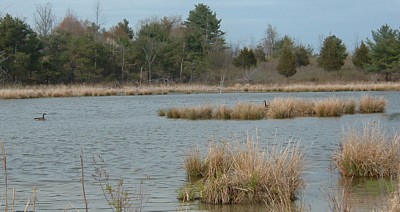
and she soon got up and swam away, not sure if the muskrats disturbed her, or me. I don't recollect seeing geese nest there before -- be curious to see if there really are eggs there. The water in the pond is higher and the beavers have done some work on the dam, but not the usual grand dollops of mud, more grasses and even a stray sprig of honeysuckle.
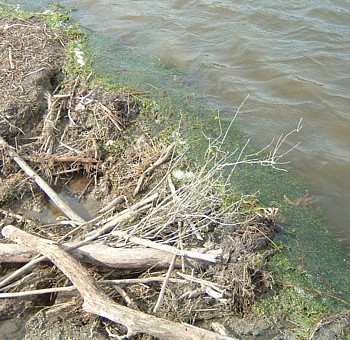
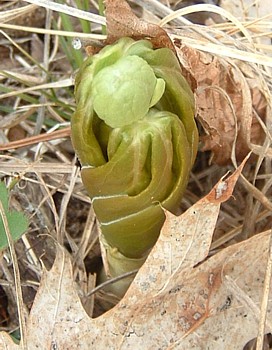
I bet some of the younger beavers are doing this. I'll have to sit one evening and see. The wind didn't conceal the muskrats on the Lost Swamp Pond, but no fights. I saw two groups keeping a distance. When swimming in the pond, the muskrats made a faint line in the water, but then when they balled up on a log to eat some grass, they seemed rather large. I wonder if they fluff their fur out to make themselves look more substantial? There were no scats around the pond, and no fresh beaver work, save for a stripped log up on the lodge they are using. But the time to start eating grasses has begun. The mayapples are coming up, always a fine entrance.
Down at the Upper Second Swamp Pond, I saw a raccoon scat that could have been mistaken for otter scat.
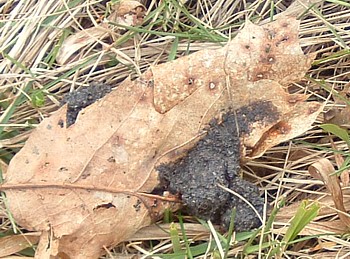
I think the raccoon chose this spot because its usual latrine on the dam is a rather perilous place. Especially with an east wind, this thin dam looks fragile.
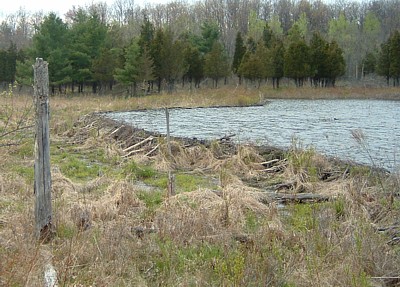
I think the beavers are pushing mud up on it, when, I think, they should be putting branches behind it. I didn't check the Second Swamp Pond otter latrines around the dam, deciding to hurry on to the willow latrine out on the point in South Bay. If the ponds aren't attracting otters, perhaps the bay is. I saw a mink scat on the platform made by the willow trunks,
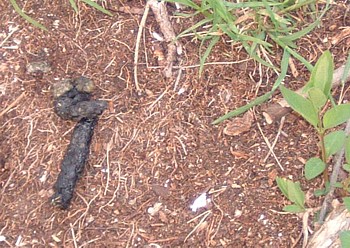
and no other scats, neither otter nor raccoon. And I didn't think there were any newly stripped sticks left by a beaver. This was disappointing and I blamed the low water level. That didn't stop a Caspian tern from diving and then as I approached the little causeway of the South Bay trail, I saw a reddish glow in the bushes by the bay.
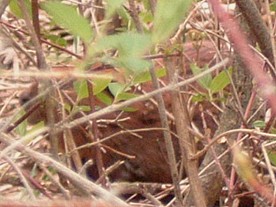
A beaver was up on the flattened cattails, long enough to get beautifully dry. With my next step it leapt into the water, but didn slap its tail and didn't swim far.
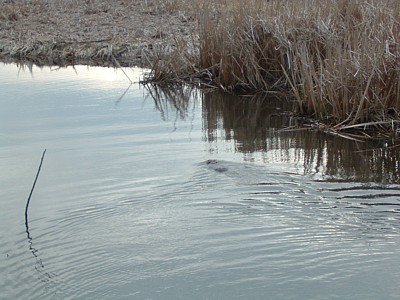
So it seems that animals can go about their business without leaving signs glaring enough to excite a dull tracker.
May 3 when we got to the land the first thing we heard was a loon repeating a call from White Swamp. We hoped to see it fly over us, calling, like one did last year, but it evidently stayed in the swamp. Then I checked on the trillium on and below the mossy cliff. White trillium carpet the ground in other areas, here I look for large trillium framed by the thick mosses on the ridge. As I took them, the photos looked like they would be good, but the white of the trillium flower was too overpowering.
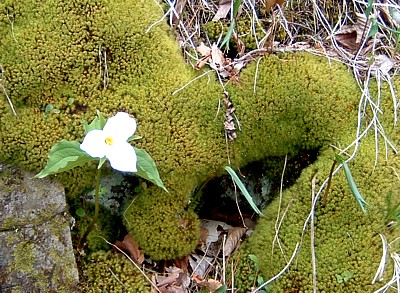
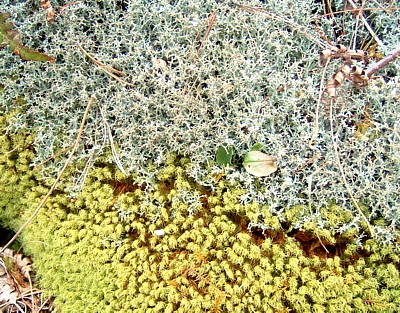
The moss itself promised some interesting photos especially when some exuberant lichen tried to over power it. Most of this lichen stood alone on the ground, but here and there it contended for prime space on the ridge.
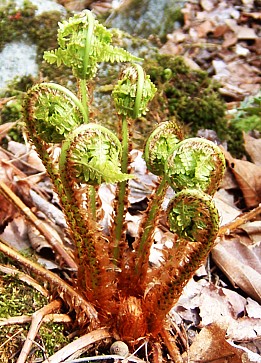
I also saw a fern with heads about to uncoil
And a plant that I couldn't quite get a good photo of, and thay we can't identify yet.
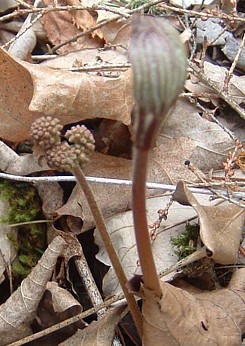
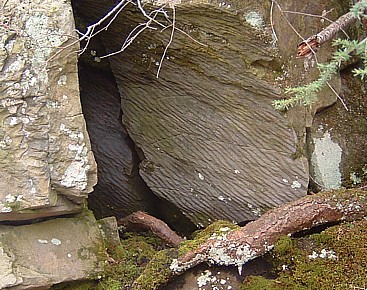
More will unfold. Then there was an excellent frame for blooms made by sandstone rippled by ancient seas, but no flower had filled the niche.
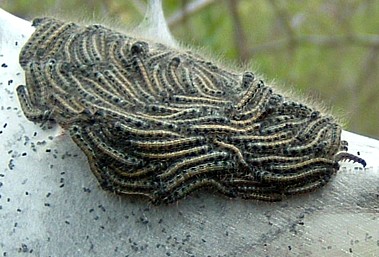
I sat on the ridge and scanned the trees for birds, but none were foraging in the emerging canopy. I saw a flock of brown birds but they got away before I could identify them. Perhaps they were after the inviting tent caterpilars, even more exposed than the knot I saw yesterday.
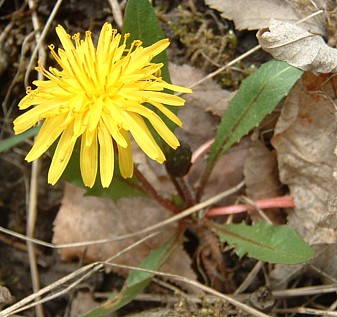
The blood flowers are done and the area on the south side of the ridge often rich with violets has yet to bloom despite getting the morning sun. I took a photo of a dandelion, I think, gentler than the one found in lawns.
I went to the Turtle Bog and the wood frog tadpoles were not to be seen. I sat briefly and with the clouds I couldn't see through the water to check for outlandish caddisfly larva. After we finished working we went down to the Third Pond. No swallows today, resident nor visiting, but a muskrat was out. It dove before I could get a photo, but left a neat pile of green grass freshly cut for dinner.
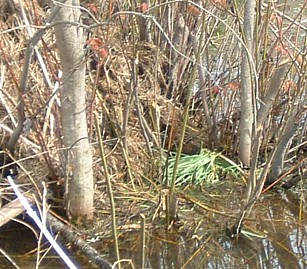
The beaver was floating in the middle of the pond.
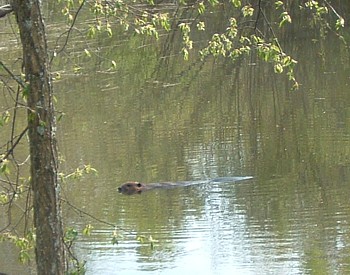
We waited for it to dive and then we hurried to shady seats on the grass. It was about 4:30 PM, and though I miss the family of beavers in the upper ponds, watching this beaver in the late afternoon beats battling the evening insects to get a glimpse of beavers keeping the regular hours of a colony. We suspected that the beaver retreated to a nook in the bush by the dam. Meanwhile the muskrats entertained us. The one we saw first was on the lodge. It dove and then I noticed it hiding under a dead plant right in front of me, and dove when I saw it. Then we saw a muskrat coming out of a burrow in the back of the pond, browsing leaves off some small saplings in the pond and taking them to the lodge, where another muskrat was out nibbling the grass that had been collected. My guess is that these two muskrats will live peacefully with each other. The contention I saw the other day, so common with muskrats at this time of year, is probably over. Leslie walked around to the dam and scared the beaver out of its nook and like the last time I watched it, it surfaced beside the willow clump, waited about five minutes, and then cut one of the willow saplings. Once again it tried to wrestle it free from the clump. When it didn't come out easily, it swam over the to crown of leaves and began nibbling them. I was able to get a little closer for a photo.
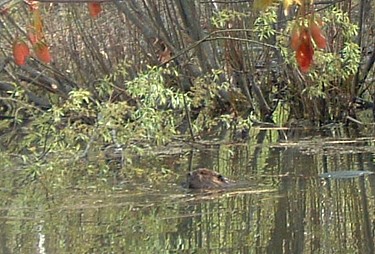
Of all the beavers we've had in the pond, this one has a easiest disposition, prudent when we are around but not at all bothered.
May 4 a bit of a west wind this morning, rare occurance this spring. We headed off to Picton in the boat but made a quick swerve to see three goslings scampering up a rock trying to follow their parents into the cover of Goose Island. We saw another pair of geese on the island, at the point, looking protective, but didn't see their goslings. When we landed on Picton point I checked the pine litter and rock where I had seen the most digging before. There seemed to be new digging but no new otter scats. Then Leslie called me over to the latrine above the tree rope where there were very fresh, loose scats
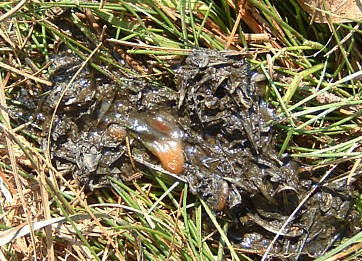
-- just the kind I've been looking for. Nearby was another rolling area
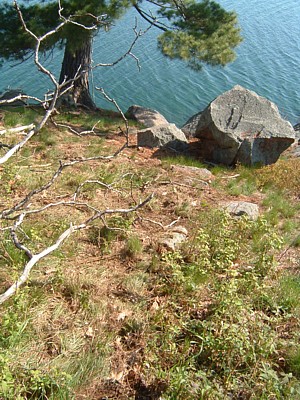
with more fresh scats, and digging.
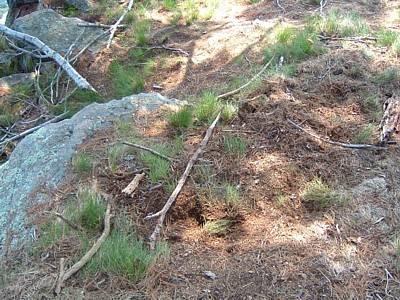
Seeing such fresh scat inspired us to continue around the island in the boat hoping to see the otters, but no such luck. Then we went back into the cove behind the point. There were two deer grazing in the water, but no otter nor beaver signs. I noticed an osprey sitting in a huge nest on a power pole on Murray Island, don't recall seeing it last year and can't believe they could build so big a nest just this spring. No buffleheads on the river. I went out after 4 pm to check the otter latrines around South Bay to see if there were scats as fresh as what I saw in the morning. I saw a tubular scat on the trail near the creek coming down from the second swamp, but thought it might be from a raccoon. Then above the docking rock I saw a new otter sent mound
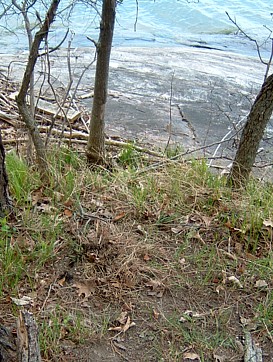
with a loose scat smeared around,
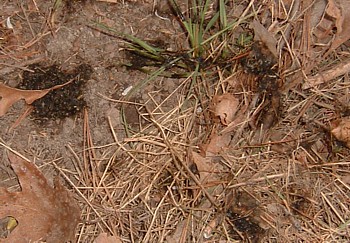
but it was much drier than what I saw in the morning. Then I detoured up to Audubon Pond, where I didn't see any scats. I saw that the beavers were cutting ash trees along the far bank of the pond above Audubon, which the last flourishing colony had worked on back in 2000.
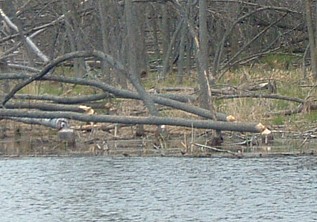
Perhaps this means the pair of beavers now in the pond is raising a family. Then I was disappointed to find no fresh otter signs out on the latrine above the entrance to South Bay. So I headed to the interior ponds. At least two toads were trilling in the South Bay marsh. They have the most relaxing trill, almost magical how what seems structured as an alarm seems so soothing. Of course I checked the New Pond latrine where I found an otter scat smeared on a rock.
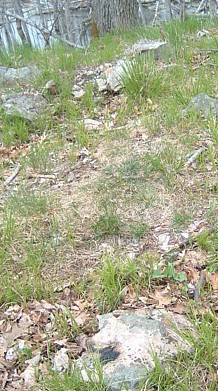
Earlier in the spring I learned that raccoons can leave loose black scats too, and one of their characteristics was being very sticky. This scat was rather stuck to the rock it was on.
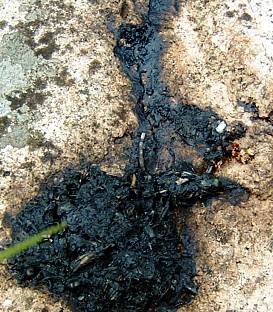
I used tweezers to flip it which released the odor of otter scat. Coming to the latrine, I walked over a tubular scat I took to be from a raccoon. I went back and found it very soft.
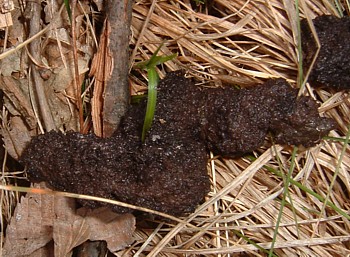
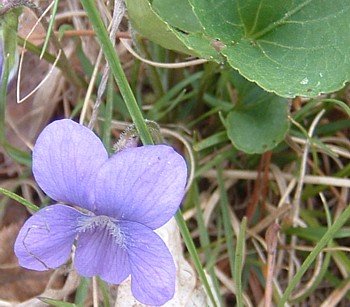
So, with all that in mind, I continued on up to the ponds where I found no new scats at all. But there were other things to enjoy. I heard a two toned whistle and then saw an oriole. Then a violet that was more violet than blue.
And for the first time I saw a goose on the lodge, but she was standing up on it.
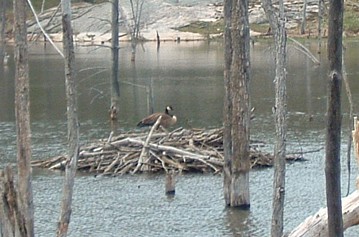
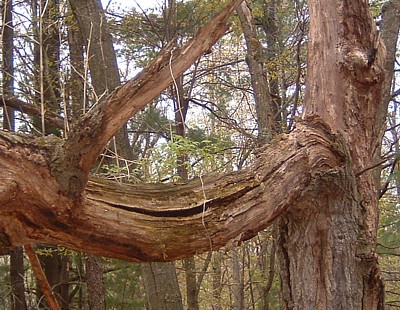
I am touched by the duty a goose feels toward her nest even when, as seemed to be the case here, the eggs had been eaten. On the way to the Big Pond I walked by the dead oak with a huge split branch that for almost 20 years now has been a nursery for a small collection of plants.
As I walked along on the Big Pond, I saw a muskrat swim off a section of the dam that had just been patched with grass and mud.
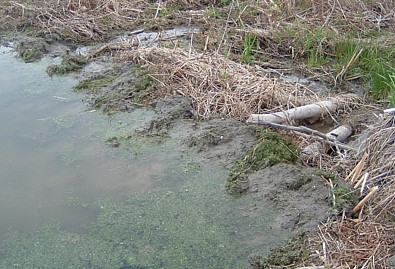
I was about to explore the possibility that muskrats and not beavers had been repairing this dam, without at the moment asking why the master of the small plants would hanker for a deeper pond. Then as I looked out to see if the muskrat would surface, I saw a beaver floating out in the pond
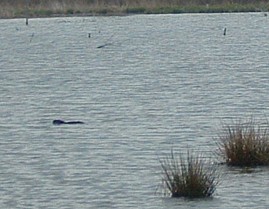
-- so much for the muskrat dam repair theory. I sat by the dam and was treated to a vision of two muskrats and a beaver swimming out in the pond. The muskrats ignored the beaver, but the beaver swam a bit in their direction. Then it angled over to the dam. I hoped it would do more repairs, but it only got close enough to sniff me and then turned away. No tail slap though. I have not seen a beaver in this pond for perhaps a year or more, even though they have kept the dam in repair. This was a small beaver, which matched the extent and character of the repairs. Was the beaver doing this on its on, or was it sent down by the matriarch of the colony? I like to think of beavers as free lancers. But for the moment, otters are my problem and there were no otter signs on or around the Big Pond dam. So not seeing fresh scat and new scent mounds everywhere, the new scats I did see are less likely to be from a touring male. I hope it means there are two or three otters working South Bay and the Picton channel, and not just one. Perhaps we'll have a dawn patrol soon.
May 5 we tried to find the plant I saw on the 3rd but couldn't identify, but, not checking the sequence of the photos beforehand, I couldn't find it. Of course, we found other flowers to admire including some purple trillium in the usual spot along the mossy ridge.
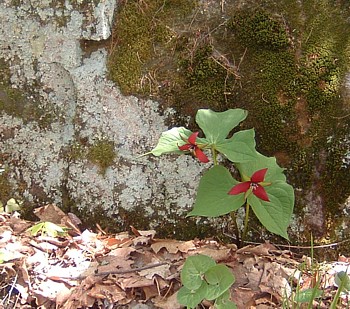
Leslie thinks the photo makes the flower too reddish, but I think it is right.
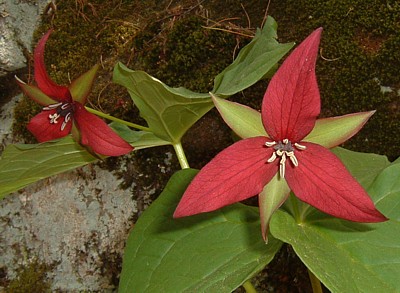
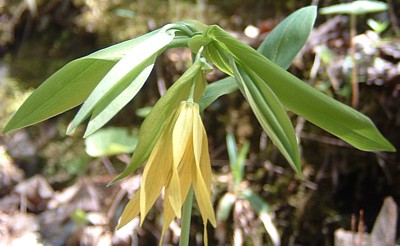
Below those beauties was a sessile bellwort,
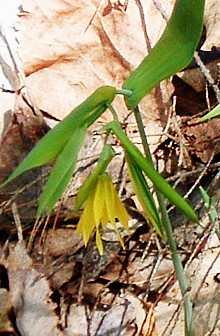
which seems a much better name than wild oats, which the books also assign to it. If this plant is about to sow wild oats then its humble bow to the earth is quite out of character.
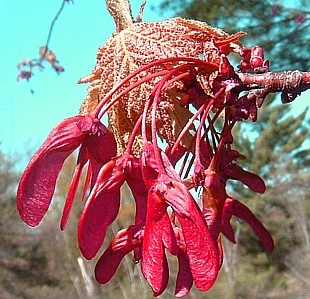
Yellow violets are about to come out. Up toward the Teepee Pond, Leslie went up to check a brilliant red tree, a red maple of course. The red of the seeds came out rather orange in the camera, I thought, so I stoked up the red in my editing.
At the foot of this tree there was a pat of mud beside the canal leading to the pond.
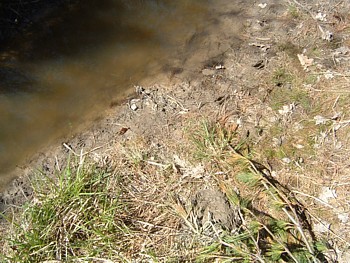
I walked around the pond to look for more mud pats, but this was it. I was surprised by a new and large hole into the bank above my path which goes over old muskrat and beaver burrows.
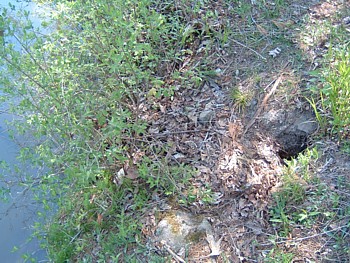
I should dig around these burrows sometime. Meanwhile, I reexamined the mud pat. I suspect a muskrat did it though the print in the mud looks more like a raccoon print
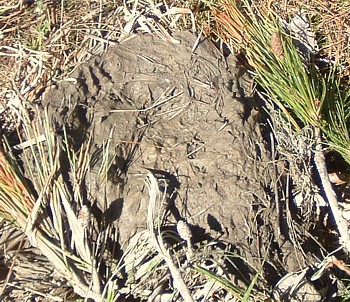
-- and a raccoon had left prints along the canal bank. I went down to the Third Pond at about 5 pm, but neither beaver nor muskrats came out, so I fell asleep. A brisk wind made it difficult to spot any new bird arrivals. The surface of the pond, which is out of the wind, was hopping with flying insects, midges laying low and not mosquitoes, I hope. I forgot to mention that I saw a dragon fly two days ago, in too much of a hurry to identify, and I saw another today, rather dark and quick, like an advance scout.
May 7 rain yesterday morning and then everytime I got ready to go out to check the ponds, a shower rolled through. Brilliant sunshine this morning and I motored out to Picton Point where I hoped to find large, black otter scats, classic scats, if you will. I checked up near the swinging rope tree first, and while I think an otter had been back since Thursday morning, there were no fresh scats. There certainly was more digging. Then at the center of the point, where I saw two nice scent mounds a week ago, that were levelled the last time I was here, I found two piles of grass,
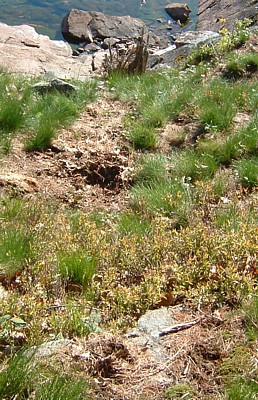
quite new, but no scats around them. This was perplexing and the perplexity continued when I got to the big rocks with the piney litter that otters had been digging into for a month. On Thursday there wasn't any fresh action. Today, there was much new digging, including a pile of grass dug up over a fox or coyote scat, which raises the question: is much of this canine or volpine digging?
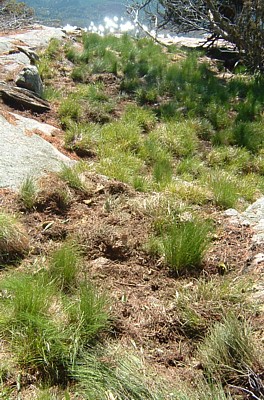
But further up from the grassed over poop, there were two piles of grass dug up and crowned with glassy squirts of scat,
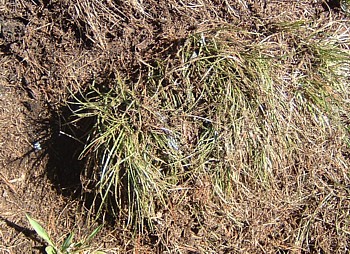
and one had a hint of scales. So I think an otter, sorely depleted of scat, made the marks. This suggested that some more generous scats might have been unloaded at another latrine, so I went across to the Murray Island rock latrine with some anticipation, but once again there appeared to be nothing new there. On the way to these islands, for the first time this spring, I saw no buffleheads, but using binoculars I saw a couple back in Picton Bay. Then I went to check the latrines on the point in South Bay. About a month ago we noticed a possible scent mound in the island that makes the point, and, assuming the otters would use this area the same way they did this year, when they didn't use this island much until the water got low in the late summer, I had not checked this latrine. Well, it dawned on me that the water has been low this spring -- and sure enough I found scats on a rock
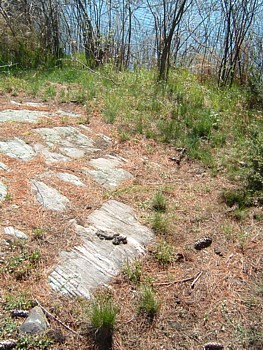
laced with crayfish parts
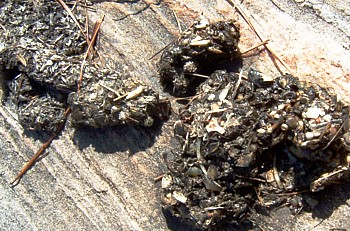
but off to the side was a squirt of liquid brown scat
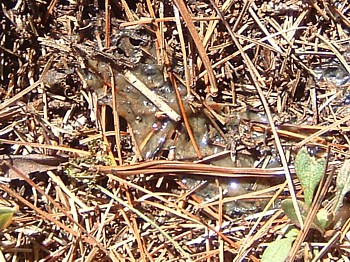
And then just up on a rock near the water was a small, scaly scat, very fresh
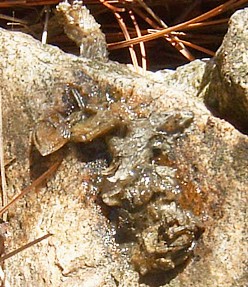
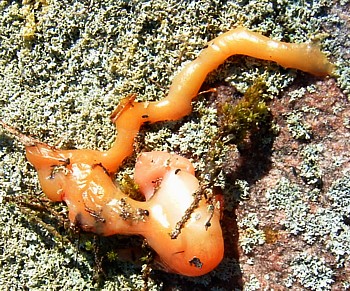
Then I continued down to their usual latrine on the peninsula, the rocks just up from the widest section of the marsh, where I speculated the mother may raise her pups. There were no new scent mounds there and no new scats. However further inland on a rock were two bits of guts and I was at a loss as to how that got there.
As I rowed away from the peninsula I took a photo to show the distance from the usual spring otter hang out (at the far left of the photo) and this year's latrine almost at the point.
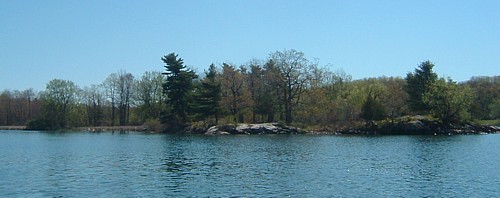
There is a marsh behind this year's latrine and rocks in the marsh, just like the area they favored last year, but the marsh is not as broad, and, I suspect, a bit higher elevation, so perhaps not as secure. As I rowed I saw the muskrat that works this part of the bay again, once again coming up from the middle and swimming to the shore. Evidently some muskrats prefer swimming distances without logs conveniently floating about. No places to rest and nibble upon, but, then again, less places that have to be obsessively marked everytime you swim by.
The first thing I did at the land was find the mystery plant which had developed since I last saw into wild sarsaparilla.
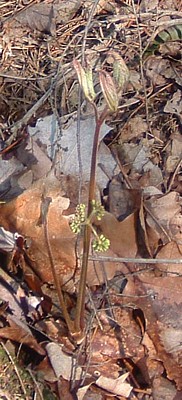
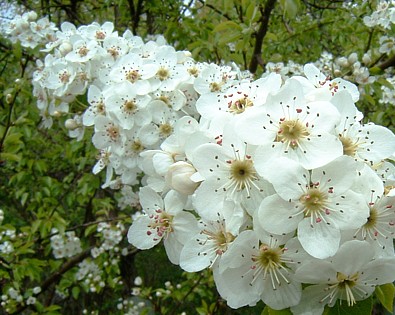
We have a patch of this on a low rock just up from the other side of our inner valley. This crop is high on a ridge. Then after working on the house foundation, I went down to check on the beaver. There was nothing in the pond as I approached so I was diverted by the blossoms of the pear trees lined up to look like a lovely avalanche
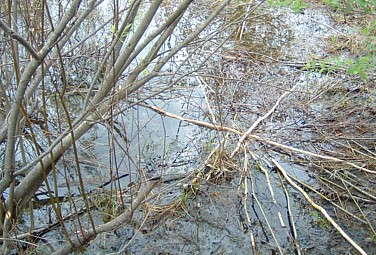
I walked around to check out the beaver's work. There was more, but I could also see that the pond level had gone down. Water has stopped running into it, and now, as usual, the water collected begins soaking into the ground below, no matter how high the beaver builds its dam
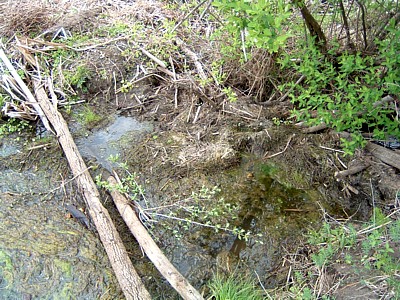
I went down to the Deep Pond, where there was no sign of any activity by beavers or muskrats, save that the dam was almost tight thanks to the wad of grass on it. I suppose just the flow of water could cause this with anything pushing the grass up -- but muskrats do push grass up on banks. Still, I'd expect to see other signs like a bit of poop and nook for nibbling. A beaver would leave some mud behind.
When I got back up to the Third Pond, I saw the beaver over in the largest clump of willows cutting down another sapling. I got closer, next to the dam. It paused but then continued munching the leaves. I noticed that the last sapling it took was stripped of leaves but all the bark was still on. Then the beaver swam over toward me, nose up sniffing, but it also dragged a spring of willow. It paused and ate the leaves off the sprig and then weaved back and forth in front of me getting closer and closer.
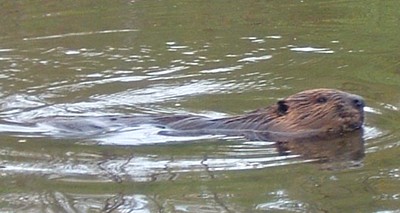
Its tail was riding high but it didn't twitch it, let alone slap the water. I had been sawing cedar logs for the foundation and even though I changed my pants, I probably smelled interesting. Unlike some beavers, this one did not stop and regard me with nostrils, eyes, and ears square in front of me. Then it went back to the willow clump and nibbled leaves. Though I concetrated on the beavers, I couldn't help but notice a pair of king birds nabbing flies over the beaver's head and then perching in the willow. Leslie saw a yellow warbler down here, but I didn't. Meanwhile, up at the house site, she saw a rose breasted grosbeak perched on one of our batter boards. It was probably attracted by the freshly dug dirt where good things to eat were exposed. Speaking of birds, the ravens were in a snit all day, flying over my head with much commentary. Now I know what it feels like to be in something else's journal.
by Bob ArnebeckCheck out my other web pages: otters; beavers; minks; muskrats;porcupines;Leslie's art