Journal 2006
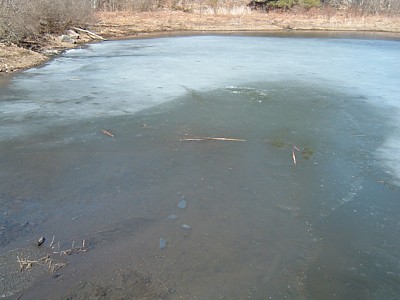
March 27 sunny, upper 40s and a bit more wind than yesterday. When we got to the land, I checked the Third Pond, which is completely open, but no signs of muskrats there. At the Deep Pond, only about a third open, there were bubbles under the thin clear ice that formed last night along the slope. And then in the new ice where the water runs in there were a couple big air bubbles
and then out in the old ice, there was a frozen over hole, perhaps two.
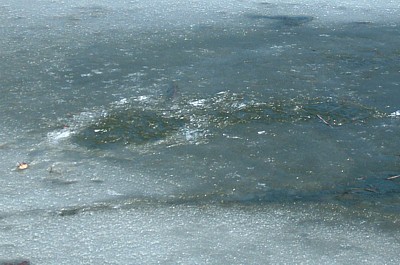
Since I didn't find any otter scats around, I credit a muskrat with making the holes and bubbles. But there were no leftovers from a muskrat's nibbling neither on the ice nor on the shore. I went down to White Swamp taking the easy route to the otters' latrine and holes. The swamp is almost completely open, with the only ice I could see was right along the shore below the ridge I was on. I almost didn't go on, figuring otters would not want to contend with ice any more. But they had. There were fresh scats added to their great pile, and a check of a photo I took four days ago shows the additions.
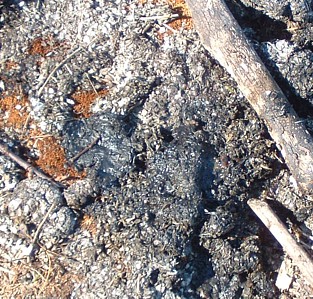
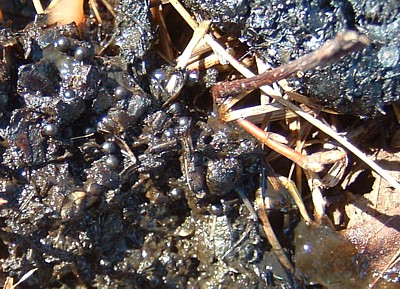
Then there were fresh scats all along the latrine. Some were on top of old scats, others off on the grass by themselves, and there were a few liquid brown scats. The close up of one shows spheres which I take to be fish eggs since there are no berries to be had this time of year.
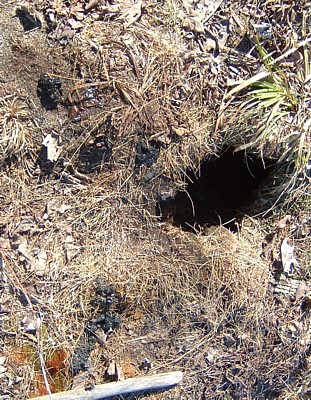
The holes into the ground, however, didn't look used, though I'm not sure what they would look like if otters popped in and out of them.
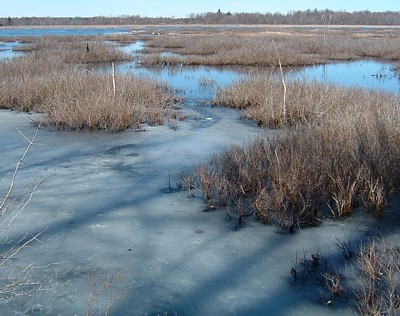
I studied the ice along the shore and saw where the otters swam in on it,
and could almost make out prints in the ice.
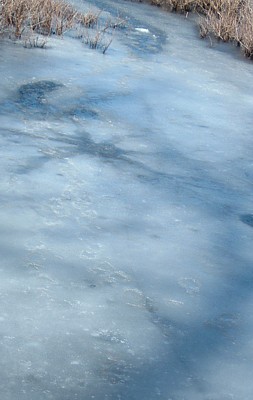
Pity that there weren't better impressions because it would be nice to know how many otters were here. At least two, I think. I went back along the ridge to the where the creek from the Deep Pond enters the swamp. Of course I studied the open water out in the swamp and could make out groups of geese, mallards, and seagulls. As I took a step down the ridge toward the creek
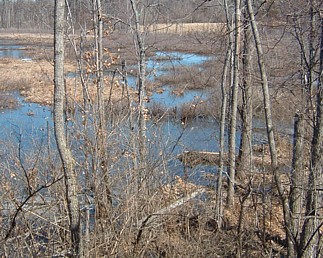
three and then two black ducks flew off. Then I saw a mallard drake and then four mallards took off. Then wood ducks came out of the grasses, and seemed to tolerate me, until they heard the noise of my camera opening. Then when I figured all the ducks had to be gone, three more black ducks flew up from behind a screen of dead cattails. When I got down to the inlet it was easy to see that a beaver had been there -- more nibbled sticks, even a sprig of pine in the water.
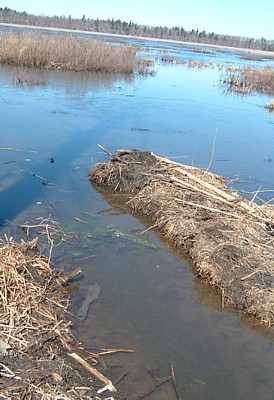
But I couldn't see any new otter scats. I went up and over the dam and saw a dollop of mud
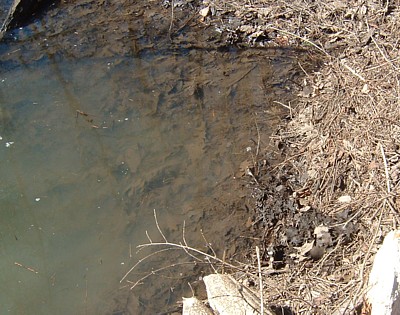
and some leaves and dirt pushed up along one old hole. I think a beaver has been here. Will one go all the way up to our pond? Tomorrow I hope to come here in the evening and perhaps see the beaver or beavers.
March 28 I headed up the golf course on a pleasant sunny morning, rapidly warming. Nothing grazing on any of the fairways. As I approached the Big Pond dam I saw hooded mergansers and mallards and managed to get a photo before they all flew away.
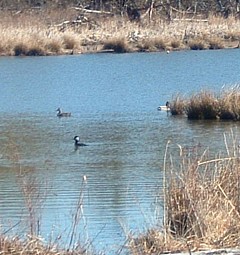
Then I sat on my perch and watched, wondering if the muddy water behind the dam was caused by ducks or muskrats browsing. Then a muskrat surfaced as it left the dam, dove again, surfaced and floated placidly further out in the pond considering its options.
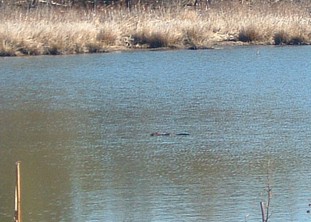
It swam over to the north end of the dam, and I followed. But some black poop on the dam gave me pause. There were three dollops in the middle of the dam, quite creamy and smooth. No scales.
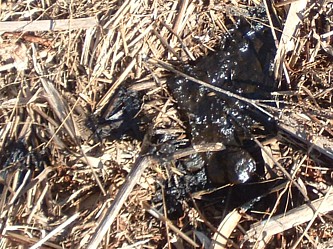
But I saw a pollywog swimming behind the dam -- otter fare that wouldn't make for scaly poop. Further along the dam -- not near any old latrines, I saw more of the same. A factor arguing against it being otter scats was that there was no muss or fuss between the scat and the water. Otters usually leave a little more collateral damage. Geese were all about the Lost Swamp Pond, and all the ice was gone save for in a few corners along the south shore. I sat to see what might happen, and a muskrat swam out in the pond -- just swam, no marking and no eating, dove and I lost track of it. I checked the mossy cove otter latrine and just saw old scats. Then I looked up and saw fresh beaver work in the northwest corner of the pond.
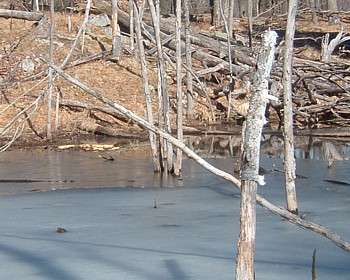
It was nice seeing fresh work so far from their lodge and I must say I've seldom seen such a neat job with the logs segmented and every log stripped.
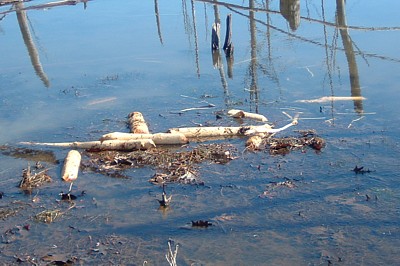
I scanned the nearby slope and saw gnawing on some trees but nothing cut down. The discrimination of beavers when they shop for trees to strip often surprises me and in this case I couldn't picture what they had done -- the nearby slope has been raked over by beavers for so many years. The logs seemed to magically appear. It also looks like the beavers are going up to old work and finding new places to gnaw -- it's like bleeding wood is a sign of spring.
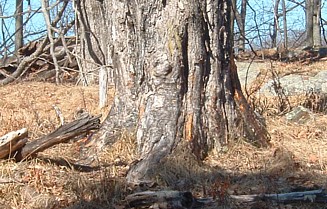
I continued looking for otter scats and saw none. The beavers have taken to pushing mud up on the tree trunk lying in the water behind the pond.
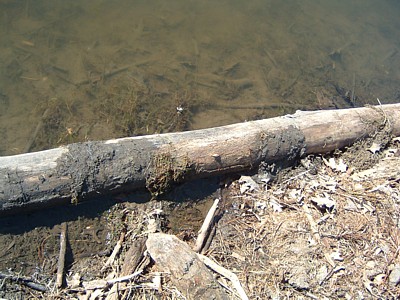
And there were also balls of grass here and there.
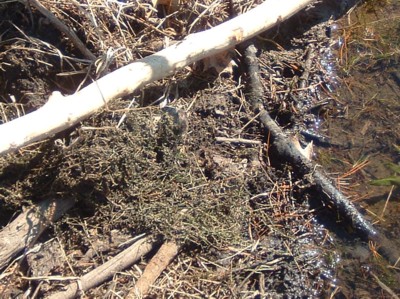
I was also looking for fish fry, but saw none. Nothing new at the Upper Second Swamp Pond and I should cross the dam and check over in the woods where the beavers had cut trees in the fall, but today, I decided to cross the Second Swamp Pond dam, then check the end of South Bay. I know where the beavers are, I'm searching for otters. I could see straight away that the Second Swamp Pond was higher and then saw that the beavers had packed in more mud on the dam,
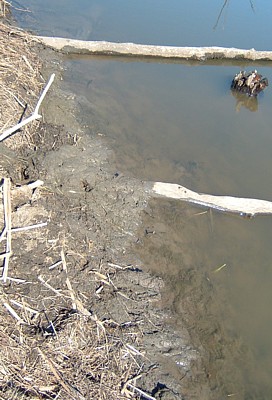
and there were tender green shoots floating behind the dam
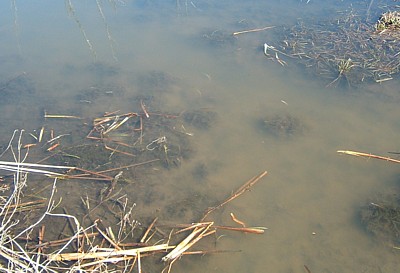
-- muskrats could have eaten them but there were beaver bitten sticks around too. Then I saw some more black scat, much like what I saw on the Big Pond dam. This stuff was very pasty but when I flipped it over, it seemed a lot more like otter scat
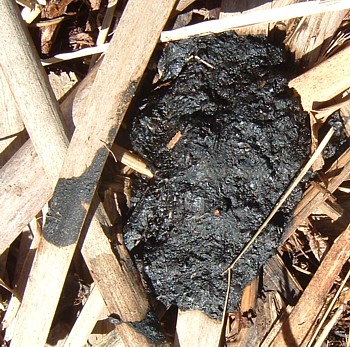
This was good to see, but where was some good old fashioned otter scat in all its scaly and gutty variety. Then as I continued along the dam toward the shallows on the north side of the pond, things began darting under water from the grasses to the deeper part of the pond. First I thought they were pollywogs, I have been seeing them, but these were too fast and too big. Then one swam the wrong way, toward the dam, and I saw a bullhead floundering in the water before it made a quick exit to the depths. I've never seen this before, and maybe this bounty explains why the otter scats look so different. They are no longer eating crayfish and perch, but pollywogs and bullheads. Then when I didn't see any otter scats around the end of South Bay, I got the notion that the otters had indeed moved into the ponds. I'll get out tomorrow and lounge a bit and see if I can see them.
We had dinner at the land, my idea, so I could sit at White Swamp when the sun went down. But first, while taking a break from sawing logs, I stared into the edges of the Teepee Pond. Boatmen were all over, and I saw a scorpion bug swimming along. Then I saw the rearend of a beetle rise out of the water. I took photos first
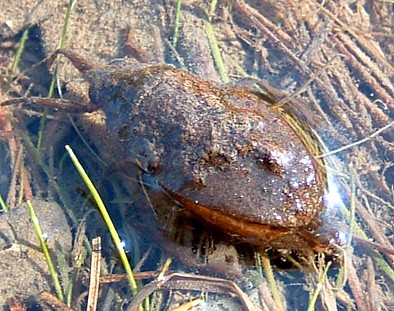
and it swam away. But I saw another doing the same thing -- laying eggs?, a little further along the shore and I got some video. The next excitement was a spider that flew in on a silken thread and almost landed at my feet. It latched onto the top of a grass stalk and seemed to be recouping its energy. Then it dropped to the ground and I expected it to move off, but again it stayed still. I lost track of it, and then I felt something crawling up my leg -- not the spider. Then I saw it swimming straight out in the pond, against a light wind. It would scamper on the water surface for two fee, then rest, two feet, rest, again, again, until I could no longer see it. The last excitement was three wood ducks landing, and staying in the pond. I stood up and snuck around to get a photo and couldn't find them -- quite a mystery until they finally flew up from the far end of the pond. I checked around for Blanding's turtles but saw no signs of them. Then after dinner I went down to White Swamp, flushed two pairs of wood ducks on the way down and then a few more pairs when I got to my spot on the ridge overlooking where the inlet stream comes into the swamp.
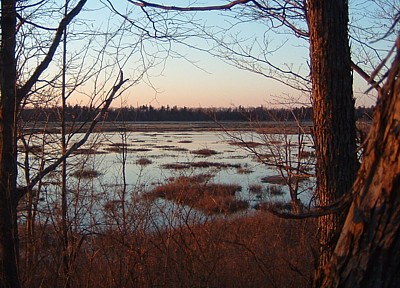
I saw that the pond behind the dam was filling up so I suspected that the beavers had done more dam repairs. But there were no beavers around. I did see a heron fishing in the shallows nearby, and then I saw two muskrats with one coming toward the inlet. But the sun was going down and I went down to check for beaver scent mounds. There were a couple small new ones, and another wad of mud and grass added to the big one.
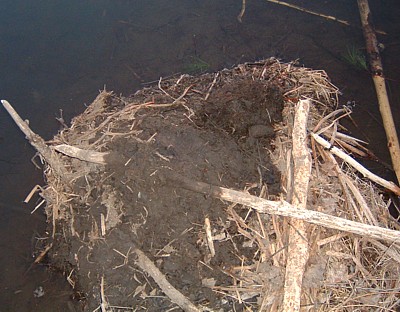
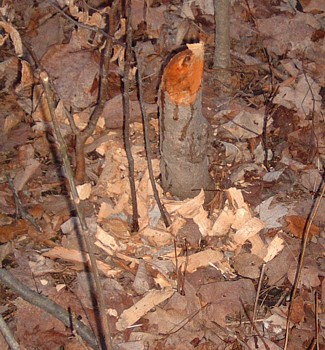
Then I checked and confirmed more mud on the dam. And I saw what looked like a freshly cut sappling
On the way back to our land, I heard a woodcock calling in the woods.
March 29 This is way too early for strategic tracking, but in my mind, I pictured otters out in the shallow of the Second Swamp Pond, in mid-afternoon when bullheads are sleeping, feasting on the bounty I saw there yesterday. A brisk southwest wind dictated that I go via South Bay so I could approach the Second Swamp Pond from the northeast. There were no new otter scats along the South Bay trail. Just when I thought to look for the little porcupine, there I saw it, just a few feet off the ground working on the trunk of a small maple. I raced to get some photos
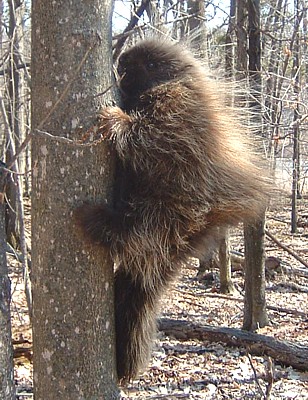
as it raced up the tree with quills all but thrown into my face
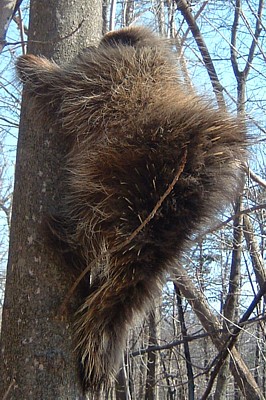
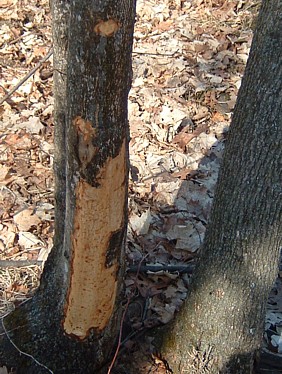
My words of assurance didn't calm it until it was twenty feet up. I took a photo of what it had been eating and moved along.
As I crossed the creek I saw a frog leaping back into South Bay, almost dancing with panic like it forgot how to use its legs during the long winter's hibernation. On the East Trail, I saw my first mourning cloak of the season.
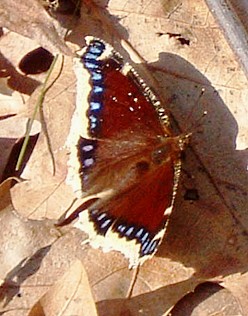
I got to my perch above the Second Swamp Pond bank lodge and watched for almost an hour. Upon arrival I set off several waves of ducks and when I looked up at what I had launched I was surprised to see about 50 repositioning themselves in the wind. A handful of mergansers remained and entertained me with their chasing around as one male tried to protect one female from other males who, to my untrained eye, seemed to be minding their own business. I also saw three painted turtles along the dam.
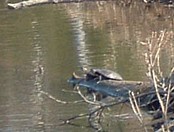
And once again there were fish splashing now and then in the shallows. But no otters. I went down on the lodge
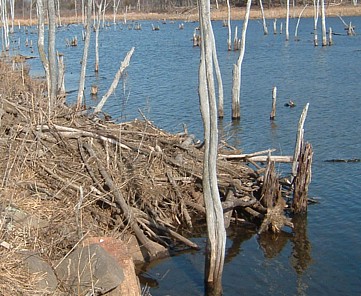
to see if there were scats and I found the same sticky black variety. One dollop was right next to raccoon scat.
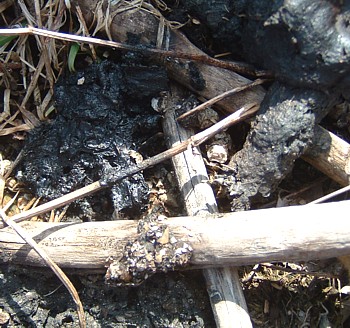
It crossed my mind that I might be seeing the scats of a raccoon with diarrhea, quite a contrast with the bony pile of scats from the fall. This black scat was as old as the scat I saw on the dam yesterday. So otters have probably not moved in, just made a brief visit, perhaps because with so little fresh vegetation there is prescious little cover for them. Of course, I hoped the otters simply moved up to the Lost Swamp Pond, but once again I saw no scats there. I was entertained by a huge flock of redwing blackbirds in the trees. They varied their screeching with some cackling that I first mistook for frogs calling.
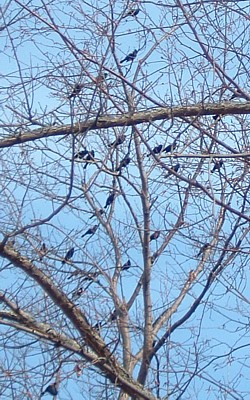
And in the pond about five pairs of geese picked fights that seemed more or less random to me. None of them has definitely claimed one spot for the nest on the lodge. Is there some ritual they go through for a few days to determine who gets that spot? Then a muskrat swam in front of me, going from the burrows to the west and around the lodge to the east. When it came back, I got some video. It didn't mark logs, but did dive and come up with grass which it ate on a log. Then I saw another muskrat across the pond and it did mark one log. Last year I saw more muskrats about as the ice melted. And over on the far south shore, where there is still a little shelf of ice, a raccoon was walking out on it, looking for things to eat. I'm not the only mammal ruing the loss of the ice that makes it so easy to get around. No new beaver work on this side of the pond and things were quieter down in the southeast end -- the geese pairs are further apart there. I went along the surveyors cut to the Big Pond, and here too I flushed about 50 ducks including a large flock of those large dark ducks that I assume are black ducks. On my way to check the lodge for scat, I saw two patches of deer hair,
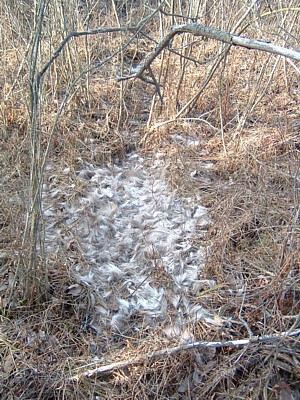
but no bones, no skin, no blood. This is not far from where I saw the deer's head in the winter. Coyotes evidently cleaned this carcass up -- as indeed they did with the one I saw in the second valley. The beaver lodge did have the same type of scat I've been seeing,
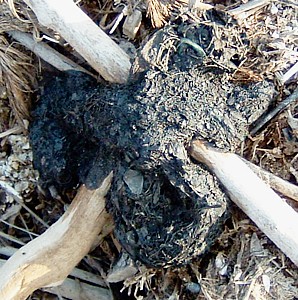
This lodge is taking on a strange shape, a study in deflation
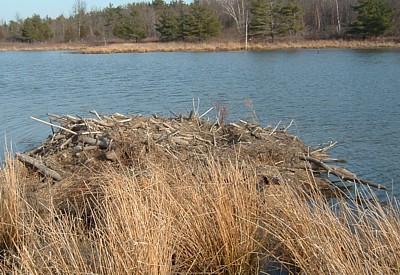
and when I got on the lodge, my foot almost went into one of the chambers, quite likely flooded now. As I continued around to the dam, I saw more of the black scats. Some made sense and I could fancy seeing an otter come out to leave it.
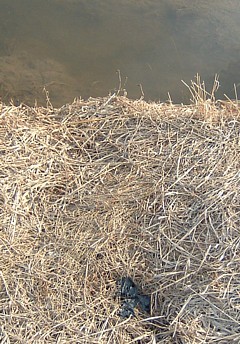
But others were smears and some were paired as otter scats often are, while others were quite alone, where, incidently, I've never noticed otters scatting before -- usually they keep larding scats into one latrine. All to say, I am tired of this type of scat -- indeed in the photos they look more like otter scats. In person, they just seem too thin and stickly. I must say I did pick up one in the grass close enough to smell, and it smelled like otter scat. No muskrat here today, but I didn't wait around for it to appear. Meanwhile Leslie saw a male Blanding's turtle up in the Turtle bog at the land. I'll check him out tomorrow
March 30 The river was calm in the morning so we headed off in the boat to check the farflung otter latrines. But the first treat was seeing the buffleheads fly off as we approached. The bright white male led with the dark female behind like a shadow in the air. Then in the bay at Picton Island we saw a flock of about twenty males with three or four females. I cruised up the Picton shore and near the slope that had been their principal latrine in the fall, we saw a classic rolling area.
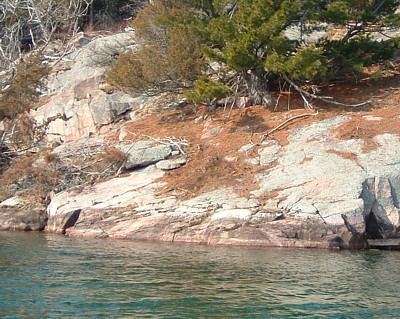
We docked the boat and among the digging and scratching in the dirt. it didn't take us long to find some scats. There was a bit of moisture so I think the otters were scating here in the last couple of days. There was not a large array, but the digging was extensive, in two sections,
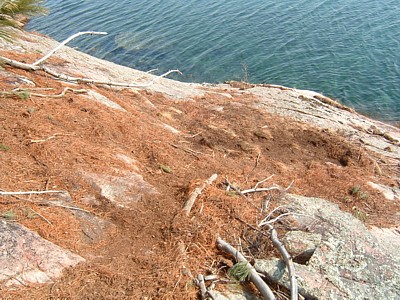
with scats in both of them.
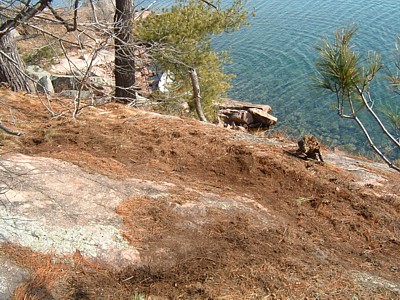
Then I walked over to the point, their old latrine and found a nice scent mound.
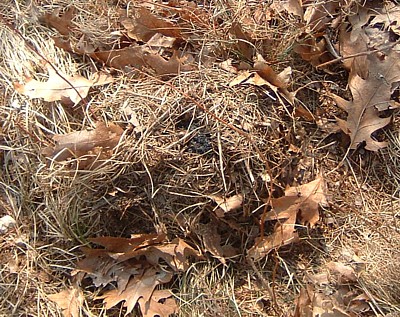
Then we motored over to the high rock on Murray Island and from the boat it didn't look like otters had been there -- no digging and scratching. But there were more scats here
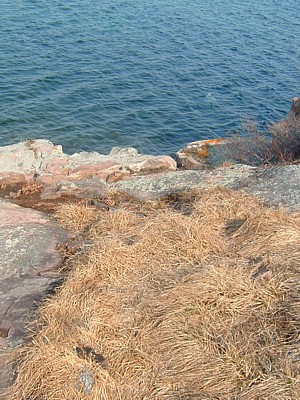
Some were moist but none were hot, as they say. I took a photo of the Picton rolling area in the distance to show how far otters go in their rounds.
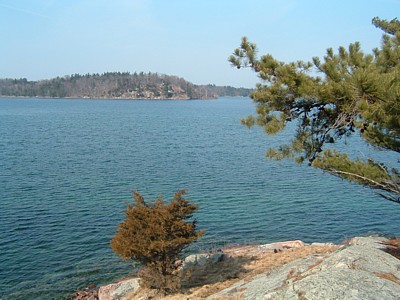
Now I'll try to connect the activity here with that in the Wellesley Island beaver ponds. I can see that the scats here are not unlike the dry scats I've been seeing around the ponds, but no real gooey smears. On the way back we went through the Narrows and noticed fresh beaver work not far from the old bank lodge on the Murray Island shore which had seemed lively in the fall. But it is still surrounded with ice so we couldn't check it for fresh beaver activity.
At the land, I checked the Turtle bog but didn't see the Blanding's turtle. There were two painted turtles out on the logs beside the Teepee Pond, but I spent most of my rest time there looking into the pond. Several scorpion waterbugs entertained me. First I saw one come out of the water, slowly, working its front legs over its small head and large eyes, then getting all the way out of the water
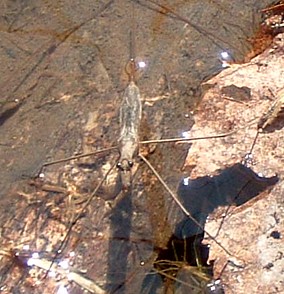
and basking in the sun., and eventually perfectly positioning itself on a dead leaf, up in the sun for about an hour.
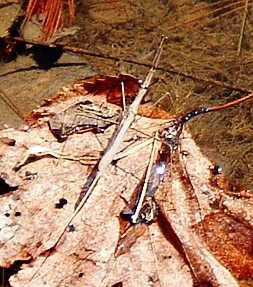
Then I saw two almost tail to tail
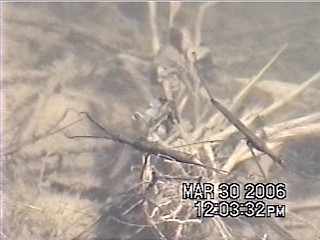
and after a brief touch, I think, they rushed off in opposite directions. The pale, and I think larger one, swam into the deeper water of the pond. The darker one preened itself while in the water. At the same time another dark scorpion bug that seemed to approaching it quickly swam backward. I paid attention to the other watching it climb up out of the water,
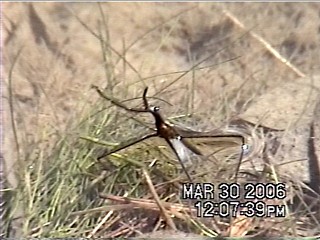
and like the first one I saw, adjusted its head, and then when it got a grip on the grass of the shore stood still in the sun drying off. Obviously a bit of mating, though I'm not sure there was any successful coupling. I also saw two grouse doing their courtship strutting right next to our sugaring operation. Everything's doing it.
March 31 warm sunny day, heading to 70F, with a growing south wind. Coming at the end of a dry spell, with nothing growing yet, the day was a bit eerie. And it's too early for all the noises of spring. Walking up the golf course hill, I heard one comb frog calling from the woods. When I got up in the woods, I heard the brief squawks of a robin and then a pileated woodpecker. Knowing it might be my last hike for a while down the second valley to the Big Pond, I decided to look up in the rocks for that deer carcass that had disappeared the valley. I went up to a likely spot, a little alcove of granite where I once saw foxes, but nothing was there. And once in the jumble I thought how unlikely it was that something would drag a carcass into such a hard knobby place. Better to drag it to some soft swale where it might be buried in leaves and litter. And so I resumed my usual route -- strange how when it is dry, I don't get curious about poking into every cranny. Moisture does make the world livelier. I did flush three grouse and a woodcock well before I could get a good look at them. Dry leaves make feet much louder. As I approached the Big Pond, I saw a mixed flotilla of ducks including mallards, merganers, and black ducks, I think. I saw a duck with the mergansers that had a very light, almost white beak, and other strange markings. I assume it was a juvenile growing out courting colors. All the ducks flew off as I was getting my camera out. Pity I'm not better at identifying them because I think I see some oddities in these ponds now and then. I came to the ponds today to try to firm up my ideas about what the otters have been doing and what they may be up to, which is to say, before the rains came I wanted to reconcile myself with the strange scats I've been seeing. Since I saw some of these scats in the straw of the shore, I walked as close to the water as I could but saw only signs that ducks have been foraging and preening, leaving muddy water and a few feathers behind. I also saw that the beavers have begun to patch the leaking dam,
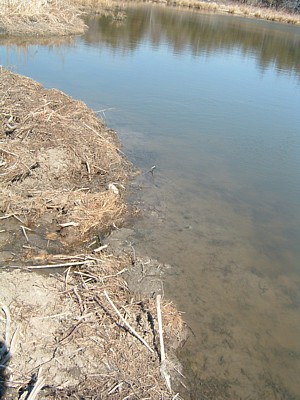
and a muskrat came shortly after to poop on the patch as if the beaver's work had skewed the muskrat's prior claim.
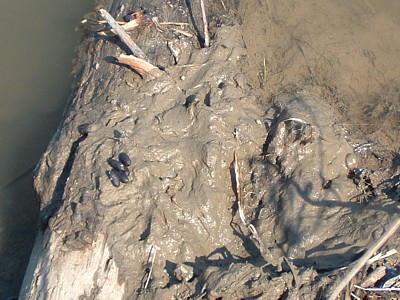
But. I must say, the beavers didn't do a very good job as the water easily worked through one feeble heave of mud.
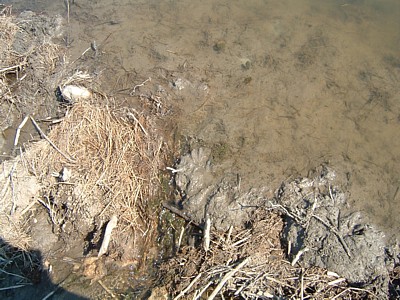
Then I sat next to the now dry flat black scats that have been puzzling me and I decided they looked more like otter scats. Then as I continued up to the lodge, I saw such a shiny scat in the grass, with a fly seemingly interested in it, that I got to my knees to photograph a fresh scat.
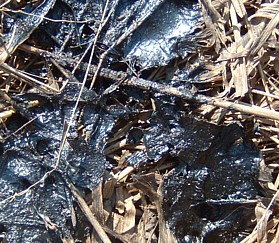
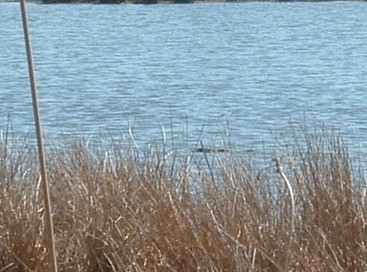
The fly buzzed off; the scat was hard; I had seen it, and photographed it the last time I was here. But it looked more like otter scat to me. Meanwhile there was something floating in the middle of the pond, probably looking at me. A muskrat. As it swam back to the lodge I took a photo knowing it would show nothing more than a short, but supple, brown line in the ripples.
As I approached the Lost Swamp Pond, I went up to the rocks to the east that the otters often use as a latrine. Nothing there. I can't fathom why an otter that went to the Big Pond and Second Swamp Pond would not leave a card, as it were, at the Lost Swamp Pond. Then just as I was about to walk away, I saw two black dots in the grass and one was juicy, inky black, much like what I've been seeing, but not much bigger than my thumbnail.
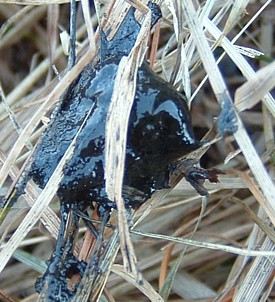
This was near a trunk and I looked up to see if perching birds... but the tree was long dead, the crown long gone. I looked out at the mud in the pond, but there was no mud, this was the one patch of pond that still had hard ice.
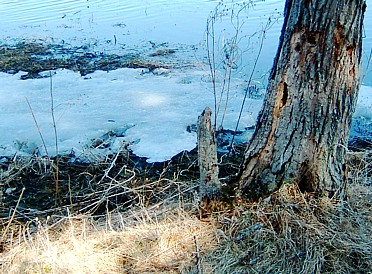
Since this supposed otter has not been religious about visiting old latrines, I walked carefully along the pond, willing to learn something new. I saw that the shrews' fur is lighter, and, of course, it moved too quickly to photograph. Later I almost stepped on one. Then as I nosed over to the old beaver bank lodge, I saw a nice array of fresh beaver gnwing, including some stripping of a pine bough that probably fell out of the nearby pines.
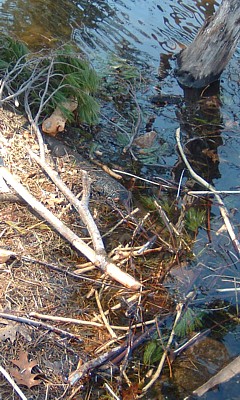
There were a few stripped twigs in front of the lodge.
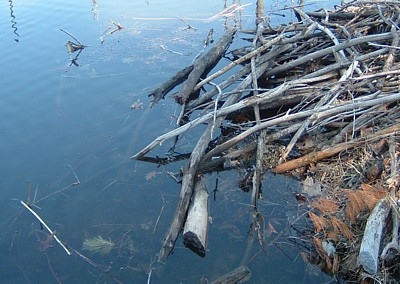
I sat and listened for beavers, but heard none. The year they moved into this lodge, I set them in a panic when I was much farther away. Meanwhile, I saw no signs of otters. The geese were quieter today. I sat and tried to figure out what they were up to. The male of a couple kept hectoring a goose that looked no bigger than the female it was protecting. My guess is that the unappreciated goose is a year old male. As it swam away from one pair, the male of another pair started hectoring it. But there were no flapping attacks. The little fellow must not have seemed that much of a threat. It seemed to approached other geese in a circuitous way, easing in for companionship, but I've never noticed a shortage of unpaired geese, so maybe it was being bold in a sneaky way. The water of the Upper Second Swamp pond is pea green which is a credit to the beavers mucking around, but none were out in the almost noonday sun. I sat for awhile. You must sit for awhile near every pond on such a warm day. I heard some strange bird calls behind the bright cheers of the song sparrows. Every year I ascribe that to familiar singers just warming up, which scarcely makes sense. Given the dry conditions I figured this was a good day to walk atop the dam to the other side of the pond. This dam is uncommonly narrow and below the dam it is always wet and soggy (perhaps there is a spring here.)
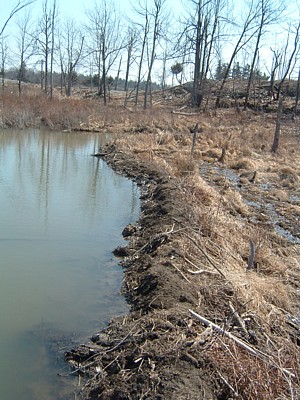
The top was springy but I could manage it. The beavers had packed on mud behind the dam (they need more logs below the dam) but I noticed that they didn't close up the gaps that I think they made in the winter as they sat on the dam under the ice. Be curious to see if they level the dam when we get more rain. I also saw muskrat poop so despite that attack by the mink a month ago, at least one muskrat is still here. I crossed to the other side of the pond to see if the beavers had resumed lumbering over there. I followed a well worn and wet path, puddles fed by wet beaver fur,
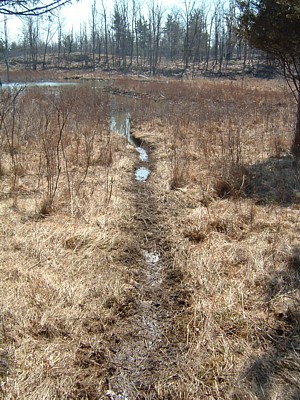
to a grove of five cut ash.
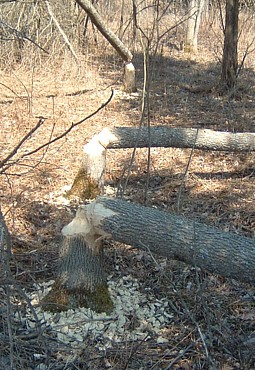
The crown of the last to fall was untouched.
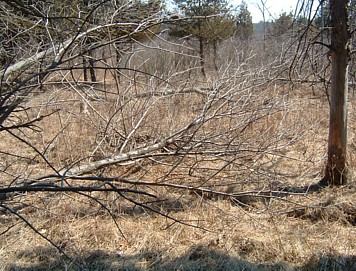
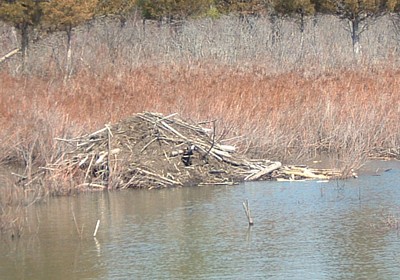
This is something to keep an eye on. There is a growing pile of stripped logs on the southeast end of the beavers' lodge.
Do they nibble there in the warmth of the dawn? I walked down the north shore of the Second Swamp Pond, not otter signs, or beaver signs. I checked the auxilliary bank lodge and no activity there. Out in the pond, a good number of painted turtles of all sizes were up on logs. But I hung back -- there didn't seem to be any point in disturbing them -- I don't think otters have gone through the ponds today. The time for lurking in one pond is over. It's time for otters to tour. I heard one comb frog calling from the vernal pool to the north of the swamp, annually the best place to hear them. I headed for South Bay via the East Trail and looked over to see that there was still a tennis court size sheet of ice on the East Trail Pond. I saw some scratching in the grass above the old dock latrine beside South Bay, but saw no scats. The early thaw and unseasonable warmth have me thinking too far ahead. I cling too much to this notion that this is the time of year for otter families to separate and for otters to go off alone. A few weeks ago I saw four otters on the White Swamp snow as lively as pups in September. And the scratching and clawing I saw in the dirt above the Picton rocks suggests a group of rather exuberant otters. Trapping season ends today, after an easy winter, no reason why I shouldn't have my mind full of otter doings soon enough.
by Bob ArnebeckCheck out my other web pages: otters; beavers; minks; muskrats;porcupines;Leslie's art