March 2006
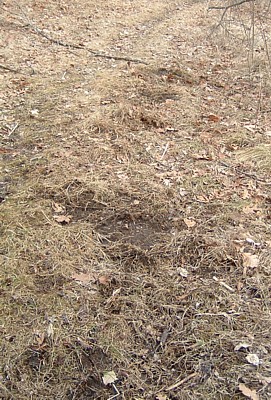
March 19 yesterday I split wood and left the bays and swamps unobserved. We had a dusting of snow in the morning and then it settled down to a cold, cloudy day with a light but steady north wind. Not an inspiring day, but the geese kept honking. I headed out mid-afternoon and went over the TI Park ridge to the South Bay trail. Where the trail crosses the creek draining the second swamp, I saw digging -- four patches of scratched up dirt and piles of loose grasses.
Definitely not done by deer and since this is a spot where otters sometime make mounds, I examined the piles of grass closely and looked around for scat, but saw none -- a skunk? I continued around the cove to the old dock where there was some open water but there was also undisturbed thin ice and no fresh otter scats. South Bay remains ice jammed all the way out. I think the bad luck of getting this jam has cramped the otters' style in South Bay. Since tracking up the bay seemed unpromising, I headed for the ponds, first checking the New Pond knoll, where there was nothing new. I always wonder on days like this if I will take a hike and not even take another photo. Then on a rock just above the upper Otter Hole Pond marsh, I saw two scats -- one old and one new.
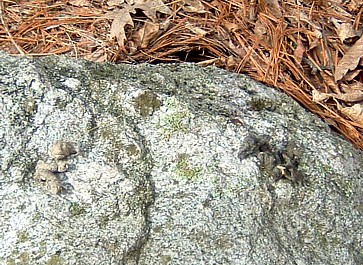
The new one had a bit of a small rodent's incisor.
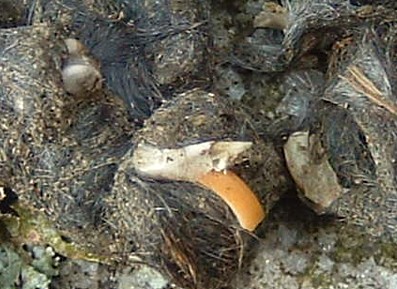
While they were small, I thought they were fisher scats. This spot is not far from where I saw the fisher in the fall and I saw fisher tracks heading in this direction off the pond ice during the last spell of good tracking. The Second Swamp Pond dam looked the same so I didn't even go out and check for scats. Then I headed up to the Lost Swamp Pond, saw nothing new at the dam, and curled back down to the Upper Second Swamp Pond. There was a beaver in the open water behind the dam and even though the wind was in my face and I was not even down near the pond, the beaver did a quick double jerk of a splash and dove under the ice. I moved down to a stump next to the pond and waited. In about five minutes a beaver surfaced in the open water behind the dam closer to me, looked over in my direction and then swam back to its spot behind the center of the dam, fished out a log and started gnawing it.
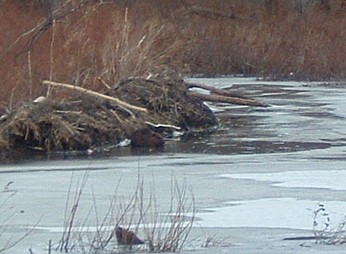
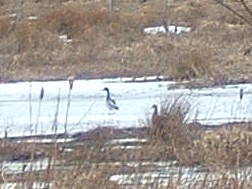
In a few minutes smaller beaver surfaced behind the other beaver, swam over to where I was, then swam back to the other beaver, hummed a bit, and made like it was thinking to gnaw that log too, then dove and disappeared. At the same time, I was keeping an eye on a pair of mallards. The male was out on the ice and the female was in a clump of grass, checking out nesting sites, I guess.
A hairy woodpecker made a bit of noise as he worked on old dead and rather thin trunks around me. I heard a strange call from the ridge on the other side of the pond -- like a bird trying to sing out "tick tock." I heard a beaver break some ice along the edge of the open water of the stream coming down from the Lost Swamp Pond dam. When I moved to go back up to the Lost Swamp Pond, I could tell that the beaver behind the dam sensed me moving, and then the other beaver slapped its tail. I crossed the Lost Swamp Pond on the ice where the dusting of snow remained, but the only tracks I saw were from a mink
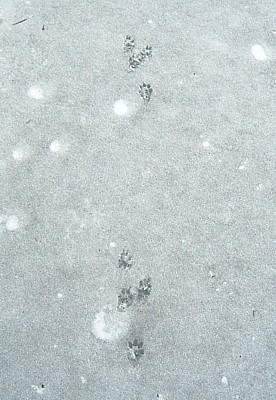
heading from the bank lodge and checking out the other two lodges in this end of the pond.
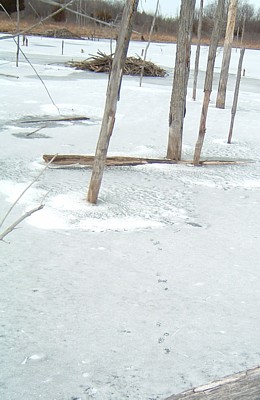
Then I got a view of the lodge in the upper end of the pond, saw much open water, and two geese swimming about,
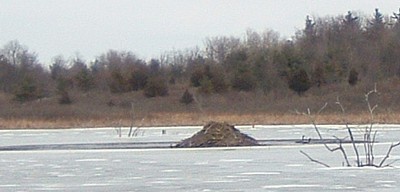
honking loudly, and two, then three, then four beavers also swimming in the open water but keeping their distance from the geese. So I stood on the ice, getting some video, moving a bit closer. Neither the geese nor beavers seemed comfortable, then I saw one beaver surface at their feeding spot along the shore, then another beaver surfaced.
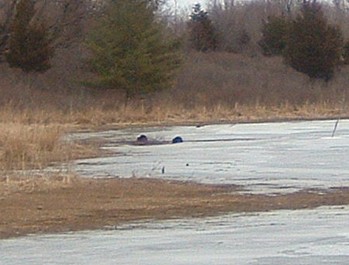
Needless to say, I was getting a bit cold standing on the ice and began moving away, but always looking back, and then I saw one beaver climb up on the edge of the lodge, on the south side. The honking geese came over to that side. Then I saw three more beavers surface along the north shore, making six beavers in all. Then the geese, still honking, flew off to the north. I think the geese were honking a warning to other geese, and while it is not uncommon for all the beavers in a colony to come out to eat at this time of year, this has been an easy winter, this was by no means the first good day inspiring all to eat, so I think the arrival of the geese excited the beavers. For a time, four beavers were swimming around the same pool of open water that the geese were swimming in, careful to keep their distance but weaving in a way that indicated to me that they were eyeing the geese. Contrast this with the fact that I have never seen beavers rally out in the water when otters were eyeing their lodge. I flushed one grouse as I headed to the Big Pond. I planned to walk down on the ice to the dam, but when I stepped out on the thinning ice, instead of finding hard ground, my boot went a foot deep in rather wet mud. So I walked around the pond which gave me an opportunity to see how much the water had drained out. The marsh behind the north end of the dam, so often favored by muskrats, was dry.
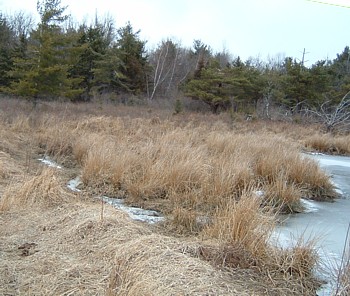
The holes at the south end of the dam, favored by minks and muskrats were exposed.
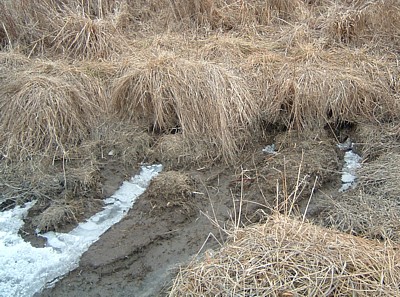
But the water behind the dam was muddy, like a muskrat had dug up some vegetation from the bottom.
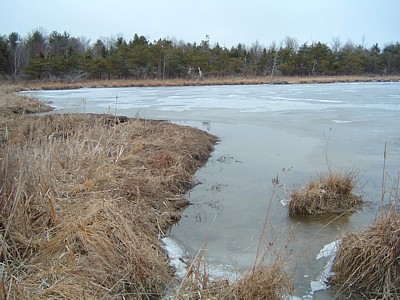
The otters didn't come to this dam in the winter, and most of the leaking results from the mud on the top of the dam being washed away.
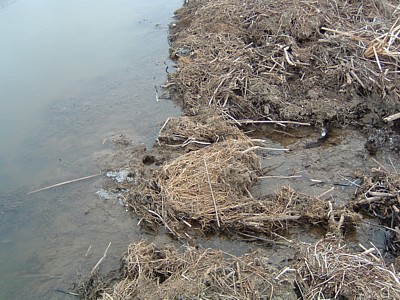
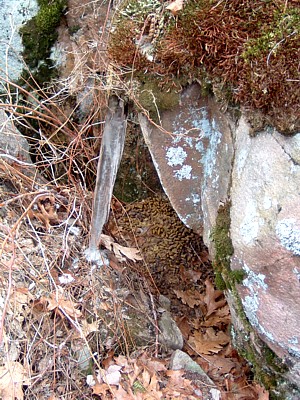
I went home via the big rock, where I can always peak into the porcupine den at the foot of it -- not very concealed, as dens go. Today I took a photo because there was a big icicle hanging down from a rock, a nice photo showing how the porcupines like to den on the cold side of a valley.
Coming down on the golf course, I saw a flock of 30 turkeys, then a flock of robins was chased off by a sharp-shinned hawk. A killdeer flew away in a snit, too, and three crows headed for higher perches, leaving a porcupine placidly eating the grass -- quills save a lot of walking.
March 20 north wind kicked up in the night, colder this morning, but still sunny. Good day for splitting wood, which I did. We went to the land in the afternoon and after seeing nothing new at the Deep Pond, I went down to White Swamp where there was nothing new, but where all that I had discovered in the past month looks quite different. Where the creek from the Deep Pond flows into White Swamp looks like it would still be a good place for otters
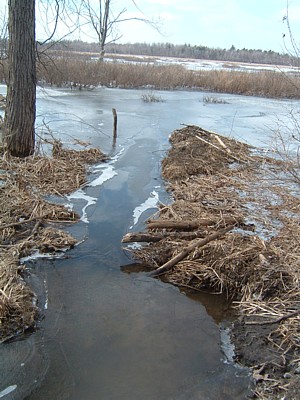
though no fresh signs of them being there. There was a channel of flowing water over a foot deep, with convenient latrines on both sides. However, the little beaver pond up stream was just about gone, just a puddle, with no depth of water under what ice remained. I walked along the shore of the swamp on the ice. All that had melted had refrozen. At one point there was some crack ice frozen over making it look like something got out from under the ice there.
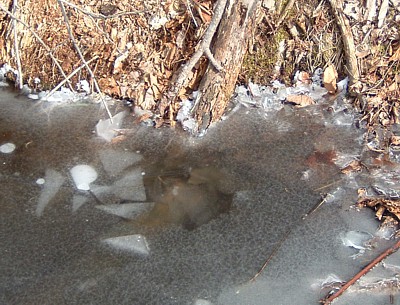
Nothing on the shore to indicate what made the hole. Down at the otter holes and latrine, what looked so mysterious and inviting when the snow covered the bank, now looked quite diminished. Yes, the piles of old scats were there, quite dry and friable, and not as scale-laden as I expected, but the holes seemed to lead to nowhere. Only the one closest to the ice looked like it might have made getting into the pond easier.
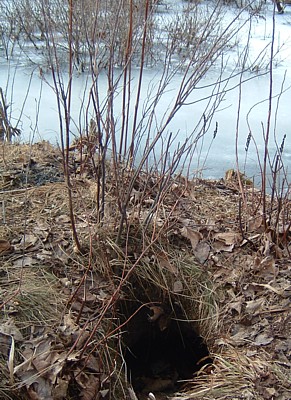
But when I jammed a stick into it, I hit ice, but not the ice of the swamp, a few feet beyond. The hole back into the bank didn't, as I expected, lead to commodious burrows. It extended no more than two feet. If beavers or muskrats had fashioned these dens, burrows would have been deep and interconnected. What the otters found were simply holes in the ground under the snow that didn't necessarily go anywhere. Clearly, with the snow gone, these holes are not that attractive. Just holes in the ground. I walked back along the shore and tried to figure out the beaver scent mounds, at least four large ones, all within 30 yards of each other.
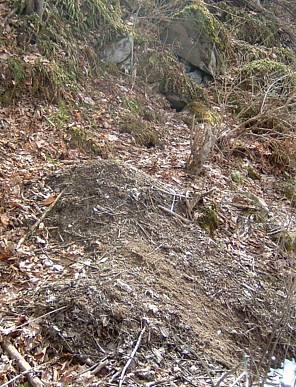
Competing claims? I still haven't found a lodge or den nearby. The nearest lodge is a quarter mile away out in the swamp, a long swim, and this bank didn't seem to have that much to eat. I hope enough beavers survive the trapper so they can show me what all this means.
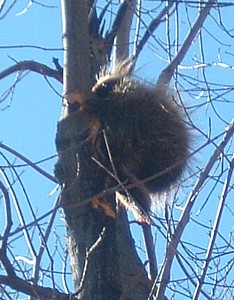
March 21 beautiful sunny day, cold and a brisk west wind. I walked around the end of South Bay and saw the little porcupine up in a tree, about 20 feet high,
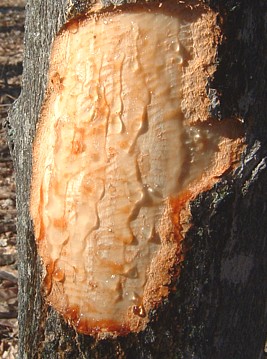
and down at eyelevel was a patch of gnawing on a small maple, the way porcupines tap trees though none was around to lick the dripping sap.
The ice at the end of South Bay has loosened up quite a bit and there are large patches of open water, around the old dock and also out in the middle of the cove.
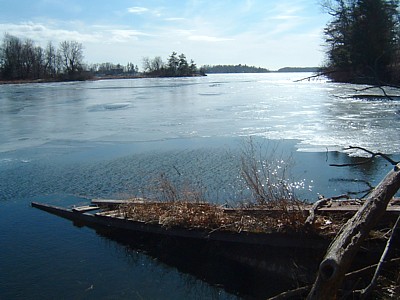
But no signs that otters have been around. There was open water all along the shore, especially around the willows leaning out over the water, but again no signs of otters, not even at the docking rock. The last large patch of open water was around the rock beside the outlet stream from Audubon Pond. The otter latrine at the entrance to South Bay over looked a sheet of ice extending all across the bay.
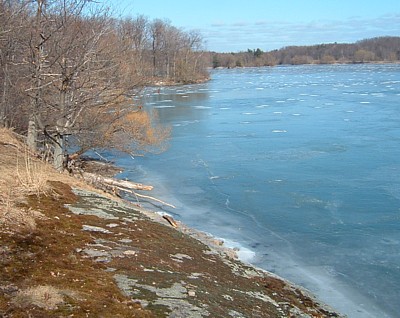
And the ice closed in along the shore all the way out to the Narrows, where there was a wide belt of jammed ice filling the entrance to the Narrows, and the strait between Murray and Grinnell islands. There was open water in front of Maple Island.
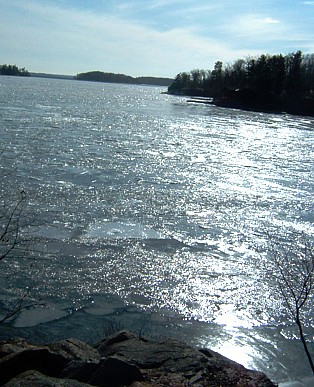
I continued around to the Narrows latrine from which the view presented nothing but ice. Some small patches of open water in the Narrows had been made by an ice boat. In most springs South Bay clears of ice in an orderly fashion with the Narrows clearing out first. One March the otters had a great feast off the endless stream of perch swimming under thin clear ice that formed at night and broke up every day. And usually ice jams form in the channel where current and wind break them up. This year the ice was jammed by the south wind right into the heart of the territory of the otters I have been watching, rather putting an end to my tracking of the otter family I first saw back in July. With a cold wind at my back, I headed for Audubon Pond. I was surprised that the vernal pond on the way was so small
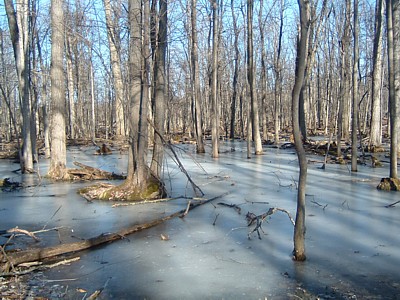
-- I seemed to get my feet wet in a much larger area when I hiked through here during the winter. I saw freshly gnawed beaver sticks on the ice of the canal at the northwest end of Audubon pond, and when I walked on the low bridge there,
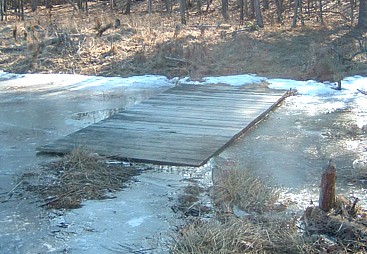
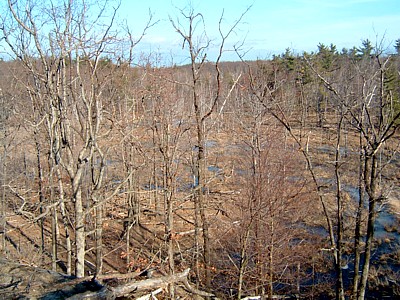
I heard somehing below dive into the water -- not sure if it was a beaver or a muskrat. No open water near the lodge. The only open water leading to thin ice with air bubbles under it was in front of the muskrat burrow near the bench. There was open water in the shallows at the northeast end of the pond but no muskrats about. I took the high road to Meander Pond, both to get out of the west wind and get an overview of the pond. Unfortunately there was no escaping the trees but the photo gives some idea of the extent and arrangement of the arm-like canals that make up the pond.
I took a seat above where they had been finding their food during the winter. I soon saw two beavers, but not there. They were in the grasses between their old and new lodge. One was quite busy with one log, I heard some gnawing, and the other kept moving around and eventually swam down the canal toward me, but it didn't go to the old work, it veered into some shallows,
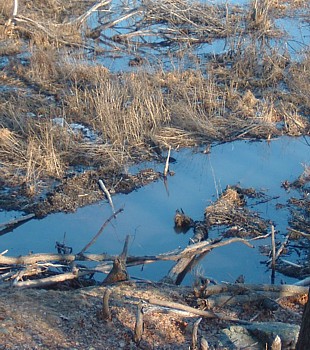
where it couldn't get to for the past four months, and soon was busy eating soft foods that it brought up from the bottom -- I wasn't sure what this soft food was, but I didn't hear any gnawing. So it could have been old grasses or wood so soaked that there was nothing for the teeth to gnaw. In other springs I've seen beavers bring up some rather old logs for food. I waited hoping to see another beaver branch out in its foraging, but the other one or two beavers out stayed in the islands of grass near their lodge, probably finding logs they left there in the fall that had been buried in the snow all winter. The setting sun and brisk wind sent me home. I meant to keep an eye on the beaver below but after negotiating some rocks, I looked up and it was gone, but no splash, and no ripples. It was probably just lurking in some thick brush, another pleasure the beavers have been denied for some time.
March 23 We spent the morning at the land, and a chipmunk came out as I was sawing. In the wet grass, the deer are digging for elecampane roots to eat.
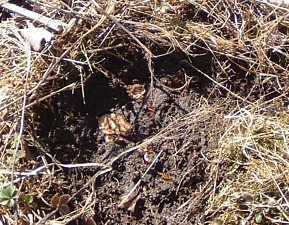
I wonder how much of the root they eat. Some of the ice on the ponds still had a dusting of snow that showed tracks. Raccoons have been around the First Pond
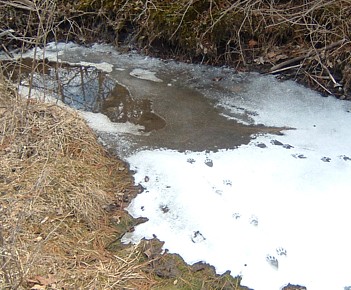
and a crow, probably, getting water at the Deep Pond.
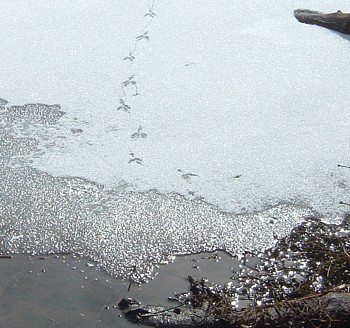
I went down to the otter latrine on the shores of White Swamp and saw coyote tracks
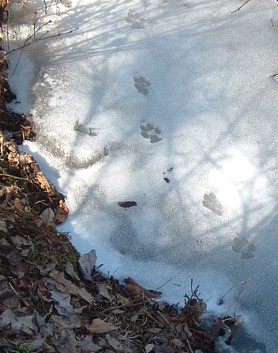
and fox tracks, though I can't understand the dragging marks in the snow.
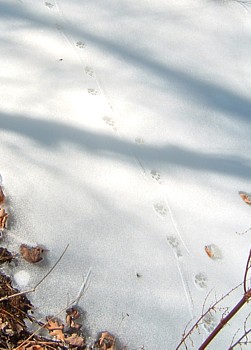
There was a fresh squirt on the old pile of otter scats, but I bet the fox or something else was just marking it.
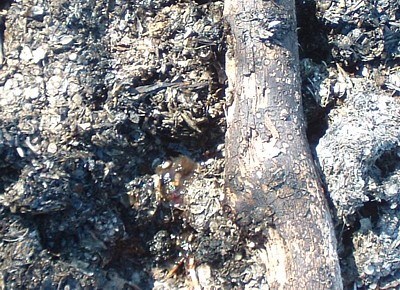
There were geese and gulls far out in the swamp where there is more likely to be pools of open water. The shore that the otters had enjoyed when it was snow covered just seemed a cold shady slope without a clue that it is spring
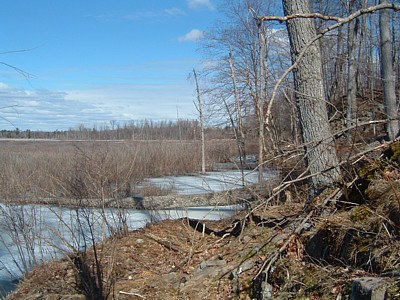
Back on the island, I headed off about three, not necessarily a bad to time to watch beavers at this time of year. Knowing that the Big Pond ice was iffy, I walked down the first valley which took me toward the Big Pond dam, but today I cut up onto the only rocks overlooking the Big Pond because this is about the only time of year you have a view from that promontory, and I hadn't been there in a year, if not two. This time of year you can best feel the bulk and shape of the granite, but that pleasure was not pursued when I saw that over half of the ice on the pond had melted and the brisk west wind had ripples of water running everywhere reminding me of how many directions there are in an open pond, how many possibilities, the simple above and below ice of the winter was over. Ducks flew off as I approached. I scanned the water for muskrats especially, but saw none. Of course, I crossed the pond along the dam and while there is still a leak, it has slowed.
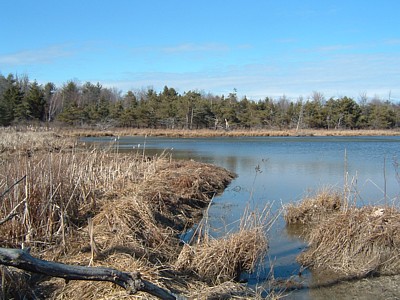
The pond will not lose all its water like it has in years when otters breached the dams. The beavers in the pond above could patch this dam at their leisure. As I walked over the leaking ruts, a fat shrew darted from one mud cavern to the next. Approaching the Lost Swamp Pond, I heard the geese before I saw them.
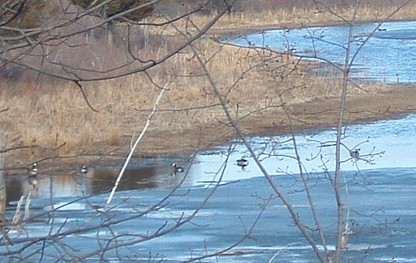
There was more ice remaining on this pond. Only the northern half of the southeast extension was open, and a large circle around the beaver lodge. Here the geese, and, further to the east, ducks seemed to be doing nothing more than skulking, honking, and now and then picking a fight. It was as if they found the pond not like they left it last year and missed old friends and were loath to cope with present company and conditions. As for the pond behind the dam, there was a good bit of open water just behind and dam and along the north shore, rings of open water around the two lodges, and holes here and there.
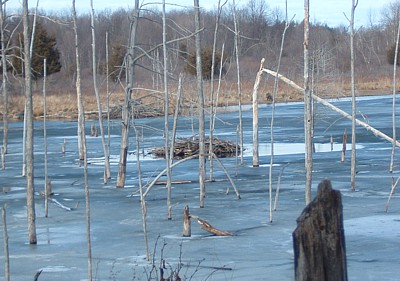
I sat for a while but no beavers nor muskrats materialized. I walked around the pond, through the old otter latrines, not expecting to see any scat and I didn't. I did see rippling in the water along the shore and stopped to appreciate a huge school of tiny fish, few longer than an inch.
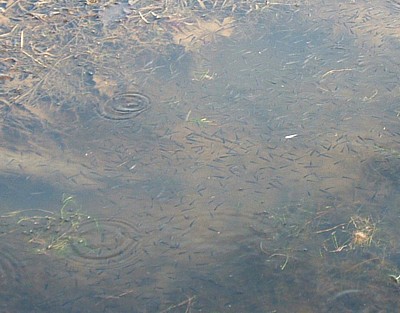
The school itself didn't move and the motion within it seemed haphazard, with most of the fish not moving much but enough were kissing the surface to make ripples and also seemingly flipping as they surfaced so the white of their underside flashed. Perhaps when I look at the short video I took, I'll see more rhyme and reason in their movements. I saw some dollops of mud along the base of the dam and the leak through the dam seemed slower.
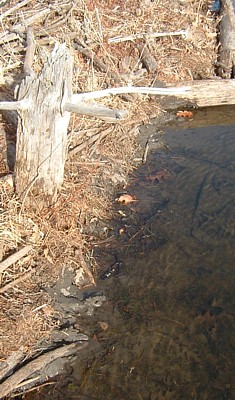
So the beavers are taking care of business, though, as I walked along the dam, I was impressed by how spare they were with mud -- waiting for it to warm up? I sat a bit on the rock by the lodge wondering if it made sense to wait for beavers to show, then I noticed rippling by the lodge, and then got up to check another large school of tiny fish. I recall seeing schools around this lodge last year but those were much more active, a tad bigger too. This school was more sluggish than the other, and thicker, that is the fish were closer together. A photo with the contrast torqued a bit shows that.
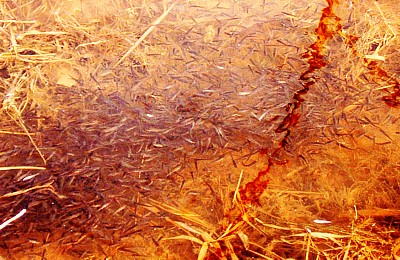
Then I saw rippling over near the entrance to an old muskrat burrow, and there was another school. Tight like the school by the lodge, but active like the school I saw first.
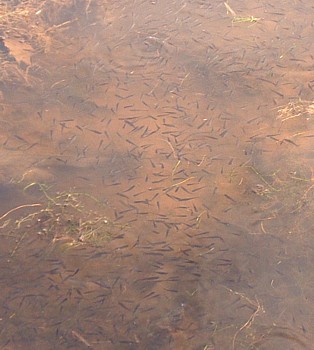
If these fish were twice their size, I would say that they were harbingers of otters to come, but it is hard to believe they will amount to anything more than food for the little sunnies and bullheads that might afford otters a meal. As I pondered that, I saw my first heron of the spring flying about 50 feet over the Second Swamp Pond, briefly perching on a tree above the pond and then going over to the Lost Swamp Pond, giving me wide berth. The sun was out moderating the chilling effects of the wind so I set out to stay awhile -- I could see the Upper Second Swamp Pond below which was ice free and muddy with beaver digging, but no beavers were out. Then I noticed that the rock next to me was afire, or so it seemed when the sunlight hit the red sprouts of the moss next to me.
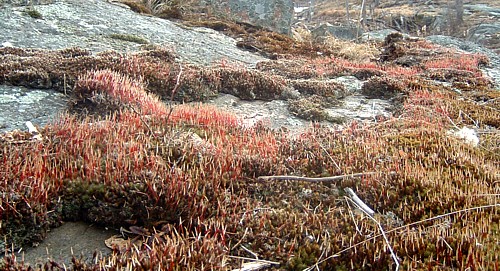
I snaked about the patch on my belly snapping away with the camera.
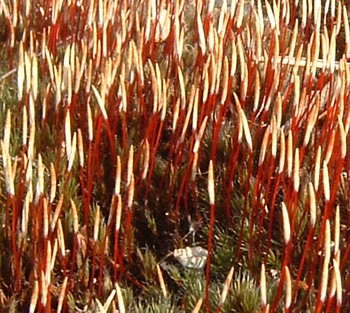
But that cold blooded activity, and the sun, didn't warm me enough, so I moved on. I took a photo of the muddy Upper Second Swamp Pond dam.
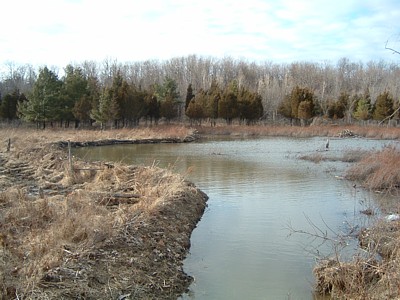
I thought I saw some swallows flying above the Second Swamp Pond -- there are midges of some sort in the air, but there was also a huge flock of male redwing blackbirds that had a penchant for dog-fighting when the flock periodically broke up. I still think I saw three swallows but I didn't see them again. Then I walked down and crossed the Second Swamp Pond dam which is still leaking.
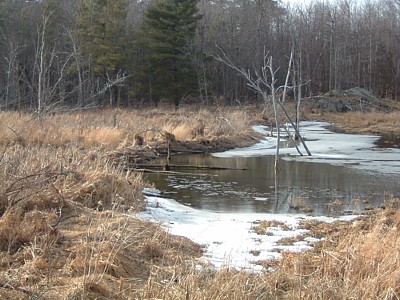
No beaver had been there and the ice fringed pond is getting low. I took a beeline via the East Trail Pond overlook -- that pond as always is the last to thaw -- to the East Trail and then down to the South Bay cove. All of the cove is open but ice remains on the upper part of the bay at least half way out between the islands to the west. I checked for scat at the old dock latrine but saw nothing new.
March 25 we spent a long day at the land and on my initial walk around, I went down to where the creek from our pond enters White Swamp. I was gratified to see three freshly made beaver scent mounds
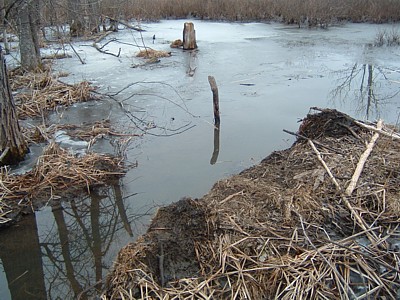
as well as some freshly stripped sticks.
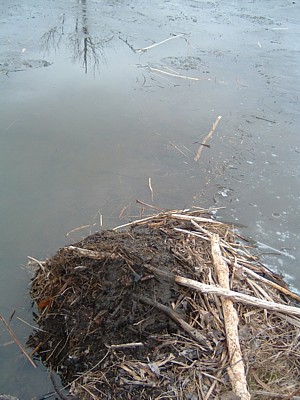
So at least one beaver has survived the trapper, though the trapping season extends another week, with the ice melting I hope there is no longer any opportunity to tend traps.
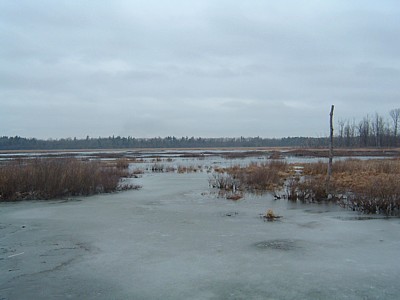
There were no fresh otter scats, but the beaver signs were enough to make my day. Much to ponder also: White Swamp extends about a half mile across from the point where the inlet creek enters it and about a half mile in either direction. So the question is why did a beaver or beavers made three scent mounds, one quite large, one about the usual side and one small. Plus there was a dollop of mud along the channel coming down from the dam. There was no evidence that a beaver went to the dam.
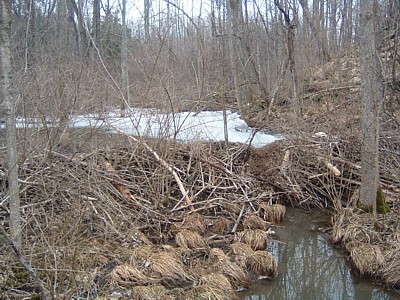
It still leaks though not much water flows out because the pond has just about drained out. It would seem that the beavers are claiming the valley extending up to our pond, even though there is no evidence that they've been there for over a year. The next time I'm here I will take the time for a long hike along the shore of White Swamp to see where other scent mounds might be, and, of course, some evening before the bugs come out, I'll sit in the gloaming and hope to see a beaver or two. The ponds on the land are still mostly ice. At the only large opening in the Teepee pond which is just along the edge of the old bank, long flooded over, I saw ripples
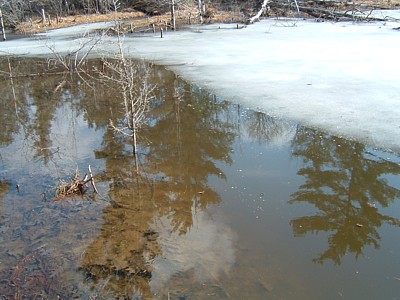
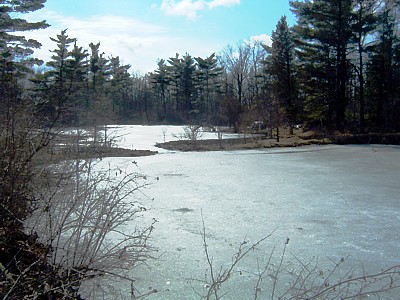
and looking closely, saw a large school of shiners, with a bit of flashing white as they flipped about. This too was an encouraging sign. One spring we had a good deal of cold rain and it took until the end of the summer for the shiner population to recover. I walked around the ponds looking for signs of muskrats and saw none. Yes, the First and Teepee ponds are mostly ice,
but the stream from the little pond above is ice free and green with algae.
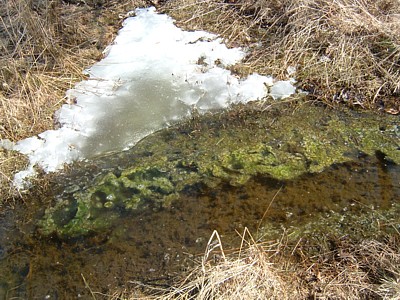
The pool at the head of the valley, into which a muskrat tried to go a month ago, is over half open. Back in September I could account for three muskrats in the First Pond, well enough to ward off a mink, and there were probably more. When the beavers left in the fall, I consoled myself with the hope that in the spring I could pay closer attention to the muskrats. Val's pond on the other side of the road that forms the long boundary of our property is quite muddy, but we haven't seen a muskrat out munching. Walking back to the cabin, I saw that something had dug out the elecampane root the deer had gnawed, but didn't eat it which makes me suspect that a deer didn't dig it out. Flushed three grouse -- one on the way to White Swamp, one walking down to the Deep Pond and one walking from the Teepee Pond to the cabin. I also heard one peeper up in the woods toward the turtle bog.
March 26 warmer but cloudy in the morning -- a little rain last night. I headed out to South Bay just as the north wind blew the clouds off. I hoped to find out what the otters were up to and right on the South Bay trail, at the little causeway over the creek draining the Big Pond, I saw a fresh otter scat,
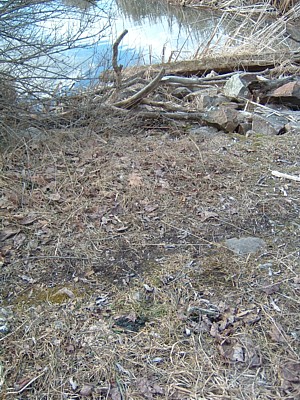
part tubular and part flattened, as if something stepped on it. This was on the south end of the causeway and usually the otters favor the north end. There was no scat over there. This inspired me to go out and check the willow latrine along the north shore of the south cove. I saw a black scat atop the willow trunk, next to old grey scats, but the black scat was definitely not fresh. Otherwise there were no signs of otters, beavers nor muskrats. While the water level of the river was high for the winter, it's not rising much so far this spring. I was able to walk along the edge of the marsh. I could have gone out to the latrines on the island on the other side of the cattail marsh, but I didn't think of that until I was sitting under the oak at the end of the north cove of South Bay. No scats there nor any fish in the cove. There was more digging on the trail near the creek draining into the north cove of South Bay, but not by otters. I checked the New Pond knoll and there were no scats up there. At first glance I thought an otter made a scent mound just above the old dock latrine,
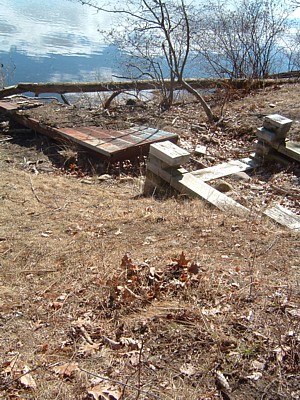
but when I got closer it looked more like skunk scat.
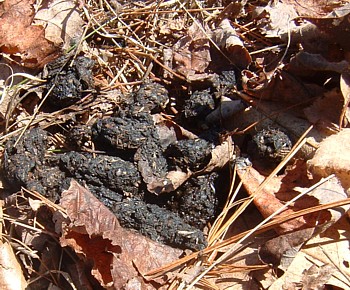
A skunk could be doing all the scratching along the trail. I continued checking possible latrines along the shore and save for some new but not fresh scat on the docking rock saw no sign of otters. As I checked the rocks where the creek from Audubon Pond runs into the bay, a pileated woodpecker worked low on a trunk on the other side of the creek.
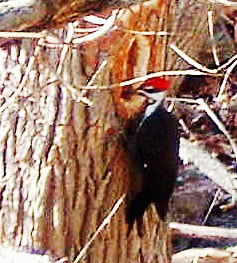
A profitable hole, as it paused several times to pick out bugs and eat them. While the cove and the lower bay are open, green rotting ice stretches across the upper bay, quite striking.
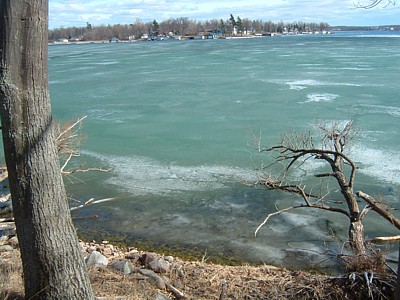
Below the otter latrine at the entrance of the bay the ice still reached the shore and there was no sign of any otter breaking through the ice. I found a warm place to sit and enjoyed the tinkling of the ice blown into the mass by the north wind. There was still a line of white ice from the jam that kept the bay iced over so long. Behind me I kept hearing what sounded like the call of a screech owl, which I don't expect to hear in the afternoon. I enjoyed the scene for an hour and had one minute of excitement: a merganser flew to the edge of the ice, dove and seemed to bring up a small fish, a gull flew over to harrass it, then the merganser flew off, all while a laker went down the channel
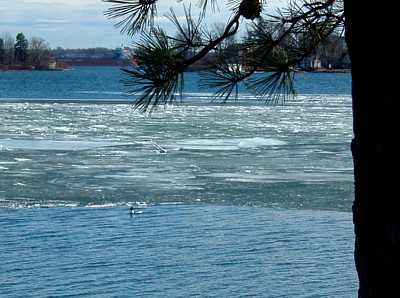
-- then all was quiet and calm again. Just before I resumed my hike a pair of mergansers surfaced in one of the holes in the ice. They looked about, not at all at ease. I thought it might be mating woes but they both flew off together perhaps just confused by the ice closing around them. The Narrows was clear of ice, but no otters had visited the latrine there. I headed to Audubon Pond, aiming to first check the beaver bank lodge on the west shore. When I stepped up to it, something swam out from the lodge, leaving a cloud of mud in the water,
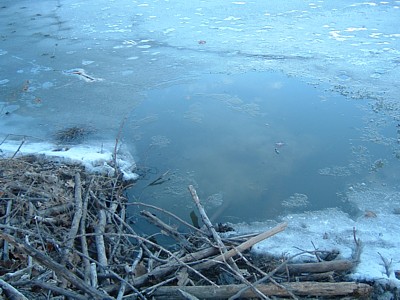
and disappeared under the shelf of rotting ice. I waited to see what might surface and after I walked further around the pond, a beaver surfaced near the lodge in the pond and started slapping its tail. As I walked around the pond it swam close to me,
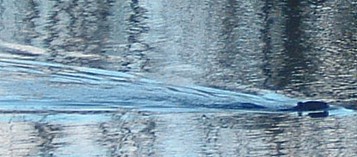
and kept slapping its tail. It was obviously concerned about me, but as it swam it kept collecting grasses, I think, to stuff in its mouth. For beavers, this is not the time of year to be empty mouthed. I admired the fresh work near the bench and lodge in the pond.
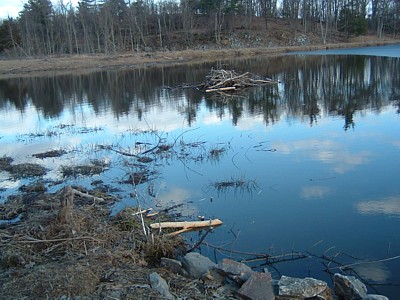
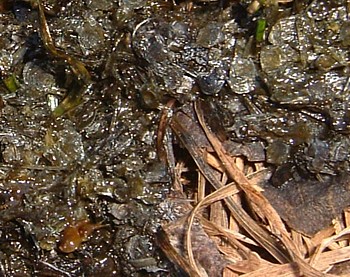
Let's hope that there are beavers in both lodges, say the male moved out of the small lodge in the pond to give his pregnant mate more room. I had planned a grand hike checking the interior beaver ponds, but I decided to recheck the scat I first saw to make sure that wasn't skunk scat too. Going acoss the long Audubon Pond causeway, I moved a pair of geese back into the pond. And I was pleased, upon the closest examination, to see that the scat was full of scales and indeed left by an otter.
Next hike I'll see if there are scats in the interior ponds -- the latrines are relatively clean there and it should be easy to see if an otter has visited them.
by Bob ArnebeckCheck out my other web pages: otters; beavers; minks; muskrats;porcupines;Leslie's art