March 2006
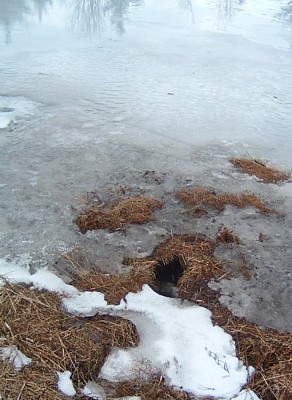
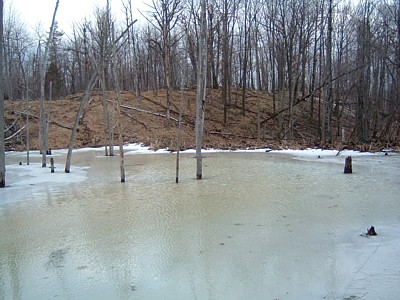
March 10 the thaw came through with rain and a good chunk of 50 degree weather. There were splashes of sun this morning, but by the time we got to the land, the low clouds were drizzling; the gusts were interesting and we were back in the 40s. I walked by the flooded Third Pond -- flooded over the ice. There wasn't that much water draining into the Deep Pond and I could study the old scats on the ice, and there was one intriguing hole through a patch of grass going into the pond, showing a good gap of air under the ice.
Of course, an otter could still get into the pond where the water flows out, but none had. I went down the creek to White Swamp. There didn't seem to be any fresh scats,
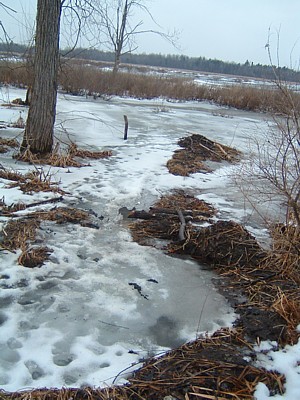
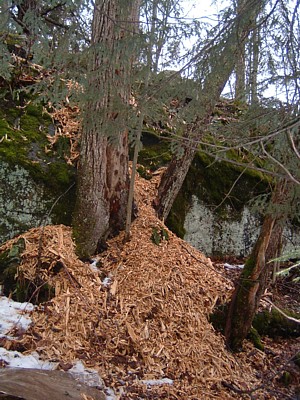
but that's very difficult to call under these wet and changing conditions. Through a small hole in the ice, I could see a good flow of water about a foot below the ice. That gives an idea of how much airy room the otters had to roam in under the ice. It also raises the question of why the water level dropped so much -- did otters breach the controlling dam or is this just the usual drop in the swamp's water level. Then I walked down grouse alley, walking down from the cabin. No grouse flew off but I saw a talus slope of pileated woodpecker picking, such lively looking rot.
There was not much snow left in the gully but down on the ice of the bogs at the end of our land, snow had some cold to cling to, and as I moved toward it, I saw a mink dance across and down the flooded ice. Then it began to rain.
Back on the island, after the rain, I crossed over the TI Park ridge, once again a deer haunt, and walked around South Bay. I crossed the flooded creek on the old oak log bridge and even went up the New Pond knoll in case an otter thought the new dispensation required new claims on the terrain, but there were no fresh scats up there. The west wind was raising the water level of the river which loosened holes in the ice along the shore, especially by the old dock. The rain and melt also flooded above the ice.
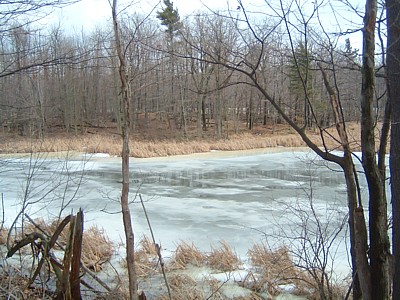
There were some scats I didn't recall seeing, but in the damp all scats begin to look the same age. I thought of checking the other South Bay latrines, but since my theory is that the otters prefer a safe beaver pond in these conditions, I turned and went toward the interior ponds. I checked the East Trail Pond first, still perplexed by the two otter slides I saw on the pond that didn't seem to come from or go anywhere else. If there were or had been otters there, I might see some scat. And since there had been no scatting there for several months, any I saw would probably be fresh. But I didn't see any nor were there any holes in the ice that otters might have made or used.
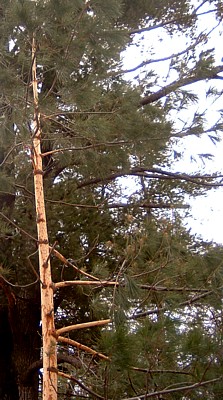
All winter I had seen a porcupine trail just below the dam. And up on the ridge west of the dam, I saw a small pine that a porcupine had perfectly stripped, nipping most of the branches, but leaving enough to give the pine a woebegone look.
I also heard a pileated woodpecker over on a dead tree just off the swamp. In other years they nested over there, but it flew away before I could get a good look at it. Then I checked the Second Swamp Pond dam. There was a good gush of water over the weak part of the dam, and a large patch of open water behind the dam there. No signs of otters. There was a good flow of water down into the snowless and apparently ice free marsh below,
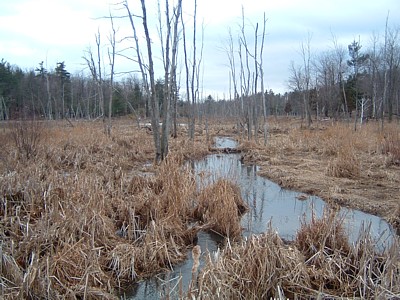
but the ice of the pond was merely flooded over, and had a few weeks of life still.
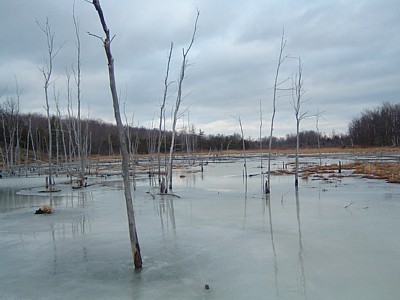
The Upper Second Swamp Pond ice, which had collapsed weeks ago, seemed the most fragile. But where I had seen mink and otter tracks go under, the ice now seemed hardly worth a sniff, just broken ice over mud. I waited a bit to see if a beaver might come out of one of the holes in the ice behind the dam but none did.
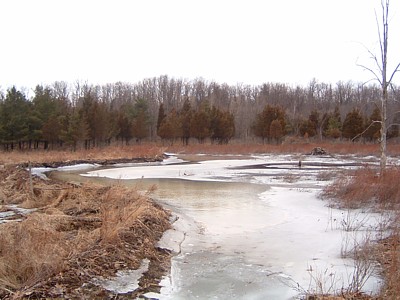
The Lost Swamp Pond ice still reigned -- perhaps the small hole in the ice behind the dam was a few inches wider. I walked across the ice, but not far enough to see if the area around the active lodge was open water or just flooded ice, I think the latter. Perhaps this pond did not suit the otters when they visited because there had not been enough beaver activity near the dam and the lodge by the dam, as in other years. I also crossed the Big Pond ice, entertained, as I walked down to the dam, by a redwing blackbird making both its territorial chireee and alarm beeps. This bird and I might be old acquaintances, at least I've received this treatment in other years. There was no activity at the dam, save for water rushing out of gaps not as deep as in other years.
March 11 At the land the water is now flowing through the Deep Pond, but again, no evidence of any animal taking advantage of that. After sawing logs, I went down to White Swamp, aiming to enjoy the warm 50F afternoon by leaning on a tree above the otter holes at the end of the inlet creek in hopes that some otters might pop up from under the ice. I could see right away that the water level of the swamp was higher.
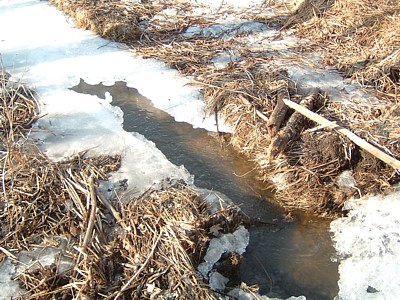
Otters can no longer run under ice. But there were many patches of water now to pop up in for air.
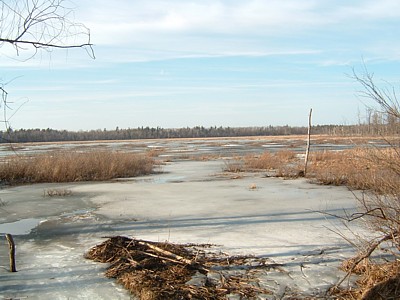
After a half hour's lounging it struck me that no otter was about to entertain me. I was farting too much for one thing. So I went down to see if I could see any fresh scats -- not easy in these conditions. But there was one creamy beige scat that I am sure I would have noticed if it had been there yesterday.
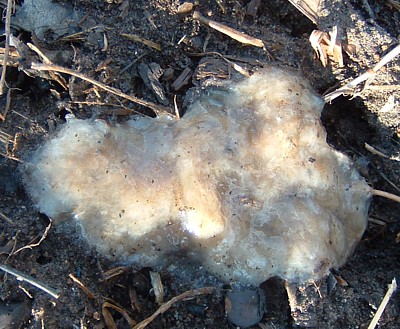
There was another scale-ladened gray scat that also looked fresh. So I think the otters still come here. Crossing the ice to check on the dead muskrat was tempting. But I could see holes in the ice, and I don't know this swamp at all. Geese were flying over the swamp but none had landed to claim a nesting site.
March 12 rain moved through mid-day, and clear skies were predicted, but after the rain, it cooled down below 50F and the river and island were shrouded in fog. I headed across the soggy golf course and saw a dozen deer and twice that many geese who were rather noisy. I anticipated seeing some claiming nesting sites on the ponds, but didn't. There is no more snow to speak of. For the record I took a photo of the porcupine den above the golf course that had been used early in the winter but has been abandoned for months. It looked like something had cleared most of the poop out of the trunk. I had planned to try to find where this porcupine went, but that's not so easy now that the snow is gone. In the flat before going down the valley, I had to dodge a good bit of turkey poop. Going down the valley, I lamented the end of easy tracking. As a rule here over the years, the porcupines denned on the rocky east slope and foraged on the gentler west slope, but this year a porcupine went up into the rocks for food, stripping one feeble little tree.
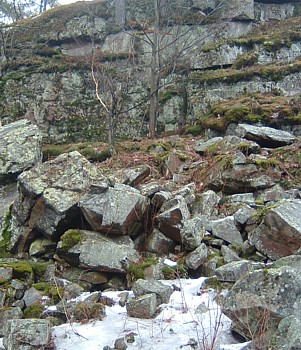
Despite the warmth I was able to cross the Big Pond ice -- quite solid actually. So when I got to the Lost Swamp Pond, I walked up the ice toward the active beaver lodge. Through the fog I saw a black lump along the north shore and then I saw one and then two in the open water near the lodge. I moved closer taking what I hope is romantic looking video. Unfortunately I switched to the camera just when a beaver emerged in the pool bearing twigs which prompted a small beaver munching by the lodge to make a dive for it. When all calmed down three beavers remained in that patch of open water,
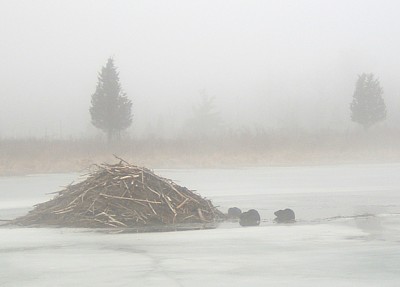
while another returned to the open water near the shore. As I walked around them toward the north shore, despite the wind being favorable, they sensed my presence and a tail slap sent two under water, but the beaver by the shore was still on the ice until I got close and it disappeared. I think my vibrations on the ice set off enough ripples in the water to alert them. One stayed up looking in my direction. When I got to the shore I saw where they were getting out
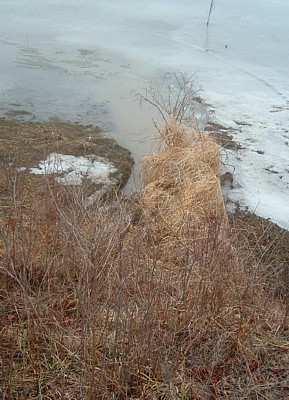
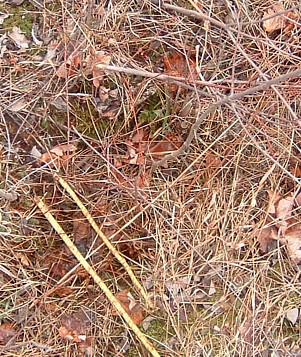
and the little bits of brush, red osier, I think, that they were stripping, scattering twigs with a greenish tinge in the wood.
There was nothing new at the dam, except that the water is getting lower. The hole in the dam seems just as they otters would fashion it, but no sign that they've taken advantage of it. From the dam I could see three beavers active down on the Upper Second Swamp Pond. Two were on the ice next to the open water of the creek coming down from the Lost Swamp and one was in the water behind the dam. For a moment it looked like the later was inspecting if not trying to repair the dam, which has at least two major leaks. The beaver twice climbed up on top of the dam,
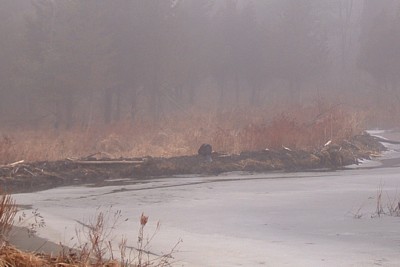
and dove a couple times, but I kept hearing gnawing and didn't see any heaving of mud. Meanwhile one of the beavers on the ice struggled to pull out a branch of the old cache frozen in the ice. Of course, in the classic tale, the beaver is swimming under the ice to find its food. Probably more convenient to get it this way. Once it got the branch it dove into the water and disappeared. The beaver by the dam soon sensed me and left. These beavers have always been quick to sense my presence. I'd like to coin a theory -- small ponds make for sensitive beavers, but in the smallest pond of all, Meander Pond, I can almost get right on top of them. I checked the Second Swamp Pond dam where there was no sign of activity. Then I decided not to bother the Meander Pond beavers, and instead headed for the South Bay dock. There were many patches of open water along the shore of South Bay and it looked like something had been on the ice around the dock, but the surer sign of otters, was a fresh scat on the bank above the dock.
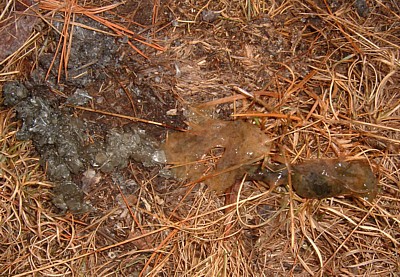
I checked Audubon Pond and the docking rock and there were no signs of otter visits there. When I approached the latrine above the entrance to South Bay, I saw grass and leaves and dirt scraped up in an otterly fashion to make a scent mound.
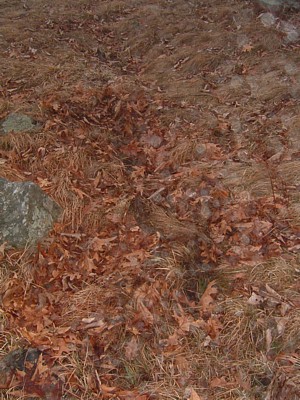
The pawing in the dirt was done by claws not hooves. I did see a fox or coyote scat nearby, but I also saw a fresh otter scat. However there seemed to be no hole in the ice below. I went down to the rock next to the ice and did see what might have been the faint traces of an otter trail with slides heading off on the ice. Holes around leaning willow branches were about 10 yards away so I should think it was easy enough for an otter to get to this important message board. Due to the fog, I couldn't see the state of the Narrows. And it was getting dark. My next trip will be out there. Walking back home I heard a good number of crows, a chorus of redwinged blackbirds, and one melodious singer, not in song sparrow territory. It was too foggy to even try to look for this sure sign of spring. Hiking in the fog is always a treat as the moisture seems to make every object lambent. I could almost fancy that my tiptoeing about was my way to adjust to the heat of the earth and all its seemingly dead vegetation, but of course, I was only trying to keep off rotting ice and keep my boots dry.
March 13 rain just as I got up, with steady temperature in the 40s, and gusts from the northeast. In the afternoon the rain stopped and the fog puddled over any large sheets of ice that remained. We went to the land and the sight of the Deep Pond ice floated up by the flood and
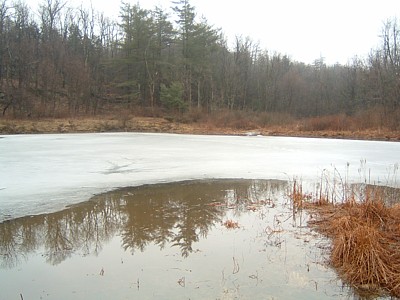
water pouring over the dam, persuaded me to go down to White Swamp and see how brightly the otter haunts glowed in these conditions. Of course, the flood from our pond hardly made a dent on the great expanse of ice remaining in the swam.
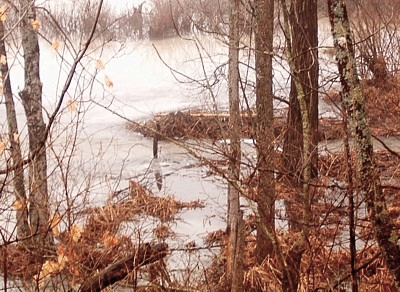
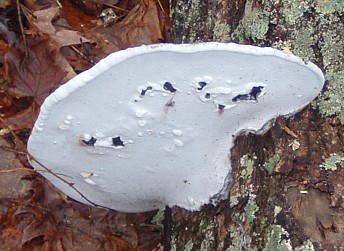
There were honking geese all about in the fog, pinpointing opportunities for nesting unseen from the shore. I headed along the steep ridge toward the otter latrines I had seen in the snow last week. But first I was startled by two large mushrooms. The familiar large plate half around a dead downed trunk had a bleeding white bottom.
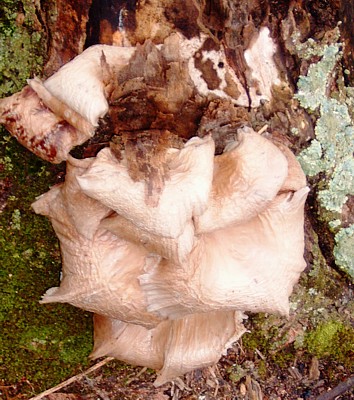
And the collapsed beige tent like tentacles of another mushroom at the base of the standing dead trunk was completely unfamiliar to me.
The shore of the swamp also held surprises. Not far from some beaver work
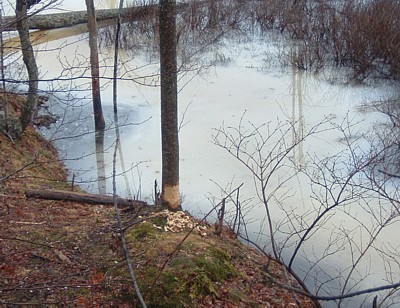
were two mounds of blackened leaves, grass and mud. The smaller pile reminded me of a beaver's scent mound, but next to it, on the other side of a downed tree trunk, was a larger, saddleshaped pile of black that could have been an otter rolling area, for there were some old scats, but there were also the now blackened nibbled left overs of beavers.
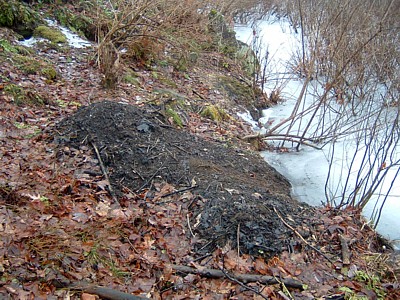
In all my walks around the beaver ponds on the island, the melting snow had never revealed anything like this. Further along the ridge, I found a small tree cut down that looked like fresh work - how I'd love to see a beaver here. Then I got to the otter latrines and with all the snow gone I could see that their holes did not go into a beaver bank lodge, but into holes in the turf either dug by the otters themselves or seams left by rotted tree trunks. Two of the holes headed under the ice of the swamp,
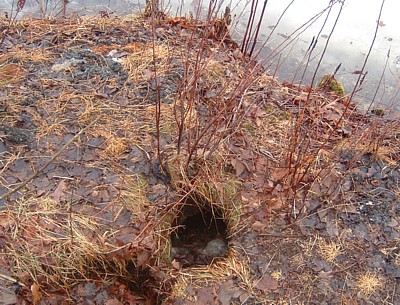
and another went up into the slope. It seemed to me like there were fresh scats, especially much beige, brown and creamy scats, the kind I usually notice.
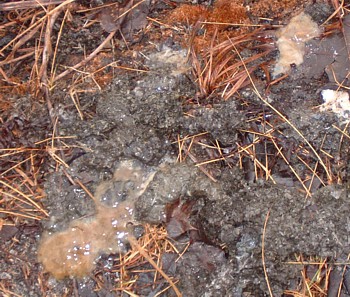
There were fresh looking piles above and below one hole and I can't believe that melting snow would reveal anything that fresh looking. Now and until the bugs claim the swamp I can keep checking this area. I continued west along the ridge and found a huge birch that looked just cut,
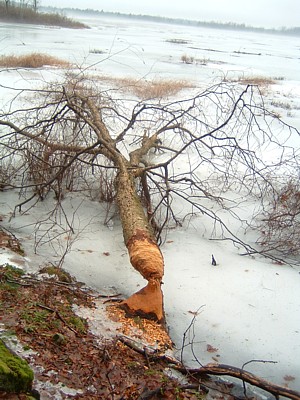
but was probably old work. I noticed that the gnawing on the stump below the cut was smooth, while above it was very rough.
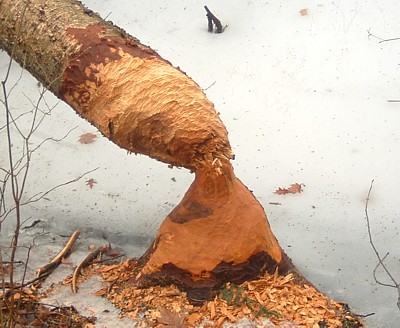
Can't readily explain that. Walking along the ridge became tough for a few dozen yards and though I walked on rocks with otter scats on them, I didn't pause for a photo -- wet slopes where ferns and mosses, not to mention rocks, seem about to tumble down, have a way of keeping you moving. And when I did stop and turn to take a photo, where I had been looked too tame from that distance, so I left it for my memory and imagination. How I would love to see the otters swimming up to and climbing on these dripping rocks. We also saw a small flock of snow geese as we drove in.
March 14 after the rain came the wind, and cold, and a few spits of snow that didn't amount to anything. We braved the wind and walked around South Bay. The hole on the south shore to where I tracked the otters was flooded over. There were no scats on the New Pond knoll, the pond below was full and the creek launched from two huge (and old) gaps in the dam. There were no new scats at the old dock latrine, and much open water. I checked the latrine behind the willow and at the docking rock. Patches of open water near both but no new scats. That said, there were certainly more old scats at these latrines then I have ever seen before after the thaw -- a testament to amount of time the otters spent in South Bay and how little time they spent in the beaver ponds. I'll soon be able to check the Murray Island and Picton latrines by boat. The scent mounds I found the other day in the grass of the latrine above the entrance to South Bay seemed less bouffant, almost flattened. No sign of any new otter activity there. While water had opened around the rock,
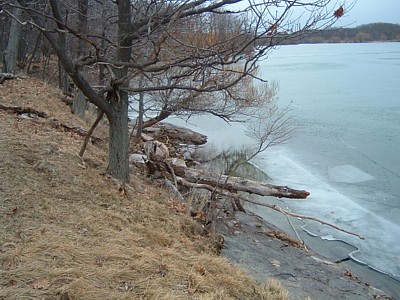
the ice was tight just below the latrine -- and a beautiful green. After sitting a spell on the rocks above the latrine, where there was no wind at all, we braved the gale and walked up and down the trail, admiring the jumble of ice below out to Murray island
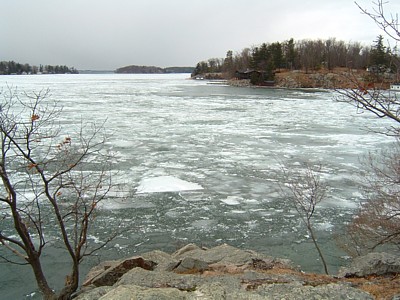
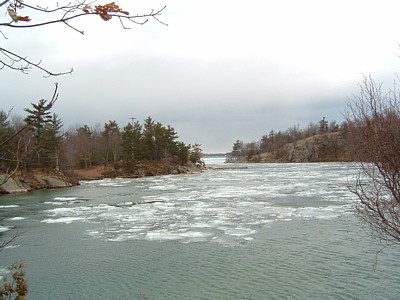
There was a large pool of open water tucked behind the rocky point there. At the Narrows we saw that the ice pack was being blown into the Narrows
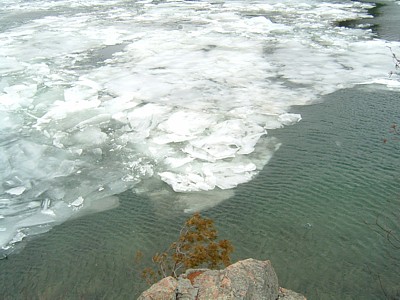
At the rock latrine there were no scats, not even old ones. We watched the ice squeeze into the Narrows and just when I got my camcorder out to catch the action, the ice jam took hold and the flow stopped.
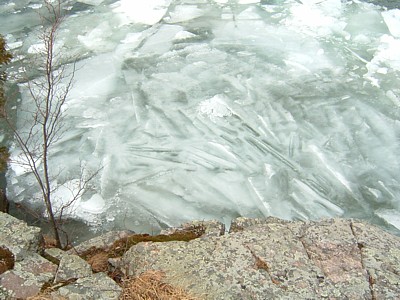
We could see open water to the north, in the Canadian channel and debated whether the gray green we saw in Eel Bay was open water or rotting ice.
We went up the valley to Audubon Pond where the water level was much lower, its normal range, and there was much flooded ice. However, the was a hole into the ice in front of the beaver bank lodge. No fresh scats or fresh beaver nibblings there. Nor had the beavers been out to get more of the pine they cut in the northwest corner of the pond. There was an apron of open water around the lodge and large, freshly stripped ash logs there.
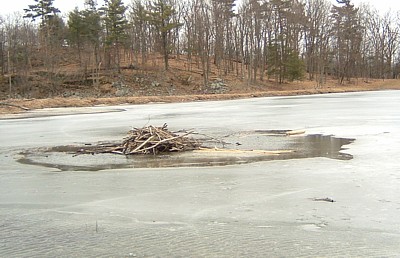
I studied the ash the beavers had cut in the cove to the west of their lodge and only one of the ashes cut seemed to have been completely segmented. We headed home with the wind more or less at our back.
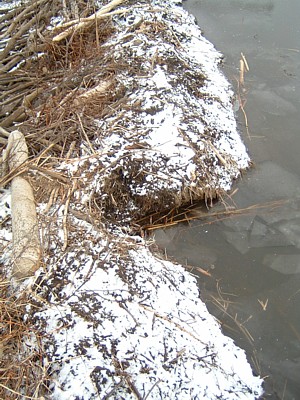
March 15 Much to my surprise we had a snow squall at midnight that left enough snow on the ground to allow for tracking this morning. I went up the TI Park ridge and then down to the Big Pond along the ridge. I picked up a deer trail and nothing else. There were no tracks at the Big Pond dam nor at the Lost Swamp Pond dam. There was much open water behind the latter. I didn't walk so that I could check the Lost Swamp Pond beavers but I could easily see that the Upper Second Swamp Pond beavers had not been out despite much open water in that pond. With all ice iffy -- it did get below freezing last night but not cold enough to undo all the damage to ice that a long spell of 50F did, I had to cross on the rather narrow dam. Fortunately, the mud remains frozen. As I crossed I notice four place where there were niches in the dam -- perhaps where there were old leaks but I wonder if beavers didn't get up there out of the water but under the ice to nibble some sticks.
No sign that the beavers foraged among the trees north of the pond, and I continued that way because I wanted to check on the active beaver lodge in the pond beyond the Third Pond. I was pleased to find signs that the beavers had been out. The ice was broken just in front of their lodge next to the cache and there were bubbles under the ice that probably formed last night.
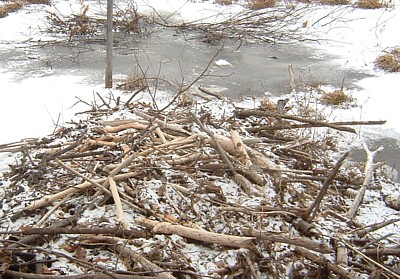
But no beavers were out and while there was open water near their recent work, and there was a wet trail up to, it seemed much like it was a month ago -- no new large trees brought down that I could see. I thought of going up the ridge to the Great Swamp but decided to make sure the otters didn't go to the Second Swamp Pond. Last winter/spring that is where I rediscovered them. I took a route over the big beautiful rock, just one grand rock, that forms the ridge between the second and third swamps.
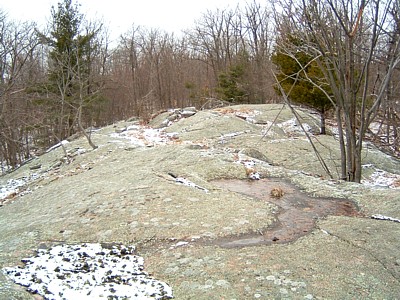
Last year there were otter slides in the snow up on this rock. At least I was proving to myself that I really didn't need to be tracking otters to get exercise. There were no tracks on the Second Swamp Pond and so I dutifully went to the East Trail Pond where again there were no tracks. And even at Meander Pond the beavers were not out and there were no tracks in what snow remained -- it was melting away. The winter configuration of the pond is over; there is open water ever where. I'll have to start walking around this pond to see what the beavers have been up to. I continued down to the dam, and they had not been out there. As I walked half way around Audubon Pond in the opposite direction that I did yesterday, I saw that there may be fresh beaver work in the northwest corner. The ice looked a bit broken up and I could see where several ash branches had been cut off the tree that fell over the pond -- that happened in the late fall but I don't think the beavers had nipped off so much then. And there was a cut pine bough in the water. I continued up the trail to the heights overlooking the Narrows, and thanks to the snow I could see what portion of Eel Bay was still ice -- most of it,
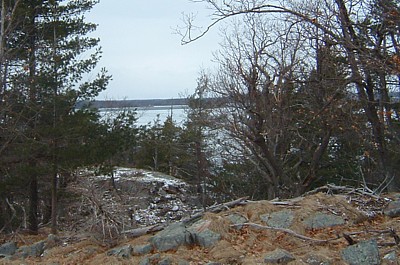
but the Picton channel is well opened -- and that, I know, is otter territory. The ice is still jammed in the Narrows so I didn't expect to see any otter tracks on the shore there, and didn't. However, on the west shore of the Narrows there was open water, and back in the bay to the west, so otters might be there. When I got to the otter latrine on the shore above what I call the entrance to South Bay, I finally saw some tracks, first some faint ones that looked like a raccoon going out on the ice, and then some bold ones that ended in a slide. Plus there was a trail with a pronounced tail drag much like the dragging I saw in the snow when I tracked two otters out of the ponds.
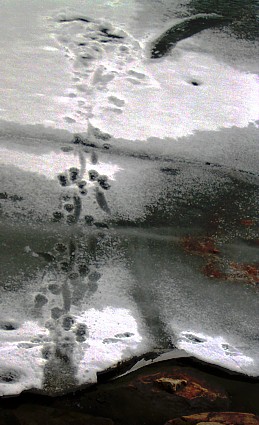
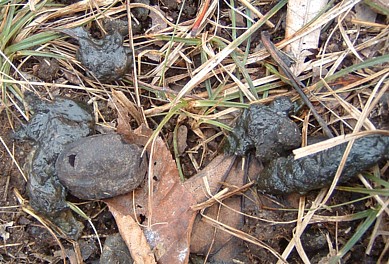
Of course, I checked the latrine, where all the snow had melted, and found fresh scats,
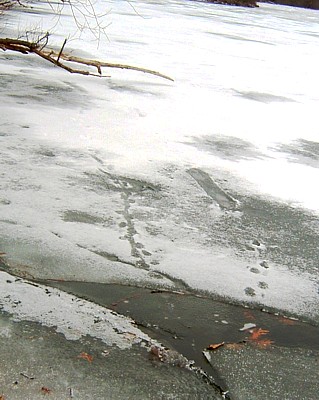
Then down at the rock next to the water I could see two trails coming in over the ice -- one with a long slide and the other dragging a tail. The prints had melted quite wide so I couldn't see the distinctive otter three-by-three.
I continued walking down the South Bay shore and fancied I could see parallel impressions out on the gray rotting ice, but nothing definite. There were no new scats at the docking rock and no slides perceptible in what ice there was -- very little snow on the ice near the shore. Finally at the old dock latrine, I am pretty sure there were fresh scats -- two brown blobs on a mass of gray fish scales. However, most of ice that formed around the dock during the night was still there, but enough open water to admit two otters.
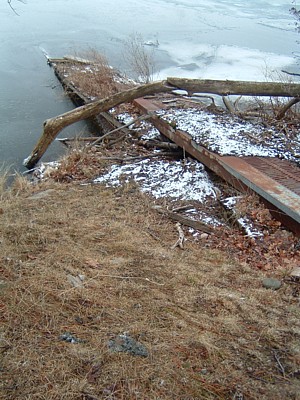
But I should think that two otters might have left at least one print in the snow that remained. Two otters were definitely out last night or this morning, heading to the open water toward Murray Island, and perhaps they came out of the hole under the dock and started fishing in the bay early enough so the water around the dock could ice over. Not the mating behavior I was hoping to see (I include mothers separating from the young as part of mating) but at least I saw signs of otters, and the mysterious pair. If I see the three otters together again, or their slides, then there at least 6 otters frequenting my stamping ground.
March 16 today I turned my attention to the White Swamp otters. First all there was no activity at the Deep Pond. The flow of water through the pond has diminished and while there was still a good flow of water down to White Swamp it was confined to the channel, and most of the channel below the dam, where the otters had been active, was frozen over with thin ice. I couldn't see any fresh scat, like I had every other time I've been down here recently. The only prints I saw in the little snow that remained were from coyotes. We walked along the ridge, Leslie quite taken with the beauty of it, and checked around the three holes into the bank, their more active latrine. There were patches of snow but not around the hole. I saw three tubular scats that were fresh and on the other side of the hole one squirt of reddish brown scat.
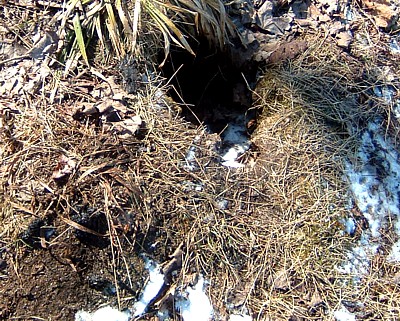
The tubular scats looked like they had insect parts,
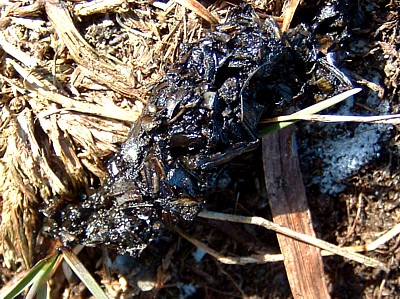
which made me wonder if a skunk hadn't been by, but there were fish scales too, and out on the ice of the swamp, there was a large patch of snow with what looked like otter tracks, though we didn't hazard to go out and get a good look.
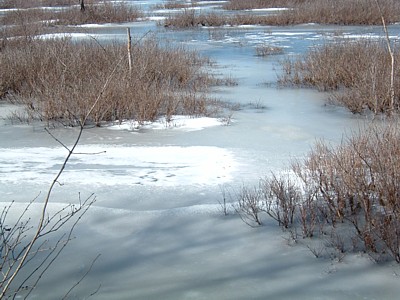
If there had not been that liquid scat, I would be more in doubt. But unlike the other times I've checked here, the otters obviously did not romp around much outside the hole. Finally we also saw some bubbles under the ice, magic beyond the power of a skunk. We continued down the ridge and I got a photo of the jagged moss covered rocks that otters have fancied enough to honor with their scats.
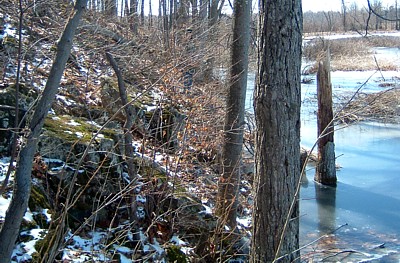
Though the temperature got a bit above freezing, the cut of my saw was about the only noise I heard, but it is not quite spring.
March 17 I headed up the golf course, late morning on a cold sunny day, with a north wind. No deer, turkeys or geese grazing on the fairways, just four crows. Going down the second valley to the Big Pond, I took a seat for no particular reason, but found myself musing on what happened there this winter -- the dead deer, the grouse, all the porcupine work and me not seeing any of the porcupines. Then I layered on memories from other winters -- another dead deer with chickadees picking at the meat, the mating foxes, and the year the otters came through and spent some time if not a night underneath one of the huge rocks at the bottom of the valley. Nothing in particular happening today, and I continued on in a retrospective mood. So I walked over to the procupine dens in the rocks just above the flats of the Big Pond swamp, not expecting to see the porcupine, who had not been there for over a month, but merely to cast my memories over the den. And who should I disturb as I looked down? The porcupine, who moved down from its porch hot with poop and went back into the den. Like old times, and I let the porcupine know how I felt. I planned to check the beavers in the Upper Big Pond and as I pointed myself that way, I saw a raccoon digging in the mud where water flows into the pond from a spring on the shore. All winter I had been ruing the lack of activity in that rivulet which in other winters had entertained me (as well as minks and raccoons) with swarms of shiners, and here a raccoon found life again. I got some video, but not close enough for a good photo, and as I got closer the raccoon walked away. Then I was surprised to see that the beavers had broken the ice, and nibbled some twigs,
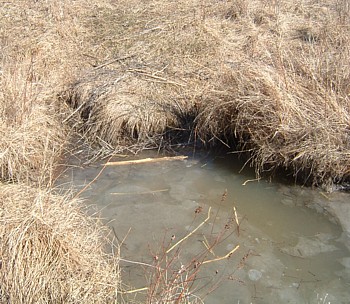
behind the dam just above the Big Pond.
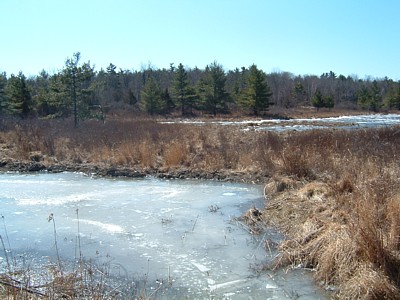
I continued back to their high and dry lodge -- with low ice all around it, and just as I started to wonder if the beavers had left, I heard two beavers hum. The cache that had been on the southeast side of the lodge was all gone. Now there was a pile of sticks on the north side of the lodge.
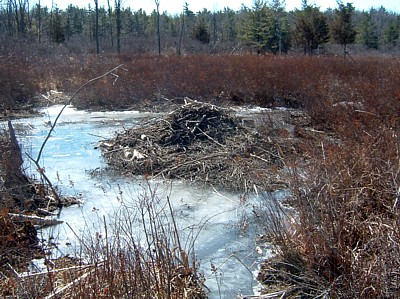
I waded through the brush on the ridge and got over to the Lost Swamp Pond where there was plenty of open water around the lodge and also along the north shore. The ice was generally firm, though a little wavy at places, but quite iffy on the north shores. However, all the ponds are low. I took a photo of the lodge from the north shore to show how much water was open along the shore, but also how it didn't seem that the beavers were making much of it -- no wet path here coming up to the brush on the ridge. Down at the dam, there was still no signs of otters, but something had broken some ice behind the dam.
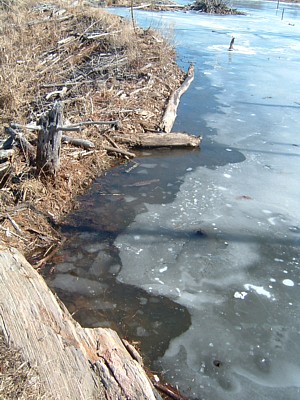
Perhaps muskrats. I checked the north shore to the west of the dam where there are a series of muskrat burrows and I saw ice that froze clear with bubbles under it -- perhaps muskrat signs, but this pond is so shallow, the water is a few feet away from these burrows.
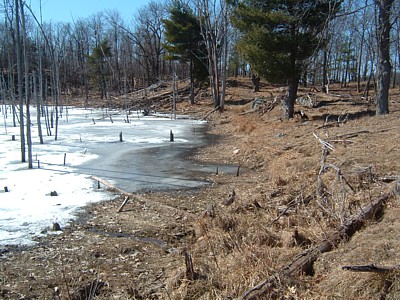
I am still confused as to why the otters came, dug into the dam so it would leak, and then left. Hopefully it was because conditions were so much better in South Bay than usual and that they wanted to store the fish up here, so to speak, keeping them in pools under ice. The water behind the dam of the Upper Second Swamp Pond had refrozen. I noticed the last time I was here that the water has backed up a bit behind this dam, as if the beavers had patched a hole or two. Still the water flowing through is keeping a long channel of open water below the dam -- a good place for otters to fish.
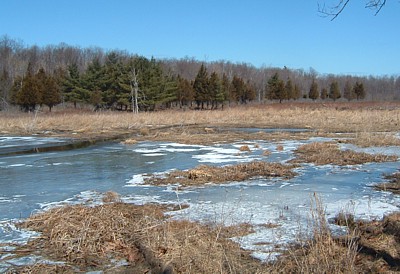
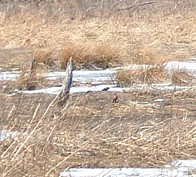
But the only animals I saw foraging nearby were a robin and redwing blackbird in the flattened grasses.
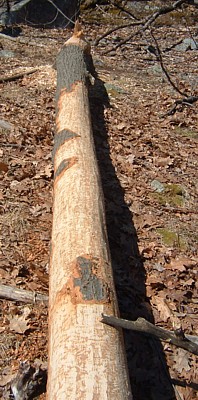
I crossed the Second Swamp Pond dam, where there was no evidence of anything visiting. It warmed enough to make this a pleasant day for a hike so I continued on my usual route. Plus I was curious to see if the Meander Pond beavers were back with their bouquet of red oak trunks or if they had broken out of the ice in other corners of the pond. No beavers were out when I got there, but the ice was broken in the usual spot, the water muddy, and more red oak wood to be seen,
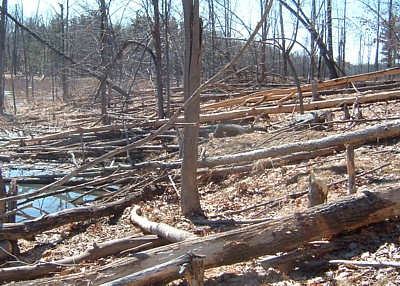
though the beavers do seem to always leave a little bark for left overs.
I took a different route to Audubon Pond, going along the rocks south of the stream and depleted ponds. This is the time of year to pat the great rib like rocks of this island -- no brush in the way. After I sorted out a series of holes in the ice as only the pattern of the melting during the last thaw, I decided there was nothing new at Audubon Pond. Then I checked the latrine on South Bay -- quite dry in the sun. No new scats, but I got another perspective on the slides and prints I saw here two days ago -- definitely left by otters and it was easier to see how one otter slide ended in a hole through the ice.
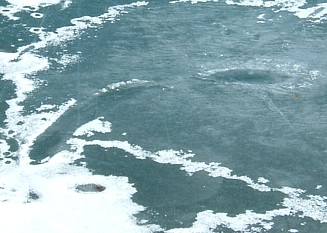
While there was a bit of open water around the old dock, it didn't look like any ice had been broken by an otter or anything else. A good day for birds, too. I saw a brown creeper, heard a couple of song sparrows singing, as well as the redwing blackbirds.
by Bob ArnebeckCheck out my other web pages: otters; beavers; minks; muskrats;porcupines;Leslie's art