June 2006
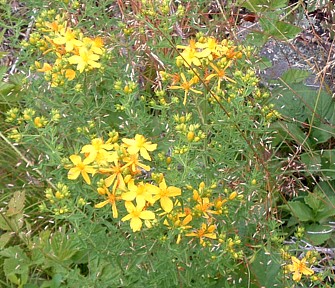
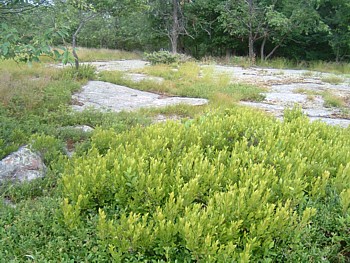
June 26 I determined that the grey clouds would not bring rain and waded into the tall meadow behind the golf course where rugosa roses and cow vetch decorated the bedrooms of the deer. Fawn here had outgrown hiding. though none were to be seen. Then I enjoyed the added color the wet summer brings to the rocky plateau. I don't expect to see St. Johnswort blooming up here
and in many whirlwinds of plants there were brighter greens.
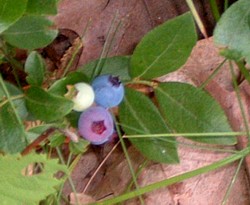
I tried a new route again and was soon entangled in the willows, with here and there a yellow rain of honeysuckle blossoms. I didn't disturb any birds. At the next rocky opening I saw some early blueberries
Once on my usual trail I gravitated to my usual spot and sat and listened -- not much bird song, save what a wren offered. There was a steady chorus of alarm calls far enough away that I didn't think I was causing them. There is more going on here than meets the eye. Down at the Big Pond dam I could see that the beaver trails up to the saplings were still being used, but no signs of otters. I sat at my usual perch, noted the muddy water, but didn't see any muskrats. The clouds that were cooling down the muggy day started sprinkling so I moved on so I could wade through the tall grasses along the dam before they got wet. The dam has been attended to and the feeding niche in the dam appeared open for business.
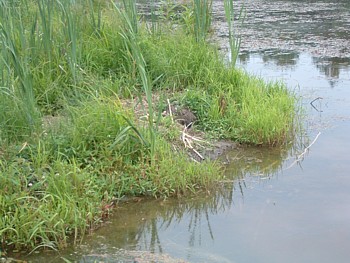
Among the old cattail flowers bobbing in the wind like shaking fists, I was puzzled by the variation in this spring's flowers
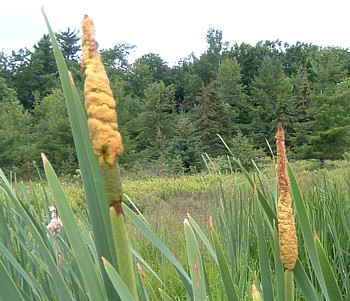
not sure which flower was older. Here too I tried to get a photo of the cowvetch, catching its counterpoint with some bindweed flowers, but my camera can't digest a flat white flower in the glaring sun.
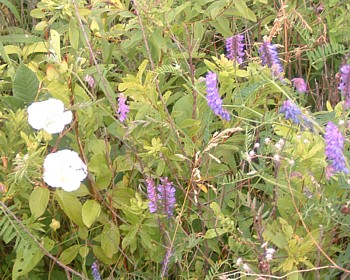
I had better luck with some smaller bulbous blooms displayed on a stalk
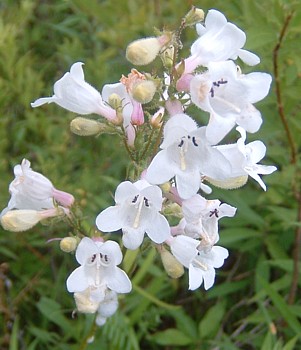
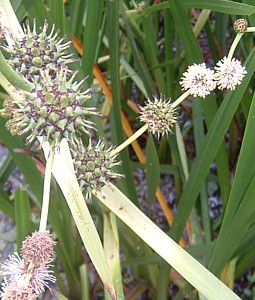
This common flower is clustering everywhere this year. The other attraction along the dam is the ferocity of the burs. I think it is early in the season to see such a ball and chain display.
Going down to the Lost Swamp Pond I was careful not to scare the beavers out of their bank lodge. So I gazed at a few placid geese in the distance, how graceful and quiet they are at this time of year seemingly too shy to even eat. I was pleased to see a kingfisher and hear its chatter. That's a token that there is otter food in these ponds. Then I began seeing muskrats, and one wake at the far northeast corner on the pond seemed to be made by a beaver -- or so the head above looked like through the monocular. But I saw no more commotion on the shore it swam too, save that made by a preening duck. I'd expect a beaver to make a few more waves. On hot humid days the deer flies have a tendency to go straight for the sweat behind my knees. So I moved up on the rocks across the mossy cove from the bank lodge. I could put my legs flat down on the rock, and the wind was more refreshing higher up. Just as I sat down I saw a muskrat swim out from the lodge and promptly dive. One winter I learned how extensive the burrows are in the point of rocky land behind the lodge, so I can't say that the muskrat was living with the beavers in the lodge. I never saw the muskrat surface in the pond. However, just as I was about to leave, a muskrat swam into view and promptly dove into the lodge. I waited with camera ready for it to pop out again, but it didn't.
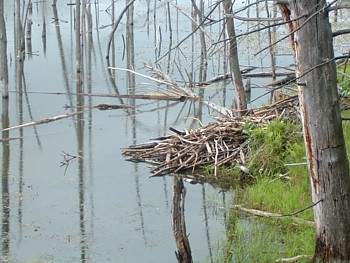
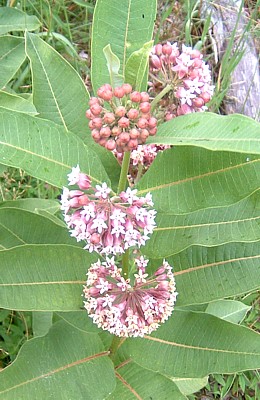
I walked around the pond and ascertained what I could tell from a distance -- no otters had been through. The north slope of the pond, as usual, had some early milkweed blooms
and some of the plants along the trails in the grass, possibly made by any number of herbivores, had been nipped. I suspect deer do that. Some dogbane looked cut and dragged down, so blame that on muskrats or beavers. I sat at my usual spot, though it was down out of the wind, but I thought I should at least wait for something dramatic. A rather brown osprey flew over me, but that didn't count. I had heard some flicker calls as I walked down to the pond, so I wasn't completely surprised when a flicker popped out of the nesting hole in the truncated dead tree standing in the water in front of me. It was quite puffed out with bright feathers, so despite its full plummage I took it for a fledgling new to the flying game. It latched on a tree like it wasn't sure how to do it.
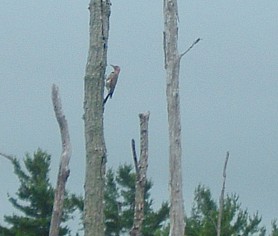
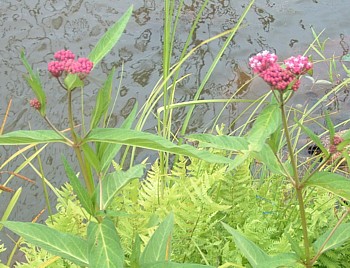
And it eagerly answered the wucka-wucka call of another flicker. Then that bird flew expertly to the top of the tree and pecked a bit in the rot there -- planting insects just caught? The awkward flicker eventually made its way up to the top and its provider quickly flew off. That's a nice story and perhaps true, but the seemingly inexperienced bird seemed quite diffident about pecking where bugs might have been left. Then it flew off in the same direction as the other bird went. A few minutes later one of the flickers flew back and quickly ducked into the nesting hole. Just as before when I saw flickers here, the swallows enlivened the air over their more stolid show. A steady drizzle kept me from capturing any of the flicker activity with my camcorder. On my way to the dam I noticed some blooming swamp milkweed, which is less seen on the island.
Then I noticed the patch of cattails below the dam, and with the black base of the flowers, these cattails looked different than the ones on the Big Pond dam.
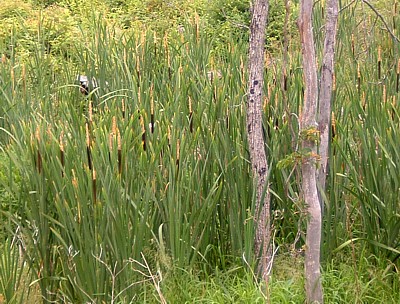
With the drizzle picking up, I didn't linger down along the Upper Second Swamp Pond. Looking down the Second Swamp Pond it seemed the beavers had made a path down it --
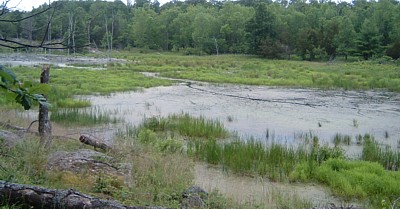
given that there were so few geese and ducks around. Down at the dam I admired a large patch of the white flowers
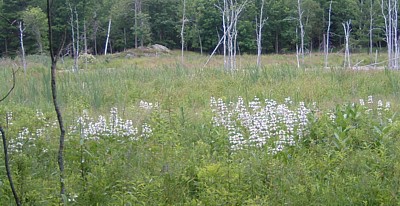
and then was struck by a dead fern up on the round rock beside the dam. Here the yellow seemed more like a result of living life too fully rather than simply not getting enough water.
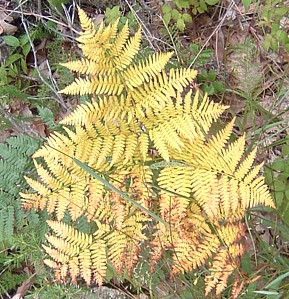
I got the same impression from a circle of moss -- too much water.
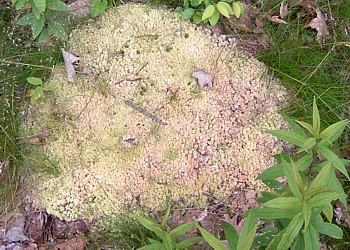
The patch of possible chanterelles that I saw here before was bigger.
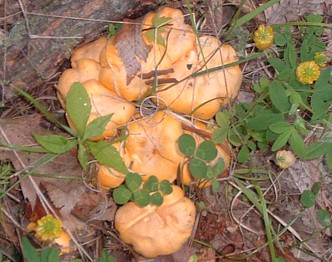
I picked one of the mushrooms, but it didn't smell like a chanterelle. I could have easily spent another hour equivocating over all this fecundity, but the rain, half the cause of it all, started coming down heavily.
June 28 I was floating down South Bay in the kayak at 8 pm, and made a feint over to the south shore thinking to come up on the willow latrine with the southwest wind in my face. There under the largest willow on the south shore I saw an animal about the size of a small otter sniffing around the concrete and vines under the willow. Last year I saw otter pups left alone about this time a year, but in a more charming spot. Then a tail cocked up and it was a little fist of spines, a baby porcupine that slowly walked up the bank sniffing all the way. The yellow heads of the spatterdock are up but a lot more white lilies, most closed up for the evening. So the beaver's munching is not putting a dent in the water lilies. I tried to make a study of all the water lily rhizomes pulled up by the beaver. A collection of three or four mushy brown tuber-like stalks were floating together in several spots. I picked a few up but could not see how it might be connected to the others, or exactly what the beaver is eating. Getting close enough to see how a beaver manages this will be a challenge. Of course, I kept looking at the willow latrine but saw no otters as I was distracted by a kingfisher, then an osprey. A Caspian tern in the distance was the only one getting fish. There seem to be less herons. As for the insects, there seem to be more damselflies than anything else. When the sun went down the green frogs began making their banjo sound, maybe a half dozen along the edge of the marsh. The carp are still about, but not splashing as much and I think some of the smaller splashes were made by frogs. The only excitement at the willow latrine was first a fast moving family of raccoons going up the rock a little to the west. I try to be optimistic when I am tracking so I wondered if an otter might have made then hurry away. But no otter appeared. Then there was a splash just off the latrine not unlike the splashes I saw an otter make there a few nights ago. I paddled closer, but no otter materialized. When I got up to the willow my probing under the tree was cut short by the sight of a kingbird sitting on a nest out on an end of a limb, and truly her black and white head struck a noble pose. I was rather close and she didn't deign to notice. I paddled around to the north cove, making a short zig zag to convince a mother duck that I meant no harm to her three ducklings. One little one, at least, kept nipping at bugs, not at all afraid. I kept close to the shore and when I got to the latrine the otters sometimes use that is in the marsh between the two islands that form the point, I saw that the tall grass was bent down. I got close enough to shake the grass and that won me a nice whiff of otter scat. I could see black stains on some grass stalks. There is a nice rock behind this front of tall grass. I'll have to get over in the boat so I can get out to check it for fresh scats. Walking the next day, I took a photo from the opposite shore.
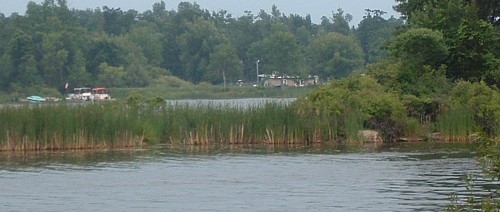
I suppose it makes sense for the otters to move out to be near deeper water to make their latrines. The shallow areas of the bay are getting choked with vegetation. However, I can still paddle all the way to the end of the cove, and I did, and only disturbed a few carp. Back at the dock I bumped in the that mother with three ducklings again. And as I walked away, I heard a suspicious splash. Probably carp but it may have been the beaver, but it was too dark to see.
June 29 I headed off in the late afternoon to check the East Trail Pond for otter signs. This is the second summer after the beavers didn't repair the dam breached by otters and I expected that this summer the otters would totally lose interest in the pond. However, for several years this pond was the nursery school for otter pups and I've had some of my best viewing of pups in July and August here. I hoped to hear a scarlet tanager in the woods on the way, but the one song I heard was too far away to stand around and gawk up at. Because of both the plentiful amount of rain this season and the grasses clogging up more the of the holes in the dam, the East Trail Pond still has a large pool of water and the sight of a raided turtle nest inspired me to take a photo showing that the water is still of service.
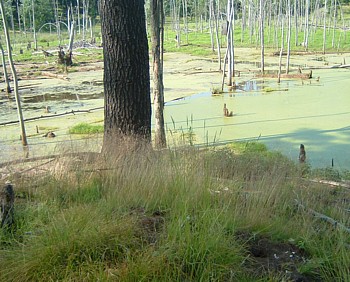
And from a slightly different angle the pond looks like it has supported some hungry ducks at least.
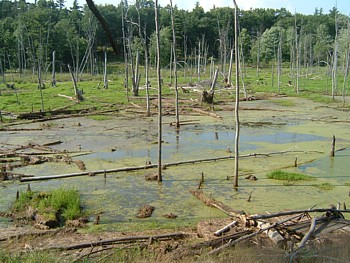
Turning toward the dam there is a carpet of green duckweed,
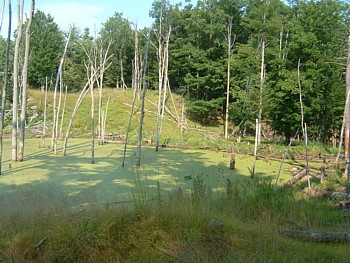
and looking down at the old pine tree and the bank lodges where I once saw otter pups, there is a carpet with a good portion darker green
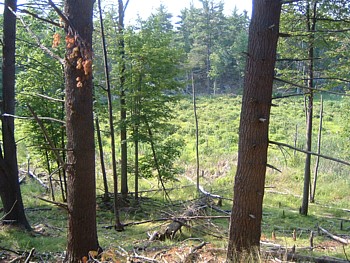
not all bright green grass that graces a generous layer of mud at this time of sunny year. But I can still dream. There may not been many fish in this pool and meadow but frogs will abound and all kinds of huge insect larva. I went on along the East Trail and then moved off it to check on Thicket Pond. I didn't see any fresh beaver work and the pond water didn't look muddy, but as I looked out into the canopy of buttonbushes
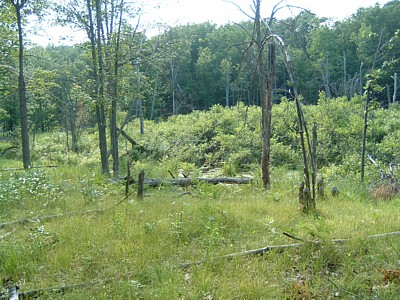
I heard splashing too loud for a frog and I new that there were no carp here. When I got to the dam I saw the muddy pool of water behind it
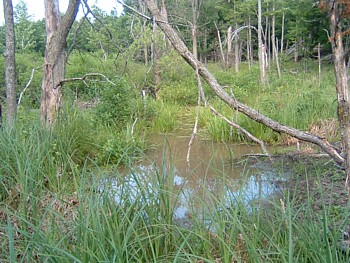
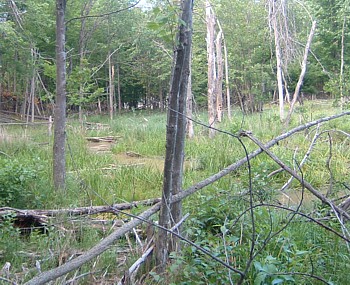
and then a muddy canal reaching back around along the north shore of the pond
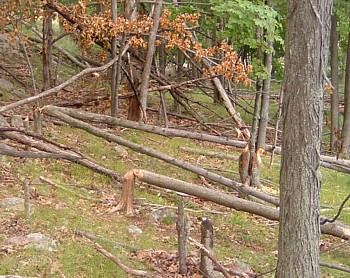
In the distance I could see fresh beaver work
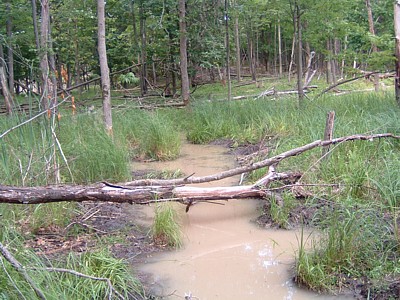
and going toward that work, not only did the canal look wide and well dredged but the beavers had fashioned a little spur for their convenience.
This is the third time I've seen beavers come back to this small pond, and evidently thrive. I kept looking for a beaver that might have done the splashing but didn't see any. The red oaks and maples they take every time they live here can't alone account for the beavers flourishing. I used to think they ate the buttonbush roots, but those plants continue to thrive. There was a path down to Meander Pond and though not wet it certainly had not been grown over with grasses.
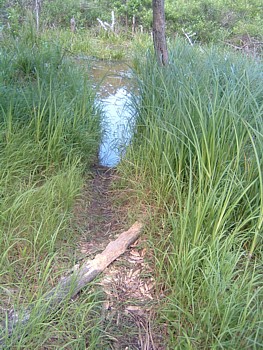
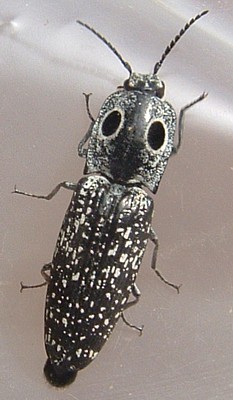
Meander Pond was not muddy so if the beavers are going down there, their visits must be brief. This is after all the season for beavers to wallow. I crossed over the granite ridge to get down to South Bay and took a photo giving a distant view of what I suspect is the otters' current latrine. Meanwhile, at the land, with the help of friends and family, we got the long back 28 foot wall of the house up. I take as a good sign the visits of the more exotics insects to the site, and this eastern eyed click beetle's visit is most notable.
by Bob Arnebeck
Check out my other web pages: otters; beavers; minks; muskrats;porcupines;Leslie's art