June 2006
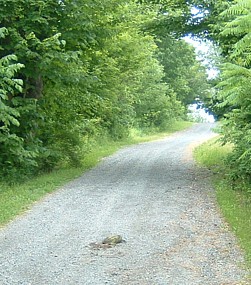
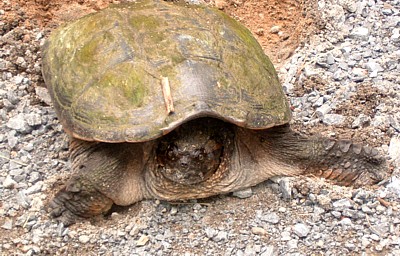
June 17 muggy but relatively cool, cloudy day. I could wear a long sleeved shirt and so went down to White Swamp where I expected the bugs to be fierce -- deer flies are about. I had to pause on the way to consider the efforts of a snapping turtle making a nest in the middle of the road.
It looked like she was at the point where she was about or just had dropped some eggs,
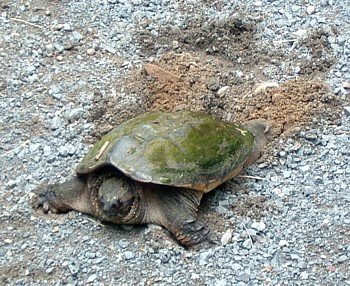
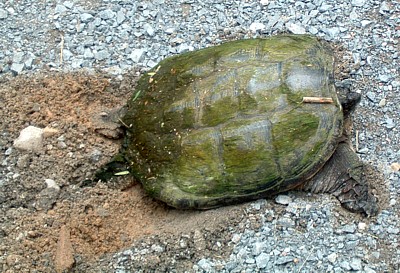
but when I thought I saw something drop, I realized it was just her back leg working digging down into the hole.
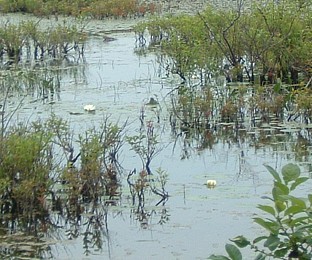
I'm not sure why turtles lay their eggs in such exposed bits of terrain, but I don't think it is for my viewing pleasure, so off to White Swamp I went. The flies and mosquitos were not bad at all. The main impediment was the vegetation. This is the best growing season in the twelve years we've lived here, and the gullies down to the swamp are always lusher than our land. The grasses had just about grown over the trails up to the otter latrine I've been watching, and there was no signs of recent otter visits, nor any recent beaver activity either. But the beavers have an excuse, the vegetation in the swamp has greened,
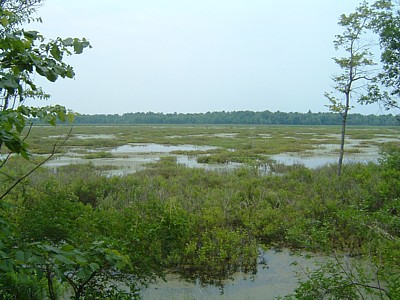
and I could see quite a few waterliles all around.
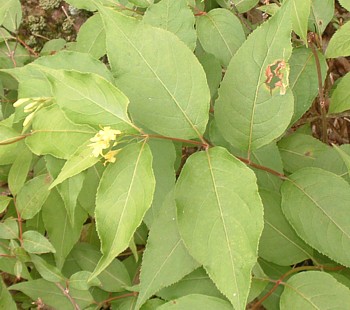
On the shore I noticed a clump of that low honeysuckle with yellow flowers.
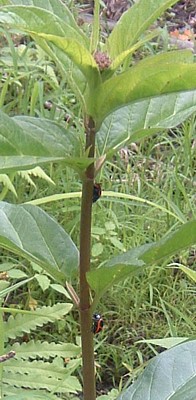
Then I walked along the ridge down to the inlet where I saw two milkweed beetles on a swamp milkweed.
The mounds and islands in the inlet that made it easy for me to see if otters or beavers had been through are quite different now. I guess the little mound of mud that remains suggests that beavers still mark there. Where otters liked to mark is all grown over.
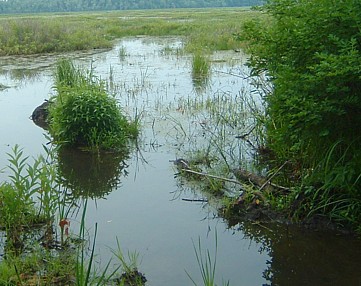
I did see signs of a recent beaver visit along the shore of the canal.
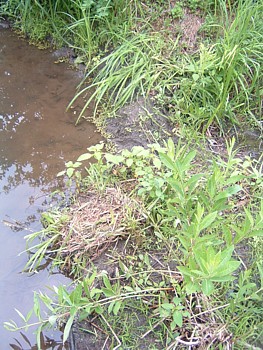
There were signs that beavers had been up behind the dam in the muddy pond. The collection of branches on the dam seemed fuller
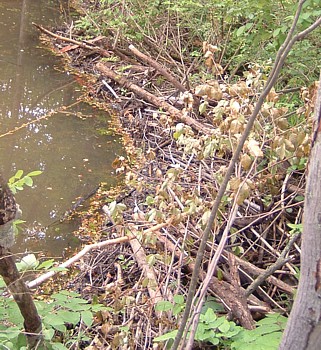
and some saplings of a nearby tree had been freshly cut.
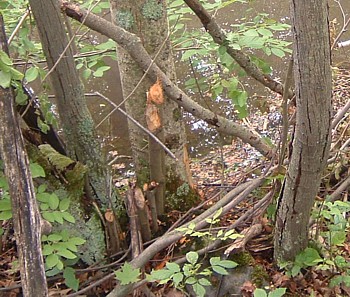
The large ash in the middle of the pond still stood, but a small tree nearby was cut and a tree back on the bank, cut and pretty well trimmed.
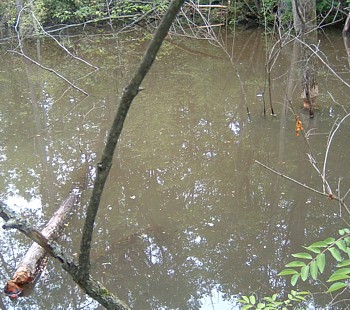
I still got no inkling of a beaver lodge or burrow here. It was difficult fighting through the tangle up the creek. I did see some beaver work, on a red maple, not their favorite tree.
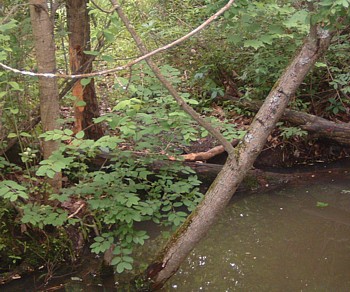
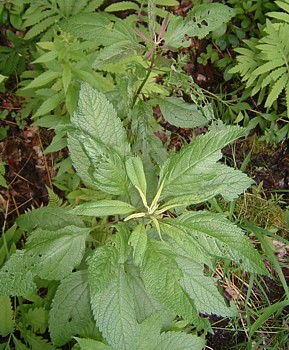
But little else. Then I went with the flow and enjoyed the lush vegetation, careful not to touch the big plants that I feared were nettles.
When I got back to the road, the turtle seemed to have made progress. It looked like she had just covered the eggs with dirt, though she was in no hurry, and hardly reacted to my nosiness, just a twitch of her nose
I checked the Deep Pond, nothing new and the dam still leaking, and I chronicled how low the water is in the Third Pond. There is still a pool of water behind the dam,
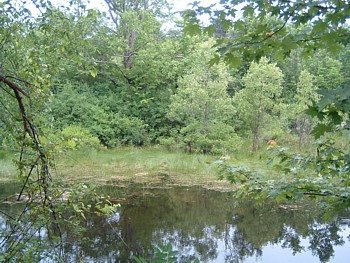
but only a narrow channel back to the burrow that both the muskrats and beaver seemed to favor.
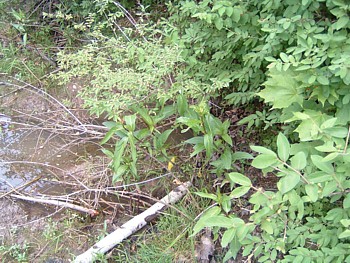
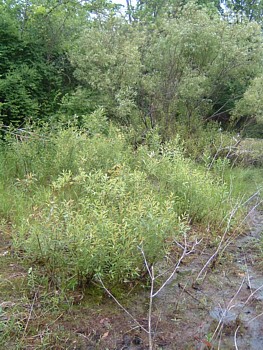
Despite the beaver's foraging, the clumps of willows continue to erupt.
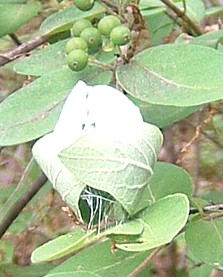
Up at the Teepee Pond, I saw a cocoon
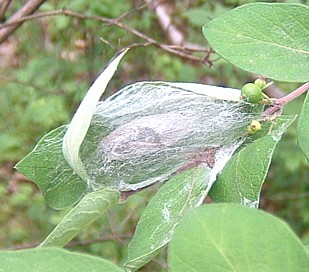
wrapped in leaves.
June 18 I woke up at 4:30 and was surprised by a light south wind which made my paddling over to South Bay livelier. As all my neighbors slept, I soon had the wind at my back. The moon was still up which evened the light throughout the sky diminishing the hint of a ball of fire rising in the east. I could see well enough and fancied the dimmer light afforded me a bit of cover as I drifted down along the boat houses where I last saw an otter. There instead were the silhouttes of over twenty geese and I could see three sizes. Certainly no bumper crop of goslings, they made up a third of the flock and recalling all the geese that I had seen flying in large flocks over the river, it was a quiet father's day in goose world. The increasing light to the east made it easier to see silhouettes on the bay -- a few mallards. I paddled gently over toward the north shore so that I could see down to the end of the north cove of the bay, and I began to see green on the north shore. A few herons had flown over me in the gloaming. Now I could make a sport of seeing how many herons I could see at once -- usually three. Down in this shorter cove I could see the carp leaping and at the far end some thrashing. I had nothing better to do than to doublecheck to make sure what I first took for flapping ripples wasn't the more dynamic wake of an otter. With the light came a few common terns, no Caspian terns today. Rather than drift to the end, I paddled back to the south cove. A mosquito tried to get a bite, otherwise the midges were quieter and no deer flies out yet. The north shore of the south cove is the best for heron watching, as they seem to more jealously guard their perches on the rocks and trees overlooking the shallowest part of the bay -- really a shoal formed by a large flat granite plane -- less mud for bullheads to hide in. I followed some mallards who were feasting on bugs they found on the surface of the water, a pastime that seemed to make them more mellow. When I got close they did not panic, just swam to shore and preened their feathers. I continued to check the carp splashes and that's when I saw the otter swimming toward the willow latrine. It dove, but was soon up again, and then treated me to some rhythmic foraging, It didn't seem to catch anything, tended toward the marsh below the willow latrine and disappeared. Mellow as all nature seemed, some carp excepted, my mind was racing. This is exactly the spot I saw what I thought was an otter some two weeks ago. And that large wounded bullhead, that I credited the heron for catching, was right in the path of this otter. Most important, unlike the otter I saw around the boat houses, this otter was quiet. Then I saw it foraging again even though I was closer. Sitting high in a yellow kayak with the dawn in my face, the otter must have seen me, and I thought it did. Here again, no sign of panic and as it swam into the marsh this time, it swam head up. All to say, this may well be the mother otter catching breakfast for her charges parked deep in the marsh. The other alternative was that this was an otter making rounds, taking a shortcut to the north cove. So I went the long way around the point and parked myself in some vegetation and waited. No otter appeared. Then I checked the rock on the south shore of the north cove to see if there were any new wrinkles in the old otter scent mounds. I couldn't see any, but I got a whiff of fresh scat. Satisfied that the otter wasn't touring, I paddled back to the south cove to make sure it wasn't fishing out there again. No. So I went down to the willow latrine and then peaked into the channel through the willows that the otter took. With day upon me, I set off to check the latrines on the north shore, but paused when I saw a redwinged blackbird hopping high in a tree, not its usual playground. And there was a huge osprey slightly flicking its tail at each attack, and once or twice half looking over its shoulder. The blackbird then jumped up on a branch in front of and above the osprey but still could get no reaction. Then it flew off. There was nothing new at the latrines, save for a fox walking between them -- perhaps the same fox that seemed to check the latrines as much as I did during the winter. Going back to the yacht club dock, I saw the geese again, and this time noticed one fledge still a big ball of yellow green fuzz.
June 19 rain moved through mid-day and I headed off to the South Bay peninsula with the last rain drops. I had the great notion that this year's otter family was in the marsh just east of the willow latrine and that with the rain ending they would be in the marsh if not in South Bay looking for something to eat. I walked slowly along the south edge of the woods until I saw what might be a trail in the grass fringing the marsh
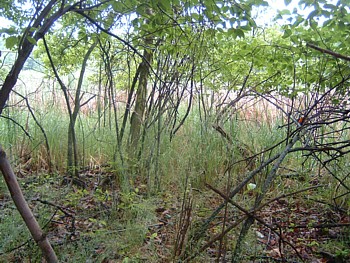
I sat on a rotten log, it broke, found another, and cupped my ears trying to discern something mammalian amidst the squeals of redwinged blackbirds and chatter of swamp sparrows and warblers. Hearing nothing, I checked the other edge of the woods. Certainly there were good sight lines to other otter latrines, the old dock
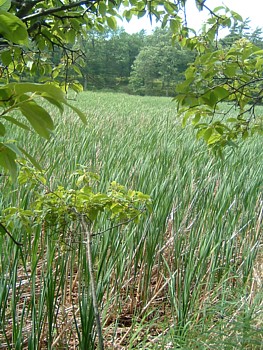
and the rock where I continue to see scats.
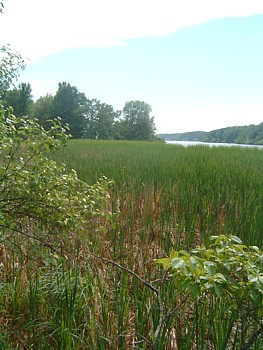
However, this year these portions of the marsh are dry. There were no trails, let alone scats that I could see. I turned back and took a photo of the woods
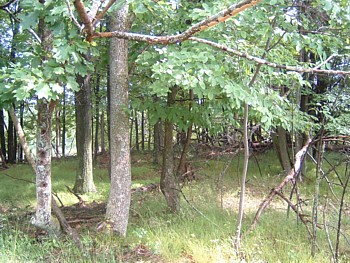
and then headed for the willow latrine, careful to check any muddy trails for prints, and saw only deer hoof marks. The wind was coming from the southwest which meant that as I went out to the willow, I spread my scent throughout the marsh I thought the otters might be in.
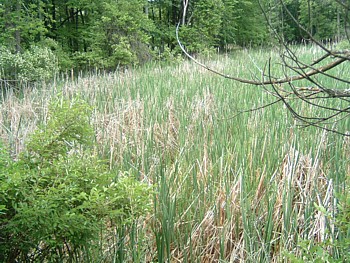
But it couldn't be helped. The rocks above the marsh had no scats and the low tentacles of the old willow seemed to make for so many finer dens than a dry marsh could afford.
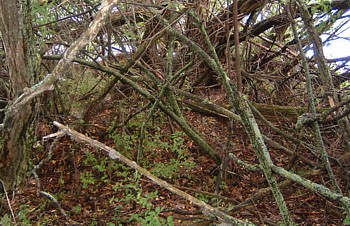
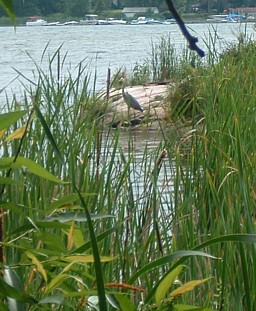
As usual heron were perched on the rocks along the nearby shore
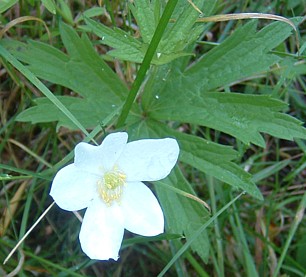
I could see that the water was higher by a few inches, thanks to the recent rains. There looked to be nothing new on the lodge. As I crawled over the willow trunk I saw nipped branches on the ground, probably thanks to that porcupine I saw last time I was here. I looked along the water and saw nothing, then I began to smell fresh otter scat. At their old latrine the blue flag iris and wood anemone reign.
But it didn't take me long to find it, generous dollops of loose scat
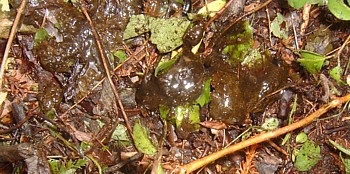
in a nice little latrine just up from the water but far enough back in low vegetation to afford some cover.
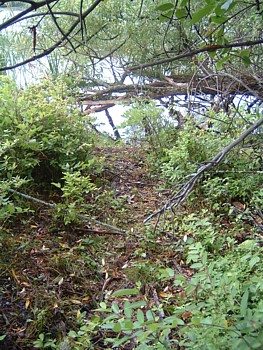
I decided to sit on a log in back of the latrine
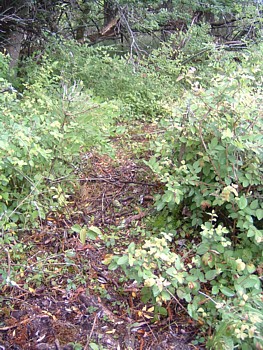
on the chance that otters were still out in the bay foraging and might come back to the latrine. And so I had a pleasant sit for an hour or so. No otters came, but twice a yellow throated warbler jungle-gymed through the tangles
and the redwing blackbirds seesawed on the high cattails. Occasional carp splashes kept me alert. I did get a view of the opposite shore where there were large willows
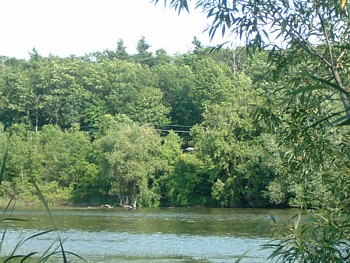
and on the way home I decided to check them out. The Thousand Island Park corporation did a number on the south shore of South Bay, pushing concrete and ash out into it for several years.
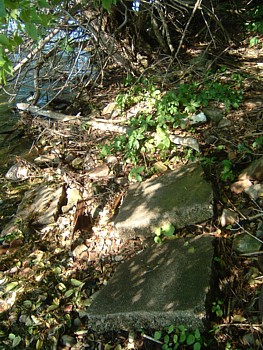
What marshes that were there were buried. Now the ash project is dormant and virulent plants cover all.
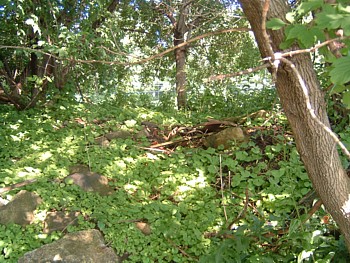
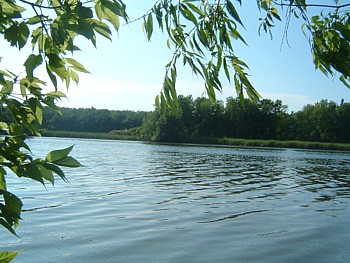
But I wouldn't put it past otters to find a den in the jumble. I thought I smelled some scats along the shore, but couldn't see it. And looking back across the bay, no doubt the large marshes on the north shore looked more inviting.
June 20 another mid-day shower cooled my heels. Then after dinner I took advantage of the light north wind pushing a cold front through and went in the kayak to check the south cove for otters. The one I had seen seemed to have crepuscular ways, and it didn't take me long to see it -- just after 8pm (on the longest day of the year.) As it did in the morning, it fished in the water around the willow. But this time instead of swimming into the marsh, it swam to the willow. I must say looking at it in the binoculars, I was impressed at how small its tail was, a good indication that it was the one year old otter and not the mother. I lost sight of it for a few minutes. Then when I saw an otter again, it seemed to act differently from the first one I saw, making shallower dives and swimming faster. It went to the willow too and it seemed to swim into the edge of the lodge. The general light was still revealing but the willow cast a large shadow, and so I got confused impressions as I watched the splashes around the willow. At one point I fancied I saw a small otter climbing up on the back of a large one, but it could very well have been the otter's tail curling up! Then I thought I saw two humps below the moss under the willow and at the same time splashing a little off to the side, which would mean three otters at least, or was it just the tail of one otter hanging back in the water. I have been in similar situations before and the only thing to do is be patient and wait until I could count heads. But for the next ten minutes or so, all I saw was one otter head, and one whole otter, as it climbed up on the bank along side the lodge. I saw it catch at least two fish. The first it ate promptly, but the second seemed to linger in its mouth and then it dove, I am pretty sure, into the lodge. So maybe there are pups in there. Again, I heard no chirps or snorts. Perhaps tomorrow evening I will drift in with the boat so I can safely take my camcorder. I paddled over to the other cove to make sure an otter didn't surface there. I did see a heron fly in with a small fish and land on the otter's rock latrine. Fishermen nearby weren't getting bites, but everything else was. As I first drifted into the bay, I saw the geese resting along the north shore of the cove on the rocks and back in the vegetation. When it began to get dark, around 9pm, they all swam over to the shallows near the yacht club dock and there they were not bothered at all when I got out of kayak -- a heron was though, and gave me a good squawk. The rain shower and north wind seemed to subdue the flying insects. Carp are still jumping.
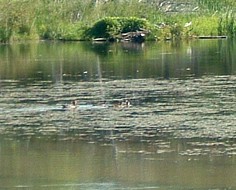
June 21 the morning clouds moved off just as I started my morning hike. Out of respect for the dew, I went to the Big Pond via the first swamp ridge, and still got rather wet as I waded through the high grasses and honeysuckle on the way to the dam. You pay for not making deer trails your trails, but the deer rush head long into the thickets and I try to skirt them. As I came up to the dam, I scared the wood duck family, and this time, the ducklings sped ahead of their mother.
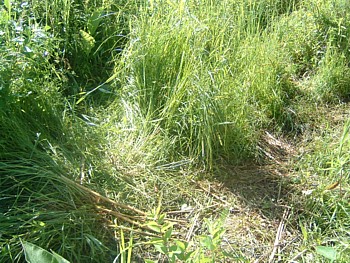
Then I admired the paths the beavers have made in the grass
and their growing collection of things to nibble.
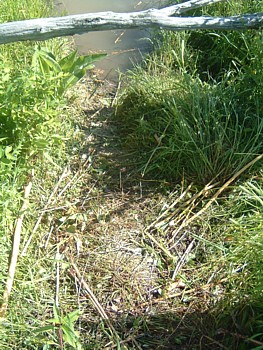
I sat for ten minutes and saw one goose at the upper end of the pond, not a ripple from any muskrats. So I crossed the dam and chronicled the beavers' efforts to keep the water level high. I fail to see how a line of thin saplings will do much
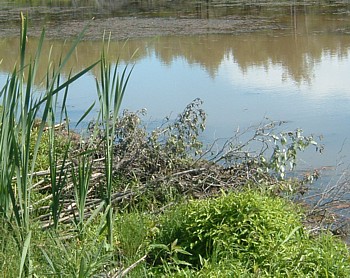
nor for that matter what a puff of pond vegetation will do,
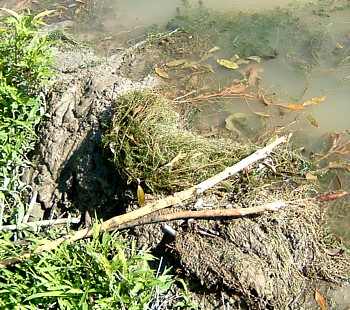
but under all those flourishes was solid mud. Their dining area pressed into the dam continues to be used,
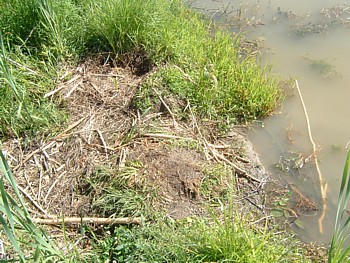
but the next one down, where I had seen the beaver sit and preen, has more muskrat poop than beaver left overs. The beavers are concentrating their activity at the south end of the dam. The canal at the north end is as clogged with vegetation as I've even seen it, but the mud in the water suggests that muskrats might come through to the burrows there.
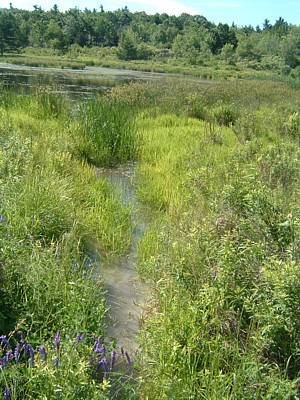
As I came down to the Lost Swamp, I saw a muskrat swimming into the lodge in the middle of the pond, and then when I sat on my rock above the beaver bank lodge, there was a great heave into the water and I saw two bubble trails. But before I saw a beaver surface, a muskrat swam onto a branch floating in the water nearby.
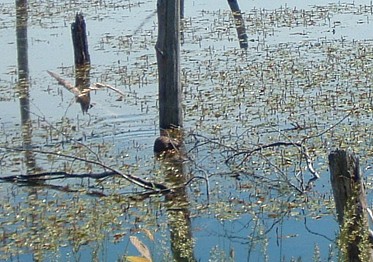
I have never scared a muskrat out of a burrow, and doubted if it was a refugee from the bank lodge, but... Then I saw the beaver that did escape from the lodge, swimming out near the lodge in the middle of the pond. However, it soon swam back to the bank lodge, and though it ducked its head into the water a few times, it couldn't reconcile itself to eating again and dove back into the lodge. Then I saw another beaver swimming toward the dam, and thought it highly likely that it was the first beaver I saw. However, it too swam back into the lodge. Of the five lodges in this pond, this one has the most shade and so I thought some of the beavers at least moved into it for that reason. As I stepped around to take a photo of the bank lodge
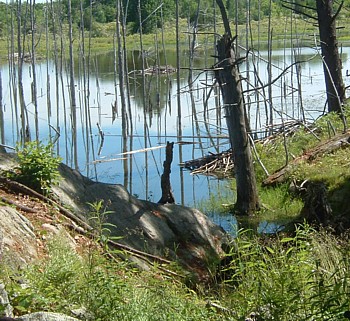
I saw another beaver swim toward it, and then another! So evidently most of the colony moved into the lodge. This was gratifying to see because there are no signs of beaver work around the pond. Every year I assume the beavers are just eating the grasses in the pond, but to prove it I have to sit out until dark and come just after dawn. Today, thanks to a heavy step near the bank lodge, I had seen four beavers. As I walked around to the north shore of the pond, I took a photo of the otter latrine, which is now all overgrown with grass.
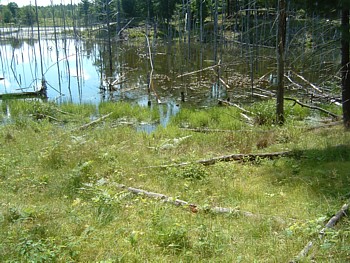
I'll have to check my notes, but this seems to be one of the longer intervals between an otter visit, especially in recent years. As I walked up to the dam, I did see trails in the grass, certainly not from otters, and I couldn't be sure it beavers or muskrats made them. Perhaps both because one trail was rather wide.
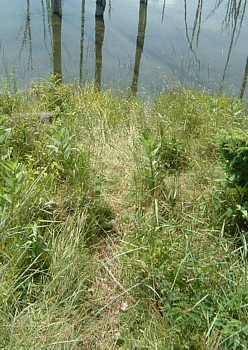
Geese are another possibility but they usually leave poop behind. None of the trails led to a turtle nest. I was debating about whether to lounge in the grass or not and see what might happen next -- I had seen three muskrats here and there around the pond, and I was curious if their days of squabbling over territory were over, then I saw another beaver, a yearling, swimming toward me from the far side of the dam. Its fur was very red and dry on top of its little head indicating that it had been high and dry while the other four beavers were swimming around. The little guy swam right below me
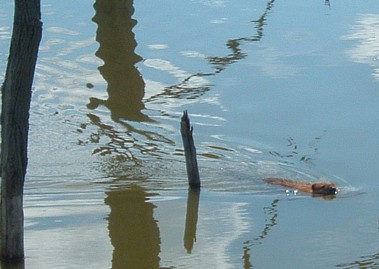
then turned and slapped its tail, but not to flee. It studied me for another ten minutes, and I got to study it. I could see its back feet paddling, and also its tail propelling it a bit as it steered with its tail.
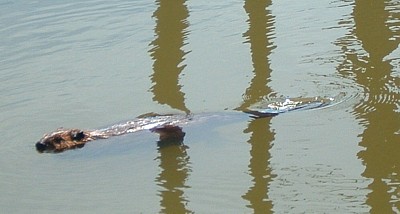
And I couldn't help but notice the torpedo shape of the body, which seemed surprising in a beaver so small
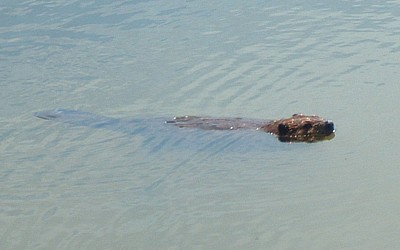
And there were twists and turns that made gentle eddies on the pond surface
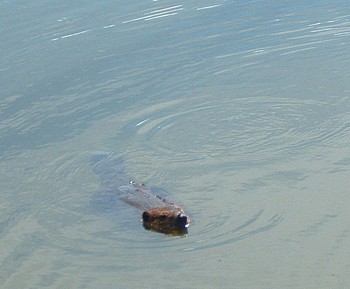
though I must admit that when a large beaver poses like a log, its breathing can make ripples and a twitch of the tail can make waves. Yes, an otter shows complete mastery of the water, but a beaver can seem completely at one with the water. Then as always with beavers, after a display of such aquatic delicacy, it was once again all engine ahead full
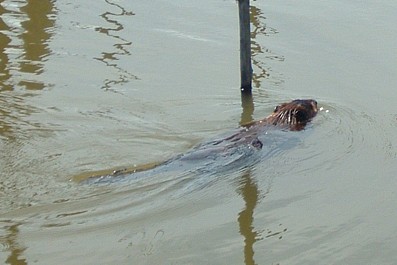
another tail slap and away to the bank lodge. So I disturbed five beavers, not bad for a morning's work. And seeing the dry yearling meant that I could not blame myself for getting the beavers out in the pond. One was already about. So, were some out in the Big Pond, but off in its many grassy corners? I left it to the Upper Second Swamp pond to decide that issue, because the beavers there have been out during the day. I sat for a bit, and saw not a hint of any being out, but I couldn't see the grassy upper end of the pond. Then at my feet I heard a noise so close and persistent that I checked my camera bag to see if any of the equipment was acting up. I had already seen a chipmunk nearby, and when I looked a little beyond my camera bag, I saw an eye and an ear far enough out on a rock to get a look at me
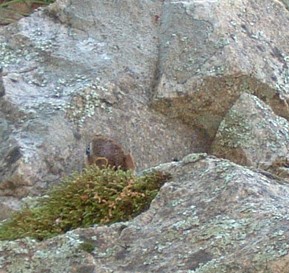
A good year for chipmunks. I only saw a pair of mallards on the Second Swamp Pond, and then I encouraged myself to pay attention to the ponds below, so diminished in their glory, by reminding myself that a mother otter might find them to be just the place for her pups to literally get their feet wet. But reality would have nothing to do with my supposing, and I headed home.
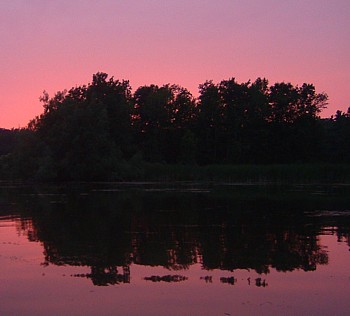
June 22 I went out in the boat after dinner, with my camcorder, hoping to see the otter or otters in South Bay. A southwest wind blew me down the bay passed the willow latrine, so quietly that I got within twenty yards of a perched heron. I waited from 7:50 to 8:45 but saw no sign of an otter. I did see a carp jump a foot in the air where I wanted an otter to be. As I rowed out I took some pleasure in a pink glow behind the willow grove latrine,
then I noticed something swimming behind me and going fast. Not an otter, but a small beaver bound for the end of the cove. I had to try to follow its progress in the growing dark with the binoculars and soon saw a white lily in its mouth. Strange that it didn't den closer to the lily beds -- but perhaps the otter's use of the beaver lodge at the willow latrine precludes that. As I left I saw the beaver working on a rhizome. Tomorrow I'll go by foot to the willow latrine and see if there are more scats, or any signs of beaver work. I still think I am going to bump into this year's pups around this marsh.
June 24 got out on South Bay in the kayak by 5am and paddled hard for Picton Point, hoping to see otters there and then get back to the south cove of South Bay to see the otter or otters there at their usual feeding time. Fast as I paddled I seemed to be accompanied all the way by beige mayflies bouncing just above the water. By the time I got to the Narrows the sun was up, and there I thought I saw a head in the water. I stopped and studied the wakes and soon saw that I was seeing fins -- perhaps bass who find this area congenial. There was a light north wind so Eel Bay was not an easy study. I paddled straight for the otter latrines thinking how amazing it would be if I saw otters scampering up and cavorting on those rocks. I didn't see anything by the brightening sunlight. I've never seen an otter in the bay south of the point, so I paddled along the edge of the old quarry, now a jumble of granite extending in many places to the water. This is where I always see otters on the rare occasions that I do see them. I paddled down about 100 yards and an otter's head popped up 20 yards in front of me. I quietly put on the breaks and soon saw another otter further off shore. I was hoping they were heading west, away from me, as they dove in and out of the water. Then one surfaced closer to me, quite a big otter and when it floated, I should say where he floated, because a female would most likely be raising or helping to care for pups at this time of year, he cocked his tail up so it seemed to float on the water. Then I saw a third otter, or so it seemed. I put down the binoculars to see if I could see three at once, and I did see one after another, one near the rocks, one 20 yards out and one a bit further out still and closer to me. Two surfaced together and went toward the rocks and began chirping, which I thought might be a reaction to me; then they did some purring, which is not usually given in alarm. They both dove and then surfaced swimming toward me. One had a small fish in his mouth. The sight of me prompted them to start snorting and they swam into the rocks. The other otter, the largest, had been further out in the river. Now he joined the others, snorting along with them. I assumed this was a group of three males, likely the group of four I've seen other years, minus one. Then I saw a little brown thing run from a tree trunk on the shore toward where the otters were. But it wasn't an otter pup. A handsome dark brown mink was soon posing on the rocks not far from the otters. Meanwhile, the large otter periscoped up and craned his body to get a better look at me, soon had enough and after a big splash, I saw and heard no more of the otters. The mink headed west and I lost it in the rocks. So I was pleased to see what I expected and following a ribbon of sunlight on the rippling water I hurried back to South Bay, hoping to see an otter there. When I got there it was well after 6, about the time the otter finished feeding when I saw it here a week ago. But due to the chilly night the cove had a layer of mist over it, and the mayflies were still bubbling over the water adding an aura of expectancy. I waited about twenty minutes for an otter to appear, and only saw several jumping carp, a couple Caspian terns, and a posse of blackbirds chasing an osprey across the bay. Then I went over to the willow latrine and saw a raccoon walk up into the otter latrine there. I also saw the bones of what appeared to be a carp. The raccoon moved over to the beaver lodge and I was about to try to catch up to it, when I saw a kingbird fledge sitting on a willow branch looking a bit confused. So I backed away and let the raccoon go about its business. As I paddled around to the north cove I caught one of the insects gyrating just above the water and was surprised to see that it looked like a small moth. Picking through adjectives to describe what I was seeing I had considered "moth-like", so.... Then I looked more closely and could easily see two long antenna on each of the fluttering bugs. So I caught another and this was one was slender, with thin wings and long antennae, moth-like as it fluttered but not a moth, a mayfly. Meanwhile the osprey came back, unattended, and flew to its usual perch high above the marsh but a blackbird was immediately back on its case. As I paddled under, the osprey flew off with the redwing on its tail. I only saw carp in the north cove and not even a hint of activity around the latrines the otter has been using. But I did see two slight trails in the grass up into the old dock, where I have not seen otter scat for some time. So a land tour of these latrines is in order, and hopefully I will find a very fresh scat at the willow latrine. My optimistic projection is that there are three male otters a Picton, a lone juvenile working the boat houses, and a mother raising a family in the marsh along with a juvenile female helper. Maybe, but there were at least three otters out this morning.
After 5 pm I had a chance to check the willow latrine. I poked a stick in the hole on top of the old beaver lodge there, which gave me a strong whiff of otter scat. But the photo I took didn't show any major pile, just perhaps some fresh scat on the bottom edge of the photo
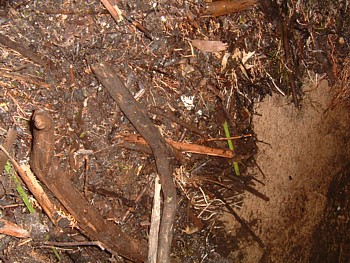
Then I checked the grass beside the lodge where I saw the otter go up on two days ago. I saw old scat, and perhaps something fresh, but not the exuberant display of fresh scat I was hoping to see.
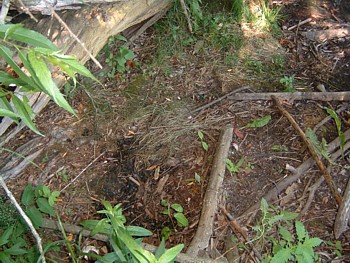
I didn't see any fresh raccoon scat either. Then I studied the carp remains, headless and picked clean.
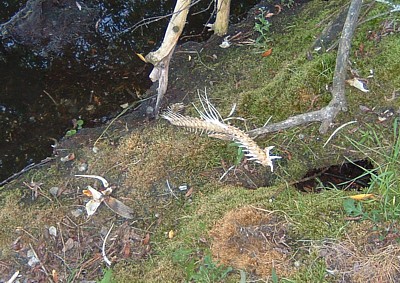
The lively looking fin was an indication of how quickly this carp had been eaten.
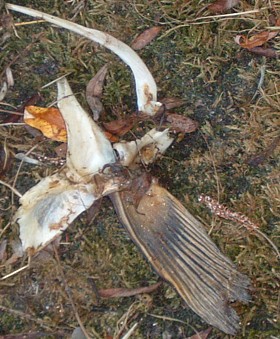
There were more bits of it in the hole in the moss but judging from the photo I got after putting the camera in the hole, there is no great pile of bones or scats under there.
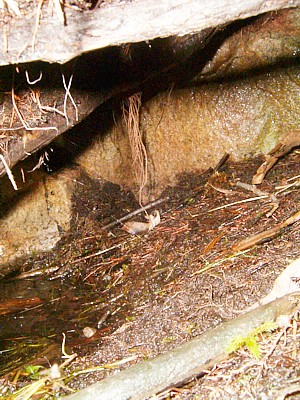
Then I checked the other latrines and even sat for ten minutes at the old dock latrine, but there was nothing new to report. No fresh scat. I'll keep coming out here at dawn and sunset when I have a chance. I took a peak at Audubon Pond and came upon some birds trying to chase a mink away. The mink came toward me so I think the birds were motivating it, then the mink disappeared in the tall grass. No signs of fresh beaver work, but this is their season to eat the pond vegetation.
by Bob Arnebeck
Check out my other web pages: otters; beavers; minks; muskrats;porcupines;Leslie's art