June 2006
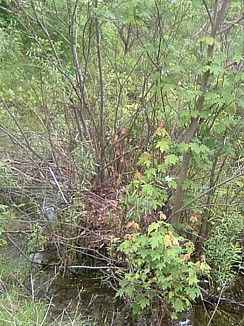
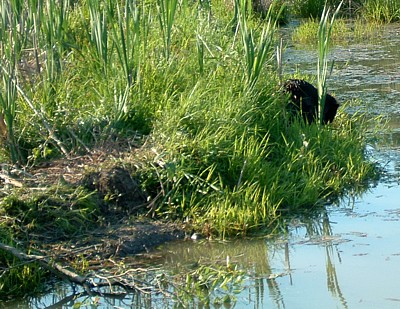
June 1 rainy day but I got a brief look at the ponds at the land, trying to figure out what the beaver has been up to and whether the muskrat babies are out. The beaver certainly has taken more of the willow saplings from the clump above the muskrat lodge.
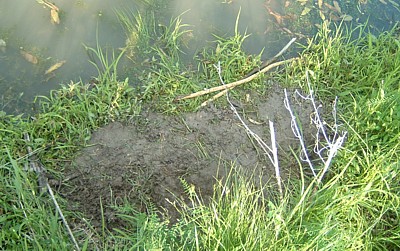
There is another small mud scent mound on the nearby bank.
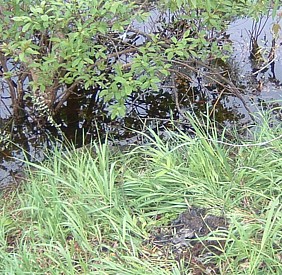
But despite the rain, this pond loses water -- it soaks into the mud below, and is usual dry by July unless we have a rainy summer. No sign of what the muskrats have been up to. Around the pear tree near the pond, a large swath of grass had been matted down
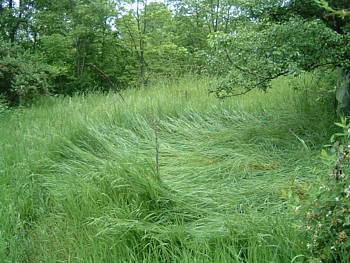
-- we had some downpours in the night but the grass nearby still stands. Not like deer beds. Strange. Down at the Deep Pond, I saw ragosa roses out at the dam,
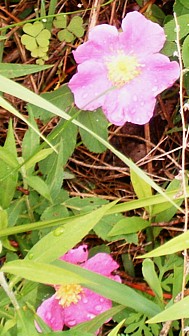
but not any new work on the dam. Honeysuckle flower petals have rained down on the dam so now it will be easy to see if the beaver pushes any fresh mud up on it.
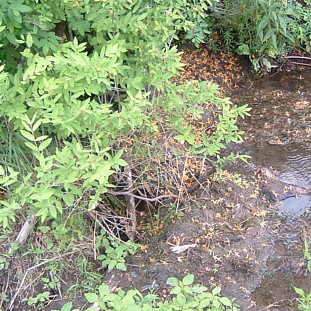
I didn't notice any new stripped twigs along the shore, but I did see a new nip from a red maple -- but unstripped, so far. I suspect the beaver visits both ponds. Now I have things to watch to verify that. While I stood on the dam I saw a muskrat bringing a bouquet of grass back to its ancient burrow on the other side of the dam. It dove before I got the camera ready leaving me with a photo of its brown pathway back to its burrow.
June 2 I planned to wake up at dawn and get out in the kayak, but when I looked out at 4:30 am, fog shrouded the river, so I tried to get back to sleep. When I went out to check the South Bay latrines at 8 am, the fog had lifted leaving a cloudy, humid day in the upper 60s with the sun always about to peak out. There was nothing new at the otter latrine near the little causeway and nothing new at the old latrine above the old South Bay dock. I went down to the burrow under the dock since I saw what might have been a trail through the grass. As I stood there a short tailed weasel, handsome brown with white underneath, came out of the gap on the other side of dock and with head high seemed to be looking at a painted turtle on the shore struggling to get into the water. When I opened my camera the weasel scooted up a log and into the underbrush and long grasses. I have never seen one so close. Then standing in the same spot I watched a heron fishing along the edge of the marsh.
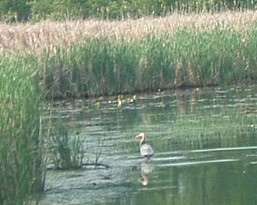
I saw a few ripples from the carp but no thrashing. I continued up the trail with camcorder cocked but I didn't catch up to the weasel. There was nothing at the docking rock but at the latrine above the entrance to South Bay an otter had once again extended the latrine a bit further down the slope.
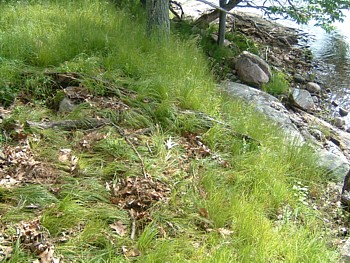
Standing above the latrine, I got a whiff of scat so I expected to see a load, but could only find one smear.
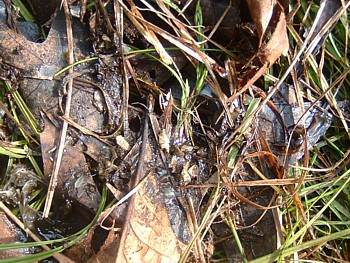
I also noticed that the rain had washed the black out of the scales that had been a fresh scat just two days ago.
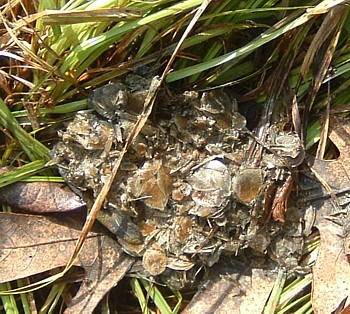
I moved away from the latrine, thinking that at last the otters had matted enough grass and scraped up enough leaves to show up in a photo. And the shot I got shows the trail they use coming up from the bay.
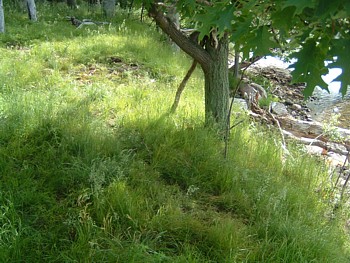
I finally think I am getting a sense of what is going on. One otter fishes along the upper shores of the bay, and I know both shores are good places to catch little perch at least, and, to stake its claim, scats at the most prominent slope overlooking its fishing grounds. Good theory, but I'd still like to see where the otter comes from and where it goes, whether it dens around the bay, or around Murray or Picton Islands. On the way back down the bay, I veered up to Audubon Pond and moved slowly along the embankment but didn't see the baby muskrats again. The pond continues to drop so the beavers' patch isn't as good as I first thought. The pond may drop another foot if the beavers don't get to work. I also checked the latrine on the New Pond knoll but there was nothing new there. Tall yellow buttercups, as well as pink fleabane, are up all along the trails, then I noticed a tall yellow flower
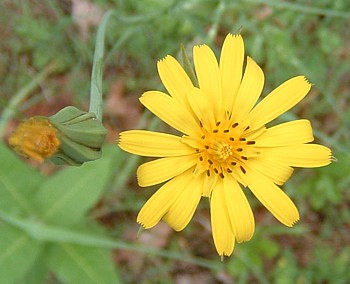
yellow goatsbeard, I guess. I saw a heron toss a fairly large bullhead in the shallows near the rock that forms the north shore of the peninsula. The fish seemed dead and I waited to see if the heron would try to eat it, but it seemed to lose interest. This happened near where I saw the half eaten bullhead a week ago. I credited an otter for that.
June 4 several times yesterday I got ready for a hike and it started raining, showers all day. I have to get out of the camera mentality and go out even if it is raining. This morning the sun came out just as the whole family headed for granite rocks between the second and third swamps. These rocks, more than the beaver ponds, initially attracted Leslie and me, and I realized that our nineteen year old son had forgotten where they were. We took him there when he was a toddler but such long trips became tedious to him as he grew older. My favorite rock, a long molded granite outcrop can't be seen from any of the park trails or from my usual routes, for that matter. Ottoleo seemed duly impressed
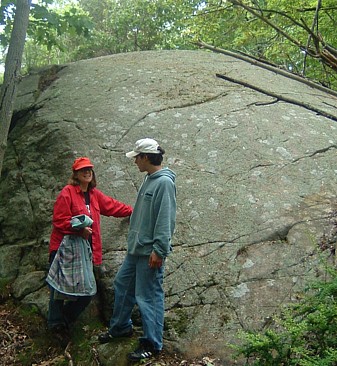
My only disappointment was that the surrounding woods weren't alive with grosbeaks, orioles and tanagers. Then we kept going east to the north face of the broad ridge of rocks between Upper Second Swamp Pond and the pond that drains toward the east.
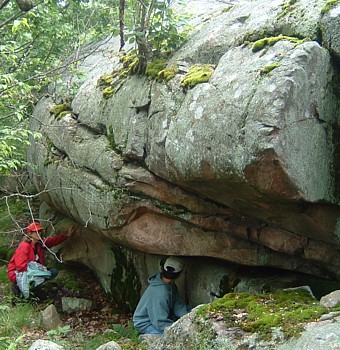
Here were homes for porcupines, and I explained that 12 years ago I thought I'd primarily be chronicling their ins and outs at these rocks. Then I discovered how the otters used the island, and how easy it was to enjoy beavers. We headed down to the beaver pond to the north, that I think I'll call the Ridge Pond, and I immediately saw why I love beaver ponds -- four ducklings scampered away from us. We crossed the grassy dam below the last pond and it looked like the beavers had firmed up a small dam below.
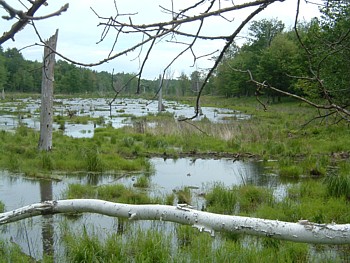
However, they still seemed more active in the last pond, but not so much in the area they foraged in last fall and winter. The lodge they had used seemed unattended to,
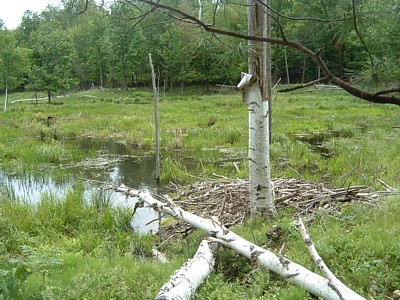
and I saw a possible bank lodge on the south shore of the pond closer to the muddy water and a recently cut maple
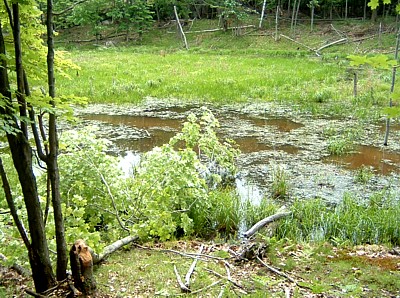
My family headed up the high ridge north of the pond, taking that route home, and I walked around the western end of the pond and saw some fresh work near the canal leading to the pond,
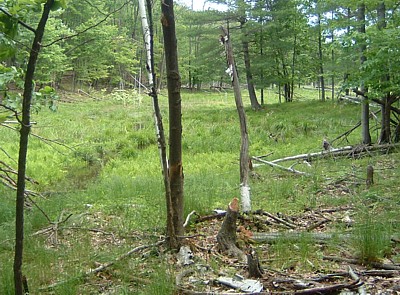
but there was no new beaver work in the watershed of South Bay suggesting this remains a territorial line even though no beavers had been from here down to Otter Hole Pond in two years. I headed south over to the Upper Second Swamp Pond expecting to see that the beavers had foraged deeper into the woods, but I only saw one tree cut in the woods
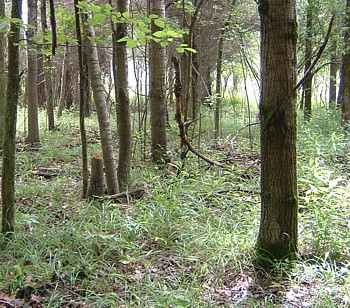
Even the areas closer to the pond where they had taken ash seemed unvisited. I had also told Ottoleo about how in the old days our sport was to try to cross the beaver dams and wet swamps and then dry out up on the rocks. That story inspired me to walk around the Upper Second Swamp Pond trying to keep my feet dry as I followed a path between the log bushes in water and the willow clumps on drier land. I was quickly rewarded for this adventurousness as I bumped into a male grosbeak caging bugs off the low leaves of the trees at the edge of the swamp. From this angle in back of the pond, the pond looked much larger since I realized that all of the low vegetation was flooded.
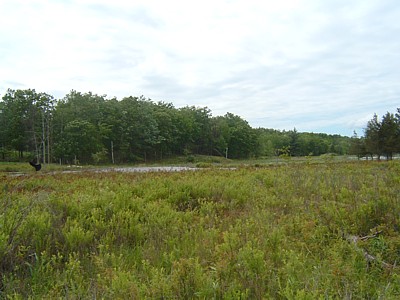
Then as I rounded the back of the pond I found one of the beavers' current routes out of the pond
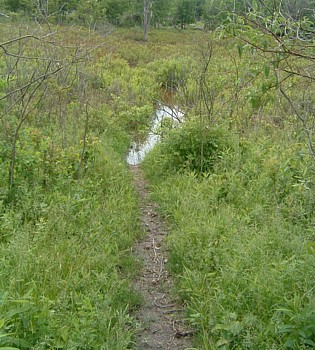
into a pool choked with greenery.
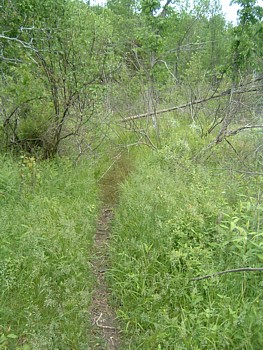
Then I uncovered an even more delicious beaver secret. Just off one back channel
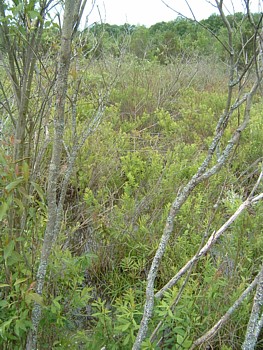
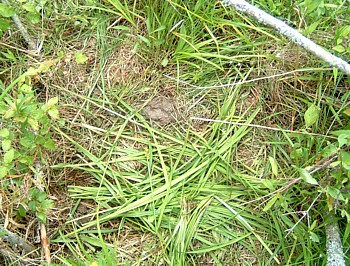
was a pat of mud and a pile of cut grass ready to eat and reward the beaver who came back there.
Needless to say the redwinged blackbird were disgusted by my progress, and a water snake was not amused. To my surprise I kept my feet fairly dry and avoided entangling willows and got up to the north shore of the Lost Swamp Pond in rather good shape. I checked the rock behind the old beaver lodge to see if otters had left any sct -- only goose poop all over. The dam seemed well mudded but no evidence of beavers foraging in the grasses below the dam, as they did last year. A small clump of blue flag iris near the dam surprised me
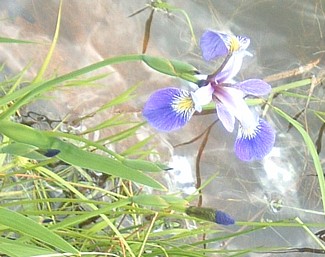
This is going to be a good year for them -- plenty of rain and plenty of sunshine. Of course, I went slowly down the north slope looking for otter scats even though I could see by the grass that no otter had been by. The only trails up from the pond were narrow and led to two raided turtle nests. Then I saw a delicate brown comma in the middle of all the green script. A fawn was new enough to the world that I could bend with camera right over
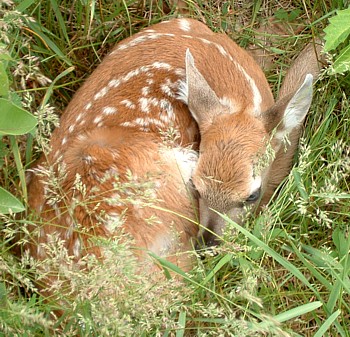
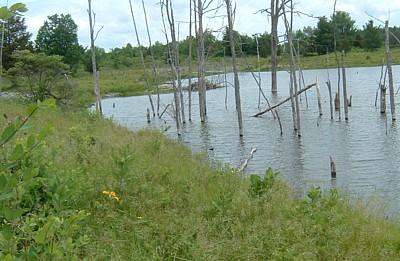
and get only a slightly arched brow with all the beauty. No sign of its mother. When I got about ten yards away, I took a photo of the slope to show how well it was concealed.
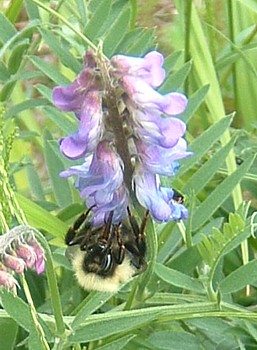
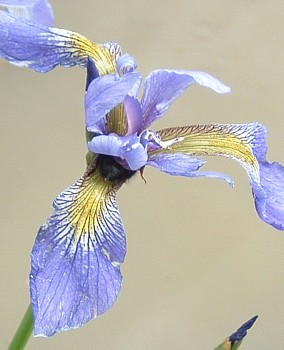
Down at the usual otter trail out of the pond, where an otter has been a few times within the last month, the grasses were all tall. I have seldom seen the area looked so unvisited. I headed for the Big Pond and as I approached the dam, the wood duck mother led her charges away from the dam back into the pond grasses. Then I was distracted by a bumble bee latched onto the purple flower I always neglect to identify
A beaver has been down at this dam,
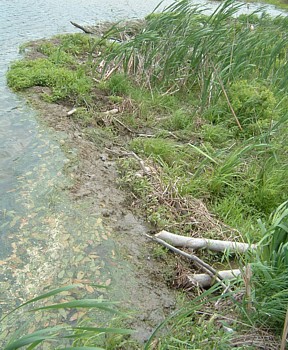
though its recent work didn't hold back the flood of the recent rain.
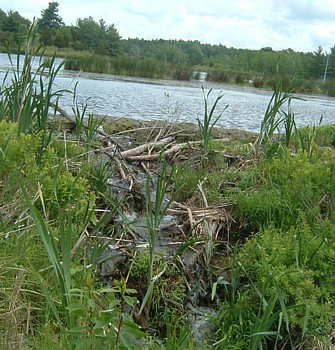
I could see a pile of beaver collected sticks through the irises at the south end of the dam.
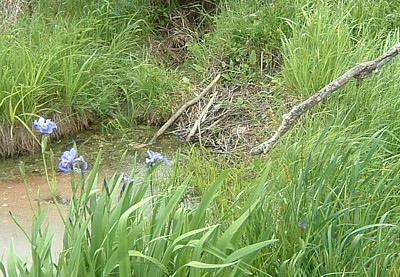
These blooms had their bumble bee too, deep in the iris's tunnels.
No otter signs here either, but if I didn't have to hurry home for lunch and then off to the land, I would have sat by these ponds a good while. Last year on June 4 an otter toured the ponds, and at the Big Pond on June 5, 2001, I had a famous encounter with a touring otter who was then chased by a beaver.
After working on the house at the land, I checked the ponds briefly. There is a muddy trail out side the burrow in the back bank
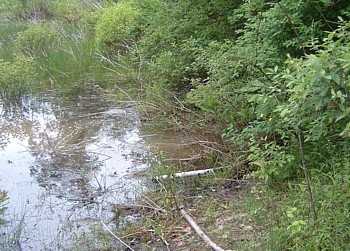
and there are sticks stripped by the beaver in the water, but more water is soaking into the clayless bottom of the this pond, then drips in from the rain. The willow clumps the beaver feasted on are beginning to look high and dry.
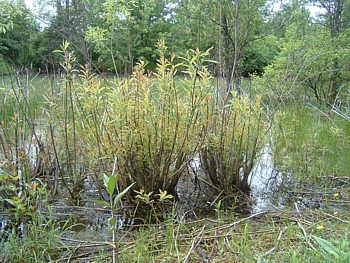
I headed down to the Deep Pond where I moved a heron out of the shallows. As I looked around I didn't see any signs of recent beaver activity, but I still walked along the edge of the pond. Once again I was startled by a pile of poop that looked very like otter scat.
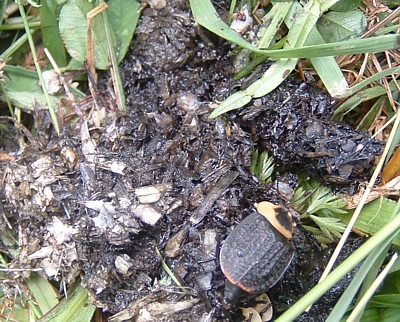
However, there was only a small trail in the grass up from the pond and none of the usual thrashing about in the grass that I am accustomed to see marking otters make.
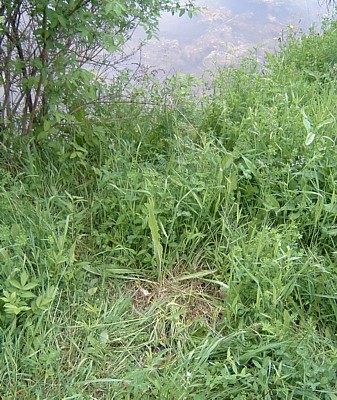
Then it crossed my mind that this might be what I have been searching for so long -- a discreet sign of the mother otter's presence as she came down to the pond briefly to get a bite before she returned to her pups holed up in either a rock den or dead tree stump up on the ridge. With that in mind I went up the ridge, lost any trail and didn't see any likely den. Of course I walked around the rest of the pond, and saw no signs of otters. I took several photos of the poop in part to get better angles on some carrion beetles
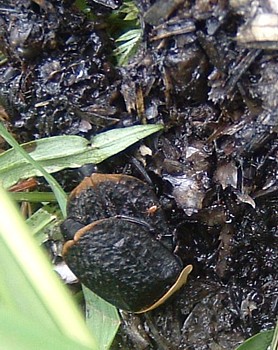
who seemed to be making the malodorous pile a marriage bed.
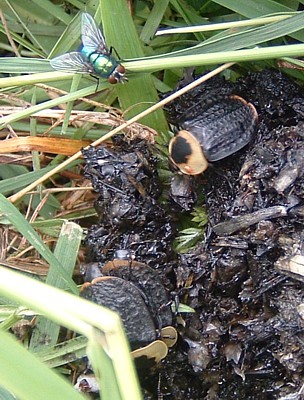
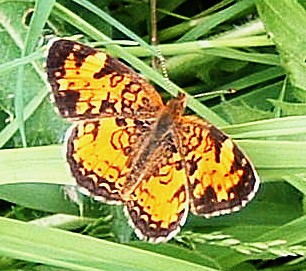
And now, studying the photos, they don't look like otter scats since I can't really identify anything that surely came from a fish. There was also a small butterfly hovering nearby that probably wanted to join the feast.
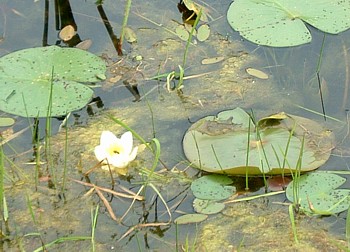
The other surprise in the pond was a blooming waterlily.
June 5 got out in the kayak in the morning and first went to the rock below what I call the entrance to South Bay latrine. I fished out one of the dead crayfish to see what shape they were in. These are the large invasive crayfish and at first glance the one I picked up seemed uneaten. Then I noticed that the shell was cracked and the innards were gone. This got me excited at the prospect of otters doing surgical work on these crayfish, getting the protein inside and avoiding the shell which so often clogs their scats. I didn't discover this until I paddled away from the rock where the three or four dead crayfish were. I was trying to keep the crayfish but the smell was too much, and I noticed the lack of innards when I inspected the shell before throwing it back in the water. I planned to return get another dead crayfish and see if it had been sucked out, so to speak. Meanwhile I skirted the east shore of the Narrows and then made a beeline across Eel Bay to the point of rocks on Picton Island. I went around the rock off Picton, forcing a reluctant heron in the air, but only seeing goose poops on the rock. I didn't have time to get out of the kayak and check the latrines on Picton, but as I paddled by there seemed to be more digging in the piney dirt on the rock, but I couldn't see any fresh scats. I continued down to the end of the little bay there. In other years I've seen otter signs down there, but none today. In other years an osprey was often busy over this bay, but not today. Insects provided the entertainment. There was a huge swirl of whirligig and a continuous dance of those smaller, and silent beige midges just a few inches above the surface of the water. The night time midges are larger, louder and when they hover over the water stay about three feet off the water, often just above my head as I kayak at dawn or after the sun goes down. There was no sign of otters rolling in the grasses on the Murray Island rock -- I may take this old latrine off my list of places to check. As I continued down along the north shore of Murray, I saw a mink running along the rocks with a fish in its mouth, either a very large shiner or a very small fry of a large fish. When convenient the mink jumped back in the water and swam to the next rock, and the plunge didn't seem to make the fish any livelier. I tried to guess where the mink's den was, usually guessed wronged as he scooted by holes in the rocks and the trunks of rotting trees. I looked ahead at docks and boat houses, but they looked none too cozy. Then the mink dropped the fish on a flat granite rock just above the water, and it went up to some moss nearby and rubbed its chin and then its whole body on the moss. Then I saw something coming down the ridge behind the rock. I first thought it was a cat, but it was a grey squirrel. The mink hopped up toward it, and I braced myself for a fight, but without any ado both animals fled in retreat. The mink, without stopping to get the fish, slipped into a little hole at the base of a large live pine tree stradling the granite. To me, quite a surprising place for a den. I was running late and just had time to fish out another dead crayfish. However this one had not been cracked open and sucked dry -- so much for my theory. However this area below the otter latrine was the only place along the shore that I saw dead crayfish. I still think the otters collected them, rather than the dead crayfish attracting the otters.
June 6 After a hard day's work on the house at the land, we got back to the island in time for me to check on the beavers. My plan was to get out to the Lost Swamp Pond, relax by the pond for an hour, then come home -- seeing beavers or muskrats was not necessary, watching the magnificent cumulus clouds in the clear blue sky would have been enough. As I approached the Big Pond, I saw that the beavers had made a trail up into the dogwood groves. I followed
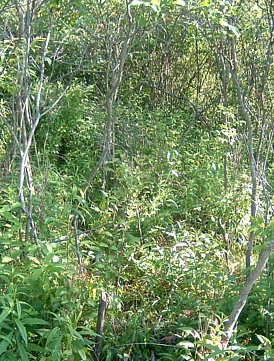
and found that they took the biggest of these trees that never get much over two inches in diameter.
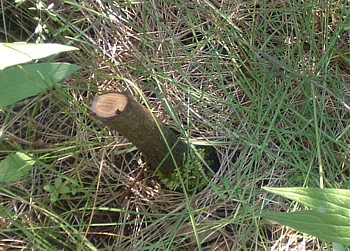
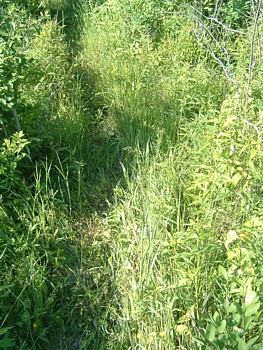
Then I noticed how the grass along the trail all bent down hill, thanks to the beavers dragging food to the pond.
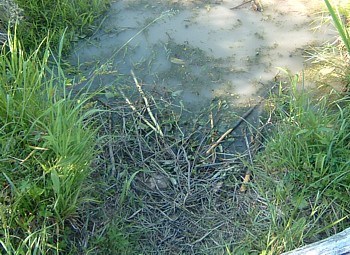
And at the foot of the pond, there was a growing pile of things to nibble just above the muddy water.
Then I looked up and saw the beaver dead still in the water not far from the collection of trimmings it had brought in the water.
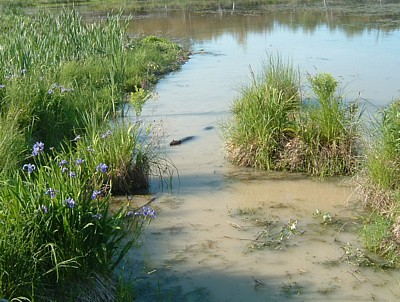
Despite my exposed position, the beaver stayed in front of me long enough for a close-up.
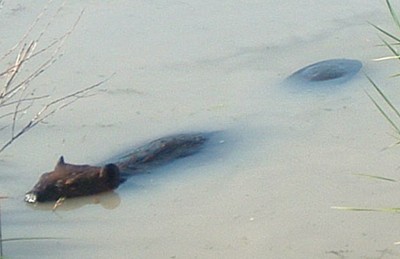
I even had a chance to get the camcord out and record the slap of its tail. And at the slap two beavers plunged from the dam into the water. Here indeed was a tail slap sounding an alarm. One of the beavers followed the slapper up pond, but the other swam over to consider me. I could see by the nappy fur on its head that I had disturbed a grooming beaver.
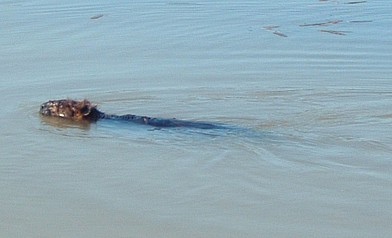
To my surprised it began to curl back to the dam and I took advantage of that by trying to get a photo of a beaver swimming behind its recent improvements to the dam, that included not only packs of mud but sapplings across the dam
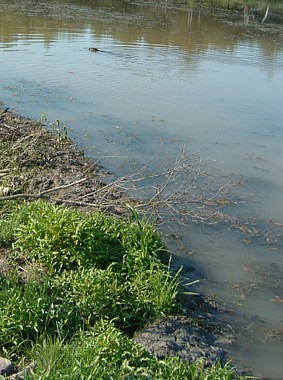
The beavers in this pond don't cut many large trees and rarely bring large branches to the dam. Beavers often take circuitous routes as they make a slow escape, but when I expected this beaver to zag back up pond, it climbed up on the bank instead, and not far from me. I took advantage of its position on the dam to get a picture of a closer eating platform fashioned on what looked more like an otter rolling area. Evidently two or three beavers had recently nibbled and groomed there.
When I walked closer to the beaver, it looked up and studied the situation. Its plunging into the water would not have disappointed me. I was looking to lounge not stand in the middle of a beaver dam on a hot afternoon. Instead the beaver resumed its grooming. A grooming beaver does not shows its features to advantage. The belly rolls to the preening of its front feet and then the massive back paws perk up the higher layers of fat. However, this beaver showed me a new wrinkle to the process. I could hear its teeth clicking. At times it looked like it was using it teeth to work its fur. Then it would often bring its front paws up to its mouth, like it was licking them clean of all gleanings from the fur. I have fancied beavers as great collectors of pollen at this time of year, usually cruising the pond with its mouth a bit open. Could the beaver had been eating pollen and other imperceptible plant matter from its body? Then as I tried to concentrate on that I saw that it seemed to be pulling strands of something with its paws up to its mouth, but close as I was I couldn't see what it was pulling. I had never seen a beaver eat with such subtlety. As often happens with beavers, in the midst of grooming it seemed to lapse into a nap with at least the eye facing me closed. Then as I stood in the middle of the dam facing the beaver, I heard what sounded like a quacking duck behind me, which gave me pause because ducks usually flee when I am within 200 feet of them. I turned to see a small muskrat quacking up the dam and into the water behind it. It did not appreciate my being there, but almost condescended to eat some of what the beaver collected anyway, then thought better of it and swam off into the grasses. The beaver resumed grooming. Eventually it got out of that trance-like state and began nibbling what was in front of it. Then thought better of that and moved along the dam, craning its neck to sniff the grasses on the dam. When I could not longer see it, I moved forward and finally it swam off heading up pond, but in a curious way: it made several shallow dives before it finally cruised up pond with its head out of the water. Then I got a look at the spot where it had been grooming, and saw mud and sticks but nothing that it might have pulled like a string into its mouth. Strange.
And there were more distractions as I was hung up on the dam watching the beaver. One of the other beavers swam back and rather close to me before my odor repelled it and it swam away. But rather than going directly up pond, and perhaps to the pond above this one where the beavers had wintered, it veered over to the beaver lodge on the north shore of the pond. I knew muskrats were living in this lodge, indeed I saw one swim into it with grass bouquet as I stood on the dam. I saw the beaver dive as if it were going into the lodge, which I thought an encouraging sign because I prefer the beavers there where I can see them. I resumed watching the grooming beaver. Then I heard a splash, much like an angry muskrat makes, and saw the beaver swimming up pond. Yes, beavers made the lodge, but they hadn't occupied it in two years and the muskrat must have thought it had squatter's rights. I finally got to the Lost Swamp Pond where I aimed to relax. I soon saw some muskrats but in the distance. Then I noticed one goose with one gosling, which I had never seen before. It seems that this has been another bad year for goslings. Last year I attributed the few goslings to the cold winter and wet spring, but this year we had a warm winter and spring with few cold rains. Then I saw a beaver swimming away from the lodge in far southeast corner of the pond. Then a deer began snorting and pounding its hoof on the ridge behind me. Though I aimed to relax, I still had the Upper Second Swamp to see. I expected to see the most beavers there. As I got up to walk around the pond I saw a beaver round the peninsula in front of me. Of course, I checked the otter latrines but there were absolutely no signs that an otter had been through. I got the camcord ready in case the fawn was near the spot I saw it two days ago, but not only did I not see the fawn but no impression remained in the grass where I had seen it. As I eased down on the usual spot in the grass where I lean back, I thought I saw a beaver in the far northeast corner of the pond. So I lounged back and enjoyed the swallows who seem to be in an endless competition to catch the bugs flying in the air above the pond. Then I looked down at the water and saw the head of a small beaver that seemed lost as to what to do. Finally, it nodded and perhaps prodded a morsel from the pond surface into its mouth. Then I saw a beaver rounding the peninsula. Earlier the goose guarding the one gosling had begun honking as a muskrat swam toward its charge. The muskrat went about its business in the grass, and the goose calmed down. Now the beaver angled toward the goose and when the goose turned toward the beaver, the latter dove with a half splash and disappeared. Soon enough the beaver surfaced about 30 yards away and swam toward the dam. I was at a good angle to get a video of the beaver working on the dam, so I sat up in anticipation. To my surprise another beaver was near the dam, and rather than both or either beaver going to the dam, one beaver began to chase the other in a slow and gentle way.
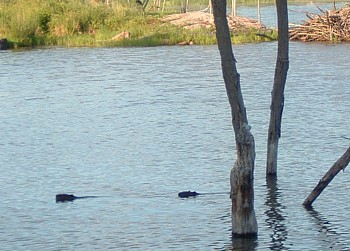
It even caught up to the other beaver and seemed to make a point of nudging its head. Then the chaser dove and surfaced right next to the other beaver and that beaver seemed to make a point of not reacting.
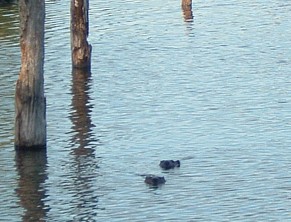
They got rather close to me and on other evenings here in other years small beavers like these, probably yearlings, seemed to make a contest out of seeing who get closer to me. But these two beavers stayed in a round-about swim, as if one beaver wanted to play and the other wasn't so sure. The one slightly larger seemed more aggressive and finally it dove and swam over to the west quickly, leaving the other beaver to swim off alone to the east. As I got up to get over the ridge and look at the Upper Second Swamp Pond, a large flock a noisy geese flew over from the south. Again, I don't recall seeing such large flocks of geese, evidently all without fledges to look after, flying about at this time of year.
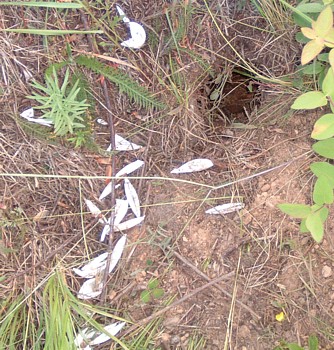
A few days ago I noticed a nest of turtle eggs eaten and spread about a small hole. The noonday sun bleached out the photo. I tried again as the evening shadows overtook the ridge. I rarely see such a pinpointed excavation of turtle eggs.
When finally looked down on the Upper Second Swamp Pond dam, I was just in time to see a beaver push mud on the dam, and then another go directly over the dam and swim down the Second Swamp Pond. The beaver packing the dam swam along it and then, I think, climbed up to eat some grass. Then another beaver swam to the dam and it too brought some mud up. It was tending in my direction and there is a spot on the south part of the dam where the beavers seem to regularly push up a dollop of mud. But this beaver got wind of me, turned, slapped its tail and disappeared. I waited a bit to see if the beaver who went over the dam would come hurrying back. No. I went I walked along the Second Swamp Pond, I could see it out in the middle of the pond fishing up vegetation to eat from the bottom. I was late for dinner so only checked the otter latrine on the small causeway -- nothing new there. Then on the other side of the creek, I startled a deer and ever mindful of a mother deer decoying the bed of her fawn, I paid attention to where the deer had been. Until I noticed that I had bothered a young buck standing in the rays of the golden setting sun which stoked his new reddish fur and fired up the knobs of his antlers.
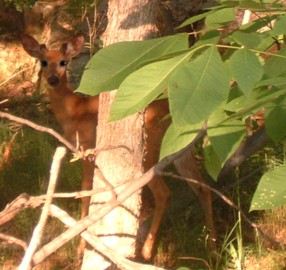
And he gave me a characteristic long look before bending to something worth his attention.
June 7 After working at the house on the land, I toured South Bay in the kayak. A strong east wind made it a good time to paddle there where the wooded hills bore the brunt of the wind. There was a heron and about ten geese at the dock. The latter swam off, and the heron flew with an angry squawk. I don't know how many times I disturbed that heron again, but sometimes as I went along the shore, I could see as many as four herons at once. Indeed, there must be twice as many around, enough to engage in a short dog fight over the bay. As I headed down to the end of the cove, I didn't see any splashing carp, but then I began seeing fins sticking out of the water, and soon enough I was accidently hitting them with the paddle and they, as I startled them, bumped into my kayaks. Certainly this is the busiest year for carp in my memory. At one point I veered out into the middle of the bay to check a floating branch and saw that it was red oak cut by a beaver but in the carp infested reaches of the bay I saw no fresh beaver work, save for sections of water lily rhizomes floating in the water. I fished a small section out and put it on my kayak to see what might swim out and saw at least thirty scuds wiggle back down to the water. Back home I took a photo and all the life was out of it
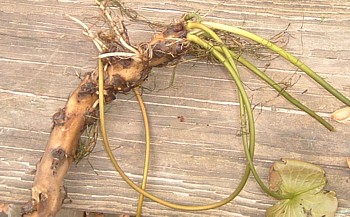
but a close up revealed some nice digs for scuds.
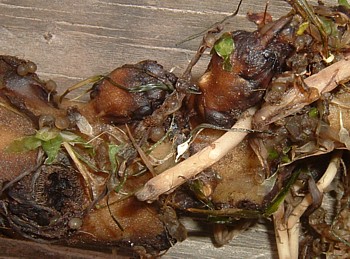
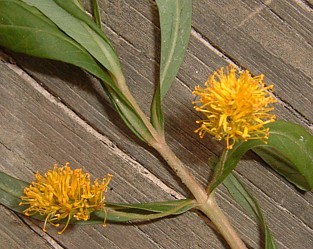
I had a little net to collect things and managed to catch one of the many boatmen now in their manic flying stage zooming low over the water (In the water these insects strike me as exemplars of steady industriousness.) Of course, I nosed about for otter signs but saw none. I saw yellow flag iris along the shore, and below, right next to the water where I could pick one, some yellow loose strife.
So this was a tour without a dull moment as carp kept erupting mud under my kayak, and herons regarded me warily and then inevitably flew off. Though I must add, that much of the pink granite along the shore is stained with white heron poop. Even when I got around to deeper water where there were fewer carp, there were innumberable sunnies. Several years ago I saw hundreds of them suspended in the water of this bay. Then they almost disappeared for years. Evidently they are back. I surprised a raccoon fishing along the mossy bank, and saw mallards with ducklings out in the middle of the bay. Then along the high dusty bank that is being eaten away by wind and waves, I saw a rather striking shrub or small tree with clustered white flowers surrounded by looser petals
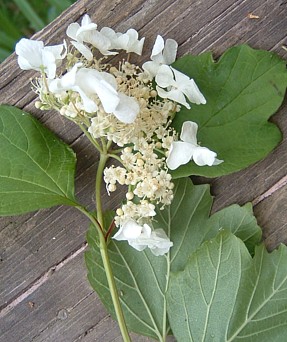
-- flowers were all over the tree, quite striking, and according the books it is highbush cranberry, a viburnum. I had never noticed this before, but this has been a very good year for flowering shrubs. I paused below the otter latrine at the entrance to the bay, I fancied that I could see yet another scent mound closer to the water -- and the otter is running out of room. I paddled across the Narrows into the bay along the west shore where I could see that the beaver lodge there had some freshly gnawed sticks, but not a great deal of work along the shore. This area was less active -- no carp or herons. I did see fry swimming by and a few large fish. No otter signs here save for a bit of digging in some piney dirt but I couldn't see any scats. I was delighted to see two kingfishers racing about which reminds me that I forgot to mention the show one common tern put on in the north cove of South Bay. I noticed that as it dove in splashing after a fish, about twenty yards away a little fish jumped making a splash of its own. Makes sense I guess. And then when one of the herons took off with great croaking, flying low into the marsh, and whole row of carp twitched below its raucousness. So on this cloudy and somewhat cool spring afternoon, the whole of South Bay seemed wired together.
by Bob ArnebeckCheck out my other web pages: otters; beavers; minks; muskrats;porcupines;Leslie's art