July 2006 part 3
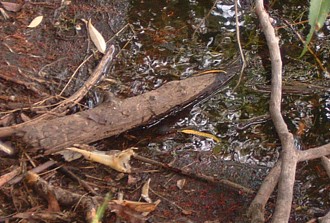
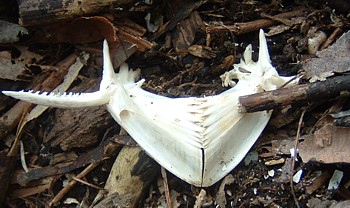
July 23 on the 21st I toured South Bay in the kayak and saw nothing new except fish bones at the willow latrine. Today my first stop on a walking tour was the willow latrine and I took a photo of the fish bone.
There were no new scats accompanying it so I can't be sure an otter left it, or it just washed up. On the night of the 21st we had a tremendous downpour, probably two inches in an hour, and that could have washed away scats, not to mention the wind whipping up waves. I couldn't find any other sign of otter activity at the willow latrine save for a precious-looking bit of bullhead skeleton atop the lodge.
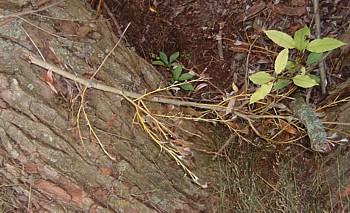
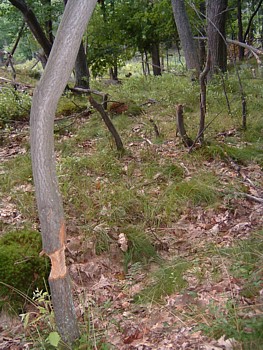
I did see a number of nipped willows left by the porcupines.
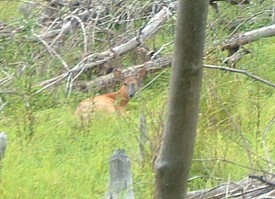
No sign of them, but pleasant as this retreat must be, a mother porcupine has to show her kit some big trees. On the South Bay trail I did see a mother and child. In fact I saw the fawn first right on the trail beyond the little causeway. It turned and ran and the mother followed. When I looked up the ridge, I couldn't see them so they probably went into the tall grasses by the creek. I checked the New Pond knoll and looking down on the meadow there saw two deer luxuriating in the tall grass. One didn't even get up off its belly as it looked up at me.
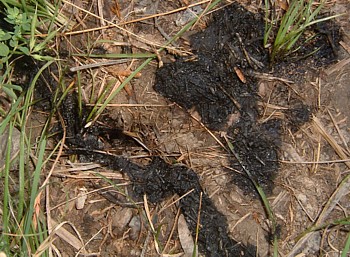
No sign of otters there, nor at the old dock lodge. The docking rock had some trails around it but no scat. I went up to Audubon Pond. It was after 5pm and the beavers there have been out that early. But nothing stirred in the pond. I walked down the embankment, enjoying a monarch butterfly enjoying the milk weed. No action at the drain - fresh green grass in the mud there. Then I continued on to the latrine at the entrance to South Bay. Grass has almost reclaimed this latrine. No sign of otters there and the trail up from the bay was almost grown over. Then I went back to walk around Audubon Pond. I heard some insistent squeaking in the tall trees and decided it was from blue jay babies. However, I couldn't see them as they complained high in the trees. The bank lodge on the west shore of the pond seemed unused by beavers, but there were some relatively fresh, though hard, black smears behind the lodge,
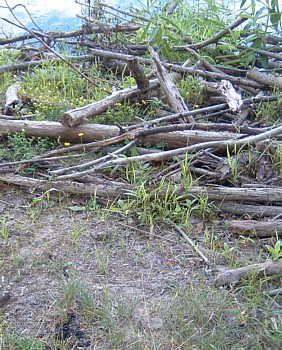
and a faint whiff of otter scat. These scats seemed gritty like the scats I saw on the rocks in the middle of the marsh in South Bay.
I saw signs of beaver work along the canal at the northwest corner of the pond. Not only were there stripped sticks but fresh gnawing on the one of the trees cut down earlier in the year. And the water was a bit muddy. On the north shore of the pond behind the lodge in the pond, I followed a trail up to some fresh gnawing on a good sized ash tree.
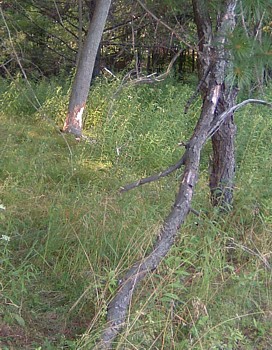
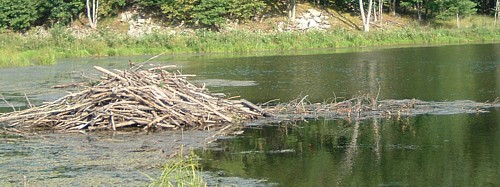
There was also muddy water outside the burrow near by, perhaps from a beaver. The lodge had a strange looking cache -- all wilted and brown leaves.
Then at the bench I saw more smeared otter scats.
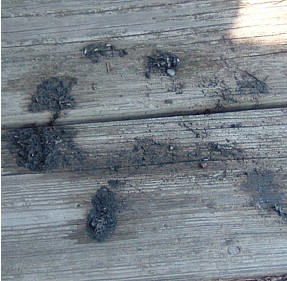
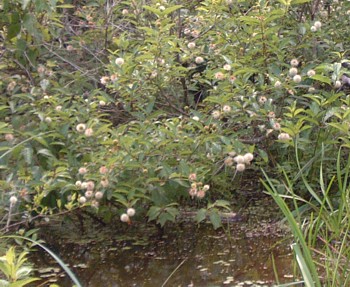
This was encouraging, and there were enough to make me think a family might have been there. I did see a kingfisher working the pond, so there are fish for otters to eat. I continued around the pond and didn't see any otter scats on that causeway, but that is a less likely place to find them. The muskrats are still in the pond above Audubon judging from the rich fan of muddy water eminating from the burrow I had seen them use. Then I went up to Thicket Pond, via the trails. In the woods along the East Trail I finally saw one of the baby blue jays -- already enormous. They were up in the leaves of a red oak. I sat by Thicket Pond hoping I might hear if not see beavers but nothing stirred. I walked around to get a closer look at the button bushes in the middle of the pond, and noticed that monarch butterflies were attracted to the blooming buttons.
I also saw a trail up to some fresh beaver work on the little ridge south of the pond.
And there I saw another deer -- about the seventh since I saw one in woods west of Audubon pond
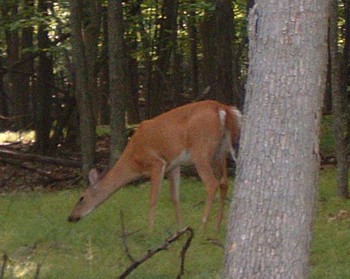
and the woods along the East Trail. This was the only one to run in a fright. Good hike. Beavers carrying on and evidence that otters are still around. Of course it is frustrating not finding the family yet and I always worry that for the first time since 1998 they'll be none in the summer
July 24 I took a kayak tour of South Bay in the late afternoon. I've been getting the impression that there are fewer herons in the bay, so today as I let the wind and waves wash me to the willow latrine, I scoped as many herons as I could and soon accounted for six, and all in the usual places. One was being chased by a very small bird, which is hard to account for. Swallows sometimes follow in the wakes of large birds, the better to get bugs, I suppose, but this was no swallow. There was nothing to account for at the willow latrine -- nothing new. But a little up from it I heard the quiet baby like call that I have noticed a few times I was here, always coming from deep in the cattail marsh. Today it came from the edge, and I paddled over. To my surprise the Fowler's toad making the call did not flee. Didn't look much like a toad, half in the water. First time I've identified that gentle singer. I stayed close to the shore on my way around the point looking for trails an otter might have made, but nothing struck me. When I got around to the rock latrine, I saw that the portion of the rock facing the bay was pocked with goose poop. The geese didn't leave anything on the portion of the rock the otters fancy, but the otters hadn't left anything new either. As I padded along through spatterdock and lilies, it also struck me that I've seen fewer painted turtles this year. I did see two today, and late July is a period when they are generally a bit scarce. I kept my eye out for bryozoa and only noticed the lack of vegetation at the end of the cove for the bryozoa to latch on. Did carp eat all the vegetation or did it simply not recover from the winter ice here? I should pay closer attention to this. Just up from the old dock, I saw same alder shrubs I saw deep in the marsh the other day. Getting closer to enjoy their seeds, brought me over two bryozoa along the shore. Ottoleo had reported seeing them in this cove a week ago, but this is the first I've seen them. Two kingfishers were along the shore again. I kept close to the shady willows, not to avoid the sun or check for scat, but merely to enjoy the red roots of the moss being washed by the waves. I did check areas that I recollected had been routes otters took off the ice on their way to Audubon Pond, but nothing struck me as indicating any otters had used them recently. But I did learn something, maybe. Coming around one willow, I scared off a heron who left a bullhead behind. I was able to get a good look at it and must say that the wound the heron left was more or less imperceptible, which suggests that the bleeding bullhead I found at the willow latrine a month or so ago was more likely caught and bloodied by otter teeth. On one of the willows along the north shore I saw where a branch had just been cut by a beaver, and saw some stripped sticks bobbing in the water. Once again I made light of the fishing abilitities of the squawking Caspian terns. Then one came out of the trees and made a beautiful dive into the water. I heard an osprey but the one I saw was very high. Fledges were probably up there too. This is the time of year for their flying lessons.
July 25 I was thinking of going out at dawn but the wind blew all night and at dawn a storm rolled down the river cracking a whip over the river which couldn't go much faster it was such a froth. So I bided my time until the afternoon giving that strong wind time to dry everything. And as long as I kept to the South Bay shore the wind kept me comfortable. I went that way to check on Audubon Pond to see if otters had visited again. As usual the first sight was at the south creek into the bay, a dead mole on the trail at the little causeway.
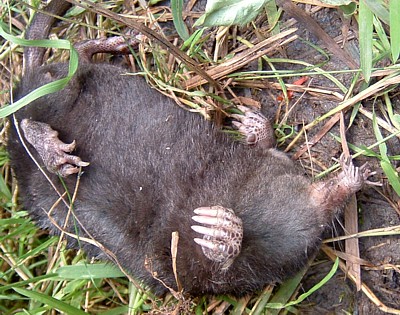
Hard to tell if it was that plump or beginning to bloat. I also saw some yellow wood sorrel, that I had seen before but failed to get a photo -- a little fly was aboard the plant
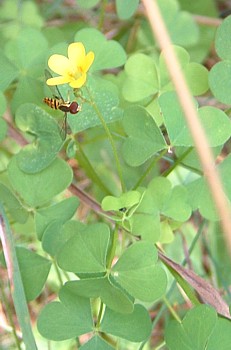
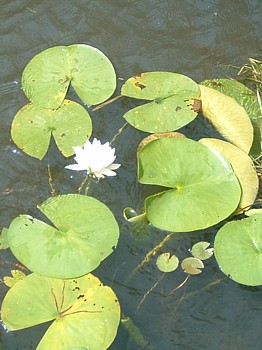
Perhaps more of a bee with that yellow striped tail. I didn't check latrines on the way, but I got the notion that by getting close to the water I might see things to illustrate my kayak trips. And I did see a nice water lily at the Audubon creek outlet
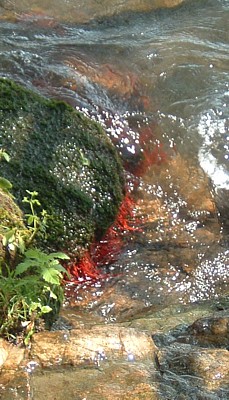
and when the rolling waves sucked back I could see the red roots of the moss under one of the willows.
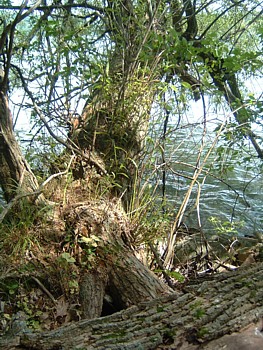
I also took a hard look at some holes at the base of some large willows, suitable for dens, and I did see some very old otter scat -- bits of bone and scales -- not far away,
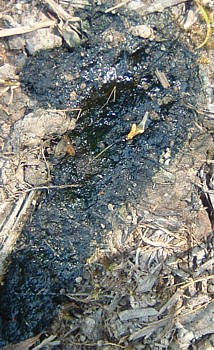
Then I went up to Audubon Pond where I had last seen scats. I could see that the black scats I saw two days ago were bleached and washed. A foot away was a fresh black smear, but only one
I continued around the pond and didn't see any new scats at the bench. So as I watched a kingfish fly over the pond cackling, I tried to figure out how an otter at this time of year for fattening up could make so little impact on the shore of the pond. I didn't let that thought weight me down and tried to get a photo with as many butterflies as possible on the swamp milk weed.
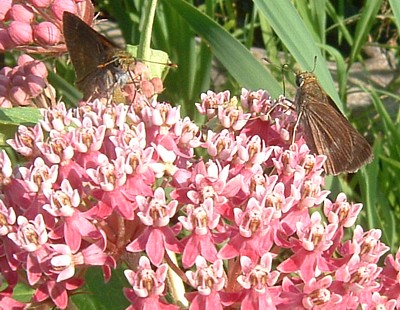
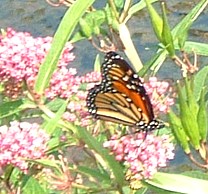
Then going down the long causeway I had monarch butterflies to chase.
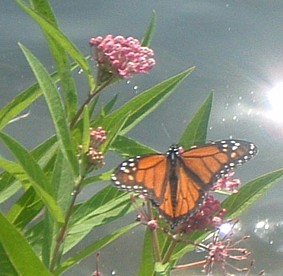
I was thinking of going via the East Trail to the Upper Second Swamp Pond dam, curious to see signs of beaver up there, but I decided to respect the heat and lack of wind in the swamps. I went directly up the easy way between the Second Swamp Pond and the Lost Swamp Pond. During this lush summer all sorts of strange looking plants have been getting my attention, and I didn't know what to make of this plant that seemed to throw up a few poles for a white flower and then quit
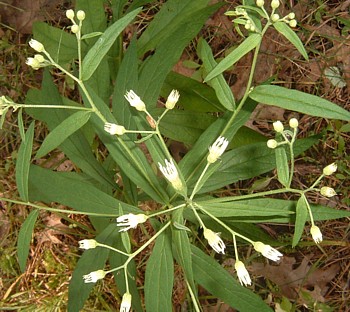
Then below the Lost Swamp Pond dam I saw a fair sized patch of wild basil
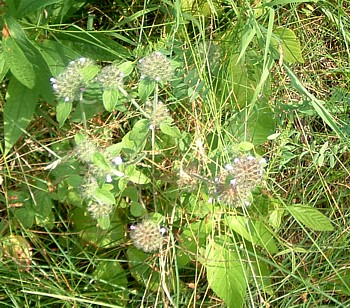
and another strange plant with fairy capped seeds
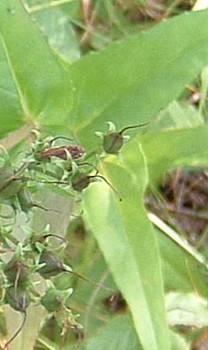
But I was looking for beaver signs, and there were none to be seen along the Upper Second Swamp Pond dam. When I went up to the Lost Swamp Pond dam, I thought I saw a huge snapping turtle out on the lodge in the middle of the pond, but that proved to be a supine heron who was soon up and off and two more herons flew up from the pond as well as several ducks, all apparently finding a refuge from the wind. I still heard the cries of one bird and soon saw that it was a flicker fledge head out the hole complaining
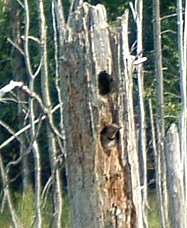
It didn't have long to wait for an adult to swoop in to feed it, which stopped its complaining a few seconds. Then another head poked out. I got the impression a week ago that there was a fledge here ready to fly and I think it did. These two babies seem quite slow. Imagine poor parents hustling to feed them in this heat, but they did. I sat on my usual spot on the north shore up toward the dam long enough to determine that nothing of great significance, other than feeding the flickers, was happening in the pond. The grass still had paths through it and niches by the shore looked a little more worn.
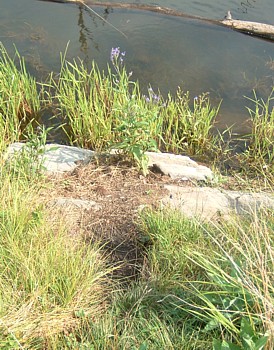
And there was a trail though ferns along the shore. I saw this last year and decided geese roosted there. Probably not beavers, but geese seem scarce in the ponds now.
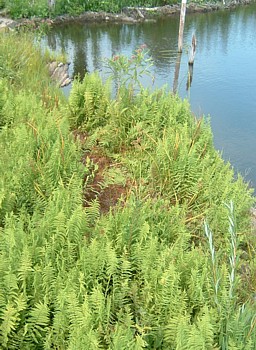
Then as I walked around the pond, dreading a confrontation with the cutting grass below the Big Pond dam, I saw something stir on the south shore of the Lost Swamp Pond, a little uppond from the mossy cove. Something was wading into the grass. With the spyglass I saw that the tail was flat, so here was a beaver out in the grass at around 4:30 in the afternoon. I couldn't get a very good video and just caught it slipping into the water. I expected it to float east toward the bank lodge but instead it went west and nosed up to the shore where I saw two more beavers.
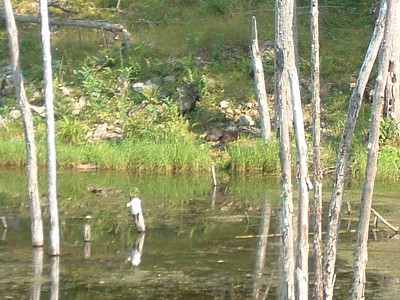
I first thought they were grooming because they seemed so close to each other. Then they didn't move. Two beavers taking a nap, and a third looking on, is a strange sight, especially in a pond which has had a seemingly prospering colony in it for years. I immediately got the notion that these were the beavers from the Upper Second Swamp Pond taking advantage of the resident beavers sleeping in their lodge. While the wind was generally favorable, with such gusts swirling eddies are common and one took my scent to the beavers. One stirred and sniffed the air, went into the water, the other followed and the third splashed after. I was able to keep track of two of them and neither went directly into a lodge which seemed to confirm my suspicions. The beavers looked a bit slow and bedraggled, but it was a hot afternoon after all. Given the conditions I should give up crossing below the Big Pond dam, little is happening in that pond. But I have my weird sense of duty and packed some long nylon pants and put them on to save lacerating my legs as I went through the grass. It worked,and one wood duck really didn't believe I was there -- took a few minutes to scooter away. The grasses were tall, and reeds taller than me. I saw one cut at the bottom, and a bit eaten, some deer's strange reaction to such claustrophobic conditions? The principal part of the dam has the added barrier of thistles as tall as me.
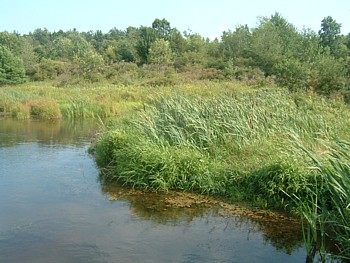
There was a reward at the end. Something had been mucking around outside burrows at the south end of the dam,
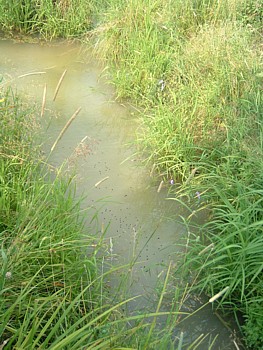
and not the whirligig beetles who were all about.
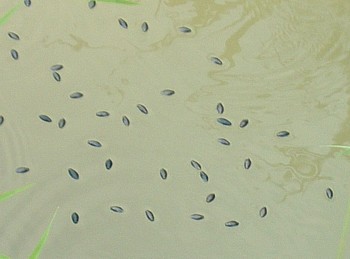
I expect muskrats are still here. Sorry I missed them. I was all sweat and didn't sit as I usually do. When I got to the edge of the woods I solved the mystery of the strange spiked flower. Asters are blooming,
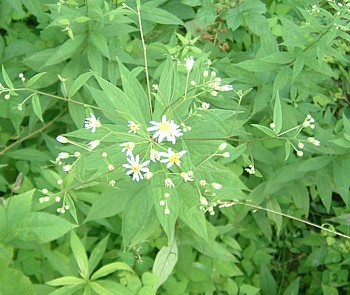
even those in the shade are trying.
July 26 I woke up at 5 am and a light wind persuaded me to stay on land. Plus I wanted to get up to the Lost Swamp Pond and figure that beaver situation out. But first I went around South Bay on my bike, pausing to see at least two carp thrash -- though I suppose it could be other big fish now,and went around to Audubon Pond on the chance that an otter might be up there. None, and no beavers either, but I did see a stripped stick by the lodge that I didn't notice yesterday. I got to the Second Swamp Pond by 6 am, saw nothing there, nor at the Upper Second Swamp Pond. Even the ducklings were coy. I could hear them paddling in the grasses, but couldn't see them. Then I went up to see the show at the Lost Swamp Pond. Just like yesterday, I saw something on the lodge out in the pond -- a beaver,
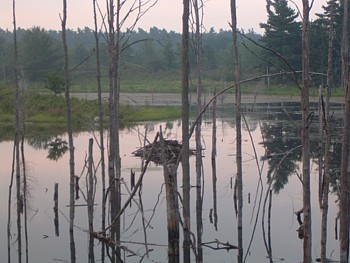
and it treated me to some lodge building, bringing up branches, sticks and grasses and taking all to the top of the lodge, and even doing a bit of rearranging of the sticks already there. Then I saw another beaver, a small one, that came right over to get a close look at me, from just a few feet away.
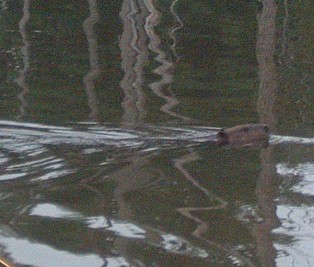
This seemed to be the normal pattern of beaver behavior here, and I put my theory aside long enough to chronical the flicker fledges' breakfast. The louder fledge seemed to get more attention, but I must say the adults seemed to go out of their way to ignore them -- swooping near the nest, calling, both the wukka-wukka and the warhoop, and then flying off. Were they trying to entice the fledges to fly? I soon saw a third beaver and heard some gnawing, which makes four. Far fewer than I expected and that pretty well dashed my theory that two colonies were now contesting for control of the pond. One of the beavers swam up wind of me, on purpose,
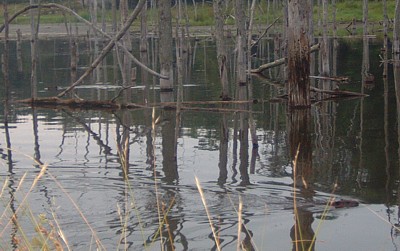
and getting a confirming scent, slapped its tail, which didn't seem to change anything. One beaver went to the west, one to the east, one gnawed and one kept piling things on the lodge. Then, just after I turned off my camcorder, the beaver came off the lodge and was greeted by a slash from another beaver in the water. Both beavers disappeared and all was quiet for ten minutes. When a beaver swam up to the lodge from the west end, I braced for a fight, but there was none, and it resumed taking sticks up on the lodge. Then it swam off to the north and I could see that it was headed toward another beaver gnawing in the shallows near the grass of the point up there. The cruising beaver circled in toward the gnawer but passed by without incident. Here was typical placid beaver behavior but my theory had me on the edge of my grassy knoll. Only the crying flicker fledge cut through the, I should say, my anticipation. Then one beaver came back to the lodge, from the east, and another beaver was bobbing on the west side of the lodge. There was a splash beside the lodge, and then there heads were bobbing next to each other where I could see them. There was shoving and insistent humming. Both went under water. It looked like one was flipped, but there was no chase. One climbed half way out of the water on the lodge and looked like it might be tending a wound or at least a hurt. Then back in the water and there was more contention, but no chase. They went on the far side of the lodge, and from there I heard more humming, loud, but not insistent. Then one beaver climbed the lodge and the other positioned itself at the foot of the lodge, more in a blocking action than an attack, but then they both started grooming.
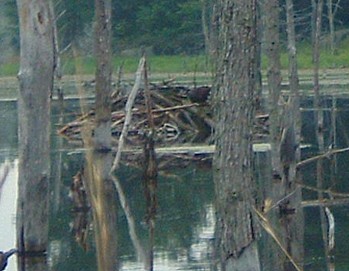
But then back in the water where they had contended before, they went at it again, a brief shoving match, and then as best as I could tell, they went into the lodge -- it was around 7:30, time to get to bed. Then another beaver came and brought more sticks up on the lodge as the other beavers hummed. Then another strange twist, when that beaver came off the lodge it swam over to the bank lodge and seemed to go in there. All to say, an interesting morning, and on my next trip to the swamps I will forget this battle of the beavers, which now strikes me to be a very family affair, and find where the beavers in the Upper Second Swamp Pond are doing there feeding.
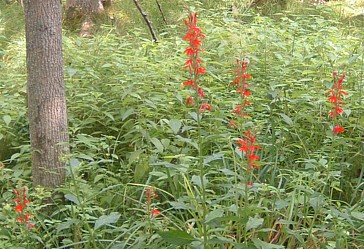
July 28 we had some rain, again, and I was hoping to get out while there were still clouds in the sky because I was headed for the thicket at the head of the second swamp. But when I left in mid-afternoon the sun came out. Still most of the way was in the shade. I paused to enjoy the cardinal flowers again, that now look to be out in earnest.
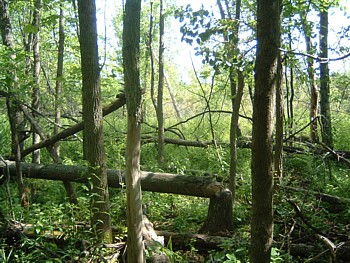
I skirted the beautiful rock to the east and sat briefly for a drink and to cool down at the edge of some old work up from the Upper Second Swamp Pond.
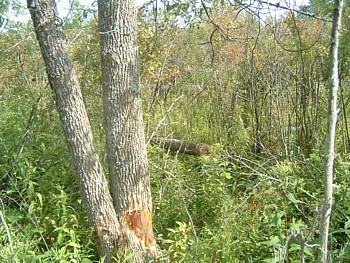
Then I angled up to where I thought the beavers must be. I parted many an aster about to bloom and then when I seemed to be heading to higher ground, toward a cedar, I got the feeling that either I had gone too far or the beavers were no longer about. So I angled back toward the Upper Second Swamp, found moist ground and then an elm freshly girdled with a cut tree further along the path.
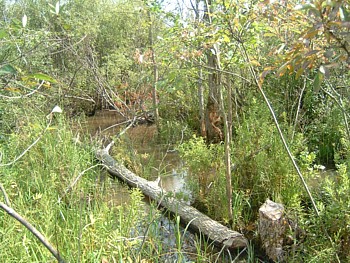
Of course all else was thickets, but I pushed along the narrow path and soon got to a wide channel, and muddy.
I kept going around keeping to the west and then found a clearing with cut logs
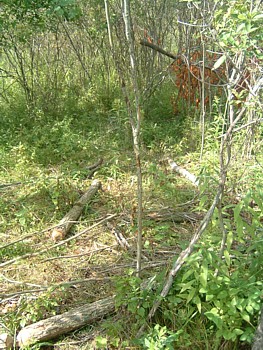
and a little beyond that a view of what I'm afraid only me and the beavers would call a paradicial pond, a Garden of Eden for beavers.
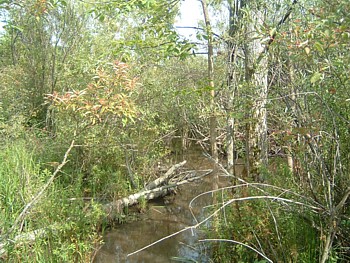
No, that's not a fair comparison, because the beavers alone fashioned this perfect world. And when I got to the path from the Upper Second Swamp Pond, and saw how trodden down it was,
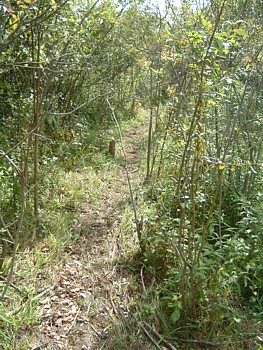
I got a sense of the labor and the accomplishment. I went to where it came from the Upper Second Swamp Pond,
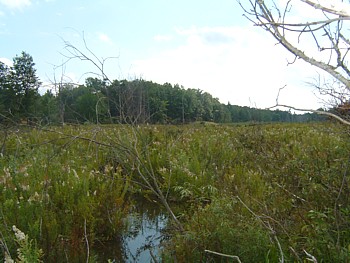
not as muddy there as it should be if they come here every night from their lodge in that pond.
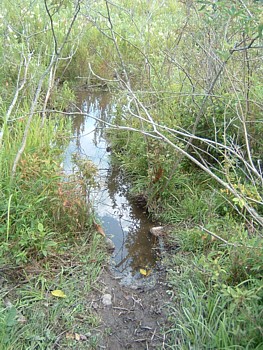
I noticed this channel was formed with two rocks on either side.
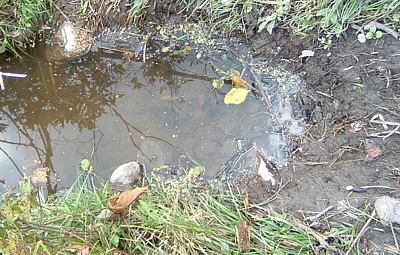
The path led to another channel where a pool was dug by the beavers.
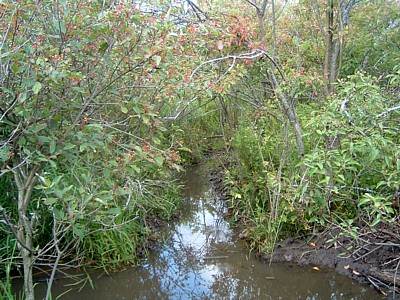
The bank of mud around it was not a dam, because the water is not flowing here, simply a beaver fashioned embankment and it struck me as a perfect half circle.
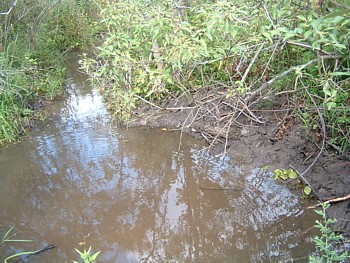
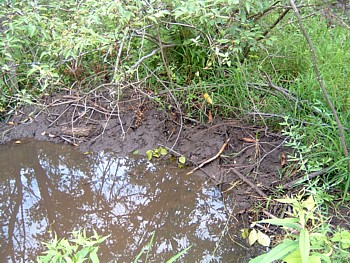
I then back tracked and tried to get above this work and find if they had fashioned a lodge in the thickets. I went back to the large elm that they cut,
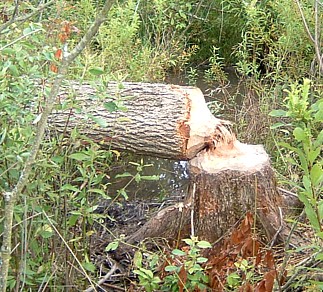
climbed on top and fancied it would be a bridge to a wider pond, but it was only a bridge to dry ground. I pressed on and only found smaller channels and paths that ended. And here the willow, dogwood, saplings of all kinds all leaved to an extreme closed over my head. Here, I thought, I could die and maybe never be found except by the beavers, of course. I could not imagine a fox or coyote or even a mink or fisher messing with these tangles. Then I reached a beaver path radiating from the beavers' pond and that brought me out of the thickets and I found the sun drenched southern expanse of this beaver world.
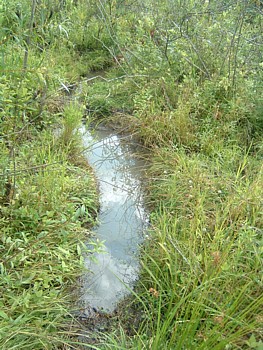
Here I found deep channels that the sun was drying or had dried them out.
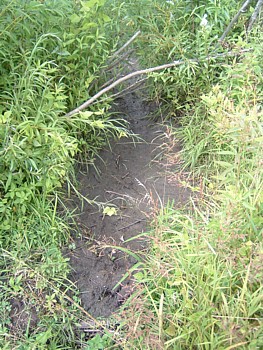
I was on an traversable outer edge of these developments, but not easy by any means. Then I picked up deer paths and threaded away from the berry bushes on the higher ground, then I reached patches of rocks, a series of oases, though guarded by stickers. I stood on one rock and looking back saw a dense expanse that looked like it had not only recovered from my intrusion in an instant but that it had obviously had never happened.
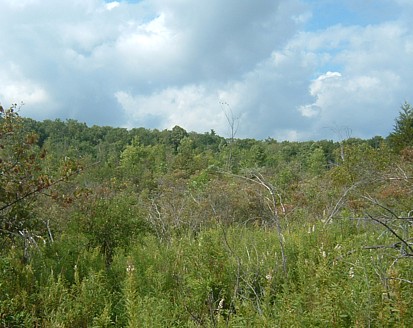
Fool that I am, I could have never gone through there and with thoughts of paradise and death. On the other side the wind and Lost Swamp Pond greeted me. Here indeed was Big Sky country and I sat on the rock behind the beaver lodge by the dam and took it all in, soon realizing I could get a photo with all three lodges, the one next to me, the one they are working, and just perceptible on the far bank, the bank lodge.
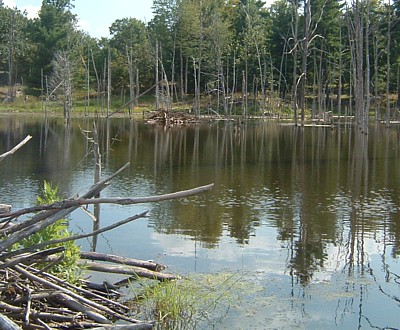
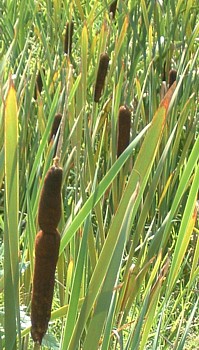
I returned to the historical narrative the beavers have given me, though I have yet to figure out the rotation of the residences from lodge to lodge here over the seasons and years. This colony goes round and round, and the colony I just left, that I've followed for twelve years, goes down and back and back. What do I name their new pond? I called one the "New Pond" years ago and that is now just a meadow guarding the entrance to this world. Then there is the large meadow of "Beaver Point Pond", a good name, and "Otter Hole Pond" seems now a name insulting to the beavers who made it. And how unimaginative are the names of the Second Swamp Pond and Upper Second Swamp Pond, but far better than what I thought of calling that area 12 years ago - Dead Pond, because I saw so little life in it. Now it seems more and more the Ur Pond from which most of the life I have watched in the last 12 years had radiated. I already have a Thicket Pond. Well, I will think about it -- Paradise Pond? Then I crossed the Lost Swamp Pond dam, got a close up of the handsome cattails,
and then tried to excuse myself around a tall thistle and was stopped in my tracks to admire the odyssey of another seeker
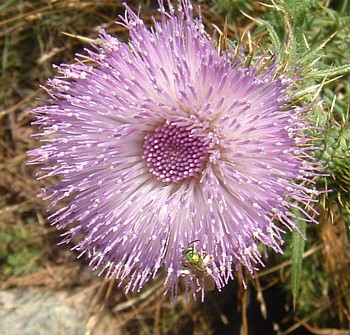
and didn't need to blow up the photos
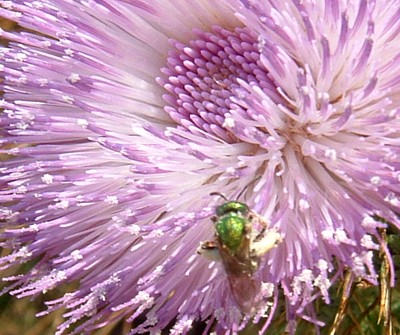
to see the dazzling dimensions of that small world. It makes my Paradise Pond seem but a dull tangle to its inviolet beauty.
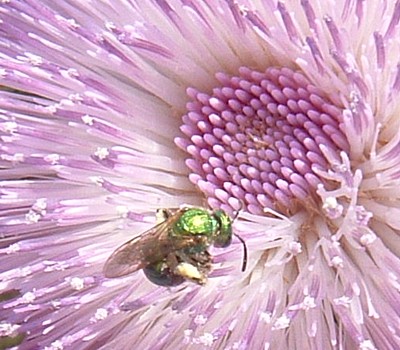
Home to the river.
July 30 we were treated a nice summer day, typical for this area but rare this year. It brought Sunday boaters out, but I still kayaked out to Picton. I went along the south shore of Murray Island, where the otters were active in the winter, but now there are folks relaxing on every third dock. I crossed the channel over to Picton so I would have a chance to go along the sandstone shore where the waves have washed out small caves, so small that nothing seems to take root or nestle in them. They are flat, pale reminders that all the world is not rounded, pink granite. Down in Picton Bay there were a dozen boats, a few genuine yachts, moored with people paddling around, not exactly an otter's haven, but I examined the shore. I was surprised not to find as many flowers as I did last year. I was amazed at the size of some of the arrowroot leaves, and wonder if the large ones, bigger by a factor of three or four, are another species. There was frogbit, not much, and wild onion, and small cattail like grasses, but not cattails. The insects were not put out by the summer crowds. The whirligig beetles were evenly dispersed, though still in groups, but there were several riots of the hopping black bugs. What a fury when I paddled by, if a fury can ever be pulsating. A good bit of the bottom has been taken over by the algae plant favored by perch and sure enough I saw small schools of small perch along the edge. There was one heron in each cove of the bay. The first croaked at me mercilessly but didn't fly off. The second couldn't abide me and flew off in moans of disgust. The South Bay herons seemed as gentle as canaries compared to these complainers. No signs of beavers and at the otter latrines at the point, while I couldn't see any scats from the kayak, I did see some scraping in the dirt and a trail or two in the grass. I continued around the quarry but saw no scats, and no fish bones -- I did see otters swimming along here not a month ago. I was about to turn back but decided to see the pine shaded cove beyond the quarry, and then I saw a mink, nose high in the water, swimming toward me. I went limp but it's hard to play possum in a yellow kayak. The mink dove and I couldn't see it swim under me. I drifted with the west wind and current and backed away from the shore, expecting to see it come up on the rocks. Instead, I saw its head a good thirty yards down to the west. It had gone under me. I paddled after it, and while I easily caught up to it, it did not accept my challenge for a race, dove and though I waited for it to get on the rocks, and scanned the water further along, I didn't see it again. I've never seen a mink committed to such an ambitious water voyage before. I crossed the channel back to Murray and went along that shore without incident. Then as I was coming through the Narrows I saw seagulls flying high over the woods on the Wellesley Island ridge. There were 30 to 40 of them and they were flying like swallows without the usual seagull cries save for a few grunts when two almost collided in the air. They must have been after insects but I couldn't see any with the binoculars. A swallow flew over and was so taken aback that it landed high in a tree and studied the novel situation. The 20 minutes I watched, only one seagull flew off, and none joined the pack. I checked the rock latrine down in the north cove, nothing new there. When I got home and went down for a swim, about 15 to 20 seagulls were flying over the trees east of our cove. I think the gull is a beautiful bird, usually a pleasing companion, and there was a remarkable grace and gentleness to this aerial display, perhaps because they were a bit awkward compared to the insectivores who do this day after day.
by Bob Arnebeck
Check out my other web pages: otters; beavers; minks; muskrats;porcupines;Leslie's art