July 2006 part two
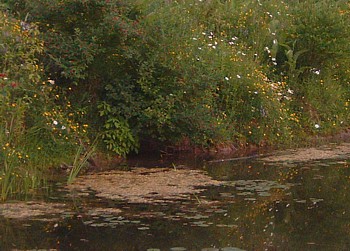
July 8 I went down to the Deep Pond as the sun went down to check on the beaver and as I waded through the deep grass, I saw it swimming toward the knoll, pushing something green and it dove into the old beaver burrow there. I sat down but it didn't come right back so I moved over and took a seat on the slope which afforded a better view. From that vantage I noticed how inviting the burrow in the slope was -- a burrow made by the last resident beaver a few years ago. The entrance was right at water level, though I didn't see any stripped sticks or even much mud at the entrance that would indicate that the beaver is using it.
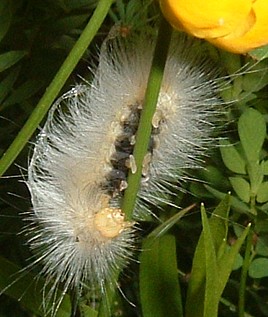
I had a long wait, with not much to entertain me, until curled on a stalk just below a yellow flower I saw a white caterpilar
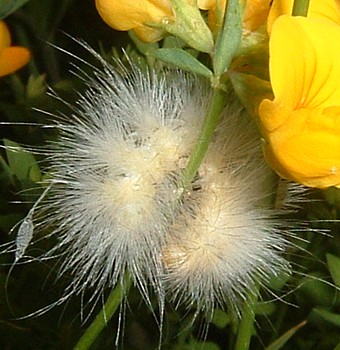
- don't recall seeing one like that before. Soon enough my scrutiny had it stretched out heading down the stalk.
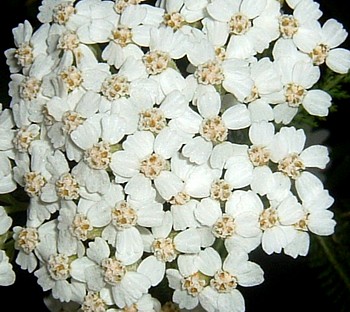
Then I decided to go back to the road and walk down to the dam -- fearing that the vegetation would be too thick to walk on the dam in the almost dark. As I walked away, I looked back and saw ripples in the water. I assumed my leaving had caused a frog to jump (usually they jump when I come up to the pond.) I took advantage of the darkness to photograph some white blooms, yarrow. In the sunlight all would be a glare with my camera.
When I walked back to the pond by the dam, I saw more ripples in the middle of the pond and saw the beaver who weaved back and forth several time, making such a wide arc that I thought it was going to go about its business. Once it gave me the half splash which was a little more fulsome than the one it gave me last time. I don't want to scare this beaver away, so I left without checking the dam. Off to be sung to sleep by the whip-poor-wills.
July 9 I took a tour of South Bay in the kayak in the late afternoon first heading directly to the willow latrine where I found no signs of otters and the kingbird nest was empty. The little dirt niche in the lodge, that I fancied that otter pups were using while waiting to be fed, was littered with some willow twigs which looked like they had been nipped but not stripped by a beaver. I can't imagine a porcupine taking them out in the open for a picnic. As I paddled around the point I saw the mallard with the three ducklings. The grassy otter latrines on the north shore of the point had no fresh wrinkles. As I paddled by them, a heron flew low over head clutching a fish in its beak and it landed down in the woods not wanting to show off its catch. As I paddled around the rock I expected to scare it from its hiding place, but didn't. Instead I was distracted by the fresh smell of otter scat, and saw three dollops on the east side of the rock. So the otters are back, if they ever actually left, in South Bay. I continued on my tour, now with eyes peeled for otters, but I couldn't help but notice the bumper crop of white waterlilies and yellow spatterdock. There were no other signs of otters, and I was careful to check the moss carpets under the willows. Then I ran into a kingbird. It flew off to get away from me so I went farther out in the water to give it some room and it showed me how to catch bugs flying just off the surface of the water. In the ponds I usually see them get one bug at a time, but this kingbird seemed to get three or four, assuming that each bite was successful. Then when it flew off again, I noticed a small grey lump on a thin willow branch hanging just above the lapping water. My first impression was that it was an animal, then as I paddled closer it looked like I was fooled again by an oddly shaded leaf. Then I saw that the stem was indeed a tail and I was soon encouraging what I took to be a baby muskrat to not panic though it seemed to in a novel and exposed position. It tolerated the lecture then dropped in the water and it swam with its tail cocked out of the water, and the tail looked rather thin. Was it a water shrew? It swam to the edge of the mossy cliff -- rather big for such a little fellow and finally got to another twig allowing it to climb up on a little rock. I continued on checking latrines and possible latrines, seeing nothing, and the possible scat on the rock at the entrance to the bay looked less like an otter scat, though from the kayak I couldn't get that good a view. It being Sunday there was heavy boat traffic through the Narrows and three groups of geese feasting on what the props were shredding as they sped through some floating grasses. I counted 60 geese in the first group, 25 in the second, and then a family of five -- mom, pop, and three goslings evidently not eager for the flock. I crossed the Narrows and was attracted to the first little cove by some beautiful bird song that I thought might be from scarlet tanagers high in the trees but the sun being behind them I had no chance of confirming my suspicion. Then I saw a muskrat working on what I would soon see was a lily rhizome. I'd expect even a muskrat to get good chunks out of this soft root, but I could only see dainty nibbles. Then when I got too close it swam to the shore and in a matter of a few seconds collected a mouthful of green grass and took that bouquet around a rock and disappeared. I continued around the shore checking other burrows and moving four adult mallards off a rock. I must say the mallard feathers are looking rather rich after their molt. The bank beaver lodge on the south shore of this bay looked rather bolstered by logs with several larded in with bark ripe for eating. This I think is the work of several beavers and probably this colony is doing all the trimming around this and South Bay -- I must credit them with not taking too many water lilies.
July 10 I went over to South Bay in the boat to get photos of the otter scats I saw on the rock yesterday and to see what else otters might have left behind on the little wooded island between the marshes. As I approached I took a photo of the trail in the grass coming down to the water.
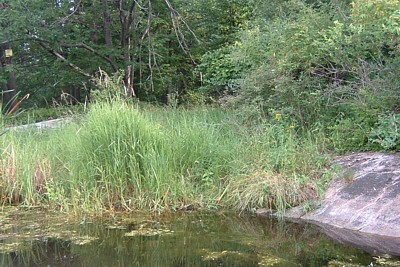
From the boat I not only saw the scat but several fish parts.
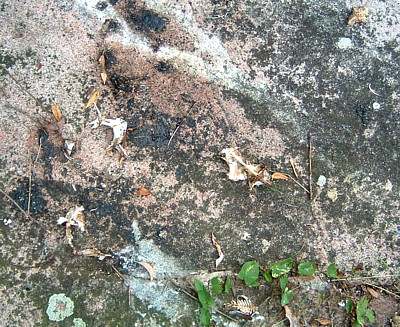
However there were no fresh scats next to the fish parts. The old scats encased what looked like dead grass stalks as well as fish bones.
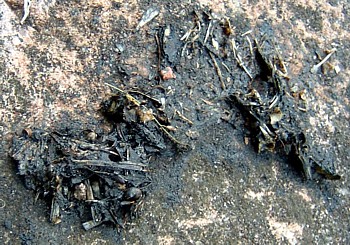
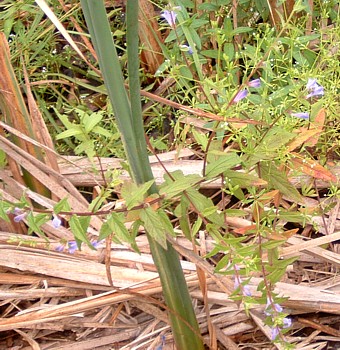
I know herons, as well as raccoons, are out here and eat fish -- minks too but I haven't seen one around the bay this summer (Last summer I saw one frequently) I also didn't smell otter scat but I did smell something dead back in the underbrush. I followed the trail back to the rock where I've also seen scat. I didn't see any scat along the way, but I did see a modest blue flower that have seen in other places in the marsh.
I did see how the water was lapping at the edge of the marsh which has been dry until now. Then flanking the rock, building up to the rock, I saw an intriguing network of holes in the dirt holding the roots of the small trees that shaded the rock. The dirt was smooth, worn down, the holes were inviting circles, if that is the womb of protection an animal craved.
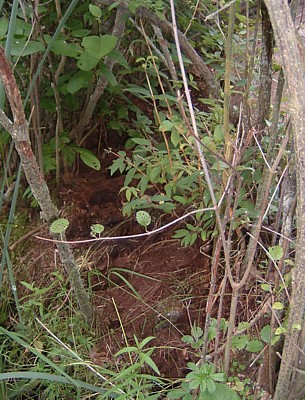
But I didn't see any otter scat there. Up on the rock I saw black smears in several places, most new to me, but all were hard and shiny.
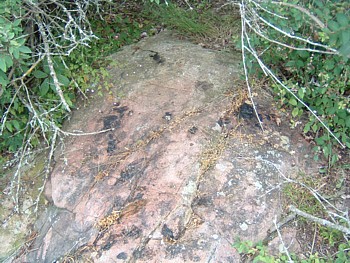
In the spring I was fooled for a few weeks by raccoon scats like this. I took close up photos hoping they would reveal fish parts less likely in raccoon poop. I did see larva, I think, curled up on the hard black plenty.
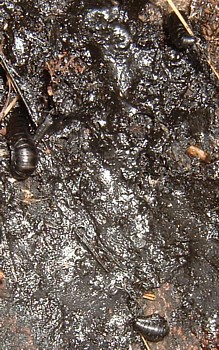
And, while I have never seen otters on this rock, nor raccoons, the proximity of the marsh, the newly discovered holes, and having seen otters in the area much more than raccoons, makes me pretty confident that this is mostly otter activity. The woods behind, with many tall trees and some dead trees, would be more congenial to raccoons. On one of the small trees shading the rock, I saw green berries of the Virginia creeper entangling it.

Berry season has begun and raccoon poop should be laced with berries, though I haven't seen an example of that. The other tree shading the rock seemed a curious exotic, deciduous leaves and small pine cone like seeds, a speckled alder?
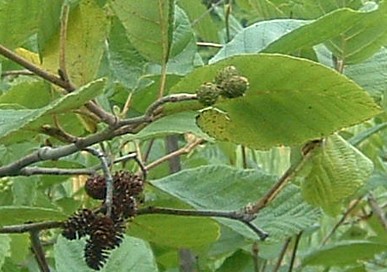
Then at the edge of the rock was perhaps the most perfect butter-and-eggs plant I have ever seen.
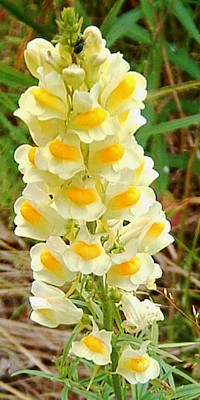
Leaving the rock I took more photos of the possible den and one photo with the camera thrust into one of the holes on the side, which didn't turn out well. Then I walked back to the center of the little island, and saw no poop of any kind. I walked back to the rock via the thick willow and as I walked around the rock along the shore, I saw two soft black scats on grass just above the rock, which indicates otters were here since yesterday, and suggests that scats in the shade and on a cooler surface didn't get baked to a shiny solid.
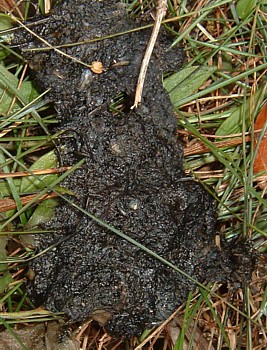
Then I searched for the source of the dead animal smell, but couldn't find any corpus olfacti. Back in the boat I rowed down along the marsh, unable to get photos of the flitting dragonflies many seemingly glued together one green on a blue, two blues stretched like an ideogram. I could get photos of the spatterdock heads
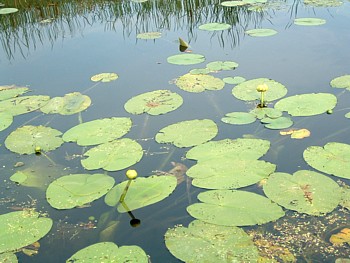
and lily blooms, though all looked rather used and buggy up close. I couldn't resist a juxtaposition of the dispised purple loosestrife with a prized waterlily, both seeming to struggle for their place in the sun, especially the supposedly virulent loosestrife.
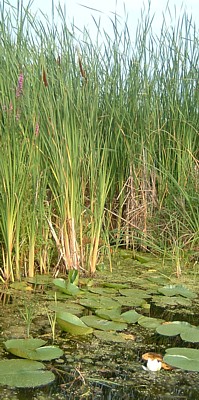
I kept scanning the water for otters, but on this hot muggy afternoon nothing was stirring but the bugs and an occassional swallow. Then I saw an osprey fluttering over the south cove of the bay, looking for dinner. I also checked the otter latrine in the marsh between the island I had just explored and the point. As I stepped off I noticed another purple plant was blooming.
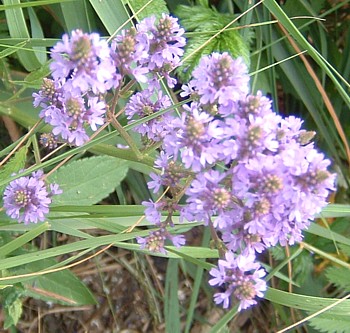
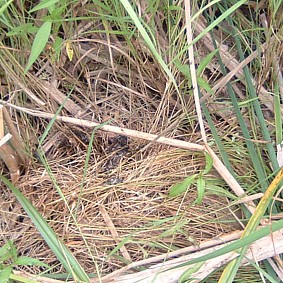
There was nothing on the rock back in the marsh, but on the way to the trampled down cattail stalks, just up from the water, I saw some new otter scat.
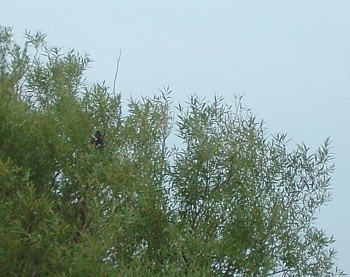
As I rowed away from the point, a kingbird flew up to her nest in a willow at the end of the point.
Then a Caspian tern was a study in indecision as it almost swooped down to get fish. Yet, again I saw the mother and three ducklings. And as I came into the cove a large flock of geese floated by the point.
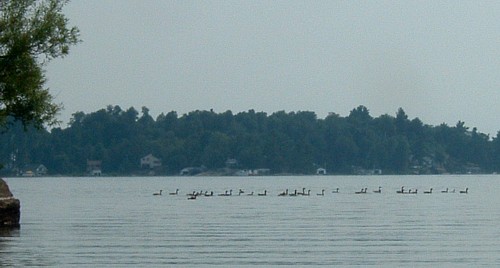
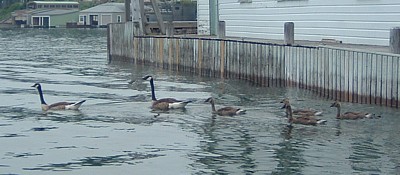
And as I came into my home cove, a family of geese meekly avoided the boat. This is not the season for flying and honking.
July 12 I was up at 4 am with a hunch that I would see this year's otter family, or at least at otter, in the north cove of South Bay. Dawn is a bit later now and few birds were singing when I got outside. At South Bay the green frogs greeted me, as well as a steadily growing chorus of birds from the woods all around, including a whip-poor-will. When I sat at the old dock at the end of South Bay, I was still groping in the almost dark, and swatting mosquitoes away. A bat sketched a bug biting foray over my head too late for my immediate comfort. Soon it was light enough to train the binoculars on the bay and marsh and for a half hour nothing stirred and one heron flew in from the east. Then I walked up the trail to the west affording me a better view of the dawn
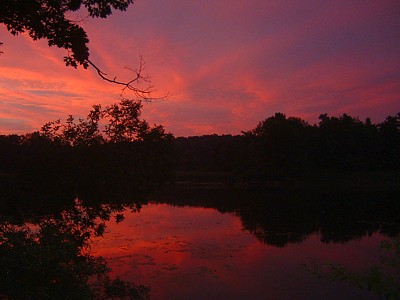
not so dark as the photo above, but equally enchanting. I walked slowly but still no otters, beavers, nor muskrats. I walked up to Audubon Pond. A friend recently mentioned seeing the beavers there so I expected to see some action, but all was quiet. I noticed a bit of a cache in front of the lodge, and will check that out another day. Not seeing otters, I went after beavers and walked up toward the Lost Swamp Pond. I checked the New Pond knoll on the way, and briefly contemplated the Second Swamp Pond from the rock at the south end of the dam. From there I took the shortcut up to the Lost Swamp Pond so that I could come down behind the bank lodge. As I did I saw one beaver swimming from that toward the north shore. I sat on the high rock on the other side of the mossy cove and soon had to sort through two loon calls -- but I couldn't see loons on the pond or in the air. Never seen them on the ponds. I noticed that three geese were on top of the big lodge in the southeast end of the pond. Showing their pride and joy where it was hatched? or prospecting for next year's nesting site? They soon swam up pond. Then some excitement began. I saw activity along the shore near the east side of the dam and got the camcorder on it in time to record a splash. It could have been a beaver reacting to some ducks getting too close, but the ducks were moving off and in their wake two beavers were in a chase. From the video it looked like one beaver was getting torqued around. I saw one tail moving first like the beaver was being pulled under water and the tail was extended in a vain effort for leverage and then moving like a propeller through the air and into the water -- never seen that before. I first thought it was an adult teaching a kit to dive, but the bigger beaver seemed to keep on the tail of the smaller, so this was not a case of a kit hanging on for a ride. They swam to the middle of the pond with the bigger seeming to dunk the smaller and then catch up to it when it got away. Then they separated, or at least I saw the larger one alone, and a wake from the smaller who perhaps went into the lodge in the middle of the pond. At the same time a beaver left the bank lodge below me. I saw it clearly. Later I would hear two dives in the lodge, see ripples in the water, but never see the beaver or muskrat. Not that I didn't have plenty of beavers to keep track of. The easiest of the bunch was a beaver diving around the lodge in the middle of the pond and bringing up sticks and swimming around and putting them on the other side of the lodge.
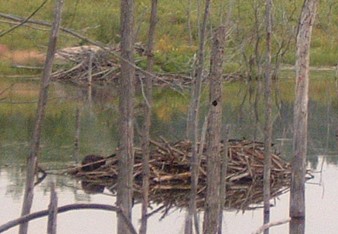
Strange activity for this time of years. Then back near the dam I saw a clearer case of a beaver splashing to move ducks along, though the beaver seemed rather shy of the ducks, first splashing and moving away and then feinting back and giving a half slash to propel it, the beaver, in the opposite direction as the four ducks moved away at their usual speed. However, as the ducks moved off, another beaver was dragging a sapling toward the dam, and the ducks veered away from the that beaver. There is a favorite feeding niche between the dam and the lodge near the dam and the beaver parked its feast there. Another smaller beaver swam toward it and evidently was not invited to join in as it moved off back to the dam directly. A beaver in the west end of the pond slapped its tail twice. It had the best view and sniff of me. But it carried no authority as none of the other beavers reacted. The slapper went out to the lodge in the middle of the pond and did some humming, perhaps making its case about the odiousness of my presence. But it got no rhythm and swam slowly toward the beaver at the dam, but it had finished with its sapling and now swam all the way across the pond to the weedy south shore, quite getting away from the other beavers though two tried to follow but must have gotten distracted because I didn't see them again. As I left, the beaver parking branches on the lodge paused after hefting a big one to do some grooming. Here was a classic morning of a large colony of beavers where each beaver goes off in its own direction somewhat to the chagrin of the smaller beavers. As for the evident fight, it rerminds me that I saw this same chasing a few weeks ago, though there was no ducking. Is there an alien beaver in the pond that has to be periodically reminded of its lower station? Or is an adult trying to make at least one of the younger members of the family uncomfortable so it might move out? Pity I can't come here every morning at dawn. I walked around the pond to check the Upper Second Swamp Pond. I saw two wood ducks but no beavers so I didn't get my camcorder out so I missed the beautiful flapping escape of one of the wood duck ducklings into the tall grasses. A male just getting its striking colors and pattern. Going back down the Second Swamp Pond I tried to conjure some life out of it, and I did see a possible trail up out of the pond near the auxilliary bank lodge. Perhaps a beaver, or otter, has been going over there. Another thing to check. I remembered to fetch some chanterelles,
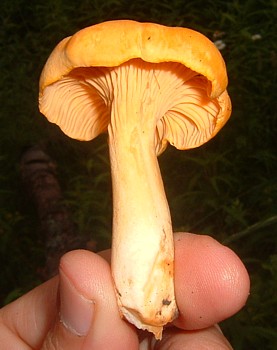
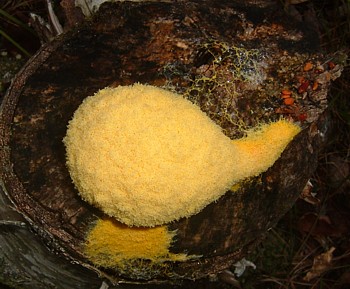
and admired a virulent yellow fungus on a stump sweating with rot.
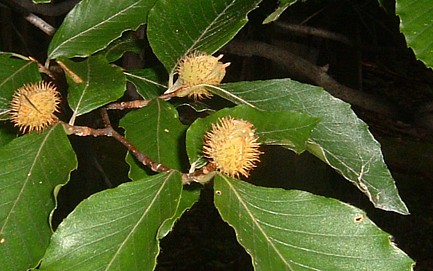
Now focusing on smaller things, I was startled by quizzical look some beech nuts gave me.
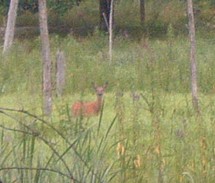
Once below the Second Swamp Pond dam, I began wrapping my own thoughts around my downed head, always a mistake at dawn. I looked around and saw a doe, head up in a sea of green grass observing nature much better than I was.
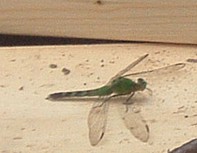
Back at work at the house on the land, hurrying to get work done before the rain, I paused to record a striking visitor.
July 14 last night before going to sleep at the land, I walked down the road to White Swamp. I stopped and looked at the Deep Pond from the road and couldn't see a beaver stirring. Then as I got down to where the road crosses White Swamp, I saw three groups of geese swimming away from me slowly. One group headed through a narrow strait in the grasses out to the wide pond. The rest of the geese went over to the grasses on the nearby shore and then seemed to freeze forming a striking tableau with all beaks turned toward me. Here was the dignity of one large family etched in the night.
Today I got a chance to take a brief tour around South Bay at the climax of a hot 90 degree afternoon. I headed to the willow latrine on the north shore of the south cove and just happened to pass the stick that had jutted out of the water earlier in the season where I often saw a heron perched. I had not see a heron on it for a while and assumed that with the water level a bit higher the perch was less convenient. Now I noticed that what formed the knob of the stick was capped by a large bryozoa. The first I've seen this year. I stayed on the look out but saw no more. As I nosed into the willow latrine, I finally saw a mother and her young, but not the otters I had been projecting there. A mother porcupine was lying out on the low broad willow truck, head to the east, and tail quills, loose, actually fluttering the wind. Behind her, with head facing the west, was her baby, with its soft quills just a kiss of menace. Both were asleep. Fortunately I did not have my camera. No photo of such a prickly beast could capture the smooth innocence of that scene. I quietly retreated and now understood who left the willow clippings in the dirt niche on the lodge that I thought would perfectly cradle a baby. For the rest of the trip I flushed herons, one with a medium sized bullhead in its beak. The spatterdock and lilies progress. The otter latrine on the east edge of the rock still smelled of otter scat but I couldn't see anything fresh. As I got deeper into the cove I noticed a new crop of dragonflies, not the blue damsels, but golden wonders even smaller. Many were bulking up by attaching themselves to a doppelganger. I saw some birds dancing on lily pads snagging insects and I thought they might kingbird getting down and dirty. But they proved to be female redwings, or fledges. Then I saw a kingbird high on a dead limb snagging bugs on the fly in the true manner of kings. And still more herons. Then as a heron flew off the rock where the creek from Audubon Pond flows, I startled a goose off its belly and into the water. I tried to do it a favor by speeding ahead so it could go back to its nap but that only caused it to bleat loudly. It dawned on me that it was a gosling desperate to join its family ahead. So I went dead in the water and it caught up and stayed with the family as it swam up to the Narrows for some grass chopped and churned by the fat motor boats.
July 15 hot muggy day and evening but I headed to the Lost Swamp Pond after dinner and even was foolhardy enough to check the Big Pond first and cross along the Big Pond dam now dense with vegetations including cutting grass and barriers of large thistle plants and the hot sun was still up. All to say, that going out to see things, I was the sight to see, admired first by deer flies and then mosquitos. What did I learn? That at least in the shade, you might startle something interesting. Two baby raccoons and their mother, even though they were all apart, kept cool and quiet, the two little ones climbed higher
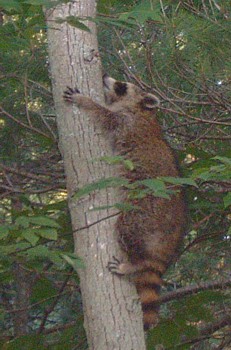
but maintained their curiosity.
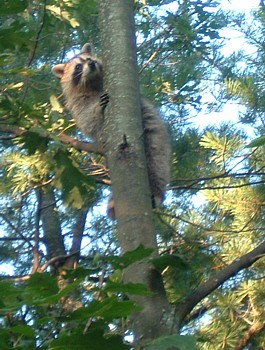
The mother looked at me and disappeared.
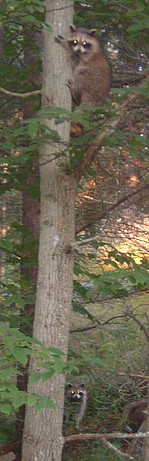
Down at the Big Pond dam the sight of a muskrat would have been cooling, but there were none to be seen. No signs of beavers anymore. The growing pile of sticks on the shore had disappeared,
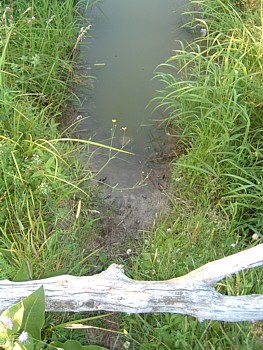
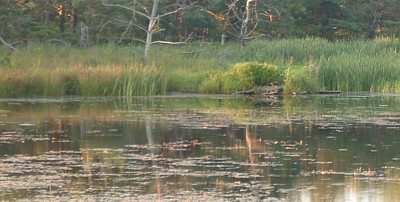
which is not uninteresting because beavers usually leave a load behind. If last year is any guide these beavers are in the next pond up which is usually lusher, more confined and at this time of year on almost any day, a guaranteed sweat bath, but I must deal with the fact that animals with fur evidently find the warm pond waters cool enough; that and their holes in the mud. I did hear a white throated sparrow. One had made much noise here in the spring and now was singing for the hometown crowd. There were ducks, and nearby. They went back into the grasses without any bother about me. I walked slowly along the dam and at least the vegetation drew no blood. Again no signs of beavers, nor any fresh muskrat poop for that matter, but the vegetation now is all concealing. However, there a nice dirt area still on the lodge.
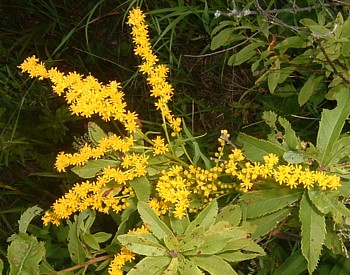
At one pause along the way I saw something yellow at my belly and enjoyed an early goldenrod bloom.
Getting to the woods between the ponds was a relief and I even went quickly to the rocks to prolong the pleasure of not having grasses pulling at my legs. As I came down to the Lost Swamp Pond, I saw a beaver in the west end of the pond doing the huck-a-buck as it subdued the pond vegetation, pulling a bunch up off the bottom, wadding it up and then gobbing it down. I saw another beaver crossing up beyond the lodge, not far from a muskrat doing the same. I should have snuck over to the north side of the pond, getting down out of the light southwest wind, but I was a ball of sweat so I sat up on the rock near the bank lodge high enough to almost persuade myself that the light wind was cooling me off. I took off my shirt and, as is often the case, when you show so much flesh the deerfly get confused and go away -- don't know why. Am I that bad looking? Two beavers came out of the lodge, probably because of my disturbing them and the larger one slapped its tail, which had no affect on anything that I could see. The other beaver escaping the lodge was small, but rather than seek cover, it began mining grasses
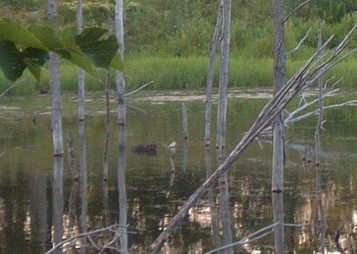
not far from the beaver in the west end of the pond, near me, who continued doing the same. I kept an eye out for any beavers in a chase, but didn't see that. One beaver swam by another, giving it a good hum or two, but there was no contention. I must say the few geese in the pond did seem as stunned by the heat as I was. Stock still, like they were trying to get cool from their own shadow. I heard a kingfisher briefly, and two heron flew in to perch for the night. I interrupted that. So with three beavers eating grass, and a forth cruising up pond, I walked over to see the show at the Upper Second Swamp Pond, and to make a long story short, I waited until 9:15 and no beavers appeared. I did see a procession of ducks, most of them ducklings going over the dam, leaving the more open Second Swamp Pond for the meadowsweet forest of the upper pond. Their wakes made the dark pond silver
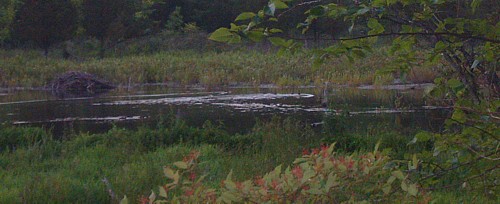
and not a few when they got over the dam into the deeper water immediately ducked their heads in the water and gave a shake. I waited until a whip-poor-will began to call. On the way home I lingered on the rock south of Second Swamp Pond dam. One hot night in July I first saw that year's otter mother and pup fishing behind that dam. None tonight.
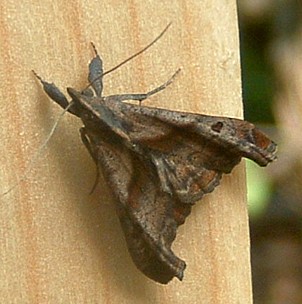
Meanwhile I keep working on the house on the land, and now and then get interesting visitors from the insect tribe who I fancy are some relations reincarnated and curious about my hammering
I'm usually too tired to hike deep in the woods or fields, but two porcupines screaming behind the cabin where we sleep drew me out.
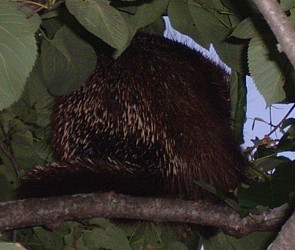
Both in one tree.
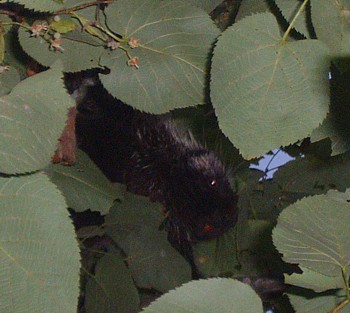
Fortunately they were quiet during the night.
July 17 I have little time to hike at the land, so now before going to bed I walk down the road and duck in to check the Deep Pond. On the way tonight I checked the Third Pond, getting lower. Leslie did see the muskrats here yesterday. There was a bit of strutting just up from the pond. The elecampane and giant thistles are hitting their stride.
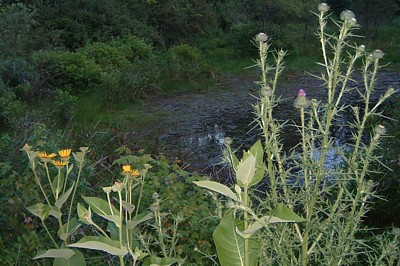
I waded through the honeysuckle now obscuring our trails and then through the thick grasses to the Deep Pond where I was pleased to see the beaver sitting up grooming in the entrance of one of the old beaver burrows on the steep bank. I knew it was too dark to get a photo but still moved closer and of course that prompted the beaver to move into the water. No tail slap, and no diving. It swam over toward me, weaving a bit, but since it followed me as I moved toward the dam, I fancied that it almost craved my company.
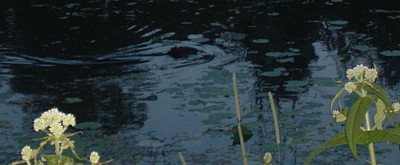
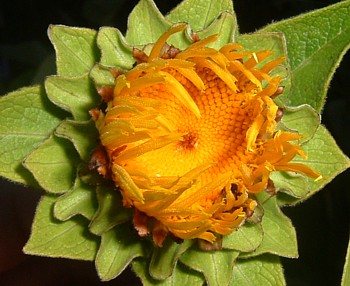
I had other distractions -- taking photos of the flowers and plants, taking advantage of the automatic flash of the camera and the dark back ground. I captured some elecampane buds opening
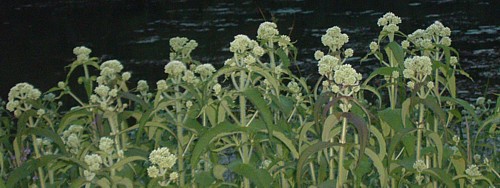
and a line of white topped plants, boneset, I guess, much lusher than usual
and then another flower, plain white with some pink, that seemed exotic in the dark.
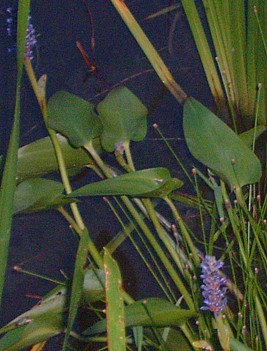
It was too dark to take a photo of the dam, which seems a little firmer, but I could capture the blooming pickerelweed.
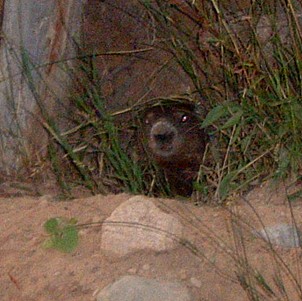
July 18 In tonight's walk I saw a small groundhog on the porch of its home
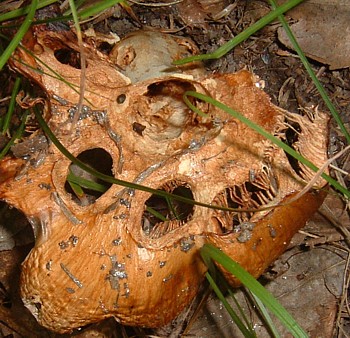
July 19 I was home for the afternoon and despite the heat thought I could at least go out and see the cardinal flowers below the East Trail Pond dam. Almost the whole way is shaded, and in the forest there might be a scarlet tanager low in the trees in an effort to coax his young. Red trophies for a blazing afternoon. Along the East Trail I noticed a mushroom that had been the meal of some mites.
I heard some birds high up but think they were red eyed or warbling vireos, which ever sings faster, and not scarlet tanagers. But the cardinal flowers were where they always are,
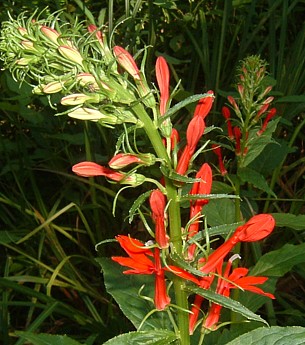
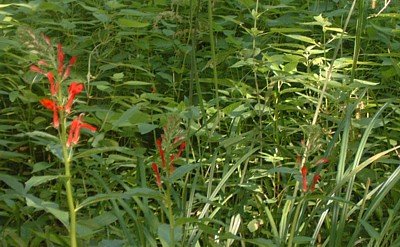
not as many as usual, but perhaps that only seems to be the case because there are so many other plants up this year.
I crossed the creek and went up the knoll above the Second Swamp Pond. I've seen this pond frequently from the opposite shore, and I usually cast a worried look. Fronting all the emerging grasses, the pond looked like it was disappearing. But today from the knoll I could see that the pond not only has possibilities, but probabilities.
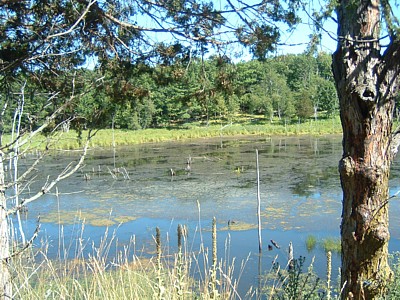
Otters will be here on soon, if not already because I saw trails in the pond. But ducks, I had to own, probably made the trails. I sent a wood duck almost flying across the water, then a mallard flew in and quacked about like it was practicing a speech, I nestled back in the grass and the wood duck came back slowly, picking bugs off the pond vegetation. Then a large mallard family came out of the grasses of the upper north shore and the little ones, about eight or nine, lined up on a log and just like Mom preened. I kept an eye on them. She was still preening when all the little ones in four bunches of two were still and low on the log, napping I suppose. Meanwhile, I admired the kingbirds and phoebes. Of course only the smaller bird got close to me.
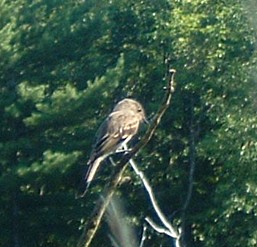
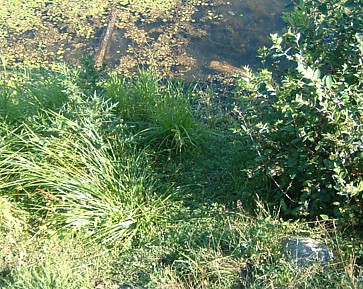
A loud flock of chickadees, all sounding an alarm because of me, still flew in the cedar above my head, as if I wasn't there. The phoebe flew over at the commotion and seemed confused by it all, at a loss for words or bound not to break that vow of silence so many birds have in July. After an hour of this enjoyment, I got up and did what I came for -- check a worn spot above the auxilliary bank lodge. I could see that the grass had been trimmed, probably by muskrats or beavers, but no otter scats.
Of course I checked the big bank lodge which was obscured by vervain, thistles and jewel weed so thick I couldn't get a good photo. Looking toward the dam it looked like there had been traffic through the lower portion of the pond.
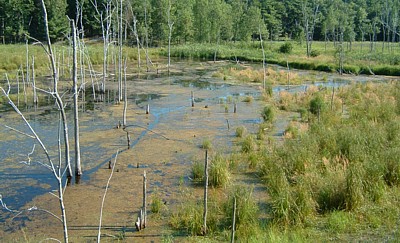
Then I went to the point of the rock that forms the knoll and saw two styles of poop -- smooth brown and insect laced.
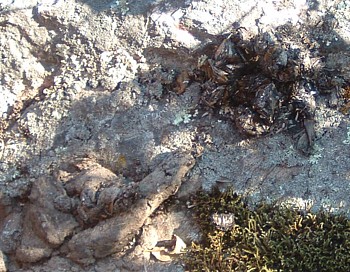
Actually this could be left by a raccoon or a skunk, but I couldn't imagine the latter going up on the point and gazing out at the swamp below.
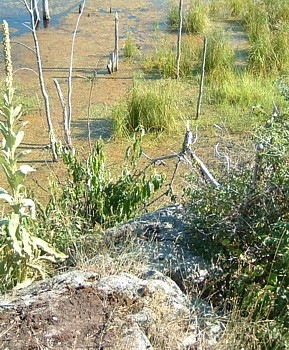
I also noticed what looked like a hole in the lodge that had had some ins-and-outs. On the way back I chronicled the low state of the East Trail Pond, which I had once fancied would never be at a loss for a brimming flow of water.
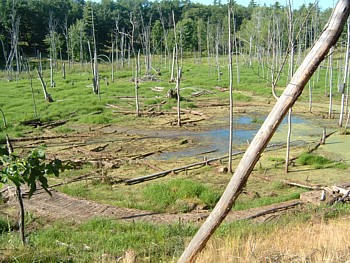
The creeks are dry now so my once favorite summer haunt is at least not losing water. Our renter Jean says she saw a fisher twice on her hikes -- something else to look for.
by Bob Arnebeck
Check out my other web pages: otters; beavers; minks; muskrats;porcupines;Leslie's art