July 2006
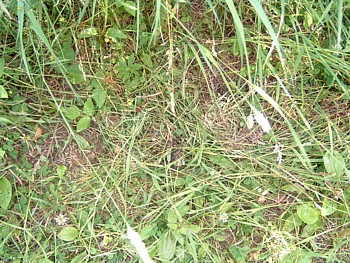
July 2 I cringe from the Fourth of July crowds that come to the river, but I can't assume that otters are at all put out. So while I would have preferred to hike into the interior swamps and sit on a pond bank for two hours just on the chance that otters would appear, I knew I had to go where I expected the otters to be, in the South Bay marsh. There I was pleasantly surprised by a small otter scent mound along the trail near the small causeway over the south creek coming into South Bay. It was on the west side of the trail where otters lined scent mounds last year.
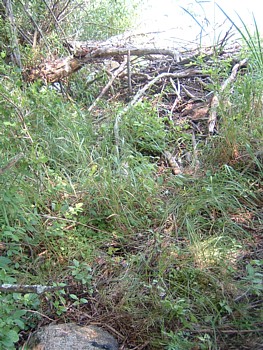
This year they marked the east side of the trail. There wasn't much scat, but I had no doubt that an otter did the deed. So I went out to the willow latrine expecting to see more scat, and I smelled it before I got there. An otter had extended the latrine in back of the beaver lodge.
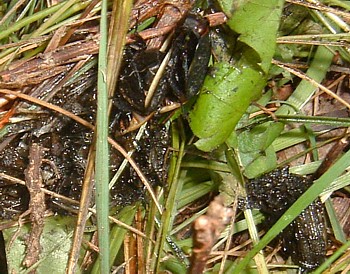
The scat here was plentiful, black, smooth, and popular with beetles whose shells merged with the scat.
A few feet away there was a freshly severed bullhead head which was even more popular with the insects.
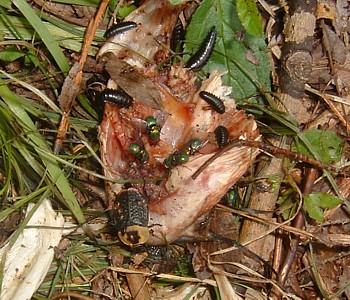
Otters commonly leave the head, and this one was so fresh that the nightime raccoons hadn't had a chance to get to it. There were a few heads picked clean in the area that I had not noticed before. There was a brisk southwest wind blowing up the water level and for the first time I noticed water sloshing in the beaver lodge.
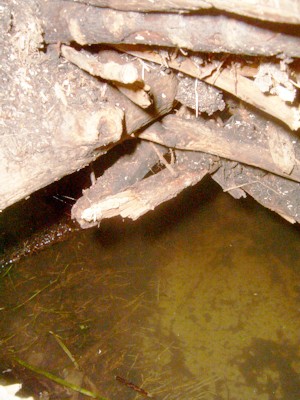
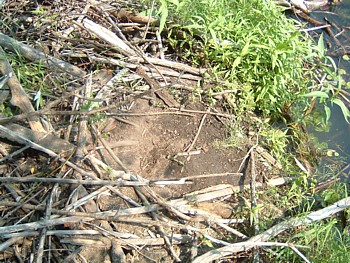
As I recall, years ago the beavers did make the lodge in the late summer, as the water level went down. So perhaps this lodge is not that convenient for a resting place, though I suspect that there are burrows going from it to burrows under the willow -- I only see half, or less, of the willow world. More to the point, I saw a nice platform fashioned on the lodge, and on this comfortable mud one could picture an otter pup being fed.
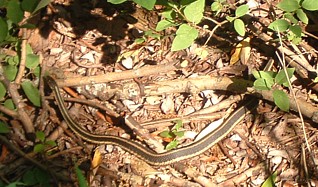
I nosed around the rest of the latrine and saw a garter snake sunning in just about the only bit of sun the willow was admitting.
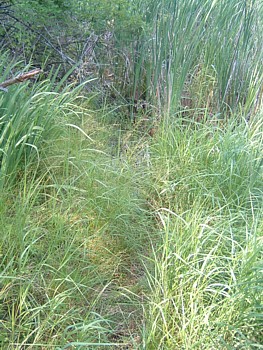
I was hoping to see a cozy latrine with fresh scats but only saw a few more bullhead and carp parts. The carp skeleton was now in the water. There was a clear trail cutting over the mound of grass back into the now flooded marsh where I suspect otters to be.
If I had not seen the new scat near the causeway, I would have continued around to check the other South Bay latrines, but I decided to check only the old dock and New Pond knoll, no otter signs at either, and then head to Big Pond dam to see the scat on the South Bay trail was left by an otter on its way to the interior ponds. On my way I checked the Porcupine Hotel again, once a July den for otters, but saw no signs that anything had denned there. From the top I got a view of the knoll on the other side of the creek that had once been a favorite July latrine,
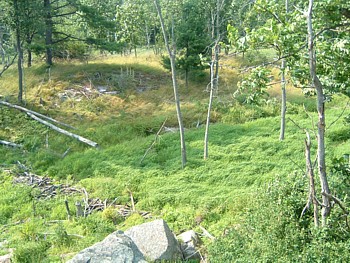
and above that was the meadow of what once was a favorite pond for otters to fish.
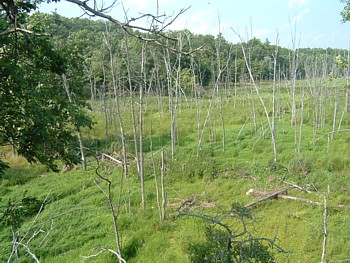
and then head to the Big Pond on the chance that an otter was marking the whole of its territory. I decided to cut over to the Big Pond by going up the broad rock ridge and stopped at a slab sticking up like Paul Bunyan had become a geology professor and had cut and propped up a rock for instruction.
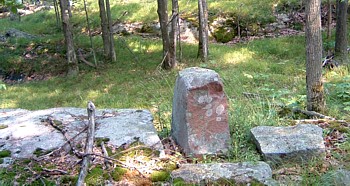
I walked down the grassy valley half formed by the rock and got a photo to show its erratic behavior.
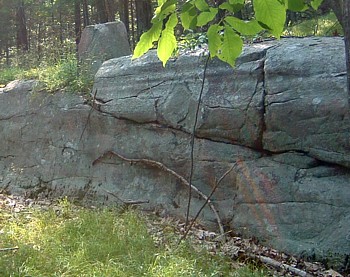
By going up the ridge I stayed in the wind, then on the lee side the deer flies began to warn me of what was to come. This year the meadows are almost impossibly thick, and from the crest of the meadow I could see a sliver of the so-called Big Pond.
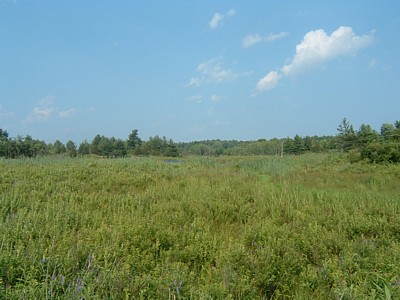
I waded through the grassy viney shag, thankfully no stickers, and scarcely noticed when I reached the creek coming down from the Big Pond.
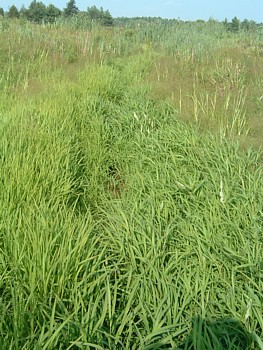
This is the highway I thought an otter might take!
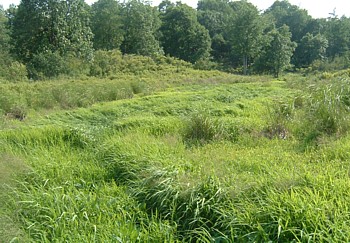
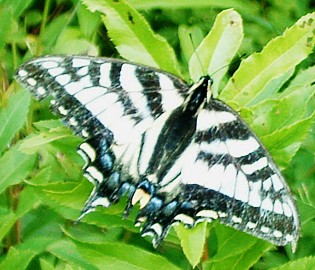
I did go up to the dam and there were no otter signs. Turning to go home via the ridge, I could see a little pool behind the dam below. So an otter would only have to negotiate some thirty yards of thick vegetation which it could easily get under. Going through the meadow I stumbled upon a doe who got away before I got my camera out, and a swallowtail who, seeming a bit worn, stayed put.
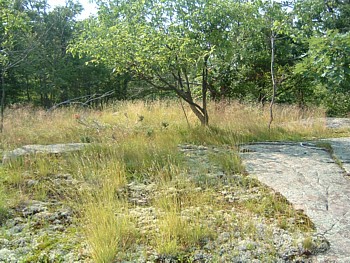
A few days ago while crossing the TI Park ridge I flushed a turkey hen and her fledges. She rather burst out of the brush and was out of sight in seconds -- no wounded bird act here, leaving the fledges to scramble for cover. Today the same thing happened, she flew off and the little ones waddled into the grasses, none too thick on the ridge.
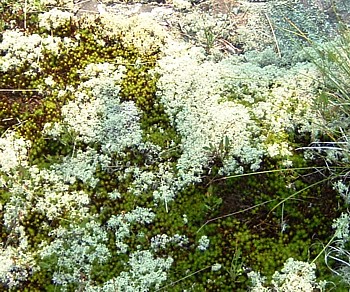
That got me looking down and admiring how rich the mosses are this year.
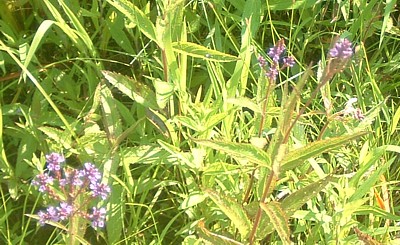
July 3 I took a break from working on the house to see what was happening at the pond. Last night I sat by the First Pond, and nothing stirred but the birds and the frogs. No muskrats appeared. This morning I walked around the Deep Pond. The vervain is starting to bloom
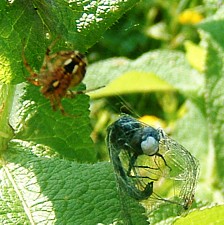
And on another plant on the dam I saw a spider wrapping a bug bigger than it was, a huge fly, I guess.
There are water lilies in the pond and the start of a good cluster of pickerel weed, all indications that a beaver or muskrats are not around. But then the dam looked different. There was grass and a bit of mud on a log I layed in front of the dam, which was holding back water.
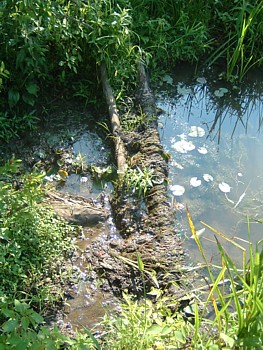
But we've had some down pours and a rush of water might have done that -- though water rarely rushes out of this pond at this time of year. Before I noted some sticks over the entrance to an old muskrat burrow, and there seemed to be more sticks there, and it all looked damp as if recently minded.
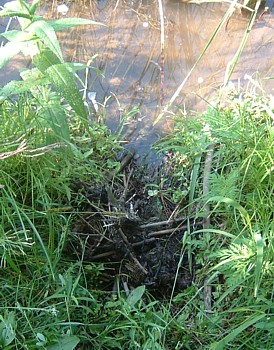
Then I found trails in the grass coming up from the pond, and one led to some nipped willow -- a good sign of a beaver or muskrat.
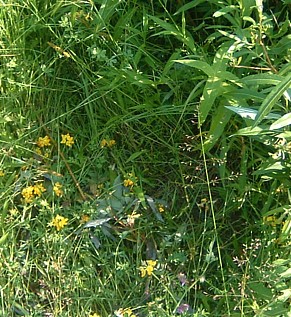
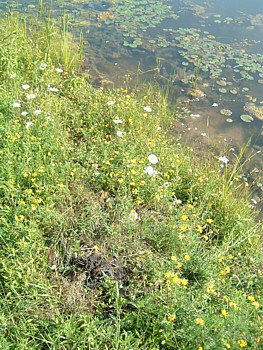
But none of the trails went up to any trees. Then beyond the embankment, toward the inlet creek, I saw a relatively fresh bit of mud and grass, a typical, though tentative beaver marking. But there were no stripped sticks about, and the pond was not especially muddy.
All to say, I better come down at night and see if a beaver is here. I think the Third Pond has lost too much water to support even muskrats
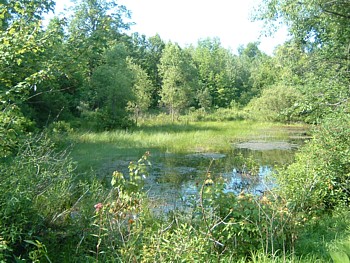
There were no trails in the pond grasses.
When I got back to the island, I took advantage of the wind calming down to go out in the boat and check the latrine in the outer marsh of South Bay. I couldn't say that it looked different than the last time I checked it
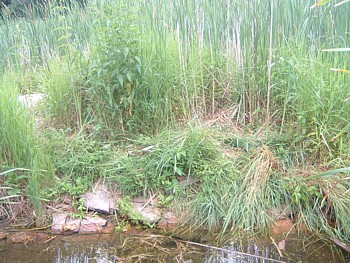
but now I could get out of the boat and see the scats and see if there were more scats deeper in the marsh.
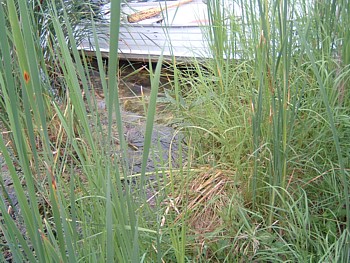
I could see old scats but nothing fresh.
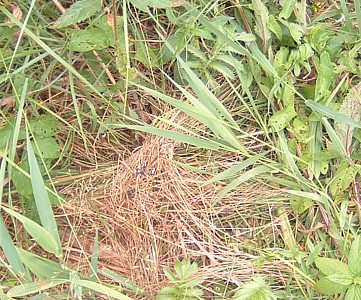
Then I checked a flat rock in the middle of the marsh but there were no scats there. Then I headed up the marsh to the west and a few yards from the waterside latrine, there was a circular area about ten feet in diameter of dead, flattened cattail stalks.
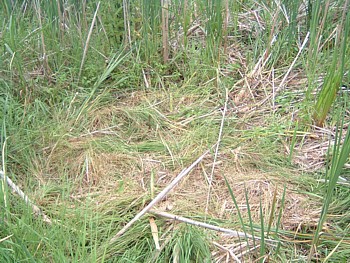
Here and there I could see old scats,
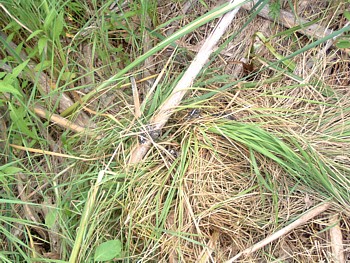
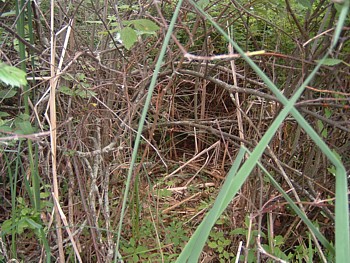
but I also saw some deer poop in the middle. The peninsula is only about ten yards wide here so it is a comfortable resting place for otters, and probably quite an exciting place for deer to sleep in, but there was very little deer poop. On the west side of this open area is a dense thicket, also, I suppose, a nice place for an otter to den.
Then I rowed down the marsh to the rock latrine that fronts the bay, nothing new there. I walked back to the rock concealed by the marsh and woods, and here I saw scats but several of them were stained brown which I often attribute to raccoons.
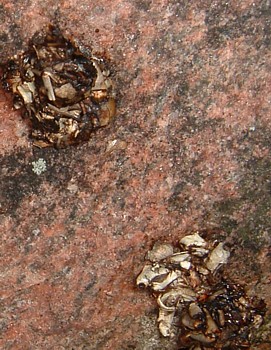
And I did see a raccoon family in this area the other day. But the freshest scat looked and smelled like an otter's doing. It was bug fresh.
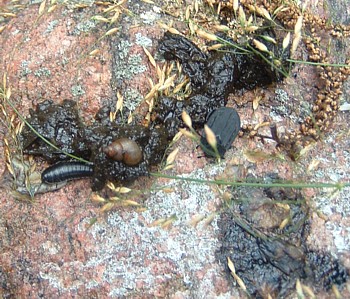
The scavenger that looked like a larva was on the move sniffing out other fresh poops.
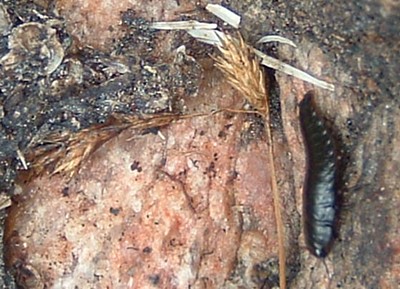
The grass next to the rock was matted down, but there were no scats there.
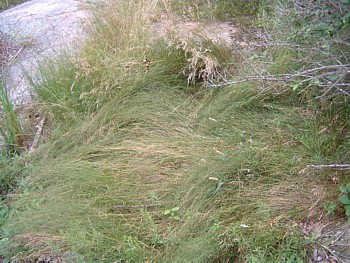
I took a photo showing a view of the willow latrine across the marsh
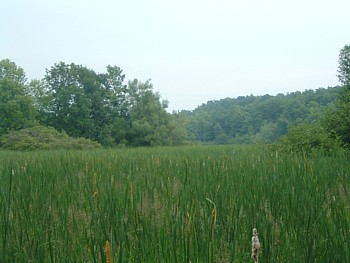
That is what I think is the axis of the otter world around here, during the early summer at least, but I had expected more scats. Then I rowed up the bay to deeper water and motored up to the latrine at the entrance to the bay. As I got out I admired some purple loosestrife just blooming, a beautiful plant that has been in this country over 150 years that is unjustly condemned by the ecologists looking for an easy target
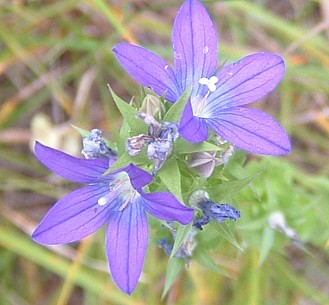
The latrine had many more new wrinkles in it, but I don't think otters were doing all of the pressing. Geese had been up in the grass and left a bit of poop. However, down at the rock just out of the water, I saw wet scat that looked like an otter scat.
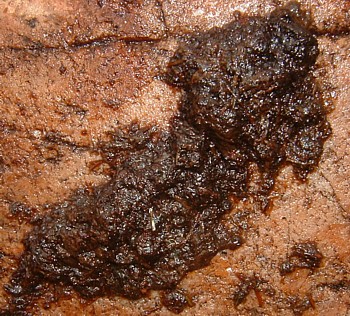
However, I had my doubts because next to it was some dried goose poop almost shaped the same way. So I suspected I was seeing goose poop merged together in an uncharacteristically large clump and kept wet by the waves. Then, looking at a photo of the dry stuff, I saw that it was streaked with black, like the otter cast a squirt of scat over it.
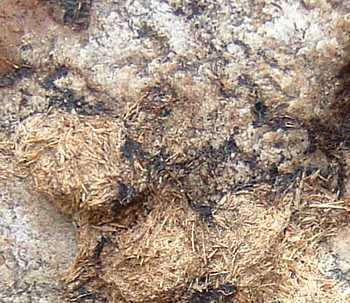
I'll have to see what it the wet scat looks like when it dries out. I didn't have an eye out for birds this trip but I couldn't help but noticing a mallard with one duckling dodging the heavy boat traffic.
We went back to the land to sleep and I went down to the Deep Pond to see if there was a beaver there. Mosquitoes are out in force now and it was like old times swatting them while waiting for a beaver. I didn't have long to wait. As I walked down to the pond I heard and saw a half splash on the other side and it was a beaver, acting just like the beaver we saw a few weeks ago. It swam up and back edging closer to me, then, still weaving back and forth, went back to the sapling it had pulled into the water. But it didn't eat it. Instead it went to the shore and seemed to hide there. I sat down to see what it might do next, and also to see if muskrats were about. Soon enough I saw a muskrat, but lost it in the diminishing light. There was still enough light however, to see the beaver wading up into the grasses on the opposite shore, dining much like it did the last time I saw it in the Third Pond. So I had a story to tell as we lay in the cabin listening first to the wood thrushes and then the whip-poor-wills.
July 4 I celebrate this noisome holiday by kayaking in the middle of the afternoon, my modest protest to the endless motor boat traffic that gets the whole river into a chaotic chop. However, this afternoon threatening squalls moved through. I got out just as they passed, ahead of boats returning to the fray. So, I had South Bay to myself. An osprey was sporting high in the wind fluttering up and back in a way I associate with courtship, but it wasn't the season for that. Then it dropped straight down, extended a talon and snared a fish out of the wind whipped waves. Otherwise, the herons were about as usual, the carp quieter, and the kingbird still in its nest. Geese were out in the waves too, in the deeper water, dispersed in a way that suggested that there were good things to eat out there -- not that I could see anything.
July 5 I headed for the South Bay trail a little after 4 pm aiming to lounge a bit at the Lost Swamp Pond after checking on otter activity in the marsh. There were no new scats on the South Bay trail -- and I forgot to get a better photo of the yellow wood sorrel I saw there. On the way to the willow latrine I noticed more digging in the circle of dirt that, last year, was an otter rolling area, but there were no scats to be seen. The willow latrine had no fresh otter activity that I could see, but I still learned something. The bullhead head that still had flesh on it the last time I was here was picked clean to the bone.
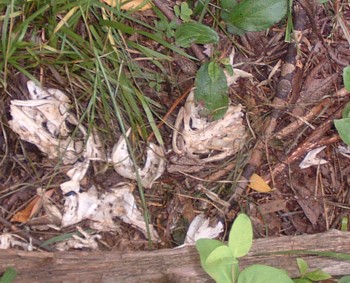
I had thought this process would take longer and always doubted how fresh clean bullhead bones were. Now I see that they can be rather fresh. I was disappointed at the lack of activity and have to suppose that there may indeed be only one otter about in South Bay or that if a mother is here, she probably has only one pup. I also checked the old dock latrine and the New Pond knoll and there was nothing new there. So I headed up the ponds first sitting at the rock on the south side of the Second Swamp Pond dam. This was a favorite pond of the otter family last year. Everything is so lush it would be easy to see an otter latrine and rolling area.
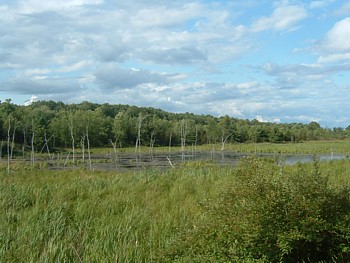
Nothing looking knocked over on the dam
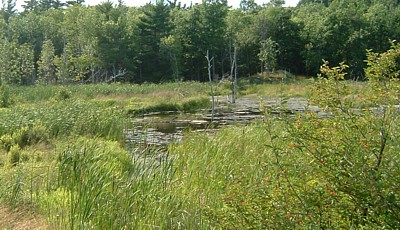
but there is a bit of brown on the bank lodge. I only saw one duck in the central oval of the pond, rather nondescript. But when I got to the upper oval I saw a large wood duck family pecking away at the water. The mother headed for the tall grass along the channel but the ducklings stayed put.
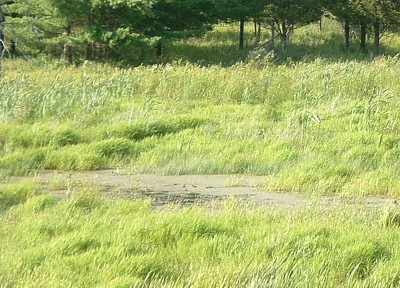
As I got the camera on them three almost grown ducks hightailed it.Meanwhile I saw some Indian pipes pushing up some dead leaves,
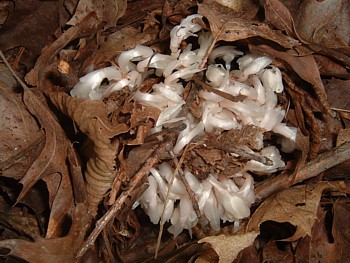
and as I bent down to take a photo, I saw a spotted salamander stretched out on a dead leaf a few feet away. Its deep brown yellow spotted body was slightly curved.
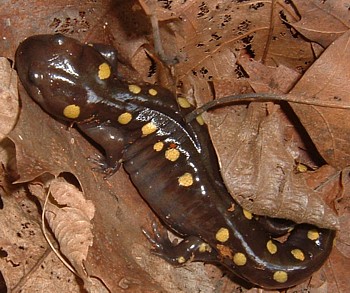
Its eyes were shut but all its delicate features, toes to nose, looked firm with life. There was none of that initial deflation of death and none of the bloating of rot.
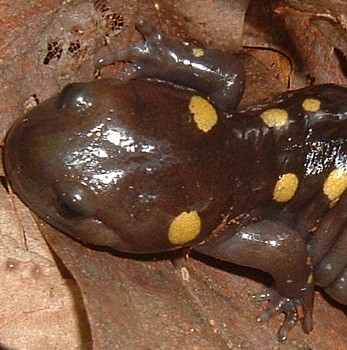
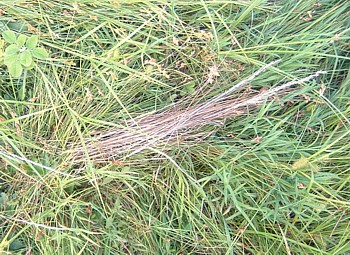
I poked it gently with a small stick and while it didn't wake up or rightly move, there was still suppleness and, I thought, some reaction. Here was something too beautiful to be dead and to prove it I tried to pick it up with a stick. That failed a few times, and still it didn't move. Death seemed more likely. So I picked up the leaves and took it to the edge of the pond and got the body down just in the water. It took about 10 seconds for it to wake up and before I could get a camcorder out, it hid in the wet detrius at the edge of the pond. I awoke it from a rather profound nap, and I hope no harm was done and perhaps some good, because while it had been sleeping in the shade, brown on brown, to me it was quite dazzling and perhaps some predator, if it has any, might have found it. I still heard the peeping of ducks so I sat up in the shade with a view of the Upper Second Swamp Pond and sure enough in about ten minutes from the time I first alarmed her, the mother wood duck led her charges over the dam and into the pond and took them along the dam into the tall grasses to the north, away from me. There were no beavers in the pond, nor muskrats, and I have not seen a mink around here for months, so I went up the ridge and over to the Lost Swamp Pond where there was more likely to be some action. As I sat by the Second Swamp Pond wondering where the otters were I noted that there were no herons working the pond and wondered if that was a sign of a lack of fish. But at the Lost Swamp Pond three herons flew up and I heard the cackling of a kingfisher. No lack of fish here. There were more trails in the grass and more indication that the beavers were making them. There was a small pile of long cut grass not far from the water much like what I've seen beavers cut to take into the lodge to feed kits.
I sat in my usual spot and before I could check its hole, a flicker flew out of it and for the next several minutes flew about on nearby trees like it wanted to get back to the hole, but not while I was there. I soon realized that I was watching a large schoolroom for birds. There was some uncommon crying from the large rock on the far south shore of the pond and I saw crows hoping about. Soon the crying stopped and there was some common cawing. Studying the scene in my monocular I saw that the biggest crow was up on a log preening while two smaller one were down at water's edge picking bugs off the frog bit, or some other pond carpeting plant. So I think the adult had trained, with some show of exasperation, her young how to get bugs off the water, and now she was relaxing in her fashion while the young continued to get the hang of it. Then I noticed that there were two kingfishers about with one doing all the cackling and most of the flying, while the other seemed to be trying to figure out the wide world. The cackler stayed close to but never lit on the same branch as the rookie.
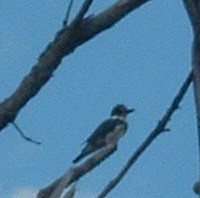
The latter found a perch right in front of me, did some preening, and then in a rather awkward, too fast of a flight, headed up pond toward where the last spate of cackling had come from. I had seen a kingbird nest here and soon enough a lone kingbird landed on the branch of a dead stump in the water. Over the years I have wasted much video tape waiting for kingbirds to fly out after bugs, so I didn't train the camcorder on this bird. Then it flew off in the most wonderfully erratic flight I have ever seen. The bird seemed to literally follow the flight of a mayfly or other fluttering bug through a series of looping gyrations until it was out of sight. While this could have been a mature bird taking it to the proverbial higher level, I think it was a fledge spellbound by the flight of a bumblebee, so to speak. Later I saw a kingbird across the pond
and several times it flew off its perch after insects according to the book, intercepting and not following, but I suppose it is good training for a bird to get inside a bug's brain. The wind was gusting from the west and cheating into a northerly direction so that it whitened small plots of the pond with ripples that went nowhere. Then I saw one of those white patches with a brown lump behind it and discovered that a large muskrat had made it out into the pond without me noticing. It seemed to be half nibbling and half grooming, typical breakfast behavior. It swam off back to the lodge in the middle of the pond but soon came back. Then before I could cock a camera, a small muskrat swam right below me and into some vegetation emerging in the water,
but it just sampled that for a few minutes and continued swimming hard to the west. My time was about up and I debated my route home. There was that flower I missed photographing by the South Bay trail and there was the bank beaver lodge to check, as it looked like the beavers had piled more on it. While I was debating that I saw the muskrat swimming to its burrow in the grassy shore below me
I knew that by getting close to the bank lodge, I might alarm the beavers, but it was past half past six and about time for them to be getting about. At least three bubble trails left the lodge one after another maybe ten seconds apart. It took awhile for the beavers to surface but I finally saw one near the lodge in the middle of the pond and the other a bit further out more toward the north shore. The lodge has been fortified with more grasses and mud and a large pine branch was on it.
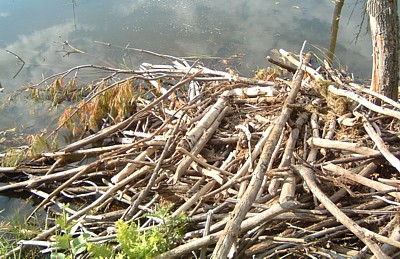
I think this colony is adjusting to life without bark, living off of grass for now. Much of my viewing pleasure depends on their success, and in that regard, I wish they had showed more spunk when they left the lodge -- not one tail slap. Let's hope they are mellow not weak. I had time for one more photo, a strange flower, wild basil?
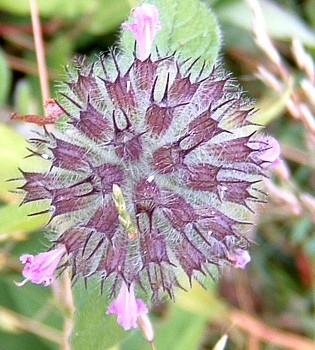
and then I hurried home via the Big Pond dam where I noticed no new beaver activity. I'll have to get out in the evening to see if this means they have retreated to the upper pond, as they did last summer, or if they too are living off the grasses.
July 6 I paddled slowly about South Bay from 8 pm to almost 10 pm and did see a muskrat for my troubles. No hint of otters, and the beaver didn't show up either. A turtle nosed up in the gloaming which I thought curious. The redwing blackbirds still hang on the cattails low above the water as always, but now they are quiet. Not a cross squawk as I paddled by. The muskrat swam out of one of the willows on the south shore, didn't go far and disappeared in the high grasses in the water. I saw a kingbird fly from the willow across the cove, but not to the willow that I knew had a kingbird nest. Two goldfinches seemed more interested in the bugs than getting a drink. When the moonlight took over all was quiet save for a few bullfrogs.
July 7 I had one more place to check for otters, the Great Swamp on the ridge to the north. I went via the East Trail and veered off it to check the east end of Thicket Pond. I saw that the southeast canal was rich with mud
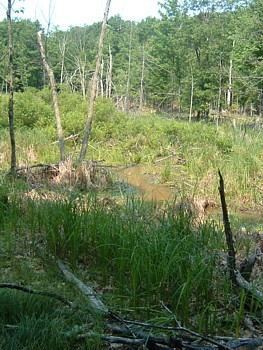
so I sat in the shade and soon heard a beaver gnawing, couldn't see it though. From the ridge between the upper end of the East Trail Pond
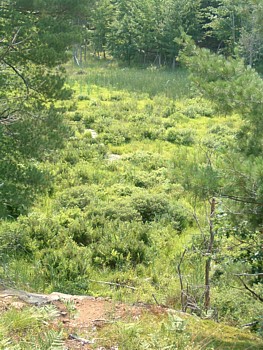
and Shangri-la Pond,
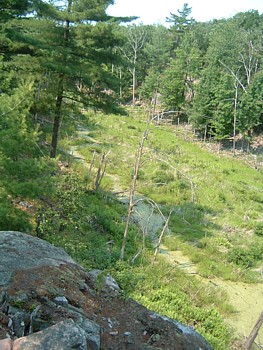
I took a photo of each, wondering if the strip of water remaining in those once potent ponds was enough to entice an otter. In other years that portion of the East Trail Pond was a nursery for otters. Going down the ridge to the Great Swamp I always check the small upper pond first. No scats in the old latrines but something, probably a muskrat, is using the old bank beaver lodge there.
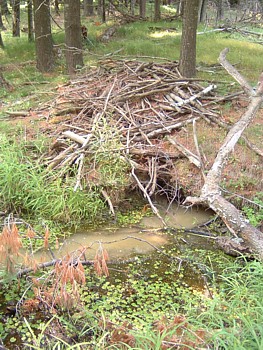
The Great Swamp was quite green with duckweed
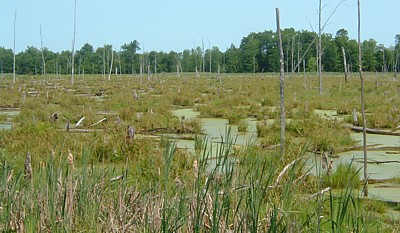
but there were enough open areas, I thought, to attract piscivores. On other visits I've had the pleasure of counting herons and ospreys but I didn't see one today. A song sparrow entertained me, and another warbler worked the litter under the trees almost to my feet.
Later, a quick drab brown bird picked through some old cattail fluff and carried it up into a tree. I didn't sit long so couldn't expect to see much, but was pleased to see a muskrat swimming through the duckweed, disappearing before I could get the camcorder to record its progress. On the way home I walked around Thicket Pond and didn't discover any beavers. They have cut a small tree across the trail, but haven't done too much lumbering since I was here last. Of course, I checked the New Pond knoll latrine, but nothing new from the otters there.
by Bob Arnebeck
Check out my other web pages: otters; beavers; minks; muskrats;porcupines;Leslie's art