February 2006 part three
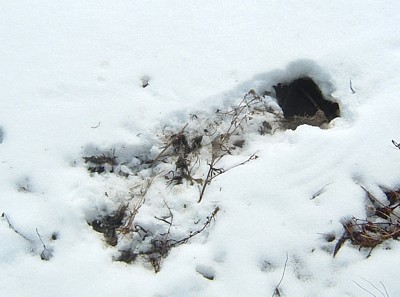
February 15 thawing once again but not enough to loosen the ice and invite the animals under the ponds to come out. That said, at the land I did see a hole where a muskrat seems to have popped out and grabbed a bite.
I walked over the beaver ponds on the island about an hour before sunset which afforded a gentle light on the slowly growing puddles of melt water atop the ponds.
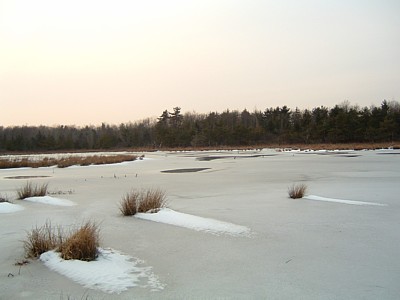
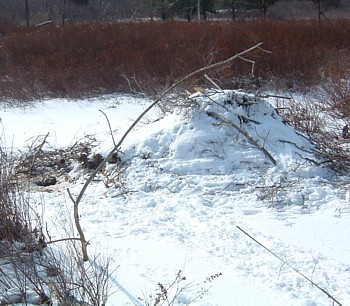
The retreating snow along the edges revealed a pile of stick just a few yards from an old beaver lodge.
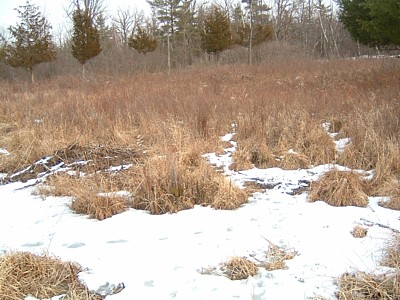
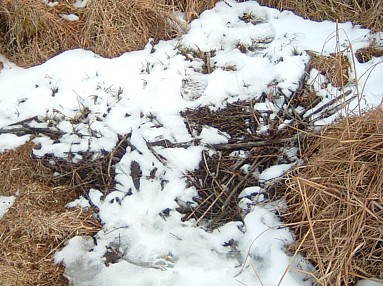
This was made two or three years ago, and by the same colony making such nice piles along the shore of the Upper Big Pond. What is interesting about these piles is that usually only half of the sticks have been stripped. It's like the beavers make a pile of these dogwood twigs as they continue to get the bigger branches and logs from maples, willows, and even red oaks. I'll have to play closer attention to these piles to see when they make them -- my guess is that they do it sometime in the fall.
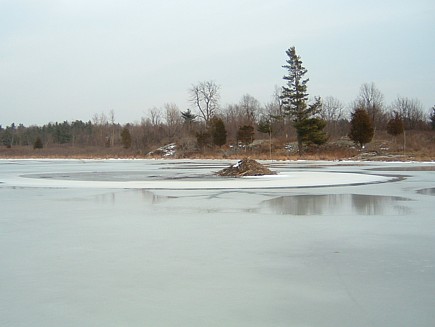
I continued on to the Lost Swamp Pond to see if the beavers had a hole in the ice beside their lodge. It was hard to tell since the wind can ripple the puddles of water on the ice. If so, it was small and no evidence of it being used. Though the lodge towered over the cold plain of ice, the circles in the surrounding ice seemed to lift it, to warm it, a curious kind of welcome mat saying this is a warm home after all.
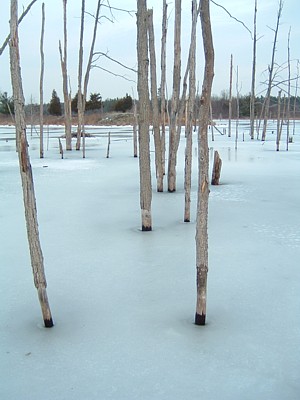
There was only a tiny hole in the ice behind the dam, and nothing had used it. And there was no hole in the ice behind the Upper Second Pond dam, nor any activity around the lodge. As I crossed the Lost Swamp Pond, heading home, I lingered among the dead trees that looked so important sticking out of the ice even though they were long dead and convenient only to the passing birds.
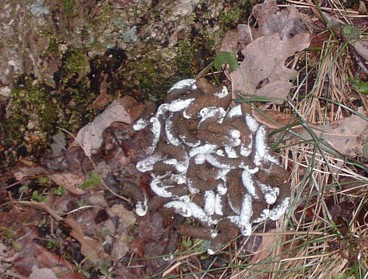
The only sign of life that I saw as I went up the snowless valleys home was a warm pile of grouse poop.
February 21 we took a long trip to Philadelphia and got back yesterday to find that we missed a ferocious wind storm that swept ice up on docks, and in the process moved our old sailboat off our dock and into the ice, slush and rocks just behind the dock. I'll wait until a thaw to assess the damage. When we returned the ground was bare, but then it started snowing, lake effect, and by late morning today we had four inches of fluffy snow. That promises good tracking for tomorrow, and the snow might be deep enough to give the otters some traction, so to speak. We went to our land to corrale buckets that had been blown about. During my walk around I stood at the Deep Pond for a few minutes appreciating the contours of the fresh white blanket, and noting that there was no open water at the inlet creek -- an indication of how dry it has become. There remained an opening behind the breach in the dam where the water runs out. Then I did a double take because I saw a small, black animal, in prayerful attitude munching something on the ice. Judging by its color and small size I decided it was a water shrew. As I got my camera out it took fright and dove into the water. I walked closer and took a photo of where it had been,
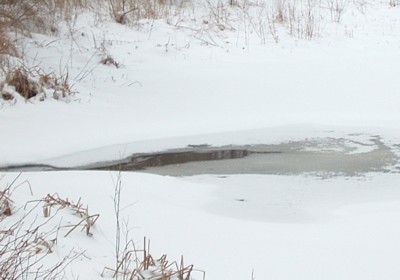
and noticed that it was so lightfooted it left no tracks. I waited a bit but the water did not stir. Later Leslie came down and saw a muskrat -- she saw its tail give a flourish. I'm still convinced I saw a water shrew. What I saw was too small to be a muskrat and did not exit with a muskrat's characteristic flourish. I hiked around in the gentle snow and got the notion of trying to find a porcupine in a tree so that I might prove that porcupines don't always take shelter from a storm but stay gripped on a tasty tree. I did find a small maple that one had been stripping but no porcupine was in it.
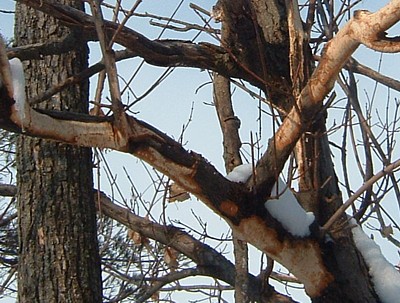
The gnawing in the tree was almost eye level; I could have touched the porcupine while it worked -- if I had been so foolish. I didn't see any fresh tracks in the snow except those made by two small deer, or one small deer going in circles. Chickadees were about; Leslie saw cedar waxwings, one with a very orange tail; crows had a row over the ridge, probably with an owl or hawk. On the way home we saw large flotillas of golden eyes in the river; and in yesterday's gale I thought I saw some buffle heads.
February 22 we headed across South Bay a little after 9 am and we saw one coyote trail going up the bay -- and the ice stretched with perhaps a few pools of possible open water all the way between the islands. We got off the ice at the docking rock and there we saw a mink trail, coming out of a hole in the brush just up from the ice
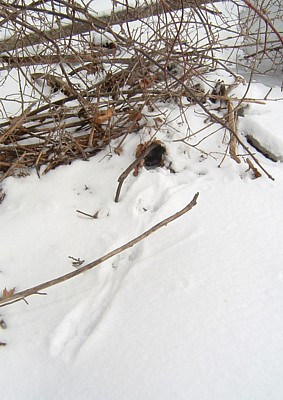
and nosing into the hole under the willow on the rock before it headed up the bay.
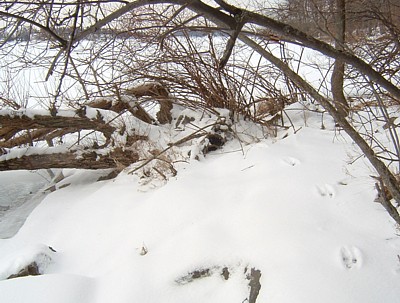
We went up to Audubon Pond and at first look nothing had been on it. Then I saw a mink trail going up from the pond and over the embankment. I walked down the embankment to the drain and while there were no tracks there, on the other side, coming up from the creek fed by the drain, there were mink tracks coming up and two smart slides going back down.
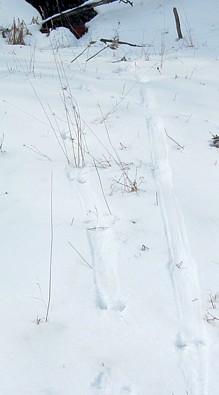
This could have been one mink taking two slides down the hill, but as we crossed the causeway we saw a small fan of mink tracks around a hole in the bank.
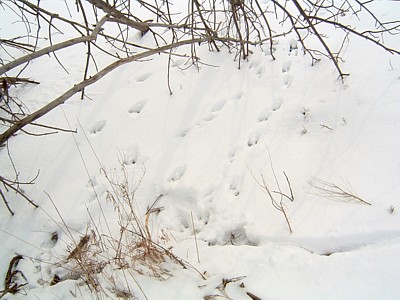
So I think there were two minks jockeying around the pond. It's as if the little minks were rewiring their territory after the snow. No signs of otters, however, nor of any beavers coming out on from under the ice. The sun was almost out and it felt like it was getting above freezing, so we expected to see some activity at Meander Pond. The lodges looked snug in the snow,
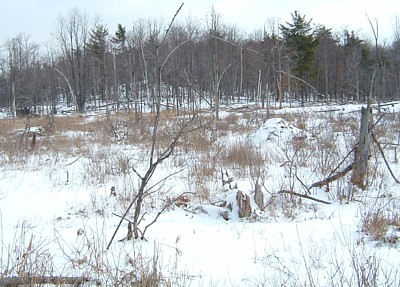
but there were fresh paths in the snow crisscrossing the beavers' collection of trees.
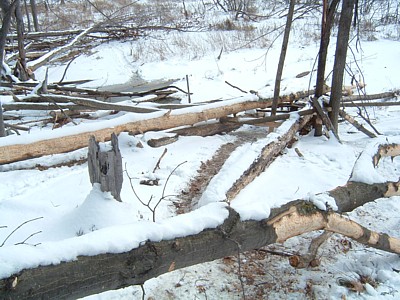
The beavers' trail extended up to the rocks of the ridge and I noticed that one went up a rock, then along the ridge to a small tree.
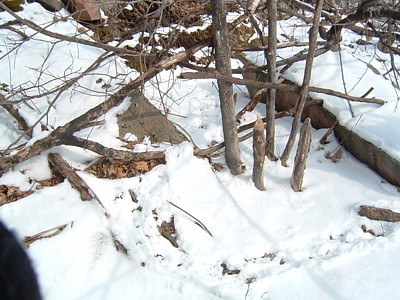
Evidently the beaver wasn't quite sure where it was going. That said, there was a straight path from the pool of water at the edge of the pond going into the crowns of two oaks that fell onto the grasses in the pond.
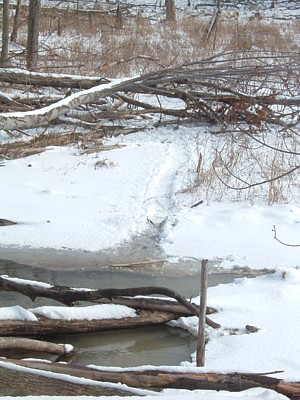
All this activity probably occured yesterday since the pool was mostly iced over. We walked down the East Trail Pond where over the years we've often been treated by porcupine trails, not to mention otters. Today, there was absolutely nothing, until we got to the old bank lodge by the dam. A porcupine had walked along the dam and then over the lodge on its way to the jumble of rocks where it dens. We walked around to the rocks and there was only one somewhat feeble porcupine trail. We also checked the ridge over the Second Swamp Pond for porcupine trails, but evidently the little porcupine who had been there at the beginning of the winter had moved on. Below, the Second Swamp Pond was clear of tracks, until a couple of foxes sported a bit along the south shore. The snow covered lodge on the Upper Second Swamp pond poked its head up over the dam,
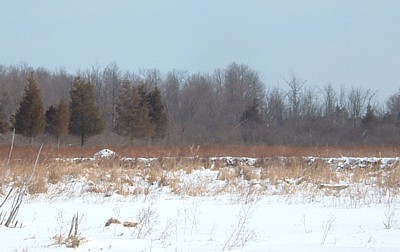
but once we got up there we saw that no animals had poked up out of that pond. Our last hope for otters, assuming they came in before the snow, was the Lost Swamp Pond, but there were no otter slides. Two or more coyotes had sported about on the pond,
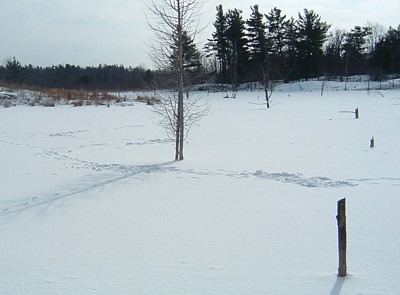
and we could see where they stamped about periodically, which is putting it chastely.
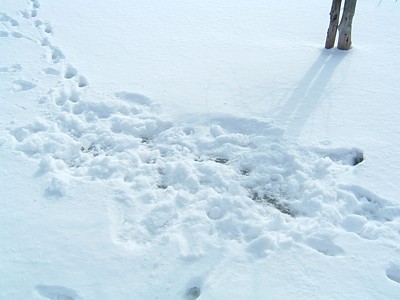
No poop, no urine, and no sign of their eating anything. From a distance we couldn't see any activity around the lodge up pond, so we pressed on to the Big Pond and then headed up pond to see if the beavers there had come out. We crossed a trail left by two or three deer crossing the pond and I showed Leslie how the shallowness of the pond this winter cheated us of seeing swarms of fish in the spring fed pool along the upper north shore. We headed up to the active beaver lodge where we saw fresh beaver trails in the snow most going no further than the piles of sticks on and beside the lodge.
There was a trail going up the ridge. It was good to see that these beavers are alive, and evidently well. As we headed home we expected the main attracting in the rock strewn valley to be porcupine trails. There were none at the bottom of the valley where the porcupines had been most active. Instead we saw a trail in the midsection, but not going to the den convenient to my camera, but higher up the ridge.
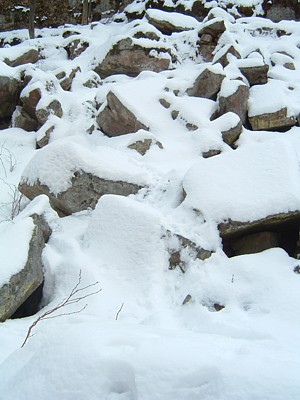
As usual we were attracted by splashes of color uncovered by snow -- especially yellow green lichens.
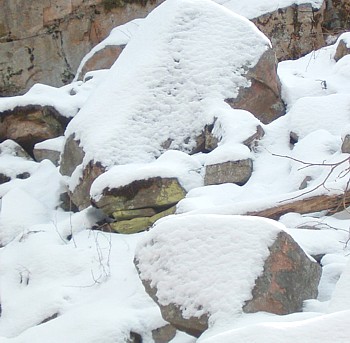
And then underneath a large basswood tree that a porcupine had climbed,
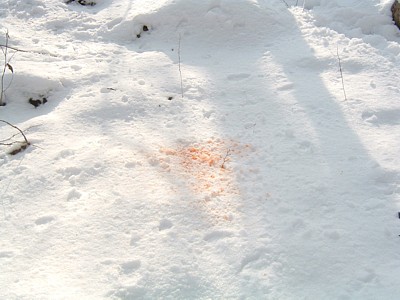
there was a spray of orange porcupine pee in the snow.
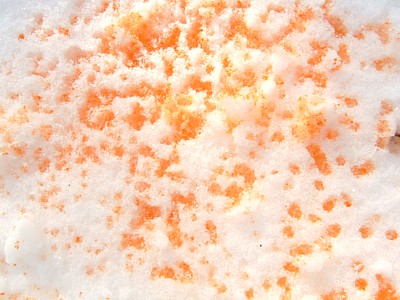
Not too many birds about during the hike: a red tail hawk looking quite beige, and some nuthatches. Quite warm when we got home, and still, the river quite calm, half clogged with lazy ice.
February 23 just above freezing, and the clouds moving off, as I headed to South Bay via the TI Park ridge. Crossing the ice on South Bay might be more dramatic, but I always learn more by going along the shore. There is usually a porcupine to check up on, and while several more small maples had been stripped a bit, I didn't see the porcupine. I walked around the old outhouse that porcupines often den under but there were no tracks coming out from under it. I think the porcupine is living up in the trees or in piles of brush nearer to where it has been foraging. As I crossed the old bridge over the creek going down to South Bay, I noticed tracks on the snow -- all raccoons. There were several holes in the ice over the creek
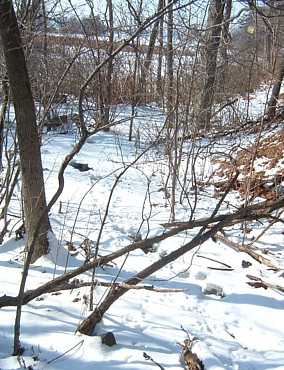
and I could see and hear a stream of water rushing underneath. Then when I got a view of the end of South Bay, I expected to see how far the raccoons ventured in that direction, and instead I saw otter slides. I soon saw that three otters nosed into the marsh at the end of the cove, and then came back out.
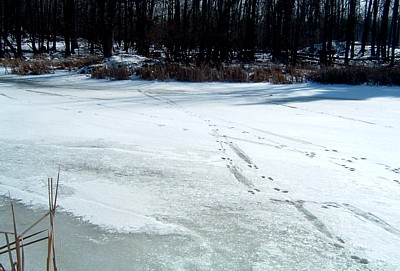
I had to walk up a bit before I could get on safe ice, and then I went out to get a close look at the prints and slides, easily ascertaining that three came in and three came out. I got back on the trail and soon lost the slides coming back up the bay. When I got to the old dock, I saw three slides coming over to it from the marsh across the bay. I saw tracks going into the hole under the dock
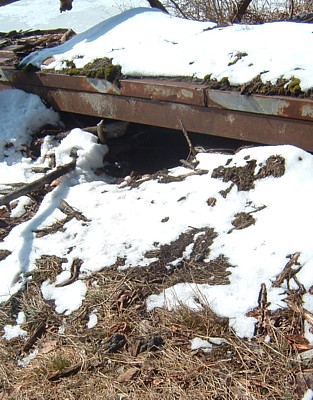
and there were fresh scats, one creamy brown
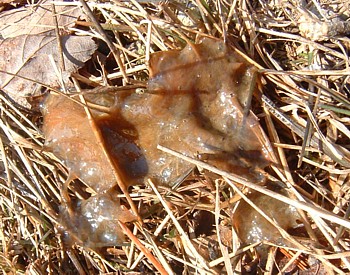
and two other tubular ones laced with scales.
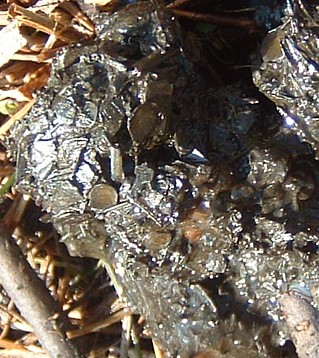
I walked up the bay a bit farther and found safe ice and walked out to back track the otters -- I had a hunch the otters came back to their old den under the dock. I got a photo of the slides coming toward the old dock,
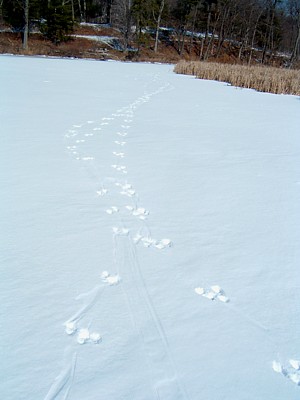
and then followed them toward the marsh which they skirted. Then I walked up along the marsh and saw that the otters had visited the large flat rock where I first saw the pups back in June. They had gone up and back near these rocks,
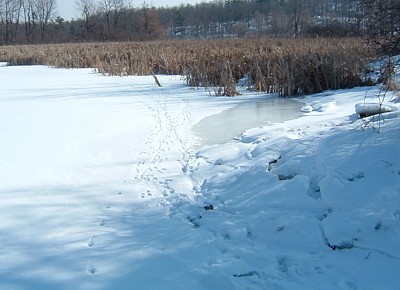
perhaps even getting into a small hole in the ice, but there were no scats on the rock, a frequent latrine.
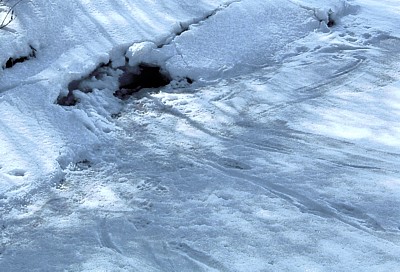
I saw that to get to this rock, the otters had crossed over from the other shore of South Bay. Here the slides were perfectly arranged to show the mother's trail next to those of the two pups.
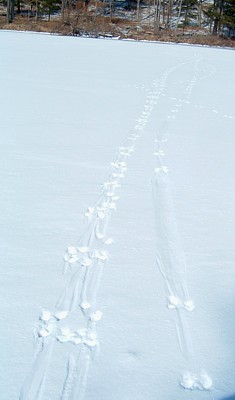
Her slides could be quite long, equal to five strides by the pups. I continued backtracking and saw where they had come out from under the ice beneath one of the willow trees bent over the bay.
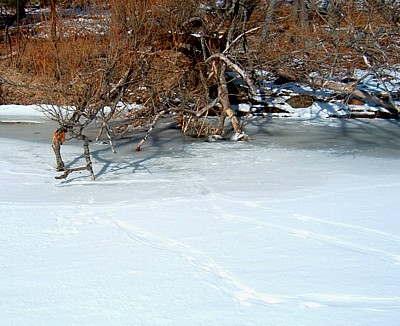
I continued up pond and then saw the trail of a single otter crossing back across the pond heading up toward the point.
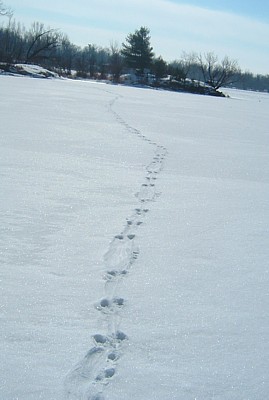
Further along I saw an old slide intersect the fresh trail,
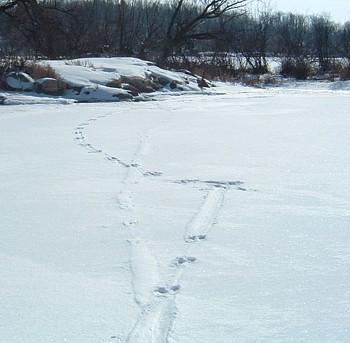
so otters have been here since the snow a few days ago. The otters had stamped their prints all around a hole in the ice near these rocks.
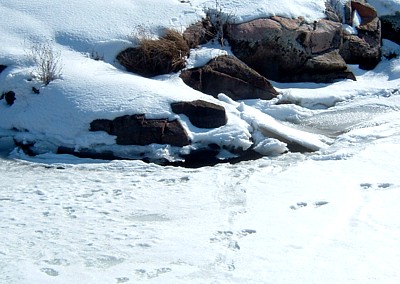
I walked around the point and saw where the otters had taken advantage of some open water under another large willow.
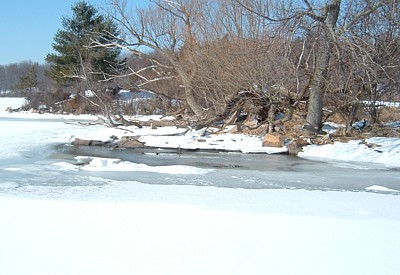
Clearly the otters, the family I have long watched, were utilizing their old haunts much like they did before the ice formed, going from shore to shore. Only now they were confined by small holes in the ice. Not seeing any slides coming from the upper part of the bay, I made a beeline to the docking rock. When I reached our prints from yesterday, I turned and saw that there was no way I could have seen the otter slides from there. Lesson learned -- I'll always check the end of the bay. There was nothing new at the docking rock, but up on the slope now free of snow,
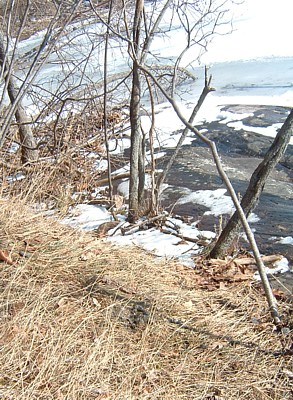
I saw what looked like fresh scats.
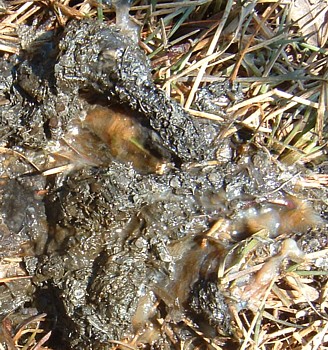
Certainly they weren't there a little over a week ago and yesterday when we came, they could have been covered by snow. This suggests that the otters were back in the bay before the snow fall on Tuesday. I headed up to the latrine above South Bay, going via Audubon Pond where there was nothing new. Here too I found what looked like fresh scats
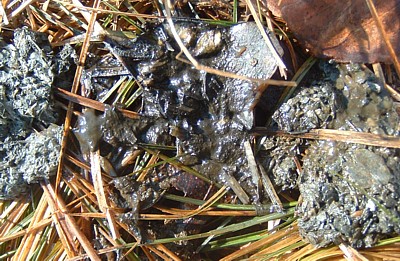
in the grass,
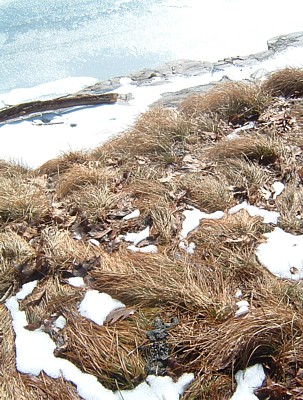
with no slides at all on any of the snow that remained in the area. And here there were no holes in the ice -- though farther out it looked like the ice was beginning to give way.
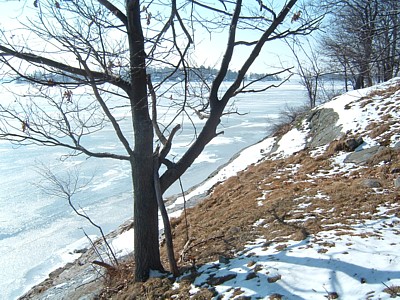
I walked back down on the trail and when I got to the willow that had a hole in the ice under it, I poked a stick in and figured the water was only six inches deep. There were quite a few otter prints on the little mossy bed under the willow,
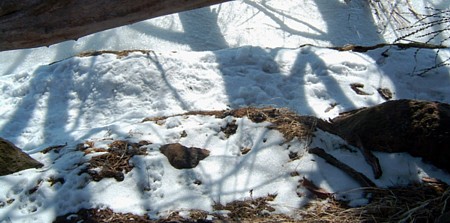
quite a bit of older scats and some that looked fresh.
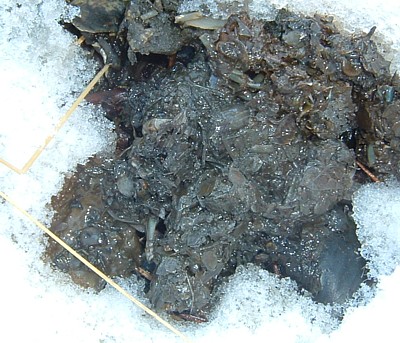
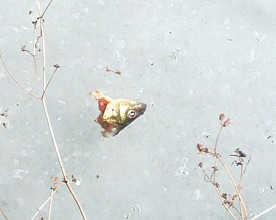
I also checked the depth of the water in an hole next to the old dock and here the water was at least a foot deep. One spring I discovered many tubular scats laced with crayfish parts here and in some of the scats I saw today, there were crayfish shells and claws, but there were many more scales. Off the old dock I saw the head of a small perch in the snow.
I continued along the shore but couldn't see where the otters might have gone under the ice. There is no snow on the ice along the shore, so I think the otters must have been traveling in the night or early morning when it was below freezing. I took the precaution of going up to the New Pond, just in case the otters went up the creek under the ice, but there were only raccoon prints there. I also poked around the end of the cove but couldn't see where the otters turned around. They didn't go up onto their old latrine under the old oak on the convenient mound of moss. Needless to say I was quite excited, not only to see that the mother and pups were still together, and perhaps another single otter also in the area, and I had never seen a clearer exposition of slides and holes showing how the otters use the shallow end of South Bay. I would plan an early vigil here to see if I could see the otters, but there are quite a few ice fisherman on South Bay, some setting up camp quite early in the morning, so my appearing close to the otters might crowd them too much. Plus I should be able to see what they are up to by the slides left in the snow. I forget to check the lodge under the willow on the north shore of the south cove.
February 24 A little before ten we crossed South Bay going to the beaver lodge underneath the willow on the north shore of the south cove. No signs of otters there. The hole cutting under the marsh just off shore was iced and snowed over. On the next rock up there were tracks on a rock,
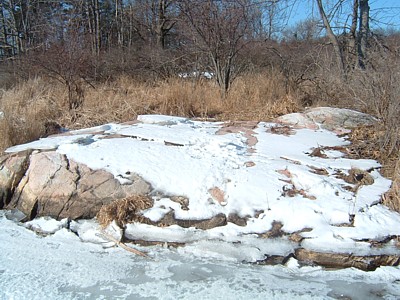
and a urine stain, but it looked like that was done by either foxes or coyotes, probably the former because the prints looked small. It was 20F, sun and a strong northwest wind. I showed Leslie all the slides I saw yesterday and was surprised at how much they had deteriorated. The old slides were imperceptible and the fresh ones looked quite old.
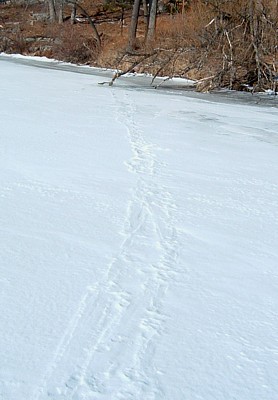
Yesterday there was one hole under the willow on the lower north shore; today there were two,
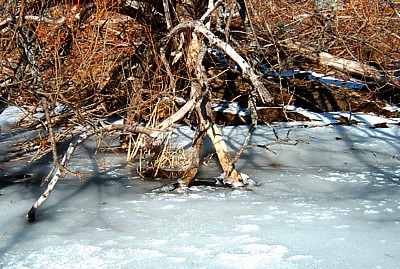
but no prints or slides in the hard ice around the hole. I checked the latrine on shore and saw no fresh scats there. Then I checked the latrine above the old dock. I saw another liquid brown scat which looked fresh, but it didn't look as fresh as the brown scat I saw yesterday. So I probably didn't notice the scat yesterday or it was even older than the other and had been covered by snow. I planned to go check the Meander Pond beavers to see if they were making exertions to keep their open water from freezing up, but first we took the precaution of checking the trail around the end of South Bay. There didn't appear to be any otter tracks. Then Leslie suggested we check the New Pond and on the middle of that pond, much to my surprise there were otter slides - a group of three going up pond and a group of three coming back.
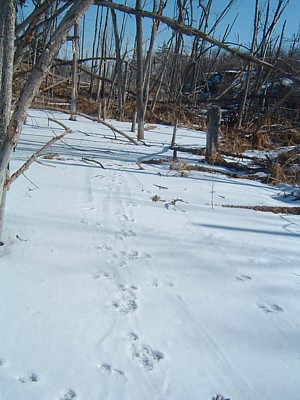
I had looked at this pond yesterday and was sure there were only raccoon tracks. So either I wasn't so perceptive or the otters made a dash up this valley yesterday afternoon. I think the tracks would have looked more distinct if they had gone up after the temperature dropped below freezing. I should have gone back to South Bay to see if I missed seeing slides going in and out of the bay -- we didn't look closely today. But it seemed more important to track the slides at hand.
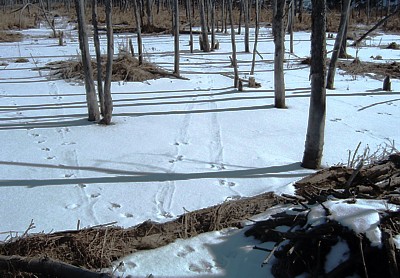
In March otters are prone to take the high road which I think has to do with mating and with the mother separating from her pups so she can mate. But these tracks went right up the creek which was mostly frozen.
Just below the Second Swamp Pond dam there was a long trough of open water filled with bright green grasses. I expected to see green otter slides coming out, but didn't.
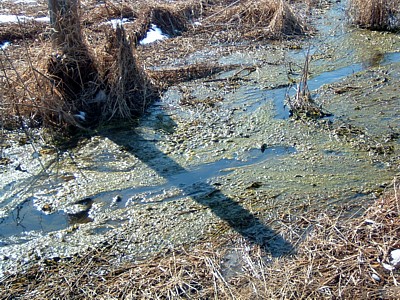
You could fancy that the otters had just slid through the slime. The otters went over the Second Swamp Pond dam and then went along the dam down to the area below the dam which they had used as a latrine in the fall.
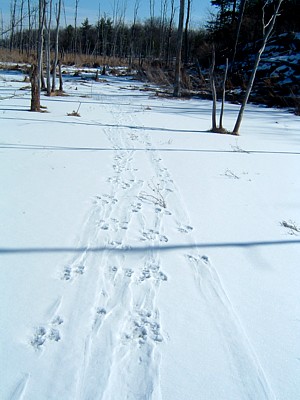
They also went about twenty yards up pond, then stopped, turned and went back.
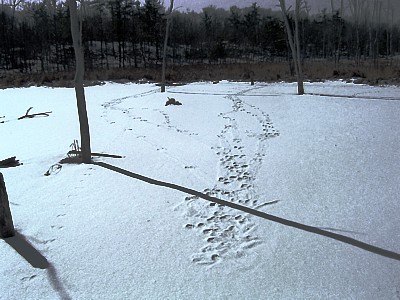
The only other time I had noticed that happening was when a family of four otters happened onto Audubon Pond where two otters had been making themselves at home for a few days. We continued up to the Upper Second Swamp pond curious to see if there were otter signs up there either made by these otters, who could have swam under the ice a couple hundred yards up to that pond, or by another otter whose scent, imperceptible to us, prompted the other otters to turn back. But there was nothing new at that pond, nor the Lost Swamp pond, nor the Big Pond. We walked up to see if the Lost Swamp Pond beavers made any effort to keep the pool open around their lodge, but all was frozen
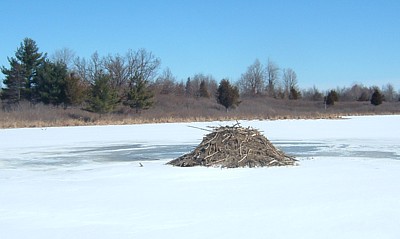
-- with the wind we had during the night and today keeping it open would not have been that hard. Going up the valley to the golf course, I noticed that a porcupine had moved back into the den under the rock flecked with bright green lichens. Earlier in the season I had gotten a photo of it in there. Leaning over to take a closer look I noticed another den under the rock just across from that one.
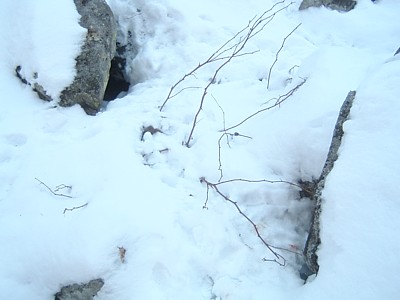
There were even stains of orange pee.
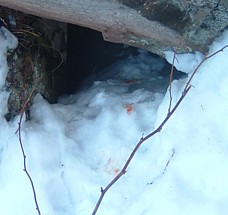
The other den had fresh poop on the snow.
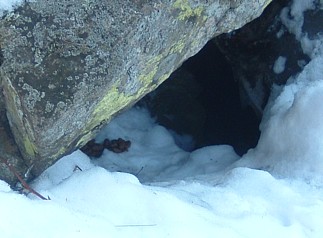
Could there be two porcupines living side by side? I suppse that would be uncharacteristic. A large red tail hawk flew up from a low tree along the golf course. So the otters are entertaining and perplexing me once again, feels good.
February 26 Yesterday we had four to five inches of snow followed by cold north winds. It was around 10F when we headed out in the late morning, and the wind had moderated. In wooded valleys it was quite comfortable. And the wooded ridge was warm enough for four foraging deer. Of course, we walked around South Bay and before looking for otter slides we scanned the trees for the little porcupine. It was high on a bigger maple than usual, right in front of us.
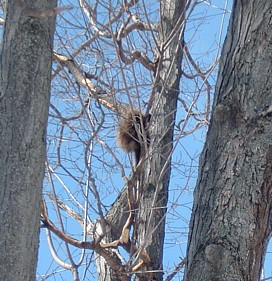
And high enough not to be bothered by us. I could hear it gnawing on a small limb. We could have tracked it back to its den but it seemed pretty clear that it had come over from a large pine, the only large pine, out on the peninsula into South Bay. There were no signs of otters at the end of South Bay, nor around the old dock. We decided to go up to the beaver ponds, thinking there was a better chance that the otters had gone there, than up South Bay. Plus tomorrow there would probably be no ice fishermen on the bay. We headed up the south shore of the ponds which afforded me a photo of a porcupine trail going up the jumble of rocks I call the porcupine hotel.
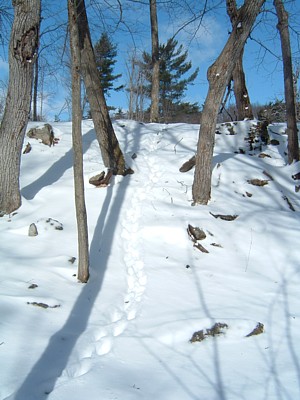
There were only deer tracks on Beaver Point Pond meadow and Otter Hole pond. The creek coming down from the Second Swamp Pond dam was still a bit open, though it was much harder to see the green vegetation in the water.
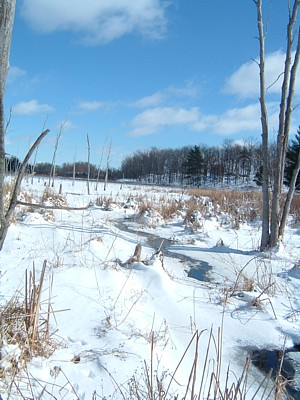
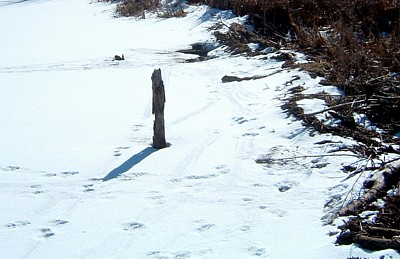
So an otter could have found solace up here, but nothing had broken a hole in the ice behind the dam. I paused beside a lifeless grey stump sticking up out of the ice. Back in the fall, I saw otters hanging on this as if they were eating its bark.
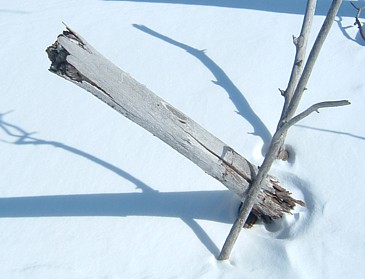
Again, there were only deer and fox trails, save for one mink trail that swooped down from the ridge and seemed to check for a hole in the ice near the auxilliary beaver lodge there
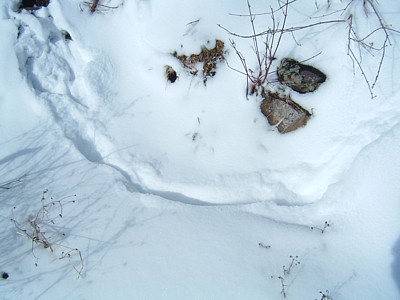
-- then it continued along the ridge, probably going in the larger lodge further down the ridge. As we cut across the Second Pond to it southeast end we crossed the mink trail again and could see how the mink slid down the ridge there, from the Lost Swamp Pond,
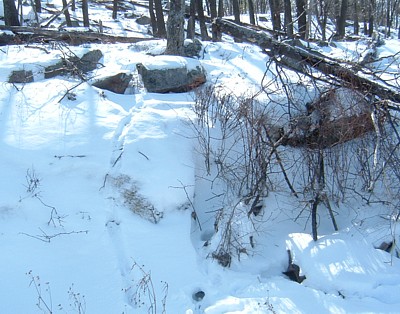
and made holes in the snow where there is a little bit of cover under the ridge.
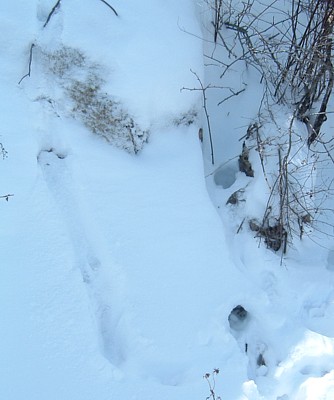
There were also mink tracks coming down to the Upper Second Swamp pond and going in holes and out holes and curriously out on the pond and then turned around and came back. What is with all these animals turning around? How superior I am always making my steady circular rut around their world! It soon became apparent that this was the day to follow mink trails, and in many ways this is more exhilerating than following an otter trail. The leap of a mink through the snow, its holes through it, and slides down ridges communicate such speed and agility and mastery of what is after all a major change in its world. Up at the Lost Swamp Pond one mink went to the dam, but along the north shore where there are so many burrows into the bank, the mink probed into every one.
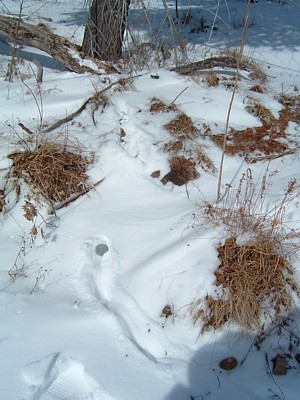
It appeared to us that two minks might have been about.
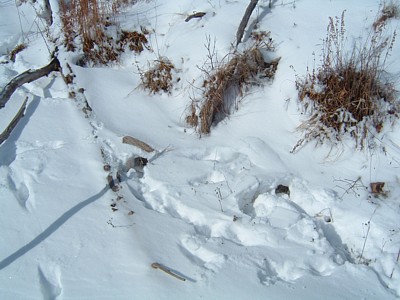
One trail looked smaller to me, but there certainly was no clear side by side going in the same direction, and even then, the same mink could have been going in circles. The mink went over to the bank lodge on the south shore
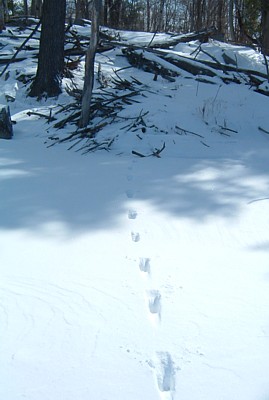
and made holes in the snow, and into the lodge, and, of course, back out and then it went to the lodge in the middle of the pond and then over to the point nearby, tracks coming and going, and at the point it made a hole in the snow just about where the otters, in other years, put holes in the ice.
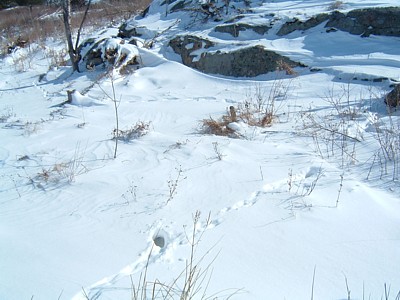
No coyote activity on the pond. Two ravens flew over in the distance and one came back to roll some r's at us. Heading to the Big Pond we flushed three grouse from the grove of pine trees. We crossed the Big Pond down to the dam where I expected to see mink using the burrows they often use at the south end of the dam, but the snow there was undisturbed. We sat on my usual perch there, two bumps on the log soaking in the sundrenched cold and sharing memories of what we had seen there over the years until the north wind nudged us on. Going up the creek to the ridge I finally saw what looked like fisher tracks -- large two by two prints that could have been made by no other animal.
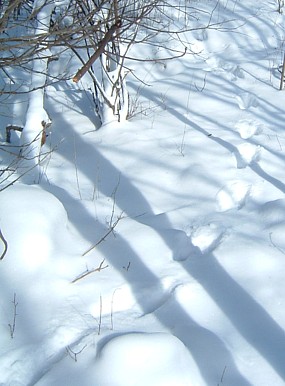
One of the surprises in the last month has been not seeing more fisher trails. A few days ago we saw one along the edge of the golf course rather near civilization. I opted to scale the big rock at its steepest point, to see if the porcupine there was about. Leslie, who took a gentler route, first saw the porcupine in the tree that I was walking under.
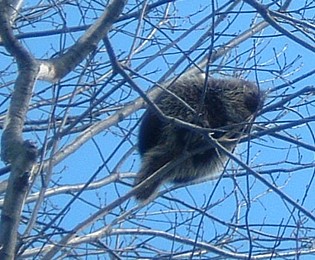
This was a bigger ppine, with quills out, but from what I could see of its face there was a spark of curiosity as it watched me slip up the rock. I paused to sudy the porcupine's circuitous route to its tree.
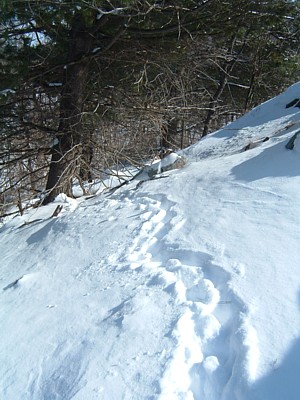
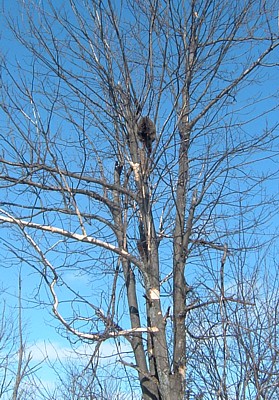
Once up I looked back and got a photo of the master tree climber and its work.
Coming down onto the golf course I again chose a lively path and we prompted a half dozen turkeys to trot out of the sumac patch and back into the woods. Leslie saw the hawk again on the golf course. During the storm a very large gaggle of geese, for this time of year, moved into our cove and kept up some honking through the night. But after our hike, when I went down to photograph them, they had moved on leaving mallards behind
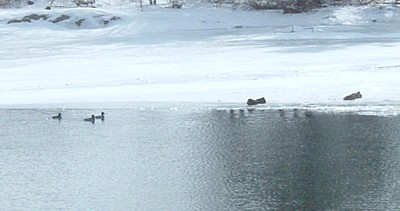
-- golden eyes, and mergansers also about in good numbers.
by Bob ArnebeckCheck out my other web pages: otters; beavers; minks; muskrats;porcupines;Leslie's art