August 2006 end
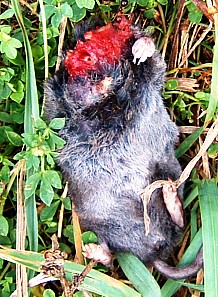
August 29 a cool, long pants day, and I headed off in the early afternoon to see where the otters might have been. I hoped to find them in the beaver ponds, but to give the legs a stretch first I checked the latrines around South Bay, and there were no otter signs at the old dock latrine, and docking rock on Audubon Pond. And once at Audubon Pond, I turned my attention to other mammals. A vole lost its head in dramatic fashion, probably victim of an attacking owl, who have a knack for decapitation.
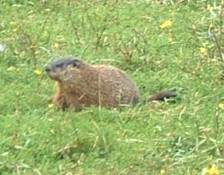
Then that groundhog was out in the sun in the middle of the path along the top of the embankment.
The beavers have done more work on the ash they cut down along the west shore of the pond
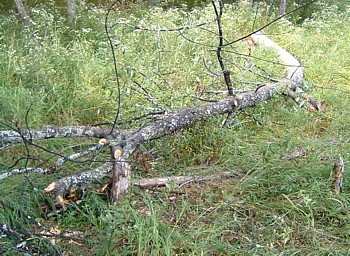
and, as usual, they seem to have left much work undone.
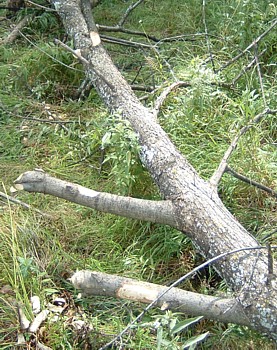
The collection of stripped sticks in front of the bank lodge nearby was quite depleted. So I am not sure where they took the branches and twigs they harvested. The pond may be getting too low for the beavers to feel comfortable in that lodge. Continuing around the pond, I noticed another half cut ash just off the trail on the north side of the pond.
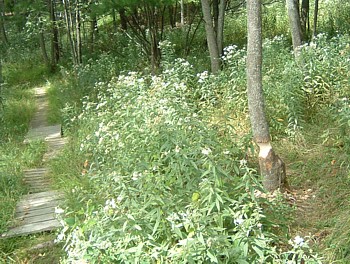
Curious that the beavers can't seem to get these ash trees cut now, while in the winter they seemed to bring them down with greater dispatch. I sat briefly at the bench where there was nothing new save for berry laced raccoon poop. There was no freshly cut ash at the lodge out in the pond. With my boat back in the water I might be able to get over in the evening to see these beavers. Curious about what the beavers have been up to on the north side of Thicket Pond, I stayed on the north side of the meadows and ponds on the way. And at the edge of the Short-cut Trail Pond meadow I almost stepped on a black snake that was stretched out along the ground sleeping in the sun. I kept my distance from its head
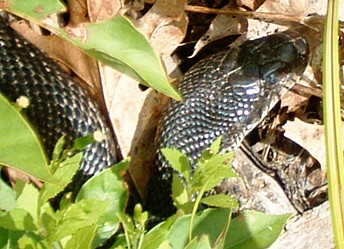
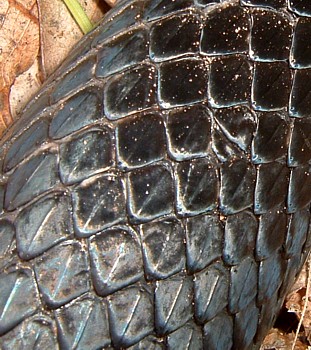
but couldn't resist a close-up of its back.
Meander Pond still has water but no sign of any beavers or muskrats enjoying it, and the photo now of the pond from the slope where I watched the beavers back in February hardly captures that winter excitement.
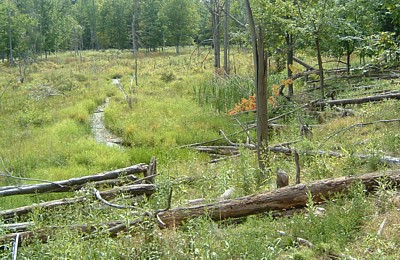
The north canal of the Thicket Pond looked as well used as I expected.
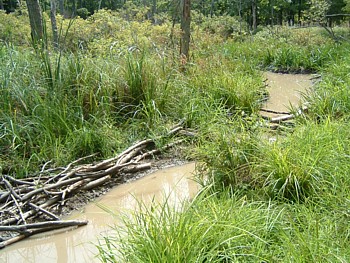
and as it stretched under a series of fallen logs, the canal looked like one of the world's major waterways.
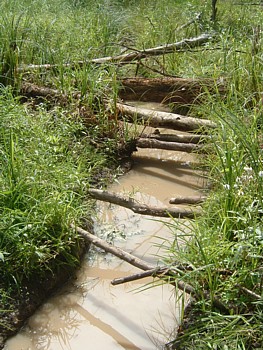
This canal ends in a kind of Y,
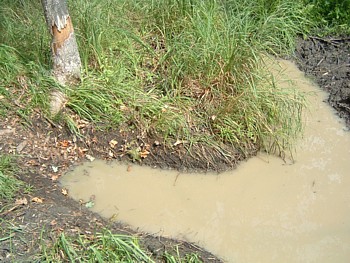
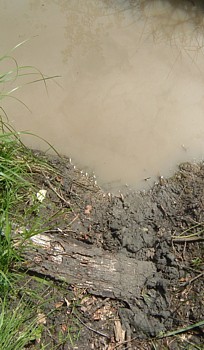
but the beavers fashioned another cut to get to their current work. My guess is that they patched on a bit of mud to ease the pain on their belly as they slipped into the water.
I soon saw that they have been bringing a load of saplings and twigs down the ridge to the north. Their path is wide, well worn down,
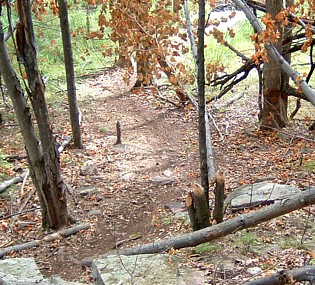
and when I came back down it, I measured it as 140 strides long, and my stride is about 2 1/2 feet.
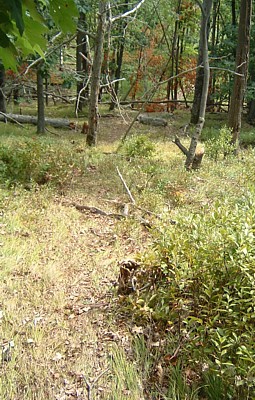
Up on top of the ridge they found three of the their favorite trees thin enough for harvesting at such a great distance from the safety of their pond: a few shag bush trees
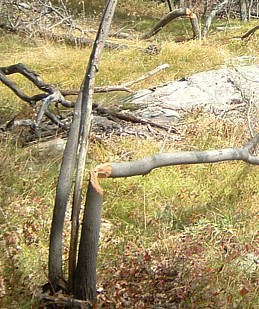
several red oaks
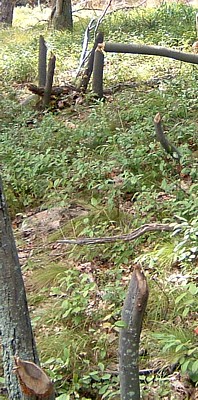
and a few sugar maples, including one not far from its ghostly ancestor.
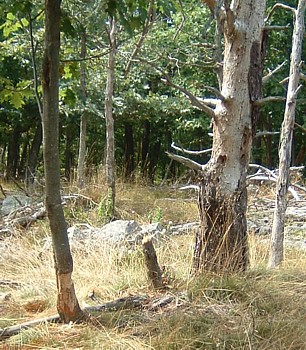
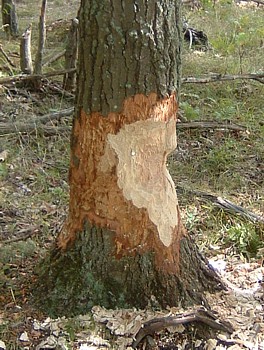
Back down at the pond, on the south side of the canal, the beavers showed how they feel comfortable taking on bigger fare closer to home
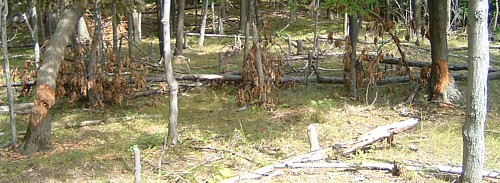
It will be curious to see if they gnaw so far as to take down the big oaks
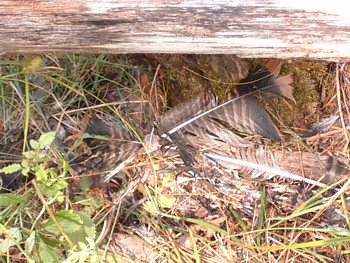
I crossed below the East Trail Pond (mostly meadow) dam, and saw that the pile of bird feathers there is more extensive then what I saw the other day, including the feathers of a victimized turkey, probably a poult not big enough to escape the hawk that evidently is taking its meals in the tall pines.
When I got to the north bank of the Second Swamp Pond, I sat for twenty minutes and enjoyed how a twitch in the vegetation floating on the pond would turn into a placid mallard. Wood ducks remain on edge and in a small flock. As I came up, a half dozen of them made a quick retreat into the marsh on the south edge of the pond. There were no osprey to enjoy today, perhaps because the east wind made this less attractive as a launching pad for their sorties over South Bay. The other day I noticed how they flew over to the ponds with freshly caught fish in their talons. After a nice rest, I headed for the dam and as I got up I saw an impression in the grass below which looked like it was made by something coming over a rock from the pond -- a typical otter move. But the nearest sign of any animal was a raccoon poop. Then when I got to the otter latrine in the middle of the dam
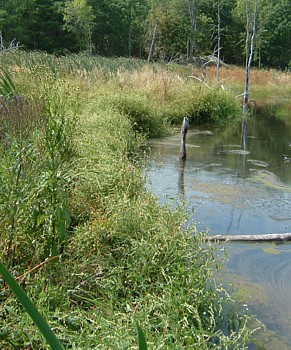
that I first saw the last time I was here,
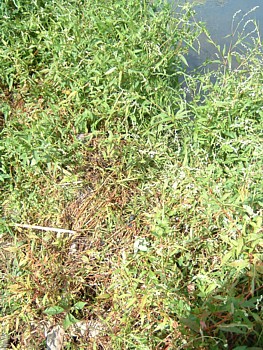
I saw three very fresh,
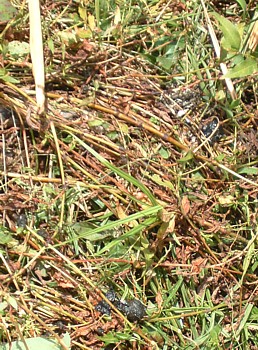
and very black otter scats. Fresh enough for me to look back up pond for otters, and fresh enough to succor a fly.
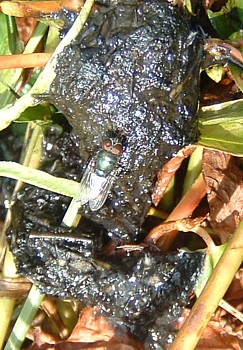
Three days ago when I checked the other ponds for otter scats, there was nothing to be seen. And today there was nothing on the old otter trail between the Second Swamp Pond and the Lost Swamp Pond. However when I came up to the Lost Swamp Pond dam, I saw two older scats.
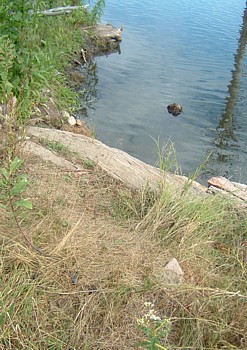
Otters have been here and so far seem to have ignored the traditional otter latrines. I sat briefly to study the lodge in the southeast expanse of the pond but geese had that surrounded and soon mounted. Geese on the river are starting to honk quarrelously again, but so far, they remain quiet in the ponds. I continued on to the Big Pond, and to my delight not only found a squirt of fresh otter scat in the middle of the dam,
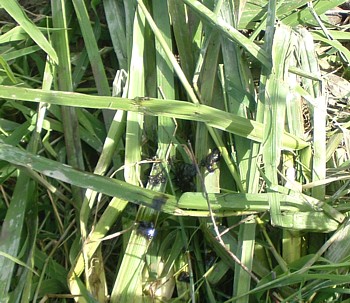
but water behind the dam was muddy,
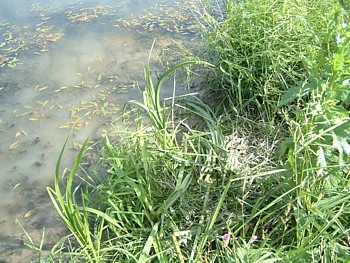
which made me feel like I just missed the otter or otters. I saw portions of a print in the mud but not enough to make a guess at the character of the otter. So the fundamental things seem to be applying. Otters have moved into the beaver ponds. Now, to see them and to confirm that it is mother and pup I saw in South Bay.
August 31 yesterday afternoon I took my brother-in-law to see the beaver work on the ridge above Thicket Pond, and coming down I took some photos of the pond. It seems the beavers stopped dredging the channel that runs along the edge of the pond to the dam and lodge
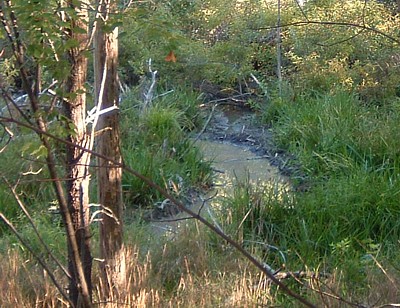
and instead kept a channel that curves into the shade of the button bushes and forms a large pool of water behind the lodge.
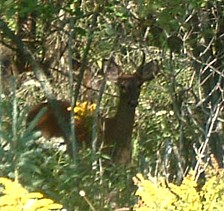
This morning I headed for the beaver ponds to find the otters, going to the Big Pond first. I sat at the south end of the dam for twenty minutes and enjoyed the jabbering of the song sparrows, too busy fattening up to sing, and the lilting calls of the goldfinches over the tall grasses and cattails, not that I could see them. The view from my perch has rather narrowed thanks to this year's growth. There were no new scats at the spot on the dam where an otter scatted. I looked harder for prints but found none -- not much of a mud skirt behind the dam this summer. A few geese were well up pond. As I headed to the woods on my way to the Lost Swamp Pond, I saw a buck browsing, sporting antlers curving out and perhaps getting ready to sprout out his first point. He stood still long enough for a poor photo.
Then as I came down to the Lost Swamp Pond I saw a buck browsing the grasses at the end of the pond -- he sported 8 or 10 points. He moved under the cliff and another buck right behind him came into view, and he had 8 points on his rack.
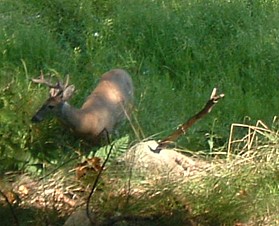
Is this the peace before the storm for these two gentlemen? They were defnitely together, and the larger buck was definitely the leader. They eased on up the gentle slope on the west side of the pond and soon got a whiff of me and moved off, but not in a panic and without any snorting. As I continued down to the pond shore, a big bird flew off from a perch on the dead tree in the middle of the pond. I assumed that it was the usual osprey, and then I looked at it and saw that it was a cormorant. Another indication that otters could find food in the pond. I sat up on the rocks for twenty minutes enjoying the considerable number of geese, say 60, that flocked together after I arrived.
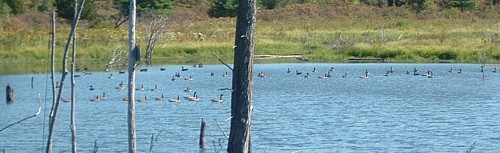
They were quiet for several minutes and then with a honk here and a honk there, the debate began. I fancied that the direction the geese began face was the way they voted. The time between honks shortened and the number of geese voicing an opinion increased and then they all flew off heading toward the river. There were only a handful of ducks, all content with the pond though they swam away from me. Not seeing otters, I started around the shore of the pond to check for scat. Working on the possibility that the otters coming here were finding new places to relieve themselves, I didn't just go from latrine to latrine. But I could have. At what I call the mossy cove latrine, just across a small cove from the bank lodge on the southwest shore,
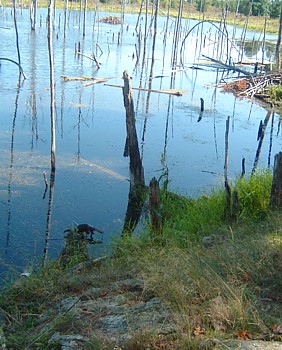
I saw two large otter scats,
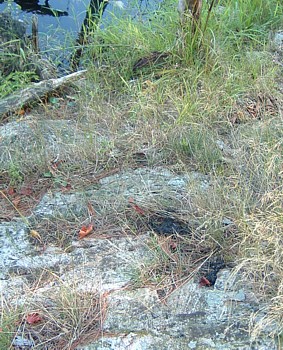
probably dropped just after my walk through the area two days ago, since they were still moist but not wet.
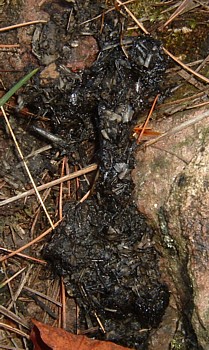
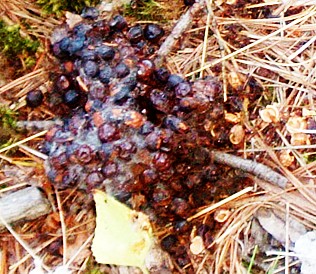
There wasn't much rolling around near the scats so I certainly haven't found the place where this mother and pup might prefer to rest. Nearby there was a berry laced raccoon poop. No mistaking the difference between that and otter scats this time of year.
I continued around the pond to the dam, and didn't see any more scats. I sat briefly overlooking the Upper Second Swamp Pond and then went down to the Second Swamp Pond which, with all its grassy areas, some even in the middle of the pond, I thought otters habituated to the South Bay marsh would prefer as they accustomed themselves to the ponds.
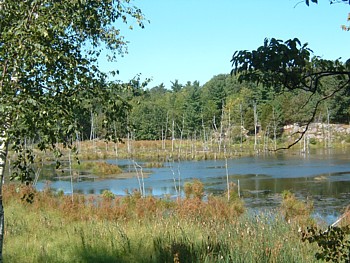
I had a nice sit and could study a kingfisher from afar, but no otters appeared. I waded out through the grasses on the dam and saw that there were no new scats at the latrine they fashioned there. On the way home, I waded out into the Otter Hole Pond meadow
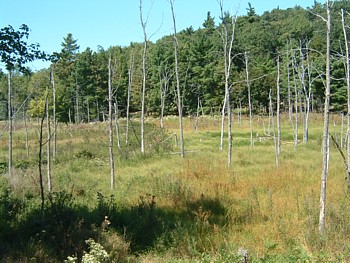
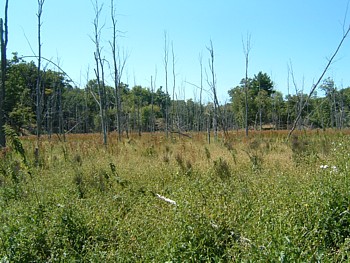
where at least the once grand lodge still peaks up from the grasses.
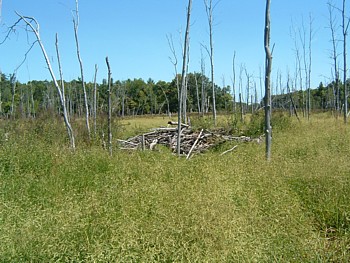
A heron flew off from the channel behind the lodge
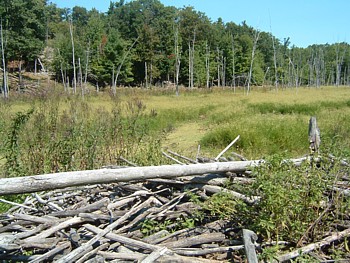
and perhaps left foot prints through the muck.
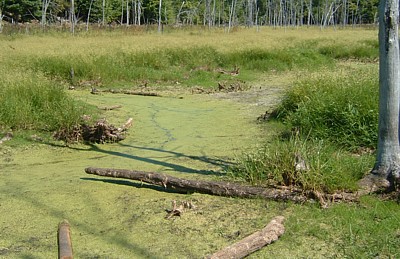
The pool here is so meagre that it no longer reaches the dam,
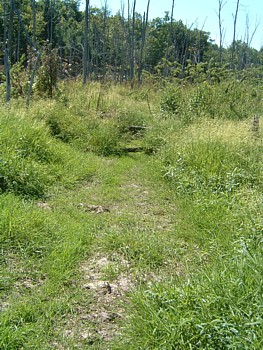
and no water flows down
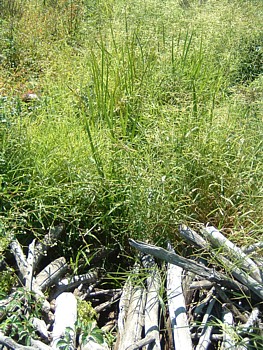
into what once was Beaver Point Pond,
and nettles have claimed one half of the dam,
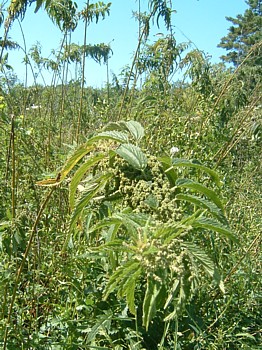
while vervains dominate the other side.
In the afternoon I toured South Bay in the boat and saw that none of the jelly globs developed into a bryozoa though the grasses,
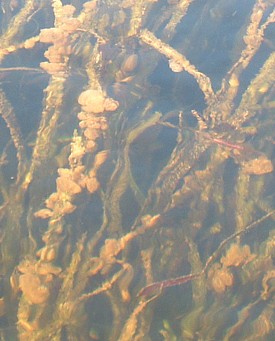
and even the algae
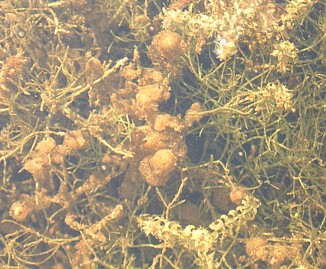
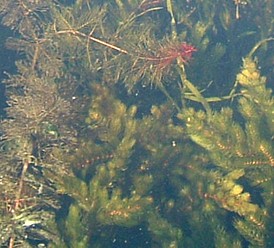
are coated with them in some areas of the north cove. I took my annual photo of the red tinged milfoil and the spruce like water plant,
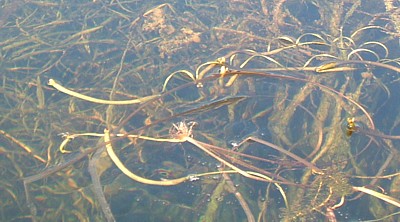
as well as the wildcelery which is quite prolific this year.
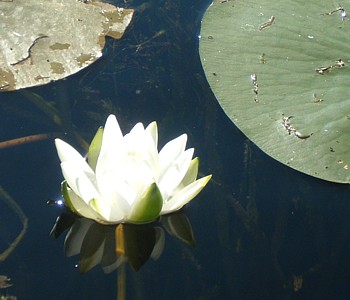
There was too much wind to drift leisurely over the water lilies, but I managed a photo.
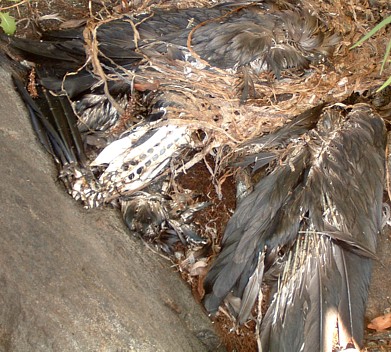
Then I finally got a chance to pbotograph the dead and now half eaten cormorant at the point.
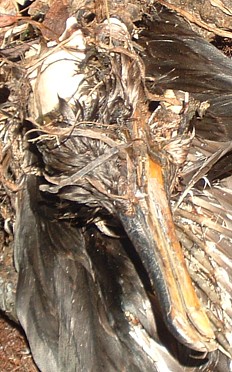
I took home the head for closer study.
By the way, there were a few live cormorants around. Then I got some photos of the ash the beavers cut down into the bay
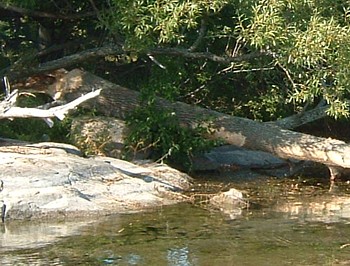
where they continue to gnaw away,
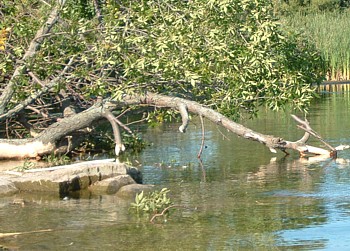
but I'll have to come back in a kayak to see the finer points of their work. Finally Leslie, who was operating in a kayak, saw some otter scats on the Yacht Club dock, five scaly heaves that must be relatively recent -- for my theories to hold this must be from the group of three males I saw around Picton, not from the mother and her pup. I'll have to check the other latrines around the bay.
by Bob Arnebeck
Check out my other web pages: otters; beavers; minks; muskrats;porcupines;Leslie's art