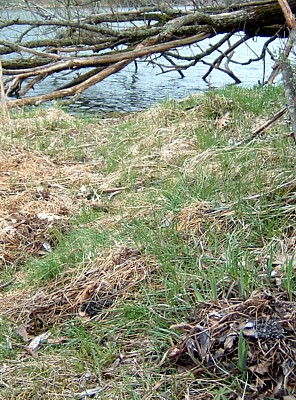
April 2006
April 24 more rain today; a bit of sun in the afternoon, then more clouds. I headed off at 4pm hoping to see the otter again in the Lost Swamp Pond, just as I did three days ago, and hoping to confirm my conclusion from yesterday's tracking that a male otter marked his whole territory which meant it was unlikely that there would be any fresh signs of him being in the interior ponds. Not exactly a contradiction. There's always a bit of quantum physics involved in tracking. On the one hand an animal is like a wave vibrating as many miles as it takes to make that animal's reality. On the other hand, the animal itself is a point in a particular place, palpable but unknowable unless you understand its farflung vibrations. Since the wind was coming out of the southwest at last, first time in over a week, I decided I best approach the ponds from the north. So I went via the South Bay trail and realized when I got there that I should check the willow latrine out on the point to see if there were fresh otter scats there. On the east side of the low mound I found some fresh scat and a new scent mound.
As is often the case the scat around the scent mound was somewhat schizophrenic. One looked like typical otter scat,
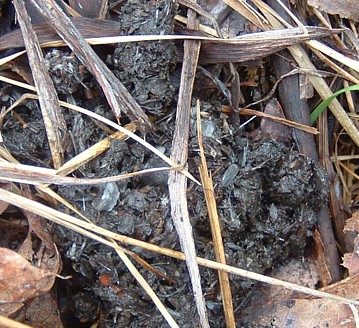
and the other was quite liquid, and in the close-up photo I see little beads in the scat which I assume are fish eggs and not seeds,
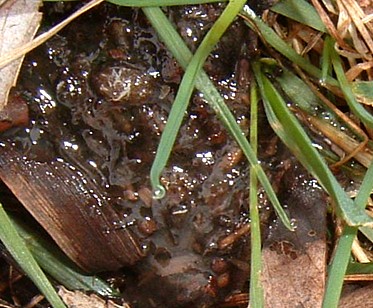
but I should go back and check. Closer to the willow I saw another scat not surrounded with the usual otter scuffing about. Could it be an atypically loose raccoon scat overloaded with insect parts?
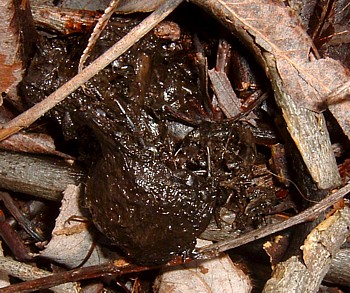
Scats sitting placidly on the ground without any sign of the dramatic heaving of the otter always have to be viewed suspiciously. There were typical raccoon poops around too, especially on the willow trunks. But the scat above was on wood litter and otter paws, grip though they might, would leave no impression. A beaver may have also visited the willow, though the one stripped stick I saw could have been washed ashore. The river water level is still low, though inching up, and I was able to get out to the island that's behind the peninsula out in the bay. Once again the rock where I found so many otter scats last summer has yet to show any signs of an otter visiting. There were two scats that might be from a fisher, though probably from a fox, Last time I was here there were otter scats on a runway coming up from the bay just on the south side of the rock that fronts the bay. Today there were more scats and a genuine otter scent mound with scats on top.
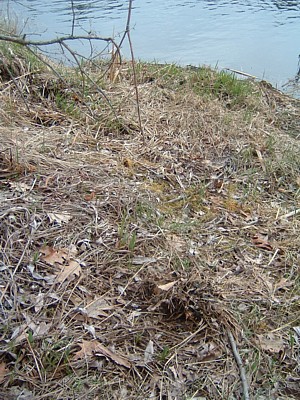
Meanwhile what I took for an otter scent mound, though no scats were near it, out on the rock just up from the water had been leveled and surrounded by the little poops of muskrats. I think. I nosed around the remainder of the rock and only saw the bones and scales from last year's otter scats. There seemed to be a trail from the otter scent mound in toward the huge willow whose tentacles over shadow this pond, but I saw no rolling areas nor any holes otters might den in. The water has risen a few inches in the river, enough I think to open some small channels throughout the marsh but probably not enough water yet to make the marsh comfortable for otters. On my way to the New Pond knoll I noticed a red circle on the large pine not unlike the blue and yellow circles that the idiots in charge here often use to mark trees near the trail. But there was a red strip at the base of the trunk too,
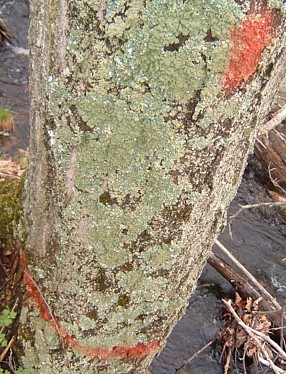
and in this case the lichens were doing the decorating.
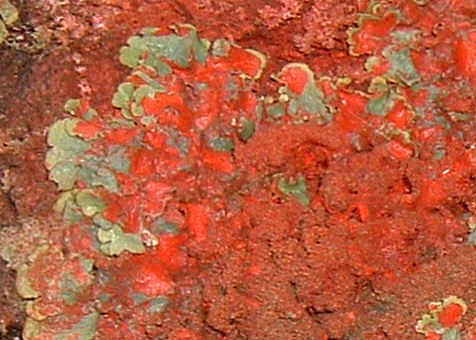
I checked the New Pond knoll and there was no fresh scat up there. Thanks to all the rain, there was water rushing through the logs of what once was a dam and it was quite dicey crossing, but I made it. One of the trunks down next to the dam is a favorite raccoon latrine
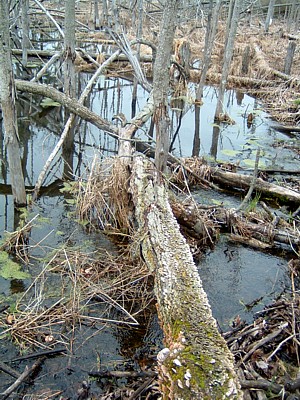
and one old scat was revealing some of the bones that make up a raccoon's meal.
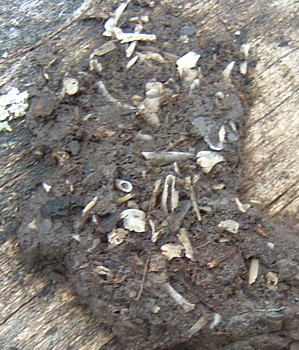
Looks like some bird bones there, and in general not at all like the bones that find there way into otter scat. I scared a dozen ducks off Otter Hole Pond, leaving a very quiet gander seemingly trying to disappear as he stood guard on a nest that I assume was on the old beaver lodge and was perfectly disguised. As I came up to the Second Swamp Pond, I thought I saw a flock of black ducks on it, but that proved to be wet girdling left on the dead trees as the pond water level dropped six inches. Needless to say, the beavers have not worked on the dam, but there's still plenty of water in the pond. Again only mallards and wood ducks on the Second Swamp Pond, and a gander there too. I sat on the rock at the south end of the dam to rethink my approach to the Lost Swamp Pond. I noticed that the wind seemed to be a truer west wind, now, perhaps a bit out of the northwest, so rather than approached the Lost Swamp Pond from the north, I angled up over the ridge so I could come to it from the southwest. When I got up on the ridge I was greeted by gusts of wind from the southwest. I think too much. But at first glance there was only a gander on the pond, then I saw a muskrat on a log
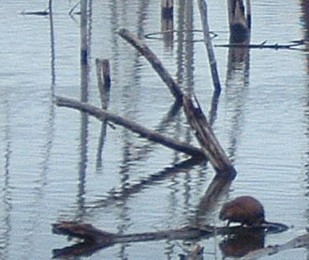
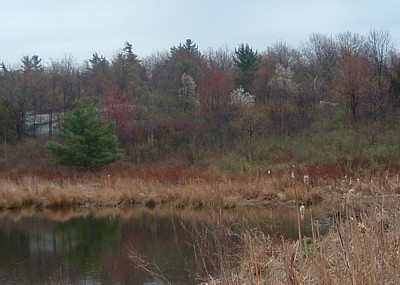
and I sat under some rocks at the mossy cove, thus out of the wind, so that the muskrat was between me and the lodge where a few days ago, at about this same time, a beaver and otter got rather close to each other. The muskrat raised itself up like it was sniffing me, but I didn't seem to inconvenience it as it dove toward me. Then another muskrat swam up from the burrows on the north shore and swam toward the middle of the pond. The muskrat I was watching swam out toward it. When the muskrats got within 15 yards of each other, the one from the north veered west, and the one I had been watching veered east and swam around the lodge. It started sprinkling. Then more muskrats appeared along the north shore of the peninsula and there was some splashing and in the camcorder I could just make out one muskrat chasing another just a couple feet behind. Then one headed for the far reaches of the pond, out of my sight, and the other went back to shore. To summarize an interesting night, I saw three muskrat encounters in that area, and I noticed that each time I did I heard some whistling. I first thought some ducks were nearby, but saw only blackbirds. So I think the muskrats were whistling warnings to each other, and the wavering whistle I suppose could be disconcerting. The wavering gave the impression of numbers -- I first thought it came from a half dozen ducks or so. But I will have to get closer to one of these encounters to be sure of what I am hearing. It seemed that one muskrat was defending the shore of the peninsula and as it drove one invader away another muskrat that had been foraging near me swam out to intercept the fleeing invader. I have been close to muskrat fights, and don't recall whistling, but those proved to be genuine fights with screeching and perhaps contact. What I was seeing tonight were chases, no screeching and no contact. Then it began to rain, which made it impossible to see the wakes and wiles of muskrats. I hurried around the pond to check for otter scats. There were none at the mossy cove, and nothing new up on the north slope latrine but at the base of it there appeared to be some bold new scratching in the grass. I got the definite impression that an otter had been here since yesterday. There were no scats up at the dam. It looked like there had been a little bit of mud pushed on the dam, but with everything so wet, it was hard to tell. A beaver was out in the Upper Second Swamp Pond working on the dam which would have made a good video clip, but it was raining hard. By the time I crossed the Big Pond dam the rain had stopped, but I was glad I had moved on because it was also getting cold. As I crossed the dam I could see the flowering and budding trees up on the ridge.
At the latrine on the south end of the dam, I could see that an otter had come up, scratched around and scattered a scat not far from the raccoon poop behind the dam.
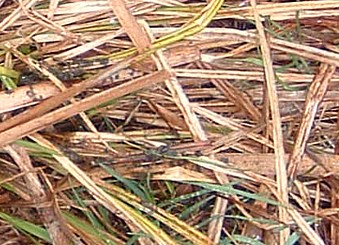
Then on the trail that the otter's favored last year (and that I've taken for some 10 years) there was a fresh wet scat.
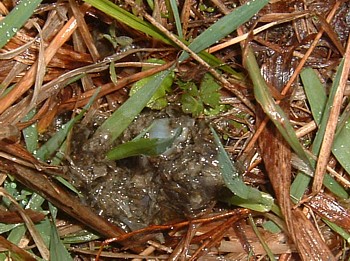
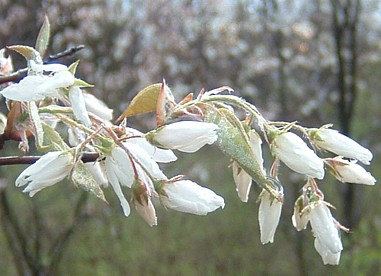
It's possible that I missed these scats yesterday but not likely since both are in areas I generally linger over. So an otter at least revisited the pond, but no indication yet that an otter is making itself at home other than the fact that I saw it swimming in the Lost Swamp Pond three days ago looking quite at home! Up on the ridge I took a photo of the shad bush blossoms.
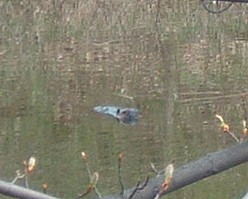
April 25 heavy rain in the morning, and just 40 degrees. Then the sun came out in the afternoon, up to 50, with a brisk wind. We hadn't been to our land in three days so rather than resume working there, I took a tour. As I approached the Third Pond, I saw something large in the water and usually ducks fly right off. But this stayed and I realized it was a beaver, bright with dry reddish fur, floating aimlessly. I got out the camcorder and tried to get closer. When it sensed me, it dove and I couldn't tell where it went. Then I noticed that it got its head half way out of the water in the shade of the dense clump of willows. When I tried to get over there, it dove and then surfaced out in the middle of the pond.
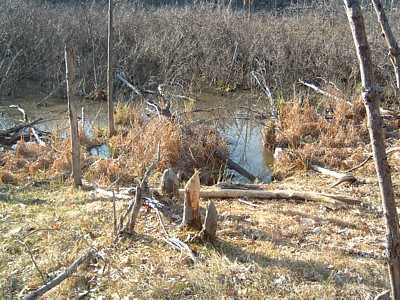
I took a photo of the dam, hoping for repairs
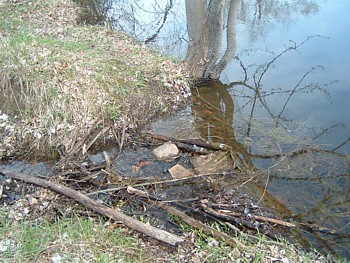
and then headed down to the Deep Pond where I expected to see some beaver signs, and I did. The water was muddy and a few stripped sticks left behind at the foot of the bank closest to the Third Pond. There were other muddy areas along the north shore, but no more stripped sticks. I noticed that there were no repairs on the dam -- and I don't expect a beaver to do that until it gets more comfortable in the pond. But on the west shore there were more stripped sticks,
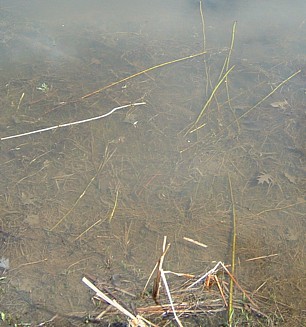
and I saw that the beaver had cut them from a clump of willow in the pool next to the pond.

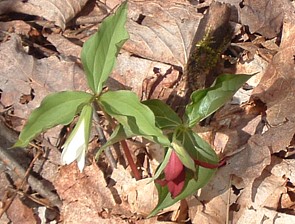
This appeared to be a small beaver so once again we may have a refugee from the winter's trapping, a yearling left alone and not a two year old simply leaving home. We've had single beavers in these ponds that seemed traumatized and others that seemed quite resourceful. Time will soon tell with this one. On my way down to White Swamp, I saw a white trillium and a red trillium side by side.
Before going up on the ridge and down to the inlet, my usual route, I went to check on the beaver sent mound that guards the little cove there. I noticed a worn trail leading up to some scratching in the dirt half way up the ridge.
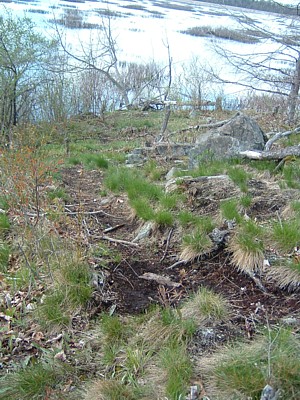
There were the pale remains of old otter scats and also at least two fresh ones -- one a bit dry and grey,
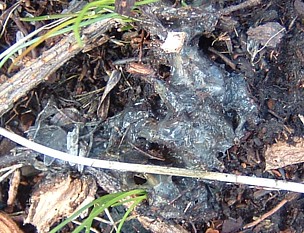
and the other a juicy little squirt.
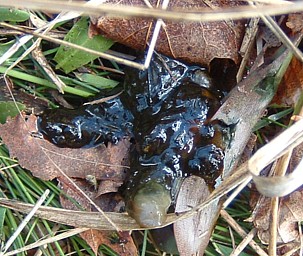
With all the rain it was hard to tell how recently the beaver had deposited scent on their mound. At the inlet, the beavers added a few more sticks to their mound there,
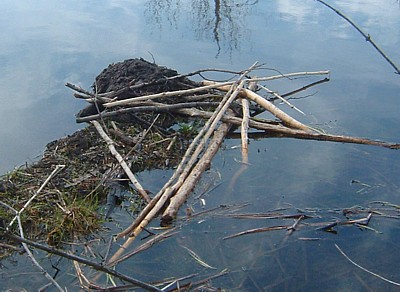
but I didn't see any new otter scats. Certainly the latrine below the ridge is more suitable for otters. As the swamp gets higher the inlet area is flooding. I probably won't be able to get out to the mound the otters had put a scent mound on. That mound is a place for otters to mark, but the dirt is hard there, nothing soft to dig into. There were more stripped sticks behind the dam, but not much patching with mud, and a liberal leaking all along it. I got a photo of the ash I had noticed that the beavers had started to cut, more cutting today, but still not felled.
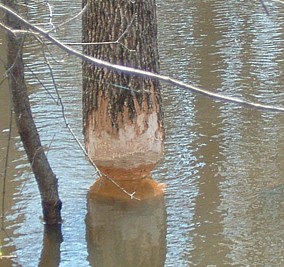
There are more cut saplings, and for the first time I noticed beaver activity up along the stream, a few stripped sticks. Quite possibly the beaver now in the Third Pond did this. Then I went up to the Teepee Pond, no beavers there. You'd think a beaver from one of the three litters that grew up there might come back. Then I went up to the Turtle Bog to check on the wood frog eggs. There were plenty of tadpoles suspended in the egg masses
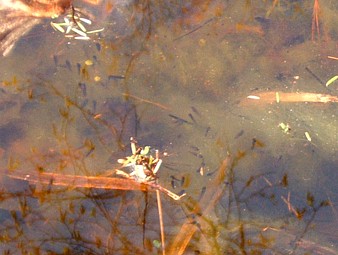
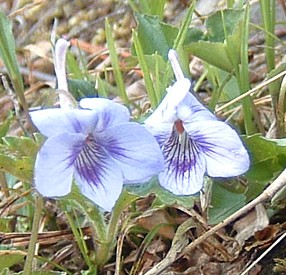
and when I disturbed a mass along the shore several tadpoles swam out. I tried to get this with the camcorder, and did, and then noticed a dragonfly larva latched onto one of the tadpoles, biting it on the neck. Both animals twitched under water. The larva seemed to subdue the tadpole and they drifted toward the bottom of the pond, out of my sight. Violets are popping out.
I saw a grouse by a log, for the second time. She walked away and I looked for eggs, but couldn't find them. Leslie heard and saw some kinglets. Also I almost stepped on three garter snakes at various points along my tour. Needless to say everything was damp. We probably got about 3 inches over the last three days.
April 26 a classic cold front blew through, cleaning the air and white capping the waves, so I had to content myself with hiking around South Bay and leaving a check of the Picton and Murray Island latrines for another day. Despite the vibrant morning, it seemed like this was going to be a hike in which I saw nothing new, even the geese and deer that politely moved aside as I walked down the Audubon Pond embankment were old acquaintances. That pond was higher but the beravers' masterful mudwork on the drain was too far under water to show up well in a photo. But as often before, an otter had scratched up more grass and leaves high on the slope that I call the entrance to South Bay latrine. I sat behind the muss hoping the bright sun might just allow this dramatic development to translate to a photo.
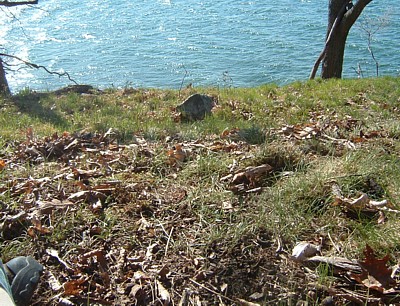
Alas, one has to be obsessed with otters to see the evidence of prancing, and scratching and tail wagging let fly. Shot from blow there is even less evidence of excitement but one can see the high rocks that I suspect at times the otters climb. One scat was a classic spread
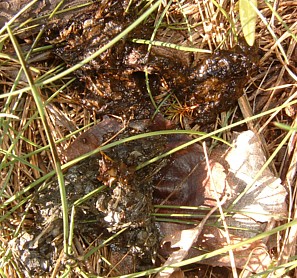
The other was dryer and more tubular, but break it open and there is the latest report from the river. I take the rusty color for crayfish parts, the balls as fish eggs, and the bony knuckle at the bottom -- I'll try to get back and check.
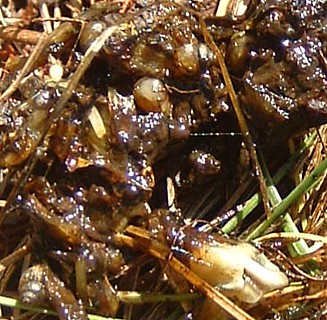
Actually these close ups don't get the impression otter scats make across. In most animals, including humans, fecal matter seems just what it is -- the well worked byproduct of digestion. Otter scat is more like an explosion from last night's menu that even an otter's muscular tail could not contain. I checked more possible latrines on the way back down the South Bay shore, but saw absolutely no signs of otters. I'll have to wait until I check the latrines along the ponds and out on the island, to guess at what this means. Two caspian terns were sporting in the wind. One dove and skimmed something off the waves.
At the land, I went down to the Third Pond to check on the beaver. Instead I saw a muskrat up on the bank right in front of me -- a small muskrat at that. It leaped into the water, but didn't drop the bouquet of grass it had collected. I tried to get a photo of it in the pond, but it dove. Then it surfaced, and dove again when the camera was ready. I am pretty sure it swam into the grass mound, evidently its lodge. I noticed much muddy water in front of the burrow on the back side of the pond, and thought perhaps the beaver lived there. Then I saw another muskrat harvesting grass near the burrow and it took its bounty into that hole. Both muskrats briefly came out again, took a look, at me, I suppose, and disappeared. I didn't check for beaver work, other than to see no repairs at the dam, expecting to come back again. But Leslie did check later, and saw much willow cut out of the clump where the beaver hid from me, but not much of it stripped. I did walk around the Deep Pond and thought I saw evidence of new beaver work, but when I compared today's photos with yesterday's I see that there is no difference. Of course, the beaver can follow a stream back to White Swamp without going through the Deep Pond.
April 27 The wind died down a bit, and as it shifted to the north, it was light enough to lure me out on the river and into the chop of Eel Bay. There are still pairs of buffleheads on the river, and a flock of them in the bay in back of Picton point. With the choppy water, it was not a day to explore back there, but I went far enough to see some fresh beaver work. I've always thought it would make sense for otters to center more of their activity back in the bay as the water gets deeper, but I've never seen evidence that they do. As I slowed the boat to dock at the point, a heron flew off from the rocks suggesting there are still fish for the picking off the point. I could see from the boat that the digging in the piney litter on the rock above the water had gotten lower. And when I got up on the rock and looked down, I could see a new, but not fresh otter scat, claiming credit for the commotion.
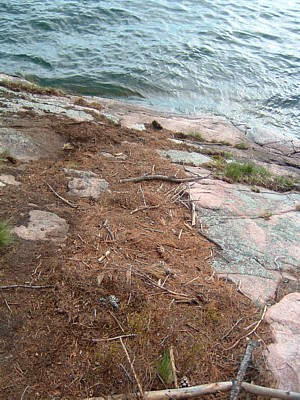
This grey scat which can't be much over a week old is a marvel and I should figure out how to explain its color.
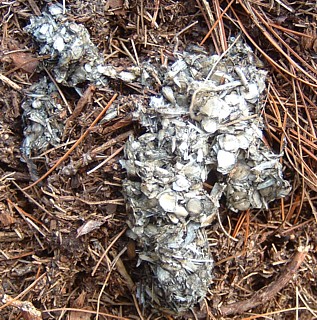
Evidently three inches of rain completely washed away any contribution that the otter's digestive system made to it. There was also some digging further up the rock,
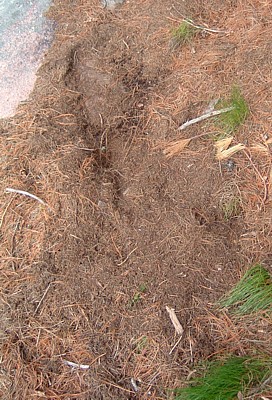
and as long as it is flanked by an otter scat, small though it may be, I credit otters for it. There was also another curious scat nearby, not from an otter.
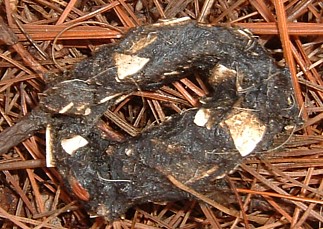
The circular pattern is not characteristic of any animal I know of. I checked the rest of the point, and didn't find any new scats in the latrines the otters have been using here. I saw one small scat in the grass below a rock, perhaps suggesting at least one otter has shaken itself out of the ritual of visiting the same old latrines. I checked the Murray island latrine too, and saw no hint that otters had visited this rock recently -- strange, considering that the last time I saw an otter around here a few weeks ago, it was fishing not far from this rock. As I went through the Narrows, the osprey collected a stick off the cliff and flew it over to its nest up on the power pole. Yesterday we saw an osprey just off Goose Island, in front of our house, striking black and white. This osprey was brown and white.
At the land, I knocked off for lunch early to sit by the Third Pond to see what the muskrats and beaver might be up to. Nothing was on the pond when I got there but I still slid down on a bank grass on the back side of the pond. In a few minutes a muskrat swam out of the burrow on the same shore I was on, off to my left, went to small tree five yards out in the pond, sat up on its roots and started grooming itself. Then it turned back to the bank, swam off the stump, and making the whistling sound I heard in the Lost Swamp the other day, chased a smaller muskrat around in a circle, humped it, and chased it back in the burrow. Now that I was closer to the sound, I wouldn't call it whistling. More like a high sing-song humming. In the next hour, this chase was repeated several times, with the humming, the humping, and one time a splash. And every time at the end of the chase the larger muskrat came back to its perch on the root and started grooming. Then the little muskrat swam out to the larger as if inviting it to chase it. The books say muskrats copulate within ten days after gestation of a litter. So this may be that. The larger muskrat could have likely killed the smaller one, but the latter kept coming back for more and the former always chased, dominated but did not damage the smaller one. I would have assume the female muskrat would be more aggressive, but would a female humped a male? Maybe climbing on the back is not a sexual act, just one of domination. Meanwhile between chases, a ruby crowned kinglet foraged in the bushes right in front of me; two pairs of swallows contended for a bird box across the pond and three painted turtles climbed up on the opposite bank. And then when I went around the pond to check for fresh beaver work, two chickadees kept up a loving jabber as they both foraged in the leaves, and one briefly fed the other. I took a photo of the willow shoots nipped by the beaver and left in the pond
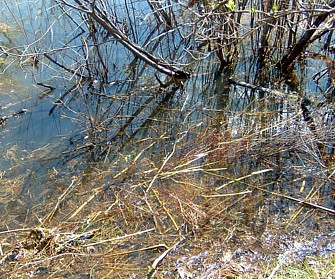
-- a few were stripped, and the dam appeared to have gotten some attention.
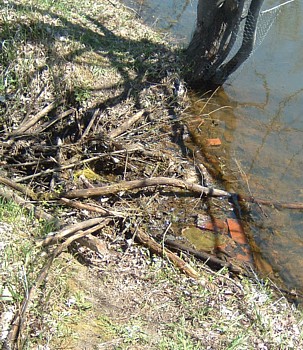
I took a brief look at the Deep Pond, and there was nothing new down there. Then before we went home, around 5 pm, we came down to check the pond again, and the beaver was floating in the middle. As we sat it cut a large willow sapling from the clump, and after thrashing a bit to show it knew we were watching, it took the sapling into the large burrow at the back of the pond. The muskrats also came out and seemed to coming out of burrow a little to the side of the large one. The muskrats repeated their chases of the morning. Leslie heard the humming, saw the humping. I also saw a muskrat cut one of the willow shoots, so I can't credit the beaver with all that trimming. There were a few peepers, and a few green frogs started their banjo call. Smallest pond I watch on the land and the island, but today, probably the most interesting.
Aprl 28 another chilly sunny day, below freezing last night, but certainly no ice on the pond. I went to the ponds via the meadow behind the golf course, and despite the rain last week, compared to other springs it was quite dry and neglected. No holes made by deer to get to elecampane roots. A porcupine had girdle two red oaks at the foot of the ridge.
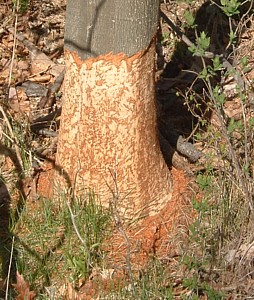
And in only one had it climbed up to get some bark at a elbow of a limb.
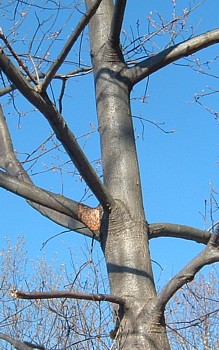
The two favorite cuts of red oak for a porcupine, the bottom of the trunk and an elbow. Above all this, I admired the blooming shad bushes on the rocks. Although we've had a towhee around the house, the tangles of bushes and puddles up on the ridge were quiet. Down at the Big Pond, I saw a quiet goose, ducks in the distance, mallards, and I think a ring necked. No scats on the dam and no work on the dam. But this was a very bright day, much glare, not the best conditions for seeing scats in the grass. There was a brisk northeast wind so as I sat on the rocks at the Lost Swamp Pond, a male wood duck splashed into the pond right in front of me. His beautiful head and breast were glistening with water. When I got the camera out he flew away. Then a pair of hooded mergansers landed near me. The male was working hard and neglectful of showing its crest. Then he flashed it only to look around and see his mate hurrying off. He hurried after. I didn't see any new otter scats in the usual latrines, and no beaver work until I got to the dam. A fan of bare mud indicated where the muskrats were denning.
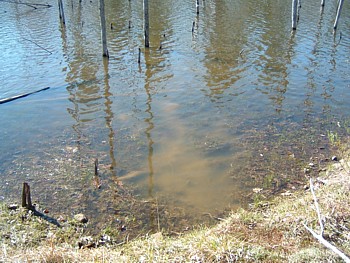
At the dam there were greens pushed up on the dam and mud,
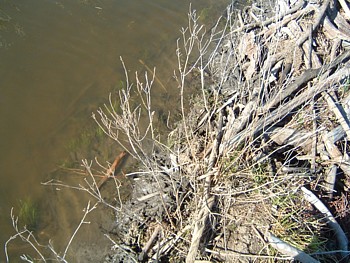
so the beavers have visited but the dam still leaks. For two years now they haven't been able to make this dam as tight as of old. I crossed the dam to the rock by the lodge to see if the otter left a token of its visit. There were two grey scats back in the grass
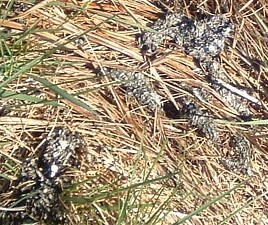
behind the rock behind the lodge.
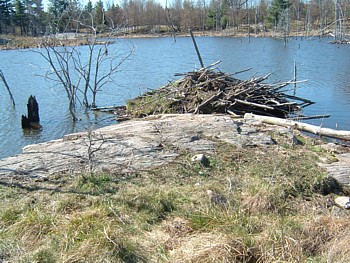
The burrow off to the east that I thought it was using looked unused, so it was probably going into the lodge. Obviously the otter is not residing here -- I don't think a mother would keep her pups in these large ponds. A male probably made two grand circuits to mark his territory and I happened to see him when he paused one evening in this pond. Down at the Upper Second Swamp Pond two pairs of geese were arguing, first sign, I think, of some failed geese nests. Then down on Otter Hole Pond, I saw a pair of quiet geese floating well away from the lodge, more failure, I suppose.
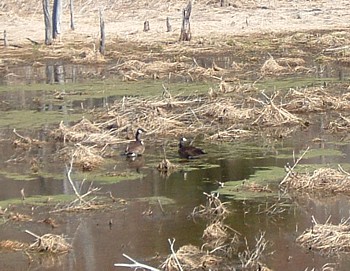
That lodge especially is easy for raccoons to get too, and the Upper Second Swamp Pond lodge is close to the shore too. These losses did not seem as traumatic as the loss of chicks last here after a coyote attack. The mother goose kept probing into the fluff as if she couldn't believe her loss. But back to the Second Swamp Pond, which seemed higher, the beavers had tended the dam.
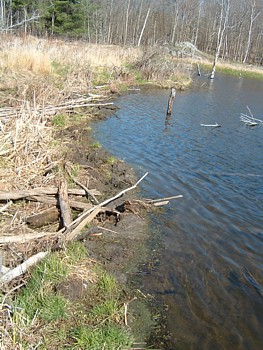
Only about four wood ducks on this pond -- perhaps not pairs because I see many single males. Down on the Otter Hole Pond, where there is little water there were many more ducks, mostly mallards. I checked the spot where some trillium, now rare on the island, remains and saw the plants growing. There were some ducks on the pool of water behind the Beaver Point Pond dam. The hike was going too fast, so I sat on a rotting log even though with the ducks gone there might be little to see. And I saw a porcupine lumbering slowy up the grassy knoll across the creek from the porcupine hotel. It paused to eat some grass but was on a mission to get over the hill. I took a photo of this old home of the porcupines, and its environs.
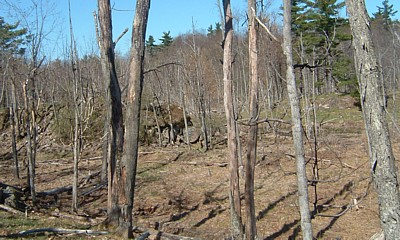
We have been seeing them here as long as we can remember, since 1980. I went out to check the otter latrine by the willow, thinking that fresh scat there would place some otters in the marsh, dry though it still remains. I saw some scat I had not seen before and since it was dry crayfish shell laced scat, an otter could have been here a few days ago. The scat was in the open grass between the shade of the willow and the marsh. Otters seldom conceal their visits. On the moss next to the lapping water, there were some freshly gnawed beaver sticks.
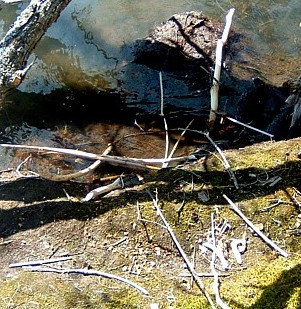
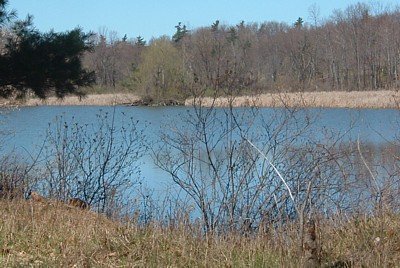
But the lodge still has a hole in the top, and no signs that beavers are denning there. I walked along the edge of the dry marsh, and saw no signs of otters going in there. I didn't try to get out to the island, but saw a heavily used deer trail. No scat on the South Bay trail, and before I headed up the ridge, I turned to take a photo of the willow tree latrine, greening ahead of the surrounding marsh.
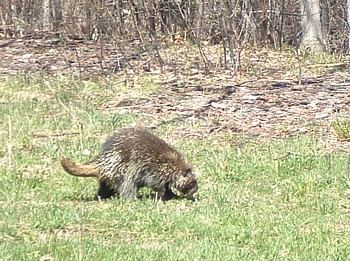
We had lunch and dinner at the land and spent most of the time working on the house foundation, which sounds more solid than the rocks we were digging into and around. On my way up to the Teepee Pond to get my gloves, a porcupine eating the grass ignored me.
The beaver in the Third Pond seems to be getting used to us too, though it still prefers to take what it eats into its den. It hasn't slapped its tail at us yet. There is no telling if this beaver has dispersed from a White Swamp colony as the natural course of things, or if it is the sole survivor of a colony trapped out. Given its small size, and tentative ways, I think it's a sole survivor. I'll have to think more about this. I sat for an hour up under the lonesome pine, which at this time of year affords a view of the Deep Pond below. No life on it, but I did hear a loon call from White Swamp. After dinner, I went up to the Teepee Pond and stayed long enough to see a muskrat swim about checking three of its burrows. There were three or four muskrats here when the beavers left in early September -- signs of only one muskrat in the winter. The peepers were sporadic here, more constant around the Third Pond. Leslie saw a huge globular egg mass just behind the dam,
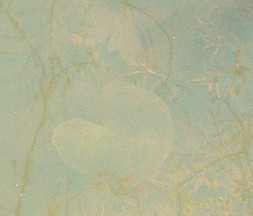
we'll have to figure out which frog packs eggs like that. We heard one leopard frog. During the day I sent three green frogs squealing into the pond. The whirligig beetles were jitterbugging in the Third Pond behind the dam. On the look out for warblers and grosbeaks now.
April 29 as I walked along South Bay a little after 4 pm there were five boats in the south cove, three or four people on the south shore, and one boat in the north cove, with two or three fishermen in each boat, all trying to catch bullheads. If otters were in the bay catching bullheads I would expect to find big wet scats without scales, but I seldom see a correlation between bullhead season and otter scats to match. I didn't find any new scats until I got out to the latrine above the entrance to South Bay, where, about two feet up from the last scats and scent mounds I saw here, I saw some more digging and a large dry scat laced with crayfish parts.
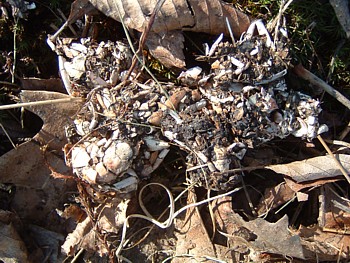
Nearby there was a small black scat.
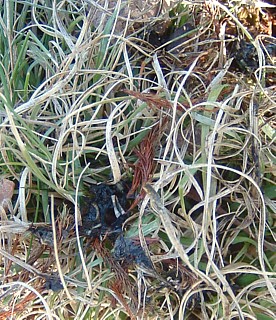
There didn't seem to be any scats on the flat rock next to the water which would be a place for otters to get out of the water to eat what juicy bullheads they might catch. There was a trail in the grass straight up to the latrine. Evidently otters don't bring the crayfish they catch to a comfortable place to eat them.
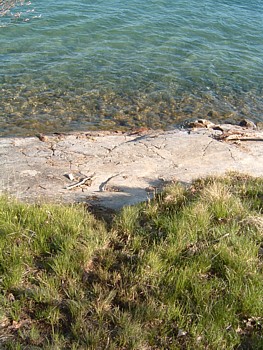
I must say, I'd like to see some really fresh scats so I could fancy that I just missed seeing the otters, but I am seeing new scats, and evidently from one otter that has a knack for catching crayfish. Audubon Pond continues to get higher which does make it a little easier for the beavers to get to the ash trees they are cutting. Not that they have taken much more than a bite or two out of the ash they cut down just up from the bridge in the northwest corner of the pond. The ash they cut on the north shore are now falling into water, and the beavers seem to be stripping the trunks in fine fashion.
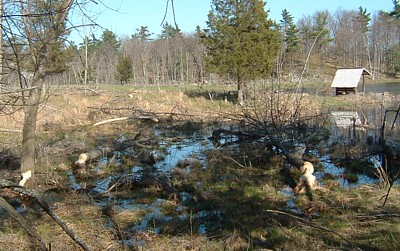
I sat on the bench just long enough to see a muskrat swim along the causeway forming the east shore, where, incidently, two geese and two deer were grazing. I fancied that the muskrat was going to the drain to dig into the mud to try to get some water out of this pond. The water has never been this high and consequently some muskrat burrows must be flooded. But I didn't see it go to the drain. I was planning to go to the Lost Swamp Pond to see if the muskrats were still singing, but the east wind was not quitting and that pond is open to an east wind. So I went to check on the Meander Pond beavers who I have not seen in a while. I take them for granted. In the back of my mind on every hike is: I can go to Meander Pond and likely see beavers, as certainly was the case during much of the winter. With an east wind I could sit near the lodge and count on not disturbing beavers that swam up pond to where most of their work has been. I sat there for a half an hour, enjoyed some song sparrows, but no beavers. The pond was not muddy at all, and this is the time of year beavers begin digging up the vegetation on the pond bottom. So I walked back to the dam, and along the north shore where I had noted several red amd white oaks being girdled and cut. There was nothing new at the dam nor had the work on the oaks progressed much. Some that are smaller than the oaks they cut in the winter were still standing. The canal they used all winter was not muddy in the least. So I went up to the Thicket Pond. The canal going up pond to the northeast was not clear, but not that muddy. I could see that there were was more gnawing on oaks up there, but none had been cut.
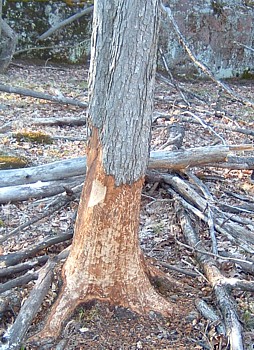
Had the beavers exhausted candidates for girdling and moved on? Along north shore of the canal going to the southeast corner of the pond, a small ash was girdled and stripped, like a beaver might be looking for some bedding material. And the water was muddy, but a white oak they had started stripping a week ago had no fresh work on it. Then I saw something slip under the water and then surface under the button bushes, leafless but thick enough to obscure what was swimming. I walked along with it and finally saw a small beaver who soon slapped its tail. And the curved ash they had cut and stripped was now straight on the ground thanks to the beavers segmenting it.
I know this yearling is not alone because it didn't have the height to do some of the girdling I saw. I sat hoping to see more beavers and listen to some frogs who were singing very sporadically, but I got two more tail splashes, and it was dinner time, so I headed home. When I walked back around South Bay all the fishermen were gone (my guess is that the east wind and low water are not conduscive to bullhead spawning.) As I paused at the little causeway, a muskrat looked up at me from the water, then dove in fright and swam away.
April 30 sunny, warming, with a manageable east wind, so we headed off in the kayaks. The bufflehead pair around Goose Island was not to be seen, and no ganders on guard either. As we rounded the headland of Wellesley Island we saw a male bufflehead and a pair of duller ducks. We went into the bay southwest of the Narrows -- which Jeff, I think, calls Escanaba Bay. The maple the beaver had been working on, up on a rocky promontory next to the water, was still standing, and the bank lodge around the corner didn't looked lived in. I saw one eight inch fish, probably a pickeral. Here and there were some fries. A male bufflehead and four female and/or juveniles flew out of the bay. There was a pair of geese and three or four half cut ash along the shore of the bay. Back against one small marsh I saw a possible otter scent mound, but it was rather shallow there and the marsh was not very big. I'd say the water has to rise a foot in the next month to provide a summer water level near to what we are used to.
The temperature got over 70 but digging foundation holes is cooling work the deeper you get, and for a bit I was three feet under. In the heat of the afternoon I took a slow tour toward White Swamp. The Third Pond looks higher, thanks to the grasses and brush the beaver put on the dam.
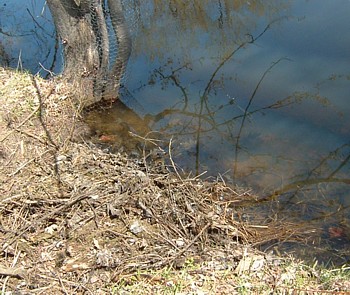
The pond water is muddy from the grasses it has been eating. Nothing out on the pond today, save for a green frog that stuck its head up after it jumped into the water. Trillium was popping out all over in the woods on the way down to White Swamp, but too much glare for a good photo. When I got to the otter latrine beside the little cove below where I've been sitting up on the ridge, I saw one neat plop of scat just up from the water
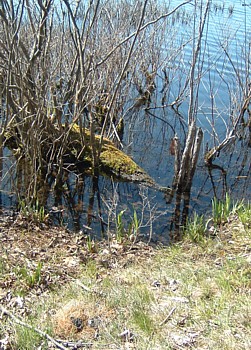
and then a bit higher on the ridge an array of black scats.
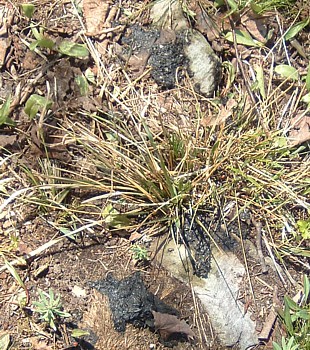
I expected to find that these were the wet scats I was hoping to find, especially since I saw lady bugs, bees and ants on them,
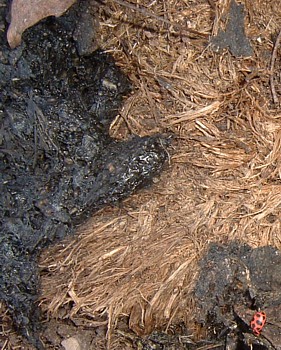
but all of them had dried out thanks to long hours of sun, low humidity and a steady east wind. I'm pleased that the otters keep visiting a latrine so convenient for me to get to, but I've yet to figure out why the otters come here. Can't tell from looking out at the swamp, since there doesn't seem to be a channel out there in front of this spot.
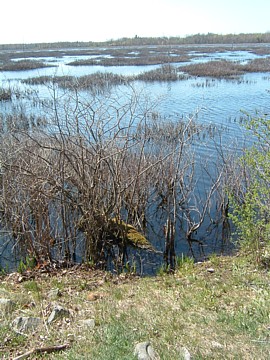
There is a wellworn path up the ridge,
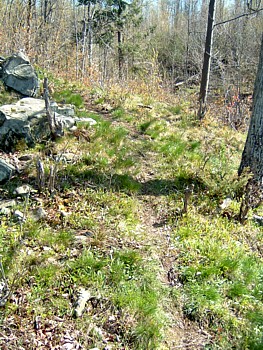
but it doesn't lead to a commanding spot -- there's a little valley behind the ridge and then a higher ridge -- but the trail doesn't continue up there. I haven't seen much raccoon poop, nor deer poop about. There is a porcupine on the ridge so perhaps it uses the path to get down to the water. I've used it twice, not enough times to make it look as worn as it does. I went down to the inlet creek and while there was no major new work, I determined that a beaver had taken down at least one sapling, nibbled some more sticks behind the dam, and gnawed some more on but did not cut down an ash behind the dam -- all this done after we saw the beaver in our Third Pond. Heard some different bird songs, but didn't see the singers. Out on the swamp, it was rather quiet -- two herons flying, a brief flap up among some geese in the distance and two calls from the snipe.
by Bob ArnebeckCheck out my other web pages: otters; beavers; minks; muskrats;porcupines;Leslie's art