April 2006
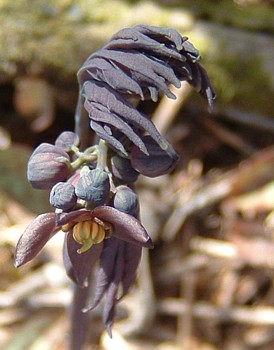
April 17 yesterday we worked at the land and then sat on the ridge over White Swamp. On the way Leslie pointed out some early meadow rue about to bloom.
There was a northeast wind raking the swamp and the ridge and the ducks were not as lively. Three heron were quite active and we heard several snipe calls. I went down to the inlet and there appeared to be no new sticks on the mound the beavers have favored. I saw a tree near the dam that seemed freshly girdled but there has been a porcupine working around here too. The beavers have mostly been taking saplings.
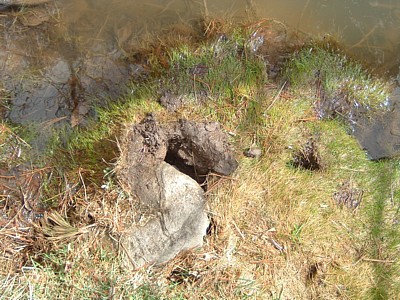
Today when I took a break from sawing I sat next to the Teepee Pond, the same perch from where I saw so much water scorpion activity a week or so ago. There was nothing hopping in the pond -- a frost last night chilled the water. However, I saw more digging in the turf right next to the pond. Now I think a raccoon is making the holes. I think they can work with surgical precision unlike most other mammals of the same size. That said, in making another hole nearby the animal just peeled back to the turf.
Spring beauties are blooming but I haven't gotten a good photo yet.
When we got home at 4, I promptly headed off to South Bay, hoping to get a sign there that would send me off to the Narrows or up to the Lost Swamp Pond, looking for more otter signs. Either way I would spend some time at Meander and Thicket ponds to see if I could see the beavers there. There were no otter scats at the little South Bay causeway. I hadn't checked the willow latrine on the north shore of the south cove of the bay in awhile, so I went out through the dry leaves then dry cattails. I saw immediately that there was no fresh beaver work -- beavers had been there until late in the fall but evidently haven't come back. However there was a small scent mound under the thick tentacle-like willow trunks reaching out over the water.
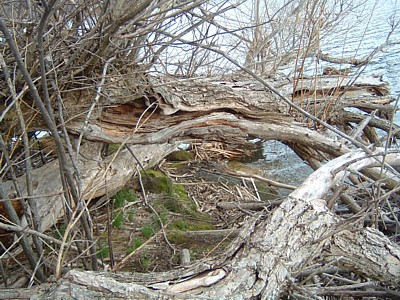
Something that small, and without much mud, is more likely the work of an otter. Then I noticed that there was a hole in the top of the lodge.
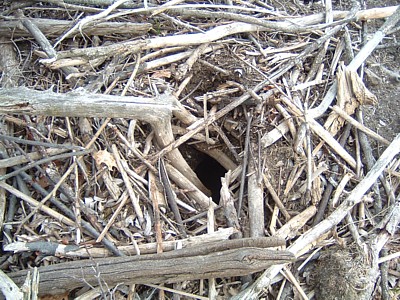
I thrust the camera down in it and was surprised to see, with my own eyes, wet granite below. And the photo shows a beaver lodge like none other that I've ever seen. Instead of chambers on two levels, there seemed to be one large chamber so that all the sticks only covered the granite.
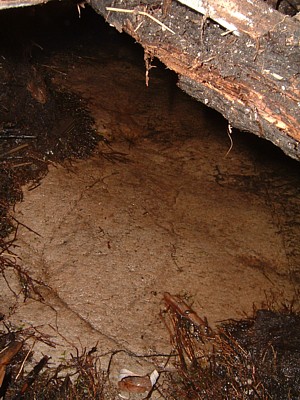
Perhaps this is because the beavers had no dirt to work with. I continued to look around the willow for otter scats. First I saw only smooth raccoon scats. Then I saw new, but not fresh, otter scats on the hard moss just up from the water. Then along the cattails beside the willow I saw more scat and a scent mound.
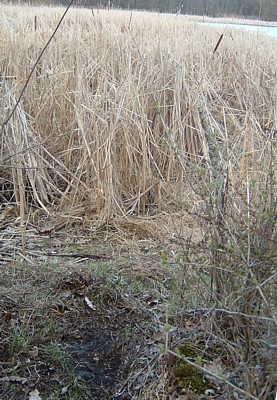
One scat was all crayfish shells, and very dry.
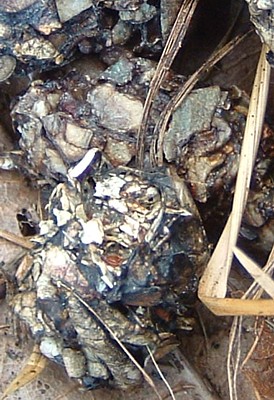
When I was last here, perhaps three weeks ago, these scats were not here. The cattail marsh beside and behind this willow world remains dry. The river's spring rise in water level has slowed down. I was able to walk out to the island, where I expect the otter mother raised her pups last year. The path was relatively dry and wide open thanks to a lot of deer traffic going through it. At the rock where I hoped to see otter scats, I saw pieces of deer bone and some deer hair. However on the rock that juts out into the water, I saw otter scat in the nearby marsh and on the rock a small scent mound.
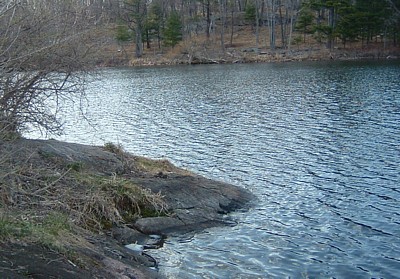
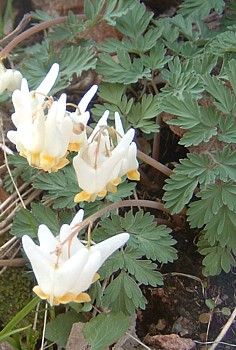
Last year the otters made a scent mound out of the clumps of grass, so this little mound could be the work of muskrats, but it seems too dry, If an otter is residing around here, I should soon see some moist scats because the bullheads will be spawning in the bay. This activity inspired me to check the New Pond knoll, There were some delicate dutchman's breeches on the path up,
and then up on the knoll there was a very curious scat with the shells of dead snails in it.
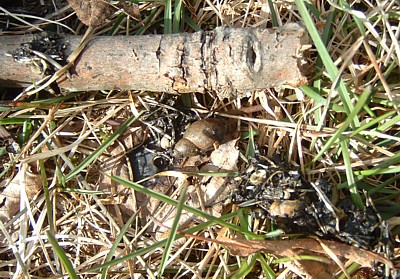
This was right where otters usually scat up on the knoll and it seemed like otter scat save for the shells. It was dry but most of the scats I've been seeing have been dry. Last year I learned not to associate scats on the New Pond knoll with otters going up to the beaver ponds.
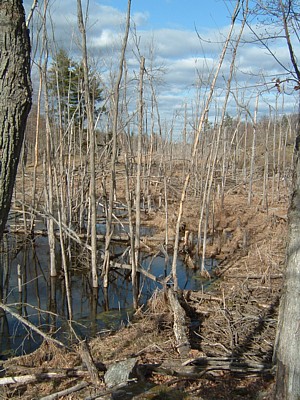
I think this is more a way to claim the end of South Bay. So I headed into the ponds, less out of an expectation of seeing more otter signs, but because I had learned a good deal about recent otter activity, and wanted to see what the beavers were up to. I went up and sat by Meander Pond. The east wind boded well, I thought, for seeing beavers swim out of the lodge and down to the east end of the pond and maybe up to Thicket Pond. Some downey woodpeckers entertained me, but no beavers, nor muskrats, and the frogs were remarkably quiet, only a few leopards and one peeper singing. I checked for recent activity on the south shore of the pond and thought I could see fresh work in logs quite convenient to the lodge in the middle of the pond.
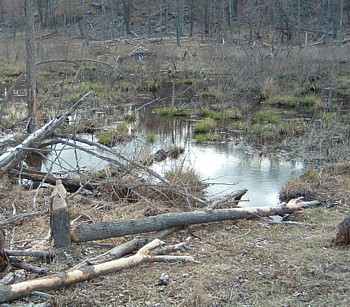
And then at the end of a canal I saw some stripped sticks in the water
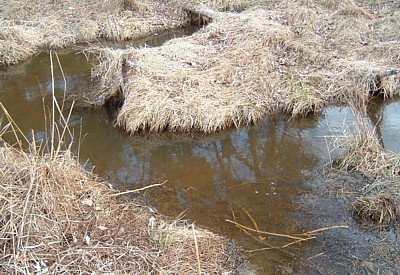
-- this season's work, I think, because at the end of the canal there were fresh smears of mud. There were no beavers out at the Thicket Pond either but I could see that they had been stripping one maple that they had cut so it curled down convenient to the pond. Below are before and after photos.
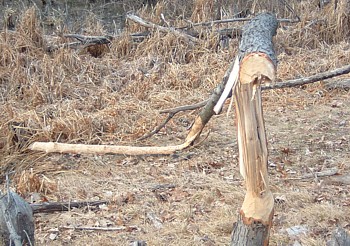
So I headed for the Second Swanp Pond, and soon paused to study a white poop with piece of deer bone in it.
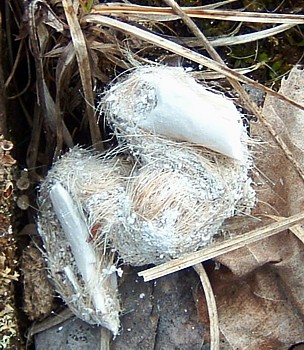
The bolus in the photo was one of several so I expect this is coyote poop. As usual when the sun sets at this time of year, the Second Swamp Pond was quite beautiful as grasses begin shooting up in it.
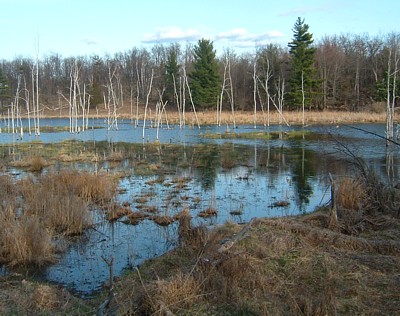
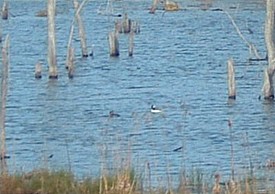
There were also two pairs of buffleheads still in the pond.
The dam was as schizophrenic as the last time I was here, quite wet on the south end that the beavers have not touched,
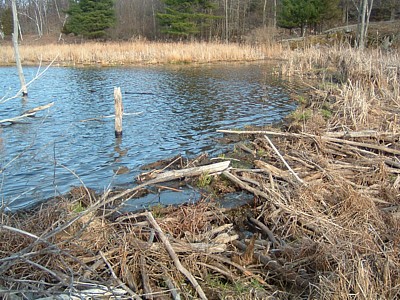
and fairly dry on the northend where the beavers have worked some magic with mud.
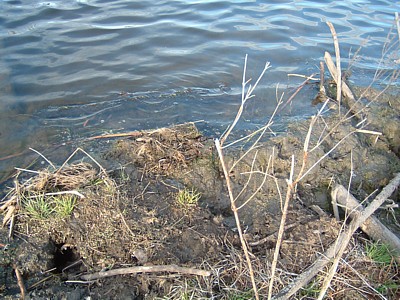
However, at the far south end, under no threat of flooding, there were dollops of mud,
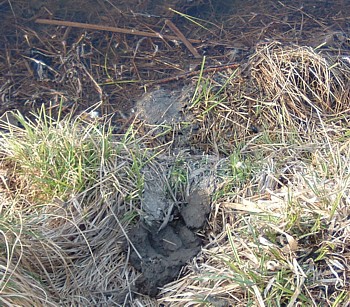
as if the beavers simply prefer this end of the dam where there was so little work to do. As I walked up to the Upper Second Swamp Pond, I saw a beaver dive there and evidently head up into the recently flooded upper reaches of the pond,
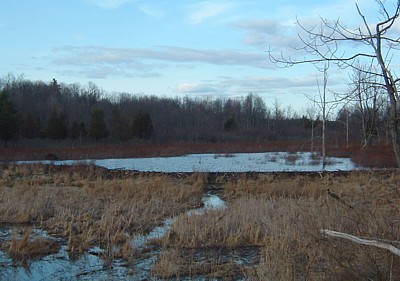
which is to say, I saw no beaver surface near the dam or lodge as I continued walking up. It was now about 6:30 pm and not too early for some beavers to be about in the Lost Swamp Pond, but not only did I not see beavers but the dam continues to leak and there is no fresh mud on it, suggesting that the beavers have stopped visiting the dam. I waited around long enough to see a muskrat, and a pair of widgeons fly off. I didn't walk around the pond looking for beaver signs, I'll come back and spend some time at night or dawn. I more or less made a beeline home to dinner, which took me to the little Double Lodge Pond just below the Big Pond. Though the pond is small,
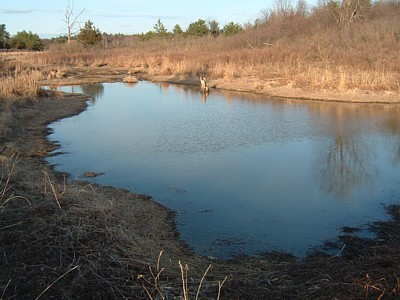
I flushed a flock of about 18 blue winged teals out of it -- or so the small ducks seemed to be to me. Of course, the dam shows no signs of repair.
April 19 yesterday I saw some spring beauties poking up through pine needles and I took photos hoping the rich green background would better bring out the beauty of the beauties
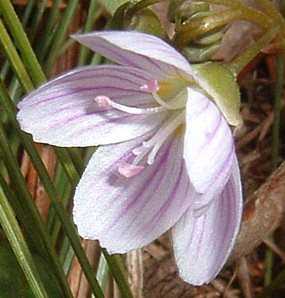
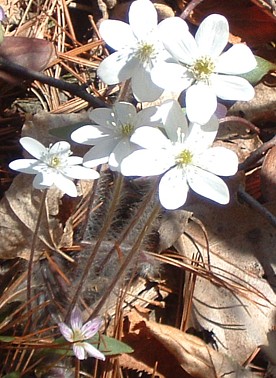
and I think the strategy worked. Then I saw a gang of hepatica looming over a spring beauty.
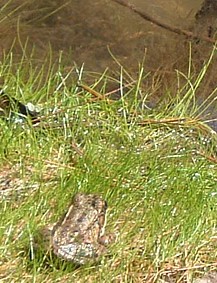
No action in the Teepee Pond, but a frog sunned on the shore as I sat during a break
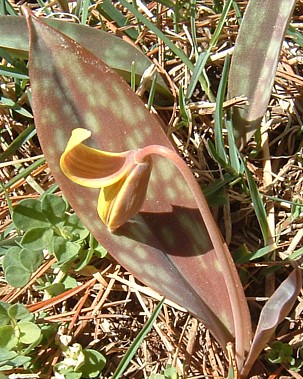
Then I noticed, right next to my pile of cut logs, a delicate trout lily.
Then after lunch, to stretch my legs, I walked down to the Deep Pond and saw a muskrat floating, then diving, nibbling, and then swimming into the burrows on the low northeast bank.
Today even though the east wind didn't quit, we still went out to check on the Picton Island otter latrines. We were surprised to see more buffleheads on the river than the last time we were out. It's like the pairs are pairing up. From the boat the digging at the Picton latrine looked a little deeper,
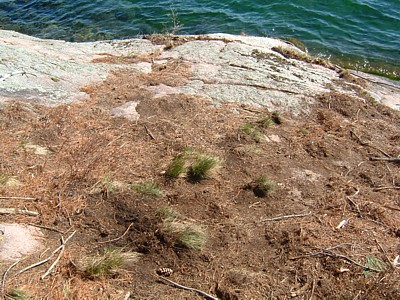
and once on the rock I saw new scats here and there, but nothing especially fresh around the digging. There were fresher scats around the rolling area near the swinging rope, and then coming up from the point of rocks there was a new scat and grass piled like a scent mound near by.
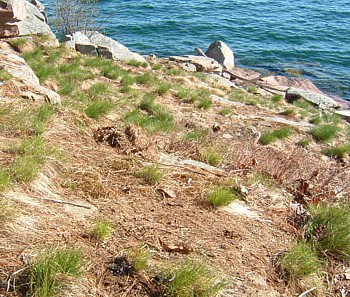
These scats have been exposed to sun and an east wind so no surprise that they seem to have dried out so fast. I didn't go up on the Murray Island latrine since I couldn't see any digging in the grass at all. The bay was too choppy to expect to see an otter swimming around. Going through the Narrows we saw the osprey fly into its nest atop the power pole atop the Narrows.
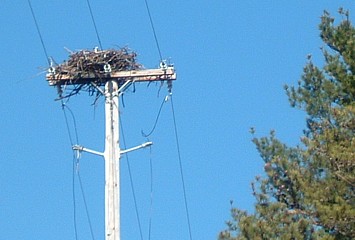
Last year this nest caught fire and one hatchling was quite burned. No learning curve here. We motored down into South Bay and drifted out, enjoying the sight of a muskrat about 10 yards off shore, diving down and then nibbling something we couldn't see, and cocking its tail out of the water. Then a little later, when I was walking to get the mail, I saw three cormorants flying relatively high, heading east.
We had lunch and dinner today at the land, so we could walk around and enjoy the flowers. We saw that some of the bloodroot that Leslie planted near the cabin was coming up and so we went up on the ridge where the biggest patch of bloodroot is, and it was spectacular
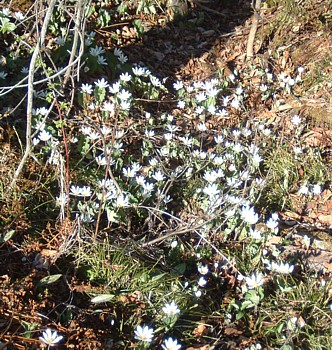
And not a few of the blooms rated close-ups
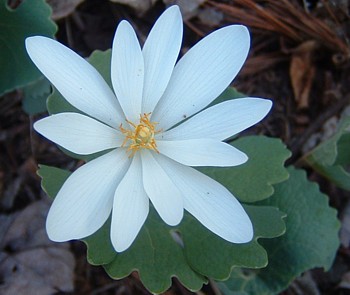
Leslie almost knelt in scientific study to count the petals and note the variations. Hanging above this patch was another perplexity, a bitternut, still looking alive, quite festooned with balls of some sort of fungus, we suppose,
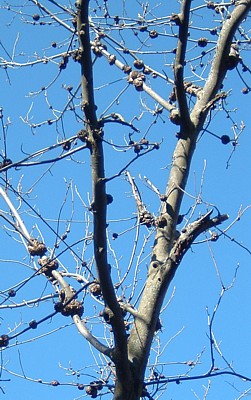
yet a neighboring bitternut had none at all. We also went to check on another small patch of bloodroot, and the upper bog, and then we went down to enjoy the hepatica poking through the leaves at the foot of the cliff. But here again the bloodroots stole the show. Last year we began noticing a patch of them in a mossy niche, and there they were again. A little later on I saw a patch more boldly posed on a ledge below a vaulting slab of rock
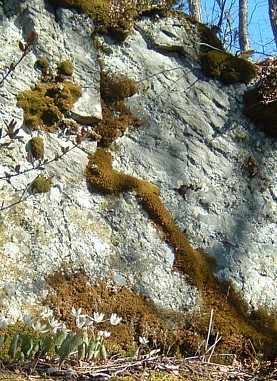
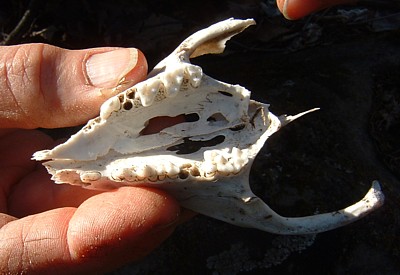
I spied some rosy quartz at the end of some sandstone well framed by moss and lichens. This got me excited about nosing into these mossy cliffs and I stumbled on some bleached bones of what we thought must be a rabbit. At least the jaw seems shaped like a rabbit's mouth and the size and delicacy of the bones seemed right. (Leslie later decided it was a baby coyote.)
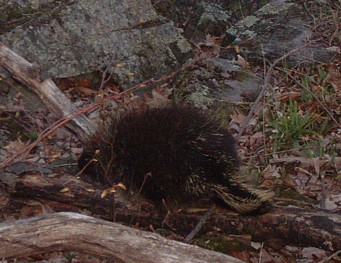
Finally Leslie noticed a patch of dead flowers, and I took a photo so we might ponder what they had been last year. After dinner we headed for White Swamp, and got there about a half hour before sunset. The snipes were boisterous again, almost sounding like bitterns. A tight flock of teals, I think, flew around in a circle. Most of the ducks and geese seemed farther away than usual. Indeed, I could see when we walked in that the swamp was more shallow. Finally I saw a muskrat swimming in from the west along the shore, then heading out into the swamp, then back. It dove just below me, and didn't come up. I was high up and can't believe it was trying to avoid me. Then I joined Leslie who was sitting above the inlet. On the way I saw a porcupine down on the ground, and it didn't panic, but did walk along, about as fast as me, and angled down the hill
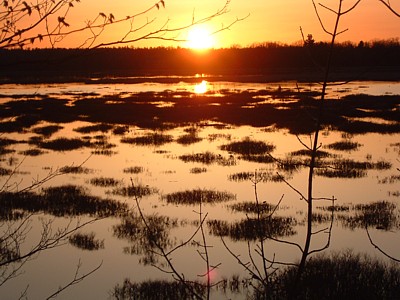
Since I had the camera out, I took a photo of the sunset
Then I sat with Leslie, and she had not seen the beaver. She noticed fresh work behind the pond, and I saw some fresh work in the pond. So she hoped a beaver would pop up in the pond. Val, who owns the land, saw the pond recently and decided he liked it. He said the trapper claimed he took 30 beaver last year -- I don't have enough experience with the "sportsmen" around here to gauge the level of their exaggeration, but, since they so often give a nice round number for their kill, I hope it is an exaggeration. Leslie was about to leave to go to our Third Pond to listen to frogs, when we both heard a beaver splash, down along the shore. We went higher up the ridge, and saw a beaver swimming out into the pond. I am used to beavers swimming away, but not in a pond a half mile wide. Though it seemed quite far from me, the beaver slapped its tail again, and then again a few minutes later. So I think it was reacting to our presence -- and why not, if the trapping season was fresh in its mind. It was heading to the inlet, and since it didn't turn back, I despaired of it, or any other beaver coming when there was still enough light to see it. So I headed up to our land. We heard a hermit thrush, and Leslie heard woodcock peints all around in the woods, but no mating flights. The peepers were lusty at the Third Pond, and also at the First Pond, where Leslie heard that overtone we noticed last year. Another night we'll investigate that. Anyway, good to see the beaver, though sorry we riled it.
April 20 I finished dinner by 6 pm and was soon hiking over the ridge to South Bay, though I planned to end my hike at the Lost Swamp Pond to try to see how many beavers were there. I always like to check the sometime otter latrine at the little causeway over the south creek running into South Bay, because a fresh otter scats there ignites all kinds of possibilities. But there were no scats, and a boat of bullhead fishermen out in the cove. An inveterate bullheader, an all-night barrel filler, told me he had never heard otters swimming nearby at night in the bay. I continued around the South Bay trail and was pleased to see a porcupine up in one of the maples sacked out in porcupine fashion with one leg limp over a limb.
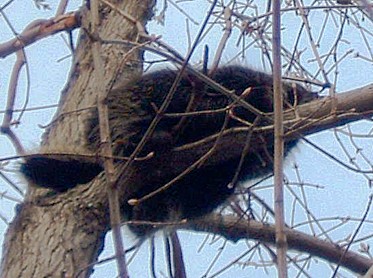
I assume its the one I've been seeing here, but it's quills were darker and looked a little bigger, but porcupines do grow after all. There were no fishermen in the north cove so I sat above the old dock briefly, no scats there and only five ducks in the bay, some buffleheads. Then I checked the New Pond knoll to take a closer look at that curious scat with snail shells in it. I ascertained that the snails were dead, the shells empty save for dirt packed into one. My guess is that an otter ate a little too much mud than it bargained for when it went after a crayfish. Clearly otter scat, I thought, especially since this is a place otters scat. I headed up the second swamp which was remarkably quiet until a pair of geese started honking at me as I approached the Second Swamp Pond. Instead of the usual buffleheads, there appeared to be a hooded merganser, but it took off before I could get the spyglass on it. Definitely not as many hooded mergansers this year. I veered up the ridge to the Lost Swamp Pond trying to keep a light northeast wind, very light, in my face. Since I was after a census and not close-ups, the last thing I wanted to do was elicit an early tail slap. As I approached it looked like more gnawing had been done on the big tree on the ridge, some digging into the wood, not just girdling.
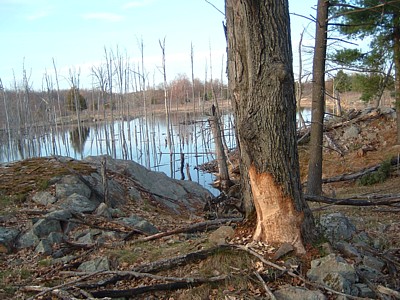
But not seeing a beaver, I moved up beyond that work and sat up at the point where I could see most of the pond, save for the mossy cove area behind me. Straight away I saw the usual muskrats going in the usual directions. Then I saw a beaver swimming from the lodge in the middle of the pond, and also some bubbles from the same area going in another direction so I expected to see another beaver surface, but I didn't. The beaver I saw swam slowly toward me and found something to eat which it did so placidly that I turned my attention again to the muskrats on the other side of the point. I saw one going in as another was going out from the southwest corner where, come to think of it, I never thought there were muskrat burrows. This back and forth usual starts when they have babies to feed, and adults come back with bouquets of grass, but there is not enough grass around yet for that. Then the beaver swam behind me and judging from the ripples I saw, I think it went into the bank lodge just below me that I couldn't see. This hardly satisfied my census taking because I knew at least one somewhat eccentric beaver was living in that lodge. I continued seeing fleeting ripples off behind the dam and kept expecting to see a beaver there but didn't. Then the muskrats in the north side of the pond got more active. There were at least two swimming in the south end, and at least three in the north, but I think there were more there. I saw one swim into the upper northeast end of the pond. They respected territory, swam more slowly than usual, though they still marked logs. I did see one brief disagreement. A small muskrat swam toward a larger one hunched on a log and when it tried to climb up on the log, the larger one nosed it away, but with hardly a splash. The little one swam off to the point. The muskrats in that part of the pond seemed to come from the lodge in the middle of the pond. One did swim over toward the muskrat burrows on the north slope but didn't go in. Then I saw more ripples near the dam and finally saw what was making them -- an otter! I am in the midst of revising and expanding my paper on otter-beaver encounters and here I had just witnessed one of a very quiet kind. There was only ten minutes between my last seeing the beaver and seeing the otter, and I know both had been around the lodge in the middle of the pond at roughly the same time. And the otter now, swimming on the surface, swam tentatively toward where the beaver had been looking in that direction. It was dark enough and the wind still in face, so I know it wasn't looking toward me. The otter had the ready but relaxed pose -- head up and tail up. It climbed on a log and shook its head, but didn't seem at all interested in foraging. It seemed like a big otter, but whenever an otter swims with tail up it seems bigger. It never dove with a tail wag so I couldn't see the tail. It was quiet and didn't have the jerky motions of a one year old. So could it be an adult female who because of the low water in the marsh of South Bay, has come up to this pond, large but unused by otters during the winter and so probably a good place to get food easily? On the otherhand, Jeff noted that the otter he saw off Murray floated a bit with its tail up, and my brief glimpse of that otter was with its tail somewhat up. But that otter was was eating and so was the otter that Jeff saw. It was too dark to check for scat, and that would have disturbed the pond, and I still had a beaver censue to take. A little before 8pm, I saw some rippling around the lodge in the southeast end of the pond, where the beavers spent the winter, and soon enough I could make out three beavers close together swimming toward the north shore where they had gotten dogwood during the winter. Then there was rippling on the other side, so all totaled I think there were at least five beavers out there. Then I noticed a vee of ripples in the pond that was contrary to the usual muskrat direction in the south end of the pond. That ripple turned into a small beaver that did some bobbing for grasses, I guess, just off to my right, and then swam around to my left, but didn't stay and swam back out to the point heading back to where it had been. Whether it sensed me or was curious about the beaver in the bank lodge, I don't know. Very quiet was this beaver, but there was a commotion behind me. A deer started stamping and snorting at me, and then hopped away. I looked back out at the pond and a deer was back stamping and snorting at me and hopping it away. I was definitely in the way of this deer and it didn't like it. Once the sun went down the peepers started singing. A curious lack of birds, though I heard one hermit thrush, and then when I walked to the Big Pond I heard peenting of wood cocks. I could see four buffleheads, just able to see their whites, swimming out in the Big Pond. It looked like the Big Pond dam had been tended but in the gloaming one begins to see a lot of fantastical shapes, each clump of grass suddenly has the authority of a marking animal's profoundest sculpture. Good hike. The Lost Swamp Pond beavers are all accounted for and did an otter just move in? I'll check the latrines in a couple of days.
April 21 after spending some of the day doing batter boards for the house and then the rest getting the car repaired, I only had time for a brief hike down the road to White Swamp where the culvert drains the pasture to the south. Val had mentioned beavers taking poplars on his land, but there were none down there. We were struck by how ghostly white the cattail clumps were in the swamp.
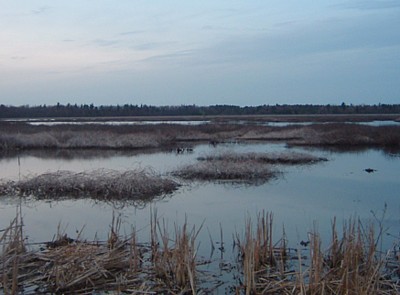
And we definitely heard the pumping sound of a bittern. In the gloaming the dutchman's britches and a bit of trillium coming out made white the theme of the night. Then we lent our ear to the frogs. Leslie sat by the Third Pond and I went to the First Pond to listen again to the dice shaking call that accompanies the peeper chorus. We thought it might be northern cricket frogs, but judging from the recording of their calls, that's not what we are hearing.
April 23 we finally got some rain, lots of it beginning Saturday at dawn, then heavy much of the day. After the last brief shower this morning, I headed off to see if the otter I saw had spread its scat around, or was keeping its arrival a secret. My rainy yesterday was enlivened by an e-mail asking for more information on the difference between otter and raccoon scats. As luck would have it, there were fresh scats in most of the latrines I tour. But first I had to herd some deer along the TI Park ridge. Only a few geese and mallards seemed to remain at the Big Pond. I sat on my usual perch south of the dam, and right in front of me was a plump fresh otter scat,
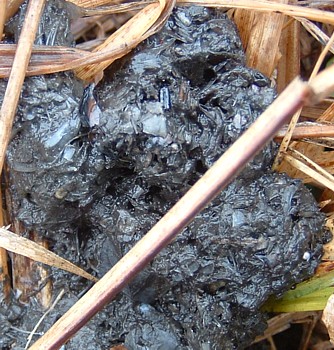
Of course with otters I expect and look for fish parts, and this scat evidently has some insect parts -- a brown bit of wing on top of it. Raccoon's specialize in insects but this scat was too loose to be a raccoon's and as is so often the case with otters, even when they manage to mold a relatively neat bolus, as raccoons almost always do, otters often throw a squirt of pure liquid near by.
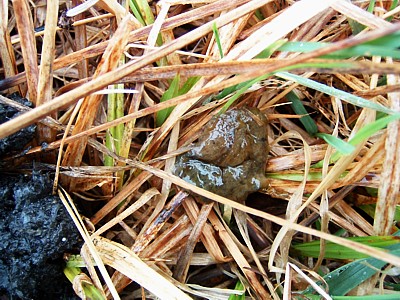
And behind that in the grass was a raccoon scat, at least a week old. Since it is wearing a bit, in it you can see insect and maybe fish parts, but I think raccoons chew their food more carefully -- the live things they eat are small, and what they scavenge is dead, and the raccoon can take its time. An otter often eats on the run and to me seems trapped in a life of gulping bites for which it rewards itself with frequent naps. Raccoons strike me as indafitigable in their tours -- indeed when I tour the ponds, they are my ideal. So the many bits and pieces in a raccoon's scat are smaller, better digested, and raccoons seem have something in them that glues their poop together so that it retains its shape much longer than an otters.
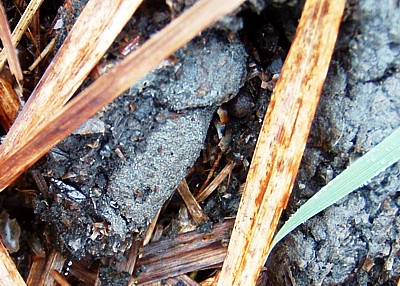
It was easy to see, though, not so apparent in the photo, the otter's trail in the grass back into the pond.
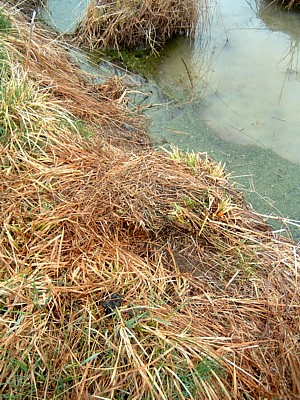
You don't usually see that leading from a raccoon scat. The beavers have not come down from their home pond just above this one to repair the dam, but it is holding up fairly well. There were no buffleheads or mergansers on the Lost Swamp Pond either. And the geese were quiet. Although I didn't expect to see anything swimming on the pond at 10:30 am on a rainy morning, a muskrat popped up on a log to entertain me.
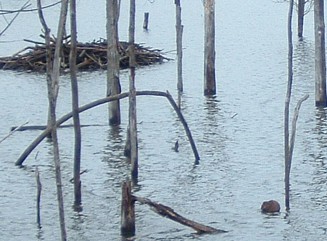
It brought up a collection of grass and using a slanted log as a perch and plate ate it in usual muskrat fashion, though the jaws went fast and grass disappeared slowly -- no scarfing here. Swallows were fighting over tree holes above the muskrat. I heard a kingfisher but didn't see it. A heron flew in the distance. By the way, I heard a tern on the river but none here yet. I no longer have any anxiety about the beavers being here, but I couldn't resist a photo of one of their nooks for nibbling not far from the bank lodge
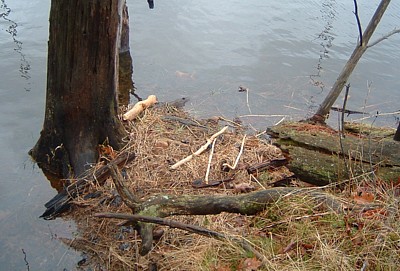
as I checked the otter latrines. No otter has scatted at the mossy cove latrine but there was much activity along the North Slope. I found two small scats that seemed a few days old, but the rest looked fresh, though with this rain scats will retain their freshness. The otter mussed up grass all along the trail, which a photo doesn't show, but below one of its large scats, a photo does give a hint of a pretty sizeable scent mound.
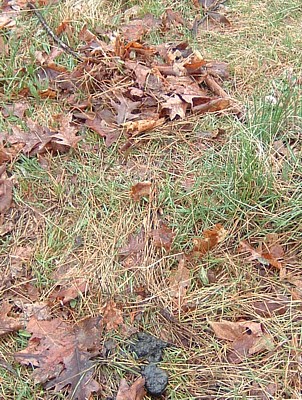
There were smaller more liquid and greyer scats higher up the hill, and darker, drier, probably older scats on mounds of grass just up from the pond.
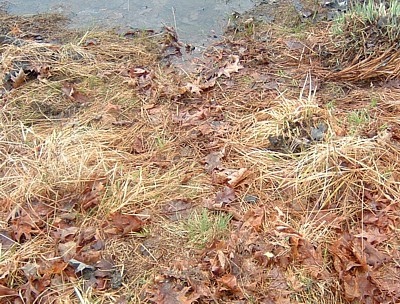
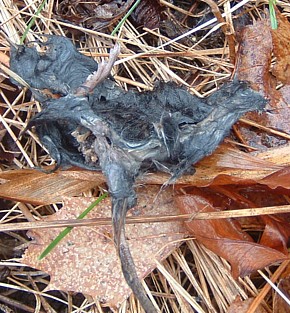
Perhaps this is a classic case of an otter moving its claim higher up the hill with each succeeding visit to the latrine. I expected that there would be scats over the ridge, but first I headed up to the dam of the Lost Swamp Pond. There were no scats in the old latrines up there, but usually only otters hanging around a while use them. Before I took photos of the brimming Upper Second Swamp Pond dam, I saw what looked like a strange scat at the south end of the dam, where I've never seen otters scat before. Of course, I worried that I had stumbled upon a loose raccoon scat. Seeing carrion beetles also gave me pause. One of my tests for raccoon scat is to see how much stickier it is. I pulled up what I thought was a stick and this supposed scat unfolded loosely into the rotting hide of a water shrew, probably. I was pulling the tail.
The beavers have packed on some logs and rocks
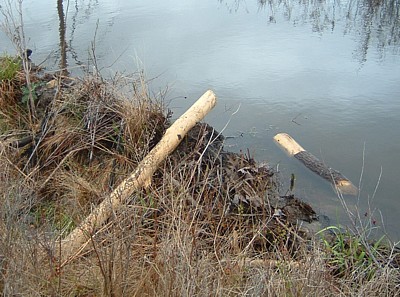
but the water is all a puddle below the dam.
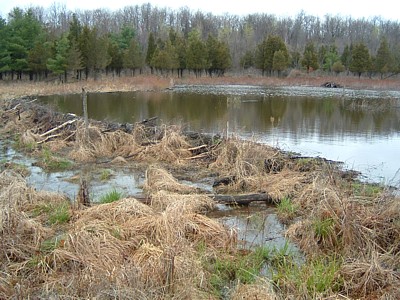
This will not be an easy dam to cross upon for a few weeks. As I expected there was otter scat on the trail down to the Second Swamp Pond in the usual latrine a few yards up from the pond.
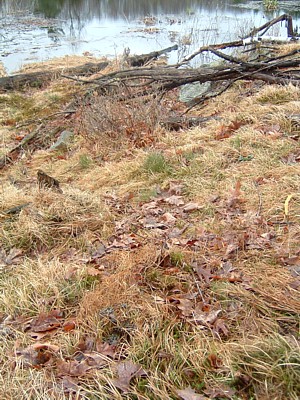
Since I was on a mission to notice the differences between otter and raccoon scat, I took a photo of the latter on the moss down by the pond, also where otters like to scat
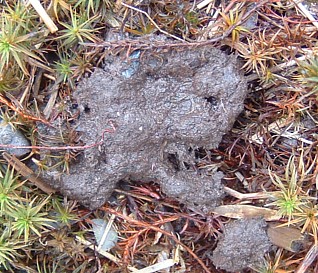
The fresh otter scat was a little higher on the slope and much different.
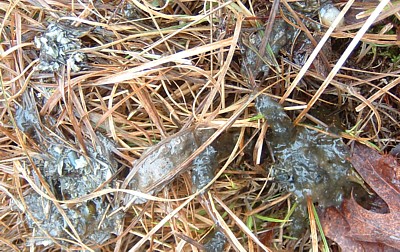
I walked back up the trail to check the top of the small ridge. One year the otters marked up there a lot, but while I did see some grass scuffed up, I didn't see any scat. Of course, the trees are budding, and knowing all the photos of scats that I was taking, I decided not to photograph the buds, but the delicately dancing maple buds argued otherwise
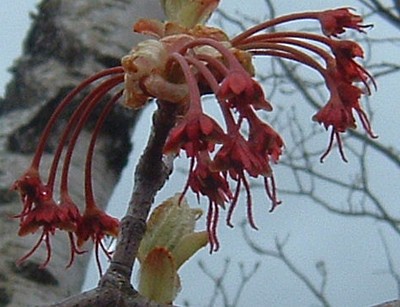
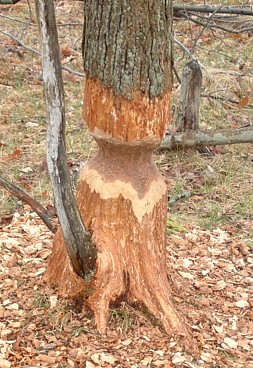
Over the past two years the otters have scatted all along the Second Swamp Pond dam, but I didn't see any there today. Of course the pond is brimming over the dam in several spots, hardly a dry spot for otters to rest and relieve themselves. I continued around the pond to the lodge and the auxilliary lodge, though I should say the former has quite deteriorated and is no longer safe to walk on. There were no otter scats to be seen. So is the otter only marking the two bigger ponds and not venturing beyond? I took the shortest way to the farthest South Bay latrine which meant that I went via the East Trail Pond dam, and Thicket, Meander and Audubon Ponds. I checked the former for otter scats, none, and then I turned my attention to beaver work. The beavers operating out of Thicket Pond have been concentrating on girdling white oaks. I noticed two girdled at the end of the canal going to the northeast, and today I saw that they had begun on a white oak at the southeast corner of the pond. They have also straightened out the curving maple by cutting off what they had stripped. Near the dam their pleasure is red oak and one is almost cut. Now if I were cutting the tree, I would trim the dead wood first, not the beavers.
Nothing along the south shore of Meander Pond struck me as fresh work, but I didn't veer up close to the west end of the pond. About five years ago beavers then in the now dry Shortcut Trail Pond cut down two large oaks, one red and one white. Today a pileated woodpecker reaped a reward as it pecked into the rotting trunk of the white oak
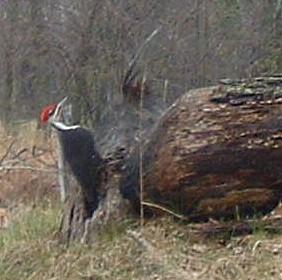
I got rather close and when it flew off, it only went higher up a nearby tree. The ants in the trunk were plentiful and the woodpecker didn't want to lose sight of them.
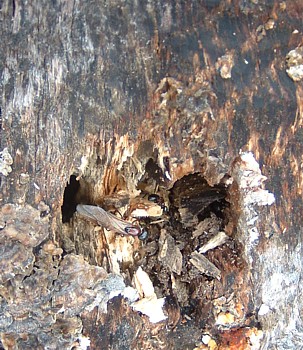
As it was digging into the trunk it periodically cocked its head up, less to look at me, I think, than to listen for other woodpeckers who might horn in on the bounty. When I began walking around Audubon Pond at its northeast corner, I saw something hop down from the bridge at the far southwest corner. It looked like what hopped stayed hunched on the grass behind the bridge. So it was either a muskrat or beaver, probably the former. The beavers here specialize in ash, taking the remaining ones along the north shore of the pond
and the one they had been cutting at the northwest corner of the pond is almost done to a point.
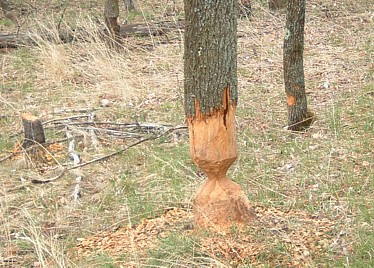
I didn't see any otter scats, nor for that matter was there much evidence of beavers doing more nibbling along the west shore. The suspected muskrat was no longer near the bridge but on the slope there were lots of mud smears in the grass. I usually attribute that to beavers, so maybe it was a small beaver that I saw. I didn't notice anything swimming into the pond which was curious. Animals are usually not shy in this pond. Perhaps there is a burrow under the bridge, but it was too wet for me to crawl down and check. Before I turned my attention back to otters along South Bay, I noticed that a beaver had started to gnaw into a elm that it had girdled. No other beaver work nearby. There were fresh scats in the latrine up on the slope over what I call the entrance to South Bay, with a bit of leaves piled and some scratching here and there
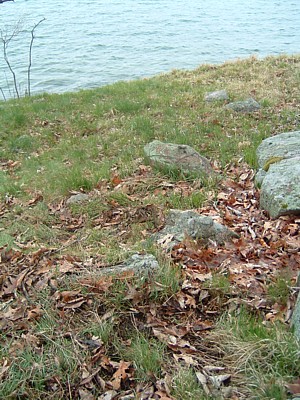
Some of the fresh scat was quite different than what I had seen in the ponds,
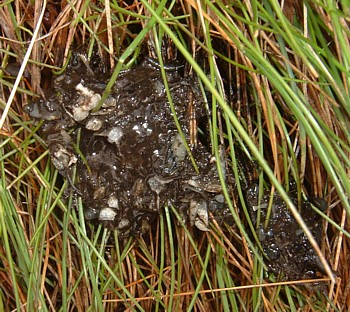
but some others were not unlike it.
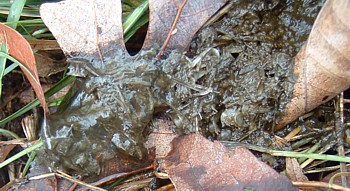
There are a series of latrines along the north shore of South Bay and so I set out to see if I could make a plausible case that the same otter hit all the latrines I saw today, or that it was obvious the two otters divided the territory. Down on the docking rock there was a small fleck of otter scat, somewhat dry, but definitely new. I went up the short trail to a sometimes latrine up under the tree between the rock and the official South Bay trail. Here I found a scent mound a little higher up the usual, and then another just off the trail. I've never found one up that far before. A little beyond that was a typical raccoon scat. Again some of the otter scat here was much like what I saw around the ponds
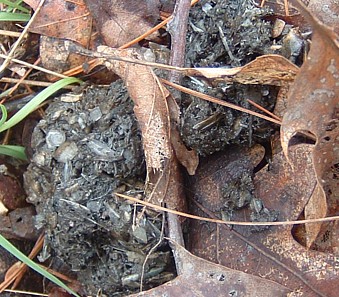
but some others were quite different with maybe a bit of crayfish in it.
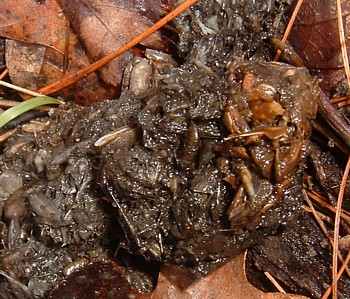
And one was quite spread out
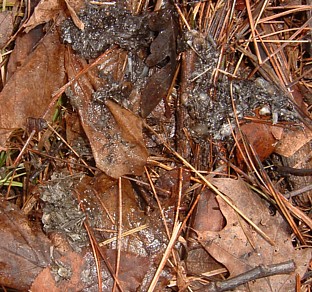
It crossed my mind that a raccoon spread it out looking for bits that might have come out of otter more or less undigested. There were no scats at the old dock latrine almost at the end of the bay. I thought this had become an important latrine, but that the otters ignored it lost some significance when I found a new scat up atop the New Pond knoll which commands the entrance to the ponds. However, there was no muss and fuss, no scent mound. That left one more latrine, since I was too tired to go out to the willow and rock latrines on the point in South Bay. So I debated what it would mean if there were no scats on the little causeway on the creek that drains the Big Pond a few hundred yards away. Last year otters made a series of scent mounds here, but today there was nothing. So? My guess is that I saw a male otter two days ago who has reestablish his claim to all this area. I assume a mother otter wouldn't have time for such marking, either just before or just after giving birth. And an immature otter would have visited the latrines that had been used for relaxing when it grew up and wouldn't have been so careful to mark the traditional otter routes. Now, to see otters where I don't expect them and prove myself all wrong!
by Bob ArnebeckCheck out my other web pages: otters; beavers; minks; muskrats;porcupines;Leslie's art