|
Back The Simple Life of Muhammad |
|
If we compare the life of Muhammad |
Before
his mission as a prophet, Muhammad  had no financial
worries. As a successful and reputed merchant, Muhammad drew a satisfactory and
comfortable income. After his mission as a prophet and because of it, he
became worse off materially. To clarify this more, let us browse the
following sayings on his life:
had no financial
worries. As a successful and reputed merchant, Muhammad drew a satisfactory and
comfortable income. After his mission as a prophet and because of it, he
became worse off materially. To clarify this more, let us browse the
following sayings on his life:
n Aa’isha, Muhammad’s wife, said, “O my nephew,
we would sight three new moons in two months without lighting a fire (to cook a
meal) in the Prophet’s houses.” Her
nephew asked, “O Aunt, what sustained you?” She said, “The two black
things, dates and water, but the Prophet had some Ansar neighbors
who had milk-giving she-camels and they used to send the Prophet some of its milk.”
n Sahl
Ibn Sa’ad, one of Muhammad’s companions, said, “The
Prophet of God did not see bread made
from fine flour from the time God sent him (as a prophet) until he died.”
n Aa’isha, Muhammad’s wife, said, “The
mattress of the Prophet , on which he slept, was
made of leather stuffed with the fiber of the date-palm tree.”
n Amr
Ibn Al-Hareth, one of Muhammad’s companions, said that
when the Prophet died, he left neither
money nor anything else except his white riding mule, his arms, and a piece of
land which he left to charity.
Muhammad lived this hard life
till he died although the Muslim treasury was at his disposal, the greater part
of the
Is
it possible that Muhammad might have claimed prophethood
in order to attain status, greatness, and power? The desire to enjoy
status and power is usually associated with good food, fancy clothing,
monumental palaces, colorful guards, and indisputable authority. Do any
of these indicators apply to Muhammad ? A few glimpses of
his life that may help answer this question follow.
Despite
his responsibilities as a prophet, a teacher, a statesman, and a judge,
Muhammad used to milk his goat,
mend his clothes, repair his shoes, help with the household work, and visit
poor people when they got sick. He also helped his companions in digging
a trench by moving sand with them. His life was an amazing model of simplicity
and humbleness.
Muhammad’s followers loved him,
respected him, and trusted him to an amazing extent. Yet he continued to
emphasize that deification should be directed to God and not to him personally.
Anas, one of Muhammad’s companions, said that
there was no person whom they loved more than the Prophet Muhammad , yet when he came to
them, they did not stand up for him because he hated their standing up for him,
as other people do with their great people.
Long
before there was any prospect of success for Islam and at the outset of a long
and painful era of torture, suffering, and persecution of Muhammad and his followers, he received
an interesting offer. An envoy of the pagan leaders, Otba, came to him
saying, “...If you want money, we will collect enough money for you so that you
will be the richest one of us. If you want leadership, we will take you
as our leader and never decide on any matter without your approval. If
you want a kingdom, we will crown you king over us...” Only one
concession was required from Muhammad in return for that, to give
up calling people to Islam and worshipping God alone without any partner.
Wouldn’t this offer be tempting to one pursuing worldly benefit?
Was Muhammad hesitant when the offer
was made? Did he turn it down as a bargaining strategy leaving the door
open for a better offer? The following was his answer: {In the Name of
God, the Most Gracious, the Most Merciful} And
he recited to Otba the verses of the Quran 41:1-38. The Following are
some of these verses:
 A revelation from
(God), the Most Gracious, the Most Merciful; a Book whereof the verses are
explained in detail; a Quran in Arabic, for people who know, giving good news
and warning, yet most of them turn away, so they do not listen.
A revelation from
(God), the Most Gracious, the Most Merciful; a Book whereof the verses are
explained in detail; a Quran in Arabic, for people who know, giving good news
and warning, yet most of them turn away, so they do not listen.  (Quran, 41:2-4)
On
another occasion and in response to his uncle’s plea to stop calling people to
Islam, Muhammad’s answer was as decisive
and sincere: {I swear by the name of God, O Uncle!, that if they place the
sun in my right-hand and the moon in my left-hand in return for giving up this
matter (calling people to Islam), I will never desist until either God makes it
triumph or I perish defending it.}
Muhammad and his few followers
did not only suffer from persecution for thirteen years but the unbelievers
even tried to kill Muhammad several times. On
one occasion they attempted to kill him by dropping a large boulder, which
could barely be lifted, on his head. Another time they tried to kill him by
poisoning his food. What could justify such a life of suffering and
sacrifice even after he was fully triumphant over his adversaries? What
could explain the humbleness and nobility which he demonstrated in his most
glorious moments when he insisted that success is due only to God’s help and
not to his own genius? Are these the characteristics of a power-hungry or
a self-centered man?
|
(7) The Phenomenal Growth of Islam |
|
At the end of this chapter, it may be
appropriate to point out an important indication of the truth of Islam.
It is well known that in the |
n “Islam
is the fastest-growing religion in
n “Moslems
are the world’s fastest-growing group...” (The Population
Reference
n “....Islam
is the fastest-growing religion in the country.” (Geraldine
Baum; Newsday Religion Writer, Newsday).
n “Islam, the fastest-growing religion in the
This
phenomenon indicates that Islam is truly a religion from God. It is
unreasonable to think that so many Americans and people from different
countries have converted to Islam without careful consideration and deep
contemplation before concluding that Islam is true. These converts have
come from different countries, classes, races, and walks of life. They
include scientists, professors, philosophers, journalists, politicians, actors,
and athletes. (To read the stories of people who have converted to Islam,
please visit the links at Stories of New Muslims.)
The
points mentioned in this chapter constitute only some of the evidence supporting
the belief that the Quran is the literal word of God, that
Muhammad is truly a
prophet sent by God, and that Islam is truly a religion from God.
Islam provides many benefits for the
individual and the society. This chapter mentions some of the benefits
gained through Islam for the individual.
(1) The Door to
Eternal
|
God has said in the Quran: |
And give good news
(O Muhammad) to those who believe and do good deeds, that they will have
gardens ( (Quran, 2:25)
God
has also said:
Race one with
another for forgiveness from your Lord and for (Quran, 57:21)
The
Prophet Muhammad told us that the lowest
in rank among the dwellers of said: {A space in
If
you enter
But those who
believe and do good deeds, We will admit them to
gardens ( (Quran, 4:57)
|
(2) Salvation from Hellfire |
|
God has said in the Quran: |
Those who have
disbelieved and died in disbelief, the earth full of gold would not be accepted
from any of them if one offered it as a ransom. They will have a painful punishment,
and they will have no helpers. (Quran, 3:91)
So,
this life is our only chance to win
If you could but
see when they are set before the Fire (Hell) and say, “Would that we might
return (to the world)! Then we would not reject the verses of our Lord,
but we would be of the believers!” (Quran, 6:27)
But
no one will have this second opportunity.
The
Prophet Muhammad said: {The happiest man in the world of those doomed to
the Fire (Hell) on the Day of Judgment will be dipped in the Fire once.
Then he will be asked, “Son of Adam, did you ever see any good? Did you
ever experience any blessing?” So he will say, “No, by God, O Lord!”}
|
3) Real Happiness and Inner Peace |
|
Real happiness and peace can be found in
On the other hand, the one who turns
away from the Quran will have a life of hardship in this world. God has
said: |

But whoever turns
away from the Quran, he
will have a hard life, and We will raise him up blind
on the Day of Judgment. (Quran, 20:124)
This may explain why some people commit suicide
while they enjoy the material comfort money can buy. For example, look at
Cat Stevens (now Yusuf Islam), formerly a famous pop singer who used to earn
sometimes more than $150,000 a night. After he converted to Islam, he
found true happiness and peace, which he had not found in material success.
|
(4) Forgiveness for All Previous Sins |
|
When someone converts to Islam, God
forgives all of his previous sins and evil deeds. A man called Amr
came to the Prophet Muhammad |
After
converting to Islam, the person will be rewarded for his or her good and bad
deeds according to the following saying of the Prophet Muhammad : {Your Lord, Who is
blessed and exalted, is most merciful. If someone intends to do a good
deed but does not do it, a good deed will be recorded for him. And if he
does do it, (a reward of) ten to seven hundred or many more times (the reward
of the good deed), will be recorded for him. And if someone intends to do
a bad deed but does not do it, a good deed will be recorded for him. And
if he does do it, a bad deed will be recorded against him or God will wipe it
out.}
What Is Islam?
The religion of Islam is
the acceptance of and obedience to the teachings of God which He revealed to
His last prophet, Muhammad .
|
Some Basic Islamic Beliefs 1) Belief in
God: Muslims believe in one, unique,
incomparable God, Who has no son nor partner, and
that none has the right to be worshipped but Him alone. He is the true
God, and every other deity is false. He has the most magnificent names
and sublime perfect attributes. No one shares His divinity, nor His attributes. In the Quran, God describes
Himself: |
Say, “He is God,
the One. God, to Whom the creatures turn for
their needs. He begets not, nor was He begotten, and there is none like
Him.” (Quran, 112:1-4)
|
|
|
Chapter
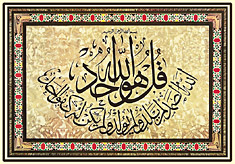
112 of the Quran written in Arabic calligraphy. |
No
one has the right to be invoked, supplicated, prayed to, or shown any act of
worship, but God alone.
God
alone is the Almighty, the Creator, the Sovereign, and the Sustainer of
everything in the whole universe. He manages all affairs. He stands
in need of none of His creatures, and all His creatures depend on Him for all
that they need. He is the All-Hearing, the All-Seeing, and the
All-Knowing. In a perfect manner, His knowledge encompasses all things,
the open and the secret, and the public and the private. He knows what
has happened, what will happen, and how it will happen. No affair occurs
in the whole world except by His will. Whatever He wills is, and whatever
He does not will is not and will never be. His will is above the will of
all the creatures. He has power over all things, and He is able to do
everything. He is the Most Gracious, the Most Merciful, and the Most
Beneficent. In one of the sayings of the Prophet Muhammad , we are told that God is
more merciful to His creatures than a mother to her child. God is far
removed from injustice and tyranny. He is All-Wise in all of His actions
and decrees. If someone wants something from God, he or she can ask God
directly without asking anyone else to intercede with God for him or her.
God
is not Jesus, and Jesus is not God. Even Jesus himself rejected this. God
has said in the Quran:
Indeed, they have
disbelieved who have said, “God is the Messiah (Jesus), son of Mary.” The
Messiah said, “Children of (Quran, 5:72)
God
is not a trinity. God has said in the Quran:
Indeed, they
disbelieve who say, “God is the third of three (in a trinity),” when there is
no god but one God. If they desist not from what they say, truly, a
painful punishment will befall the disbelievers among them. Would they not
rather repent to God and ask His forgiveness? For God is Oft-Forgiving,
Most Merciful. The Messiah (Jesus), son of Mary, was no more than a
messenger... (Quran, 5:73-75)
Islam
rejects that God rested on the seventh day of the creation,
that He wrestled with one of His angels, that He is an envious plotter
against mankind, or that He is incarnate in any human being. Islam also
rejects the attribution of any human form to God. All of these are considered
blasphemous. God is the Exalted. He is far removed from every
imperfection. He never becomes weary. He does not become drowsy nor
does he sleep.
The Arabic word Allah means God (the
one and only true God who created the whole universe). This word Allah
is a name for God, which is used by Arabic speakers, both Arab Muslims and Arab
Christians. This word cannot be used to designate anything other than the
one true God. The Arabic word Allah occurs in the Quran about 2700
times. In Aramaic, a language related closely to Arabic and the language
that Jesus habitually spoke, God is also referred to as Allah.
2) Belief in the
Angels:
Muslims believe in the existence of the
angels and that they are honored creatures. The angels worship God alone,
obey Him, and act only by His command. Among the angels is Gabriel, who
brought down the Quran to Muhammad .
3) Belief in God’s
Revealed Books:
Muslims believe that God revealed books to
His messengers as proof for mankind and as guidance for them. Among these
books is the Quran, which God revealed to the Prophet Muhammad . God has
guaranteed the Quran’s protection from any corruption or distortion. God
has said:
Indeed, We have sent down the Quran, and surely We will guard it
(from corruption). (Quran, 15:9)
4) Belief in the
Prophets and Messengers of God:
Muslims believe in the prophets and
messengers of God, starting with Adam, including Noah, Abraham, Ishmael, Isaac,
Jacob, Moses, and Jesus (peace be upon them).
But God’s final message to man, a reconfirmation of the eternal message, was
revealed to the Prophet Muhammad . Muslims believe
that Muhammad is the last prophet sent
by God, as God has said:
Muhammad is not the
father of any one of your men, but he is the Messenger of God and the last of
the prophets... (Quran, 33:40)
Muslims believe that all the prophets and
messengers were created human beings who had none of the divine qualities of
God.
5) Belief in the
Day of Judgment:
Muslims believe in the Day of Judgment
(the Day of Resurrection) when all people will be resurrected for God’s judgment
according to their beliefs and deeds.
6) Belief in Al-Qadar:
Muslims believe in Al-Qadar, which
is Divine Predestination, but this belief in Divine Predestination does not
mean that human beings do not have freewill. Rather, Muslims believe that
God has given human beings freewill. This means that they can choose
right or wrong and that they are responsible for their choices.
The belief in Divine Predestination
includes belief in four things: 1) God knows everything. He knows
what has happened and what will happen. 2) God has recorded all that
has happened and all that will happen. 3) Whatever God wills to
happen happens, and whatever He wills not to happen does not happen.
4) God is the Creator of everything.
|
|
||
|
Is There Any Sacred Source |
|
Yes. The sunnah
(what the Prophet Muhammad said, did, or approved
of) is the second source in Islam. The sunnah
is comprised of hadeeths, which are reliably transmitted reports by the
Prophet Muhammad’s companions of what he
said, did, or approved of. Belief in the sunnah
is a basic Islamic belief.
Examples of the Prophet
Muhammad’s Sayings
n {The
believers, in their love, mercy, and kindness to one another are like a body: if
any part of it is ill, the whole body shares its sleeplessness and fever.}
n {The
most perfect of the believers in faith are the best of them in morals.
And the best among them are those who are best to their wives.} n {None of you believes (completely) until he
loves for his brother what he loves for himself.}
n {The
merciful are shown mercy by the All-Merciful. Show mercy to those on
earth, and God will show mercy to you.} n {Smiling
at your brother is charity...}
n {A
good word is charity.}
n {Whoever
believes in God and the Last Day (the Day of Judgment) should do good to his
neighbor.}
n {God
does not judge you according to your appearance and your wealth, but He looks
at your hearts and looks into your deeds.} n {Pay
the worker his wage before his sweat dries.}
n {A man
walking along a path felt very thirsty. Reaching a well, he descended
into it, drank his fill, and came up. Then he saw a dog with its tongue
hanging out, trying to lick up mud to quench its thirst. The man said, “This
dog is feeling the same thirst that I felt.” So he went down into the
well again, filled his shoe with water, and gave the dog a drink. So, God
thanked him and forgave his sins.} The Prophet was asked, “Messenger of
God, are we rewarded for kindness towards animals?” He said: {There is a reward for kindness to every living
animal or human.}
And those who
believe and do good deeds, they are dwellers of (Quran, 2:82)
But
those who die while not believing that “There is no true god but God, and
Muhammad is the Messenger (Prophet) of God” or are not Muslim will lose
And whoever seeks a
religion other than Islam, it will not be accepted from him and he will be one
of the losers in the Hereafter. (Quran, 3:85)
And
as He has said:
Those who have
disbelieved and died in disbelief, the earth full of gold would not be accepted
from any of them if it were offered as a ransom. They will have a painful
punishment, and they will have no helpers. (Quran, 3:91)
One
may ask, ‘I think Islam is a good religion, but if I were to convert to Islam,
my family, friends, and other people would persecute me and make fun of me.
So if I do not convert to Islam, will I enter
The
answer is what God has said in the preceding verse, “And whoever seeks a
religion other than Islam, it will not be accepted from him and he will be one
of the losers in the Hereafter.”
After
having sent the Prophet Muhammad to call people to Islam,
God does not accept adherence to any religion other than Islam. God is
our Creator and Sustainer. He created for us whatever is in the earth.
All the blessings and good things we have are from Him. So after
all this, when someone rejects belief in God, His Prophet Muhammad , or His religion of
Islam, it is just that he or she be punished in the Hereafter. Actually,
the main purpose of our creation is to worship God alone and to obey Him, as
God has said in the Holy Quran (51:56).
This
life we live today is a very short life. The unbelievers on the Day of
Judgment will think that the life they lived on earth was only a day or part of
a day, as God has said:
He (God) will say,
“How many years did you stay on the earth?” They will say: “We stayed a
day or part of a day....” (Quran, 23:112-113)
And
He has said:
Did you then think
that We had created you in jest (without any purpose),
and that you would not be returned to Us (in the Hereafter)? So, God is
exalted, the True King. None has the right to be worshipped but
Him... (Quran, 23:115-116)
The
life in the Hereafter is a very real life. It is not only spiritual, but
physical as well. We will live there with our souls and bodies.
In
comparing this world with the Hereafter, the Prophet Muhammad said: {The value of
this world compared to that of the Hereafter is like what your finger brings
from the sea when you put it in and then take it out.} The meaning is
that, the value of this world compared to that of the Hereafter is like a few
drops of water compared to the sea.
How Does Someone Become a Muslim?
Simply by saying with conviction, “La
ilaha illa Allah, Muhammadur rasoolu Allah,” one converts to Islam and
becomes a Muslim (to hear it click here). This
saying means “There is no true god (deity) but God (Allah), and
Muhammad is the Messenger (Prophet) of God.” The first part, “There
is no true god but God,” means that none has the right to be worshipped but God
alone, and that God has neither partner nor son. To be a Muslim, one
should also:
n Believe that the Holy Quran is the literal word of God, revealed by Him.
n Believe that the Day of Judgment (the Day of Resurrection) is true and
will come, as God promised in the Quran.
n Accept Islam as his or her religion.
n Not
worship anything nor anyone except God.
The
Prophet Muhammad said: {God is more
joyful at the repentance of someone when he turns to Him in repentance than one
of you would be if he were riding his camel in the wilderness, and it runs away
from him, carrying his food and drink, so that he loses all hope of getting it
back. He comes to a tree and lies down in its shade (awaiting death), for he has lost all hope of finding his camel. Then,
while he is in that state (of desperation), suddenly it is there before
him! So he seizes its halter and cries out from the depth of his joy, “O
God, You are my servant and I am Your Lord!” His mistake comes from the
intensity of his joy.}
|
|
|
The saying, “There is no true god but God, and Muhammad
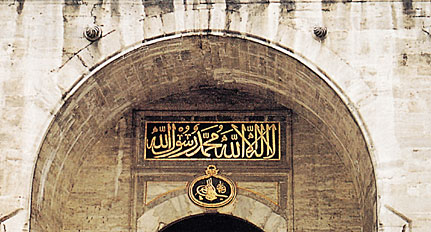
is the Messenger (Prophet) of God,” inscribed over an entrance. |
_____________________________
|
What Is the Quran About? |
|
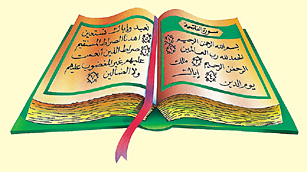
The Quran, the last revealed word of
God, is the primary source of every Muslim’s faith and practice. |
Note
that the Quran was revealed to Muhammad in Arabic only.
So, any Quranic translation, either in English or any other language, is
neither a Quran, nor a version of the Quran, but rather it is only a
translation of the meaning of the Quran. The Quran exists only in the
Arabic in which it was revealed.
|
|
||
|
Who Is the Prophet Muhammad |
|
|
Muhammad |
|
|
|
|
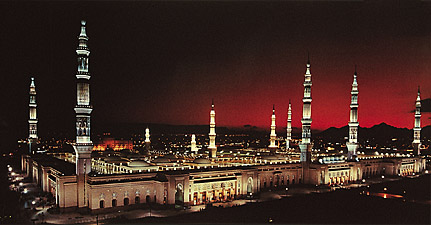
The Prophet Muhammad’s |
At
the age of forty, Muhammad received his first
revelation from God through the Angel Gabriel. The revelations continued
for twenty-three years, and they are collectively known as the Quran.
As
soon as he began to recite the Quran and to preach the truth which God had
revealed to him, he and his small group of followers suffered persecution from
unbelievers. The persecution grew so fierce that in the year 622 God gave
them the command to emigrate. This emigration from Makkah to the city of
After
several years, Muhammad and his followers were
able to return to Makkah, where they forgave their enemies. Before
Muhammad died, at the age of
sixty-three, the greater part of the Arabian Peninsula had become Muslim, and
within a century of his death, Islam had spread to Spain in the West and as far
East as China. Among the reasons for the rapid and peaceful spread of
Islam was the truth and clarity of its doctrine. Islam calls for faith in
only one God, Who is the only one worthy of worship.
The
Prophet Muhammad was a perfect example of
an honest, just, merciful, compassionate, truthful, and brave human being.
Though he was a man, he was far removed from all evil characteristics and
strove solely for the sake of God and His reward in the Hereafter.
Moreover, in all his actions and dealings, he was ever mindful and
fearful of God.
(For
more information on the Prophet Muhammad , please refer to the
links at More on the Prophet Muhammad .)
_____________________________
|
How Did the Spread of Islam |
|
Islam instructs man to use his powers of
intelligence and observation. |

|
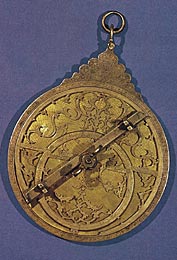
The Astrolabe:
One of the most important scientific instruments developed by Muslims which
was also used widely in the West until modern times. |
|
|
|
|
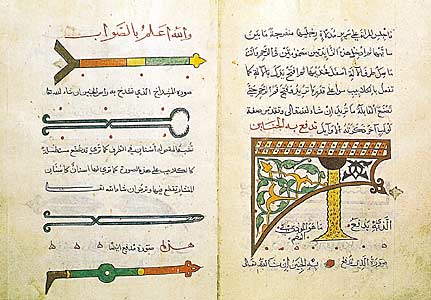
Muslim physicians paid much attention to surgery and
developed many surgical instruments as seen in this old manuscript. |
|
|
|
What Do Muslims Believe about Jesus? |
|
Muslims respect and revere Jesus (peace
be upon him). They consider him one of the greatest of God’s messengers
to mankind. The Quran confirms his virgin birth, and a chapter of the
Quran is entitled ‘Maryam’ (Mary). The Quran describes the birth
of Jesus as follows: |
(Remember) when the
angels said, “O Mary, God gives you good news of a word from Him (God), whose
name is the Messiah Jesus, son of Mary, revered in this world and the Hereafter,
and one of those brought near (to God). He will speak to the people from
his cradle and as a man, and he is of the righteous.” She said, “My Lord, how
can I have a child when no mortal has touched me?” He said, “So (it will be).
God creates what He wills. If He decrees a thing, He says to it
only, ‘Be!’ and it is.” (Quran, 3:45-47)
Jesus
was born miraculously by the command of God, the same command that had brought Adam
into being with neither a father nor a mother. God has said:
The case of Jesus
with God is like the case of Adam. He created him from dust, and then He
said to him, “Be!” and he came into being. (Quran, 3:59)
During
his prophetic mission, Jesus performed many miracles. God tells us that
Jesus said:
“I have come to you
with a sign from your Lord. I make for you the shape of a bird out of
clay, I breathe into it, and it becomes a bird by God’s permission. I
heal the blind from birth and the leper. And I bring the dead to life by
God’s permission. And I tell you what you eat and what you store in your
houses....” (Quran, 3:49)
Muslims
believe that Jesus was not crucified. It was the plan of Jesus’ enemies
to crucify him, but God saved him and raised him up to Him. And the
likeness of Jesus was put over another man. Jesus’ enemies took this man
and crucified him, thinking that he was Jesus. God has said:
...They said, “We
killed the Messiah Jesus, son of Mary, the messenger of God.” They did not kill
him, nor did they crucify him, but the likeness of him was put on another man
(and they killed that man)... (Quran, 4:157)
Neither
Muhammad nor Jesus came to change
the basic doctrine of the belief in one God, brought by earlier prophets, but
rather to confirm and renew it.
|
|
|
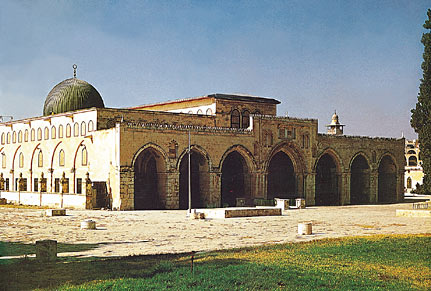
The Aqsa Mosque in |
(For
in-depth articles on Jesus, please refer to the links at In-Depth Articles on Jesus.)
|
|
||
|
What Does Islam Say about Terrorism? |
|
|
Islam, a religion of mercy, does not
permit terrorism. In the Quran, God has said: |
|
God does not forbid
you from showing kindness and dealing justly with those who have not fought you
about religion and have not driven you out of your homes. God loves just
dealers. (Quran, 60:8)
The
Prophet Muhammad used to prohibit
soldiers from killing women and children, and he would advise them: {...Do not
betray, do not be excessive, do not kill a newborn
child.} And he also said: {Whoever has
killed a person having a treaty with the Muslims shall not smell the fragrance
of
Also,
the Prophet Muhammad has forbidden punishment
with fire.
He
once listed murder as the second of the major sins, and he even warned that on
the Day of Judgment, {The first cases to be adjudicated between people on
the Day of Judgment will be those of bloodshed. }
Muslims
are even encouraged to be kind to animals and are forbidden to hurt them.
Once the Prophet Muhammad said: {A woman was punished because she imprisoned a cat
until it died. On account of this, she was doomed to Hell. While she
imprisoned it, she did not give the cat food or drink, nor did she free it to
eat the insects of the earth.} He also said that a man gave a very thirsty
dog a drink, so God forgave his sins for this action. The Prophet was asked, “Messenger of
God, are we rewarded for kindness towards animals?” He said: {There is a reward for kindness to every living
animal or human.}
Additionally,
while taking the life of an animal for food, Muslims are commanded to do so in
a manner that causes the least amount of fright and suffering possible.
The Prophet Muhammad said: {When you slaughter an animal, do so in the best
way. One should sharpen his knife to reduce the suffering of the animal.}
In
light of these and other Islamic texts, the act of inciting terror in the
hearts of defenseless civilians, the wholesale destruction of buildings and
properties, the bombing and maiming of innocent men, women, and children are
all forbidden and detestable acts according to Islam and the Muslims.
Muslims follow a religion of peace, mercy, and forgiveness, and the vast
majority have nothing to do with the violent events some have associated with
Muslims. If an individual Muslim were to commit an act of terrorism, this
person would be guilty of violating the laws of Islam.
(For
more articles on Islam on terrorism, please refer to the links at More on Islam on Terrorism.)
The
life and property of all citizens in an Islamic state are considered sacred,
whether a person is Muslim or not. Islam also protects honor. So,
in Islam, insulting others or making fun of them is not allowed. The
Prophet Muhammad said: {Truly your blood, your property, and your honor
are inviolable.} Racism is not allowed in Islam, for the Quran speaks of
human equality in the following terms:
O mankind, We have created you from a male and a female and have made
you into nations and tribes for you to know one another. Truly, the
noblest of you with God is the most pious. Truly, God is All-Knowing,
All-Aware. (Quran, 49:13)
Islam
rejects certain individuals or nations being favored because of their wealth,
power, or race. God created human beings as equals who are to be
distinguished from each other only on the basis of their faith and piety.
The Prophet Muhammad said: {O
people! Your God is one and your forefather (Adam) is one. An Arab
is not better than a non-Arab and a non-Arab is not better than an Arab, and a
red (i.e. white tinged with red) person is not better than a black person and a
black person is not better than a red person, except in piety.}
One
of the major problems facing mankind today is racism. The developed world can send a man
to the moon but cannot stop man from hating and fighting his fellow man.
Ever since the days of the Prophet Muhammad , Islam has provided a
vivid example of how racism can be ended. The annual pilgrimage (Hajj)
to Makkah shows the real Islamic brotherhood of all races and nations, when
about two million Muslims from all over the world come to Makkah to perform the
pilgrimage.
The developed world can send a man
to the moon but cannot stop man from hating and fighting his fellow man.
Ever since the days of the Prophet Muhammad , Islam has provided a
vivid example of how racism can be ended. The annual pilgrimage (Hajj)
to Makkah shows the real Islamic brotherhood of all races and nations, when
about two million Muslims from all over the world come to Makkah to perform the
pilgrimage.
Islam
is a religion of justice. God has said:
Truly God commands
you to give back trusts to those to whom they are due, and when you judge
between people, to judge with justice.... (Quran, 4:58)
And
He has said:
...And act justly.
Truly, God loves those who are just. (Quran, 49:9)
We
should even be just with those who we hate, as God has said:
...And let not the
hatred of others make you avoid justice. Be just: that is nearer to
piety.... (Quran, 5:8)
The
Prophet Muhammad said: {People, beware
of injustice, for injustice shall be darkness on the Day of Judgment.}
And
those who have not gotten their rights (i.e. what they have a just claim to) in
this life will receive them on the Day of Judgment, as the Prophet said: {On the Day of
Judgment, rights will be given to those to whom they are due (and wrongs will
be redressed)...}
|
|
||
|
What Is the Status of Women in Islam? |
|
|
Islam sees a woman, whether single or
married, as an individual in her own right, |
|

Islam
encourages the husband to treat his wife well, as the Prophet Muhammad said: {The best among you are those who are best to their
wives.}
Mothers
in Islam are highly honored. Islam recommends treating them in the best
way. A man came to the Prophet Muhammad and said, “O Messenger
of God! Who among the people is the most worthy of my good
companionship?” The Prophet said: {Your mother.} The man said, “Then
who?” The Prophet said: {Then your mother.} The man further
asked, “Then who?” The Prophet said: {Then your mother.} The man asked
again, “Then who?” The Prophet said: {Then your father.} (For in-depth articles on
women in Islam, please refer to the links at In-Depth Articles on Women in Islam.)
_____________________________
|
The Family in Islam |
|
The family, which is the basic unit of
civilization, is now disintegrating. Islam’s family system brings the
rights of the husband, wife, children, and relatives into a fine
equilibrium. It nourishes unselfish behavior, generosity, and love in
the framework of a well-organized family system. The peace and security
offered by a stable family unit is greatly valued, and it is seen as
essential for the spiritual growth of its members. A harmonious social
order is created by the existence of extended families and by treasuring
children. |
|
How Do Muslims Treat the Elderly? |
|
In the Islamic world, one rarely finds
“old people’s homes.” The strain of caring for one’s parents in this most difficult
time of their lives is considered an honor and a blessing and an opportunity
for great spiritual growth. In Islam, it is not enough that we only
pray for our parents, but we should act with limitless compassion,
remembering that when we were helpless children, they preferred us to
themselves. Mothers are particularly honored. When Muslim parents
reach old age, they are treated mercifully, with kindness and selflessness. |
In
Islam, serving one’s parents is a duty second to prayer, and it is their right
to expect it. It is considered despicable to express any irritation when,
through no fault of their own, the old become difficult.
God
has said:
Your Lord has
commanded that you worship none but Him, and that you be kind to your
parents. If one of them or both of them reach old age with you, do not
say to them a word of disrespect, or scold them, but say a generous word to
them. And act humbly to them in mercy, and say, “My Lord, have mercy on
them, since they cared for me when I was small.” (Quran, 17:23-24)
|
|
||
|
What Are the Five Pillars of Islam? |
|
|
The Five Pillars of Islam are the
framework of the Muslim life. They are the testimony of faith, prayer,
giving zakat (support of the needy), fasting during the month of Ramadan,
and the pilgrimage to Makkah once in a lifetime for those who are able. |
|
1) The Testimony
of Faith:
The testimony of faith is saying with
conviction, “La ilaha illa Allah, Muhammadur rasoolu Allah.”
This saying means “There is no true god (deity) but God (Allah), and
Muhammad is the Messenger (Prophet) of God.” The first part, “There
is no true god but God,” means that none has the right to be worshipped but God
alone, and that God has neither partner nor son. This testimony of faith
is called the Shahada, a simple formula which should be said with
conviction in order to convert to Islam (as explained previously on this page). The testimony of faith is the most important
pillar of Islam.
2) Prayer:
Muslims perform five prayers a day.
Each prayer does not take more than a few minutes to perform.
Prayer in Islam is a direct link between the worshipper and God.
There are no intermediaries between God and the worshipper.
In prayer, a person feels inner happiness,
peace, and comfort, and that God is pleased with him or her. The Prophet
Muhammad said: {Bilal, call
(the people) to prayer, let us be comforted by it.} Bilal was one of
Muhammad’s companions who was charged to call the people to prayers.
Prayers are performed at dawn, noon,
mid-afternoon, sunset, and night. A Muslim may pray almost anywhere, such
as in fields, offices, factories, or universities.
(For detailed information on how to
perform prayer, please refer to the links at How to Perform Prayer or refer to the book entitled A Guide
to Salat (Prayer) by M. A. K. Saqib.)
3) Giving Zakat
(Support of the Needy):
All things belong to God, and wealth is
therefore held by human beings in trust. The original meaning of the word zakat
is both ‘purification’ and ‘growth.’ Giving zakat means ‘giving a specified
percentage on certain properties to certain classes of needy people.’ The
percentage which is due on gold, silver, and cash funds that have reached the
amount of about 85 grams of gold and held in possession for one lunar year is
two and a half percent. Our possessions are purified by setting aside a
small portion for those in need, and, like the pruning of plants, this cutting
back balances and encourages new growth.
The original meaning of the word zakat
is both ‘purification’ and ‘growth.’ Giving zakat means ‘giving a specified
percentage on certain properties to certain classes of needy people.’ The
percentage which is due on gold, silver, and cash funds that have reached the
amount of about 85 grams of gold and held in possession for one lunar year is
two and a half percent. Our possessions are purified by setting aside a
small portion for those in need, and, like the pruning of plants, this cutting
back balances and encourages new growth.
A person may also give as much as he or
she pleases as voluntary alms or charity.
4) Fasting the
Month of Ramadan:
 Every year in the month
of Ramadan, all Muslims fast from dawn until sundown, abstaining from food,
drink, and sexual relations.
Every year in the month
of Ramadan, all Muslims fast from dawn until sundown, abstaining from food,
drink, and sexual relations.
Although the fast is beneficial to health,
it is regarded principally as a method of spiritual self-purification. By
cutting oneself off from worldly comforts, even for a short time, a fasting
person gains true sympathy with those who go hungry, as well as growth in his
or her spiritual life.
5) The Pilgrimage
to Makkah:
The annual pilgrimage (Hajj) to
Makkah is an obligation once in a lifetime for those who are physically and
financially able to perform it. About two million people go to Makkah
each year from every corner of the globe. Although Makkah is always
filled with visitors, the annual Hajj is performed in the twelfth month
of the Islamic calendar. Male pilgrims wear special simple clothes which
strip away distinctions of class and culture so that all stand equal before
God.
|
|
|
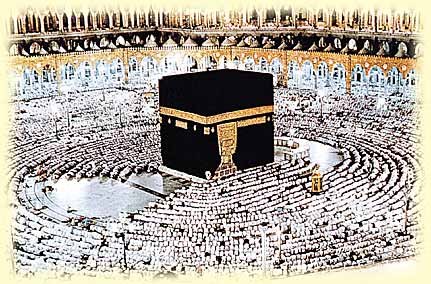
Pilgrims praying at the Haram mosque in
Makkah. In this mosque is the Kaaba (the black building in the picture)
which Muslims turn toward when praying. The Kaaba is the place of worship
which God commanded the Prophets Abraham and his son, Ishmael, to build. |
The
rites of the Hajj include circling the Kaaba seven times and going seven
times between the hillocks of Safa and Marwa, as Hagar did during her search
for water. Then the pilgrims stand together in Arafa and ask God for what
they wish and for His forgiveness, in what is often thought of as a preview of
the Day of Judgment.
The
end of the Hajj is marked by a festival, Eid Al-Adha, which is
celebrated with prayers. This, and Eid al-Fitr, a feast-day
commemorating the end of Ramadan, are the two annual festivals of the Muslim
calendar.

Chosen by
Swsan
Alamoodi
Somia bin
Akdha
Suhair Mgrum
Seham
Almohommedi

