
Many variations of projectile tossing siege weapons appear in history. One of the earliest things considered to be a siege weapon was a large bow turned on its side called the gastrophetes. These large bow-like siege weapons, more commonly known as ballistas, have appeared in many different sizes. Ballistas are another type siege weapon clouded in misconceptions. Just because they look like ballistas in Warcraft I-III doesn't mean that�s how the majority of them were built. Most Ballistas use the same system as the "common" catapult, the stick through the twisted rope(although they have two sticks through bundles of rope as opposed to one.) The torsion ballista may be a bit hard to visualize, but if you don't get it and it drives you nuts, there are websites out there for you to look at. I bet building and operating one of these things would be absolutly spectacular. These torsion ballistas kicked a lot of ass. If you had them and your enemy didn't, it might be a little like a battle between people with muskets and people with sniper rifles.
Torsion ballistas were even machined to the point where they were semi-automatic. A crank powered a chain which cocked and loaded the bow. Th Although semi-automatic ballistas were not put into wide use because of their extreme complexity, they would have been comparable to the introduction of the Gatling gun to warfare. Making one of these automatic ballistas would be a really complex but cool thing to do. I haven't heard of anyone doing it yet. Other interesting but not implemented innovations include: pneumatic ballistas and bronze spring ballistas. Keep in mind this was made by the Greeks! Over 2000 years ago! They were epochal badasses.
I digress. Weapons like the catapult and ballista were used by nearly everyone who needed something destroyed in Europe. Just as the first ballistas evolved from bows out of the great masculine ideal "make it bigger," trebuchets too came from a smaller counterpart-the pole sling. Pole slings were simply sticks with slings on them. One end of the sling was attached to the pole while the other was looped around a spike at the poles end. The projectile went in the pouch of the sling an was thrown by swinging the pole. Pole slings are easy to make with a broomstick, a nail, some rope, and cloth. I wouldn't know, but I hear they are perfect for throwing eggs. The sling on the end of a pole wasn't a new idea, it was also seen on the end of many catapults to increase range. Anyways, out of the need to inflict more damage, pole slings got an accessory, an axle. This allowed many people to pull on one end of the pole and shoot larger rocks further. A lot of these things were implemented during the crusades. One observer described that the air was so full of stones that they bounced off each other.
One of the more intelligent crusaders must have realized that the besieged were hunkering down behind their shields and laughing at the stupid Christian.Infidels. So somewhere along the way weight replaced man power. This was a relief to the peons who were forced to shoot trebuchets by hand and suffer many severe concussions. Once trebuchets got big enough the could tear down the best of castles. The best tactic to defend against an opposing trebuchet was to build your own and knock it out first. Modern reconstructions of trebuchets throw 300 lb. boulders 300yds. That�s a lot of power out of just gravity. Unfortunately, just as trebuchets were becoming the terror of the world, cannons came along and ruined the fun by offering a more economically viable solution for destroying stuff.
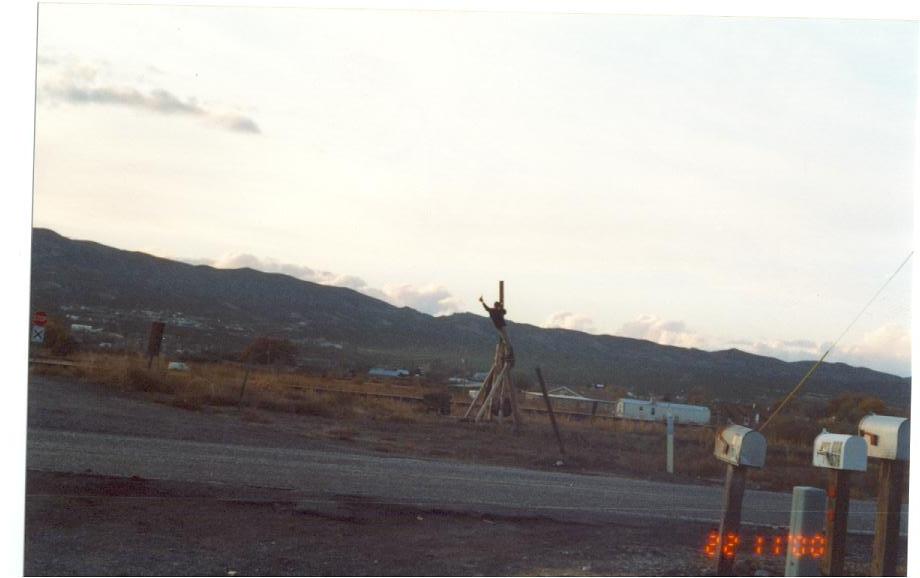
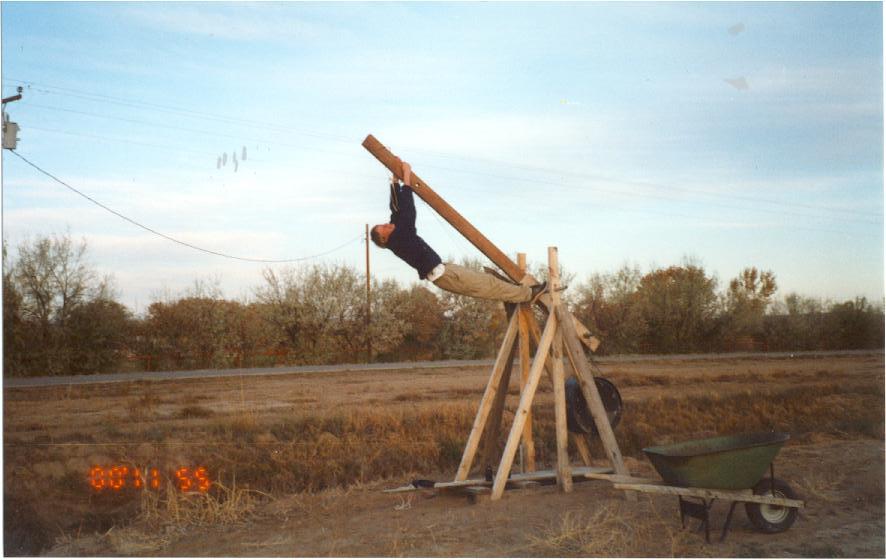
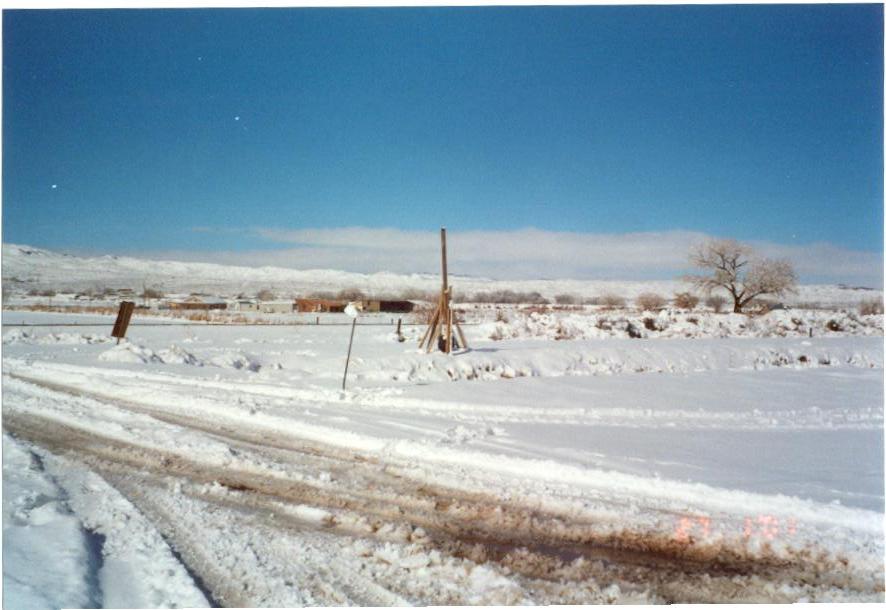
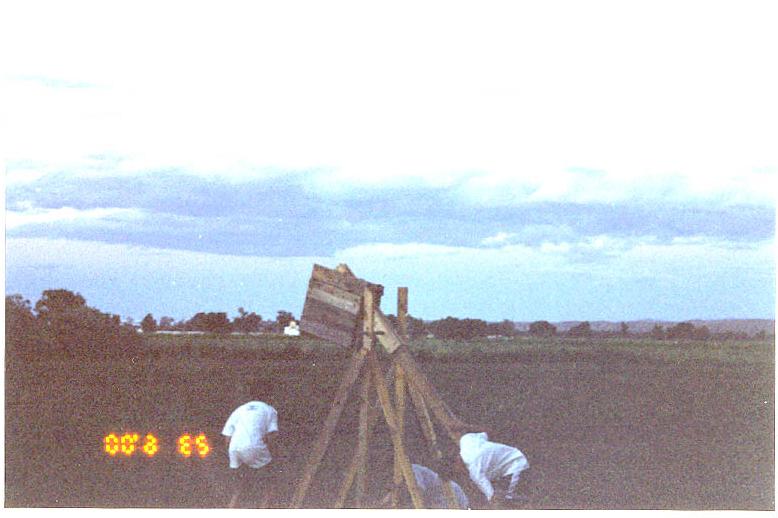
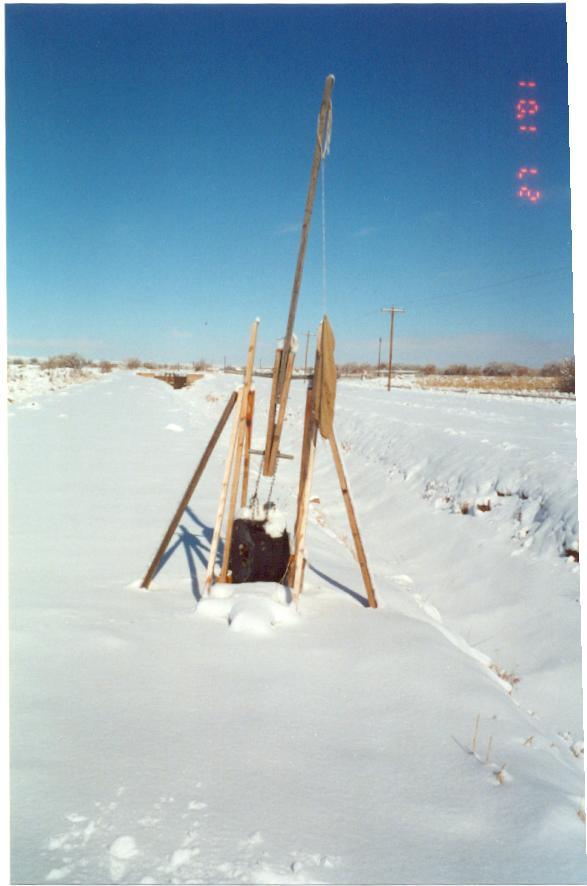
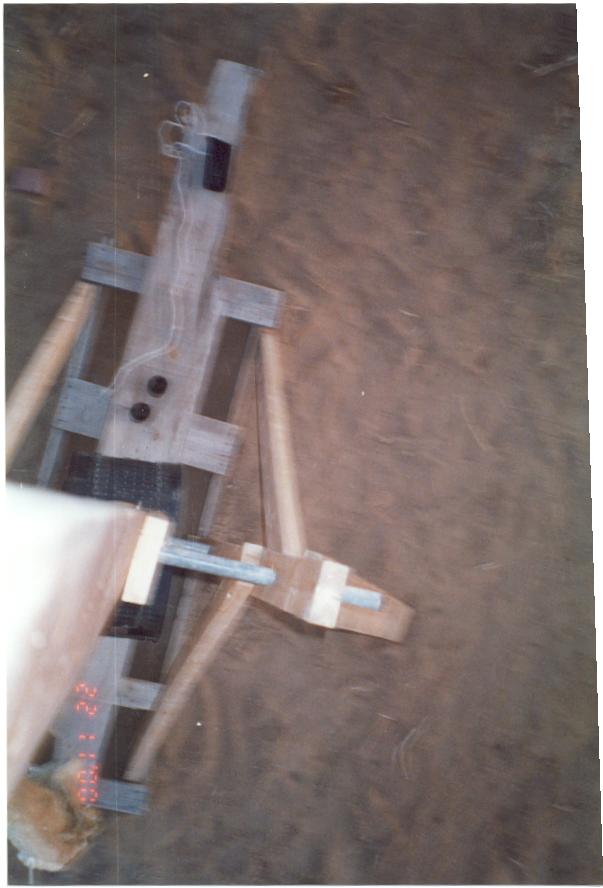
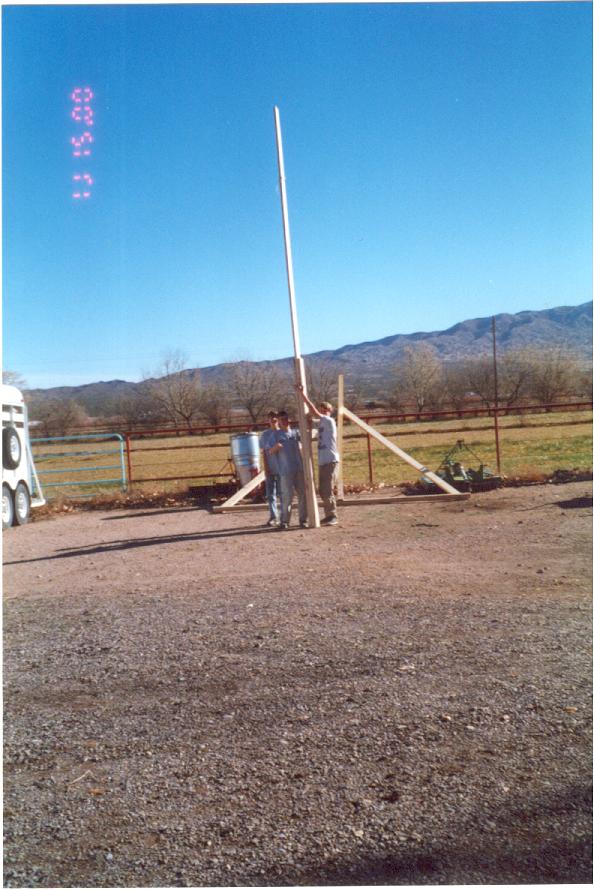
Nowadays, trebuchets are making a comeback. Obsolete weapons of mass destruction are now toys. It only costs about $50 to build a decent sized piece of history. But just like the Greeks, hurlers are finding ways to shoot things further. The floating arm trebuchet can shoot farther than conventional trebuchets pound for pound. Check it out here. But Wait! There's more! I have my own whoop-ass version of a remodled trebuchet here. And of course below are a couple of pictures of the screwdriver, the first trebuchet I built. I did make a larger one(14 ft at the shoulder, 25ft total height) but someone stole it! Isn't that stupid...
Well thats all I have to say about trebuchets(although that was still too much.) Pardon all the spelling and grammatical errors. If you linked here from another page and want to see the rest of my site, click here.