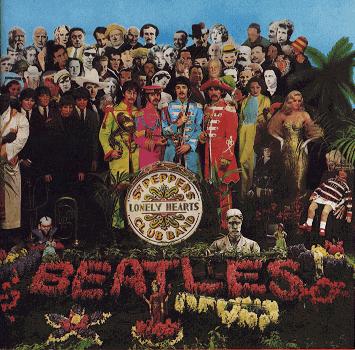
Sgt. Pepper's Lonely Hearts
Club Band
1967 Parlophone
It was twenty years ago today
Sergeant Pepper taught the band to play,
They've been going in and out of style,
But they're guaranteed to raise the smile,
So may I introduce to you,
The act you've known for all these years,
Sergeant Pepper's Lonely Hearts Club Band.
We're Sergeant Pepper's Lonely Hearts Club Band
We hope you will enjoy the show
Sergeant Pepper's Lonely Hearts Club Band
Sit back and let the evening go
Sergeant Pepper's Lonely
Sergeant Pepper's Lonely
Sergeant Pepper's Lonely Hearts Club Band
It's wonderful to be here,
It's certainly a thrill
You're such a lovely audience,
We'd like to take you home with us, we'd love to take you home.
I don't really want to stop the show,
But I thought you might like to know,
That the singer's going to sing a song
And he wants you all to sing along,
So let me introduce to you
The one and only Billy Shears
And Sergeant Pepper's Lonely Hearts Club Band.
McCartney
John:Voces
Paul:Guitarra R�tmica, Bajo y Voz
George:Guitarra Solista y Voces
Ringo:Beater�a
James W. Buck, Neil Sanders, Tony Randall and John Burden: Trompas Francesas
| El proyecto Pepper, no lo era hasta
que se grab� esta gran canci�n de Paul. La idea de una banda de viento que
tuviera vida propia y que tambi�n tocara rock en medio de la era
psicod�lica, creci� pronto en la mente de Paul como una excusa para hacer un
nuevo �lbum. La canci�n en si misma es tal vez una de las m�s excitantes de
los Beatles. La guitarra de George sirve de introducci�n, de una manera que
tan solo se ve superada por la manera en la que Ringo comienza el Reprise.
Los Beatles provocaron un nuevo hito tecnol�gico en las t�cnicas de
grabaci�n. Los ingenieros de sonido en Abbey Road inventaron la Direct
Injection. Esto significaba que las guitarras pod�an ser conectadas
directamente a la consola de grabaci�n en lugar de grabarlas con un
micr�fono en el amplificador. Lo que hoy en d�a supone algo normal en una
grabadora de 4 pistas, era una caja externa llamada DI. Mas tarde los
m�sicos han preferido normalmente, seguir grabando de los amplificadores,
justificando un mejor sonido. Pero es tan solo tras los Beatles, que tienen
elecci�n. Los efectos de sonido son esenciales para el resultado final de la
canci�n. Los m�sicos afinando, fueron grabados previamente al crescendo
musical final de "A Day In The Life". El p�blico, ven�a del famoso archivo
de efectos de sonido de Abbey Road. La secci�n de viento de la canci�n (Sgt.
Pepper y sus muchachos) fue tocada por cuatro m�sicos con trompas francesas.
La voz de Paul en la canci�n, increible, termina con una introducci�n de
varias voces al cantante de la banda, Billy Shears...
Los murmullos del p�blico y los instrumentos afin�ndose que inauguran Sgt.
Pepper proclaman la originalidad del �lbum de inmediato, al crear la ilusi�n
transparente de un espect�culo en directo; ya sentimos que estamos dentro de una
representaci�n; y lo estamos de todas maneras. Luego, esta presunci�n es
elaborada por una pista inicial cuyas guitarras crujientes, acompa�adas por la
voz gutural de McCartney, nos devuelven a las ra�ces de rock duro de los Beatles
en Liverpool. (La canci�n tambi�n prefigura de forma inconsciente la reputaci�n
de los Beatles despu�s de su separaci�n en la l�nea �they've been going in and
out of styIe/But they're guaranteed to raise a smile� [han estado de moda y han
dejado de estarlo/pero siempre provocar�n una sonrisa].) Uno de los �xitos de
Sgt. Pepper es su capacidad de provocar una sucesi�n cautivadora de im�genes
visuales, que aqu� comienza con cuatro chicos vestidos con ropajes brillantes en
escena, que cantan con todo el coraz�n. Entonces Paul presenta al cantante, el
comp�s cambia y de pronto, solo en la luz del foco aparece �the one and only
Billy Shears� [el irrepetible Billy Shears]. Shears, la m�xima expresi�n del
hombre corriente, comienza en un tono de contricci�n, prometiendo que �/I'llJ
try not to sing out of key� [intentar� no desafinar]. Pero apenas se lanza al refr�n edificante y que invita a cantar junto a �l, acerca de arregl�rselas �mith a little help from my friends� [con un poco de ayuda de mis amigos], est� claro que le ir� perfectamente. Esta canci�n, una de las m�s irresistibles de los Beatles, fue originalmente compuesta para que la cantara Ringo y s�lo �l pod�a hacer justicia completa a su mensaje reconfortante. Como escribir�a el cr�tico Wilfrid Mellers: �Es el miembro del grupo con menos talento, el menos elocuente, el "inferior"; sin embargo, posee su propia identidad inatacable: algo que bastar�, a condici�n de recibir el amor suficiente�. Es un mensaje que consolida el nexo, no s�lo entre la banda y el p�blico, sino entre todos nosotros: cuidar de cada uno responde al inter�s de todos. |
What would you think if I sang out of tune,
Would you stand up and walk out on me ?
Lend me your ears and I'll sing you a song
And I'll try not to sing out of key.
Oh, I get by with a little help from my friends
Mm, I get high with a little help from my friends
Mm, gonna try with a little help from my friends
What do I do when my love is away
(Does it worry you to be alone ?)
How do I feel by the end of the day,
(Are you sad because you're on your own ?)
No, I get by with a little help from my friends
Mm, I get high with a little help from my friends
Mm, gonna try with a little help from my friends
Do you need anybody
I need somebody to love
Could it be anybody
I want somebody to love.
Would you believe in a love at first sight
Yes, I'm certain that it happens all the time
What do you see when you turn out the light
I can't tell you but I know it's mine,
Oh, I get by with a little help from my friends
Mm, I get high with a little help from my friends
Mm, gonna try with a little help from my friends
Do you need anybody
I just need someone to love
Could it be anybody
I want somebody to love.
Oh, I get by with a little help from my friends
with a little help from my friends.
Lennon-McCartney
T�tulo de Trabajo:Badfinger
Paul:Bajo, Piano y Voces
John:Cencerro y Voces
George:Guitarra Solista y Pandereta
Ringo:Bater�a y Voz
George Martin:Organo Hammond
|
Aunque supon�a el final de Sgt. Pepper la frase de Billy Shears fue grabada en realidad como principio de With a Little Help From My Friends. Parece ser que a Paul se le ocurri� la melod�a y la letra fue un trabajo conjunto en casa de John una tarde. Durante la sesi�n, cuando se atascaban, tocaban canciones de rock, viejos �xitos, e incluso Paul esboz� lo que ser�a The Fool on The Hill. El t�tulo de trabajo provisional que Paul le dio a la canci�n, deriv� mas tarde en el nombre de un grupo que firm� con Apple, Badfinger. Por supuesto que componer canciones no siempre era una experiencia cosmica; Lennon y McCartney eran unos profesionales que a veces ten�an que producir canciones de manera mecanica. �With A Little Help From My Friends� era una de este tipo y confirma el comentario de McCartney de que tales canciones �no son necesariamente peores que las que surgen de la imaginacion�. Pero tambi�n destaca el hecho de que, incluso en el caso de las canciones que les costaban trabajo, el enfoque instintivo de Lennon y McCartney consist�a en confiar en que su musa les indicar�a el camino. |
Picture yourself in a boat on a river
With tangerine trees and marmalade skies.
Somebody calls you, you answer quite slowly,
A girl with caleidoscope eyes.
Cellophane flowers of yellow and green
Towering over your head.
Look for the girl with the sun in her eyes
And she's gone.
[Ref :] Lucy in the sky with diamonds
Lucy in the sky with diamonds
Lucy in the sky with diamonds, ah, ah
Follow her downto a bridge by the fountain
where rocking horse people eat marshmallow pies.
Everyone smiles as you drift past the flowers
That grow so incredibly high.
Newspaper taxis appear on the shore
Waiting to take you away
Climb in the back with your head in the clouds
And you're gone.
Ref.
Picture yourself on a train in a station
With plasticine porters with looking glass ties,
Suddenly someone is there at the turnstile,
The girl with caleidoscope eyes.
Ref...
Lennon
John:Guitarra Solista y Voz
Paul:Bajo y Voces
George:Guitarras Solista y Fuzz, Voces
Ringo:Bater�a
|
Lucy in the Sky With Diamonds es
probablemente una de las canciones de los Beatles con mas historia detr�s.
|
It's getting better all the time
I used to get mad in my school (No, I can't complain)
The teachers that taught me weren't cool (No, I can't complain)
Holding me down, turning me round,
Filling me up with your rules
I've got to admit it's getting better,
A little better all the time (can't get no worse)
To admit it's getting better,
It's getting better since you've been mine.
Me used to be angry young man
Me hiding me head in the sand
You gave me the word I finally heard
I'm doing the best that I can.
To admit it's getting better,
A little better all the time
To admit it's getting better,
It's getting better since you've been mine.
Getting so much better all the time
It's getting better all the time
Better, better, better,
It's getting better all the time.
Better, better, better
I used to be cruel to my woman
I beat her and kept her apart from the things that she loved
Man I was mean but I'm changing my scene
And I'm doing the best that I can.
I admit it's getting better,
A little better all the time (can't get no worse)
Yes, I admit it's getting better,
It's getting better since you've been mine.
Getting so much better all the time
It's getting better all the time
Better, better, better,
It's getting better all the time.
Better, better, better,
Getting so much better all the time.
McCartney
John:Guitarra R�tmica y Voces
Paul:Bajo y Voz
George:Guitarra Solista, Tambura y Voces
Ringo Starr:Beater�a y Bongos
George Martin:Piano
| Tal vez el ejemplo m�s destacado es
el ritmo maravillosamente chill�n que inicia la siguiente canci�n del �lbum: �Getting Better�. Brillante y agudo como un
piolet, este sonido fue producido por un piano, y el truco consisti� en que - en
lugar de tocar las teclas - George Martin meti� la mano y golpe� las cuerdas con
un martillo. As�, la canci�n arranca de un modo estupendo y Paul contin�a el
movimiento con un bajo mel�dico antes de que las voces ocupen el sitio
principal.'" En efecto, la l�nea era tan t�pica que John la escribi� casi sin pensar apenas escuch� la canci�n, seg�n Martin. El productor recuerda a Paul, sentado ante un piano en el Estudio Dos de Abbey Road, tocando �Getting Better� para que Martin, Harrison y Starr pudieran aprenderla, cuando de pronto entr� John, comenz� a cantar y aport� esta l�nea legendaria en ese preciso instante. Hay que decir que la biograf�a autorizada de los Beatles contradice el recuerdo de Martin de esta escena, pero es el tipo de historia que deber�a ser cierta, aunque no lo fuera. Originalmente, �Getting Better� deb�a conducir a a�n otro producto m�s de la extraordinaria sociedad estilo yin y yang de Lennon y McCartney, la magn�fica �She's Leaving Home�. �Getting Better� es un encuentro cl�sico de las mentalidades de Lennon y McCartney como compositores y tambi�n un escaparate para la interrelaci�n poco corriente de ambos como cantantes. La voz principal de Paul es fuerte, alegre y repleta de optimismo; el acompa�amiento de John en falsetto es agudo, maliciosamente c�mico e imparte justo la cantidad suficiente de cinismo como para conectar a Paul a tierra sin hundirlo. La l�nea de John: �It can't get worse� [no puede empeorar] era, como Paul recuerda con afecto, �t�pica de John�. La �nica vez que uno de los Beatles tuvo que ser sustituido debido a enfermedad fue durante la gira de verano de 1964. Ringo fue operado y Jimmy Nicols, un bater�a sin un pasado significativo, y como el tiempo se encarg� de demostrar, un futuro lejos de la popularidad, fue elegido por estas razones para tocar la bater�a con los Beatles. Nicols, que no hablaba mucho con los chicos, toc� en directo habiendo ensayado una sola vez. Conforme los conciertos fueron pasando, despu�s de cada uno, los tres Beatles restantes le preguntaban como iba todo. La respuesta siempre era la misma "It's Getting Better" (va mejorando) Tres a�os m�s tarde Paul estaba dando un paseo con su perra Martha en Primrose Hill y conforme la ma�ana se iba haciendo m�s c�lida record� la frase. M�s tarde le dir�a a John que la frase ser�a un buen t�tulo de canci�n. Getting Better da realmente la impresi�n de haber sido escrita por dos voces, una diciendo claramente que todo est� mejorando, mientras que la otra dice que no pod�an ya ir a peor. Por supuesto el optimismo de Paul se contrapon�a al realismo de John. |
I'm fixing a hole where the rain gets in
And stops my mind from wandering
Where it will go
I'm filling the cracks that ran through the door
And kept my mind from wandering
Where it will go
And it really doesn't matter if I'm wrong
I'm right
Where I belong I'm right
Where I belong
See the people standing there who disagre and never win
And wonder why they don't get in my door
I'm painting my room in a colourful way
And when my mind is wandering
There I will go
And it really doesn't matter if I'm wrong
I'm right
Where I belong I'm right
Where I belong
Silly people run around, they worry me
And never ask me why they don't get past my door
I'm taking the time for a number of things
That weren't important yesterday
And I still go
Fixing a hole where the rain gets in
Stops my mind from wandering
Where it will go
John:Maracas y Voces
Paul:Bajo y Voz
George:Guitarra Solista y Voces
Ringo:Bater�a
George Martin?:Clavicordio
|
No obstante, con el paso del tiempo, los observadores externos extrapolaron las diferencias entre las personalidades y los instintos musicales de Lennon y McCartney hasta alcanzar unos estereotipos enga�osos. Paul fue caracterizado como el peso ligero sensiblero, incapaz de escribir letras aceptables, y John como el artista rebelde y chico malo agresivo. Sin embargo, ambos eran demasiado complejos y talentosos como para ser encasillados en unos retratos tan unidimensionales. En realidad, Paul era �un letrista bastante capaz� cuando se lo propon�a, argument� John, citando canciones como "Fixing A Hole". Pero las im�genes se les pegaron, en parte porque no s�lo eran los cr�ticos torpes los que las promulgaban; John en particular fue muy poco generoso en sus comentarios respecto a Paul durante los amargos a�os setenta, posteriores a la separaci�n. �Me conocen como el compositor de baladas sensiblero y por supuesto que John hizo mucho para dar impulso a ese mito cuando nos est�bamos peleando. Realmente trat� de difundir aquello, pero sab�a que no era cierto.� De hecho, fue McCartney quien compuso y cant� �Helter Skelter�, una canci�n exagerada que revolv�a las tripas y golpeaba tan intensamente como cualquier canci�n jam�s compuesta por The Who. La primera vez que los Beatles grabaron en un estudio que no fuera Abbey Road en Gran Breta�a, fue durante la noche del 9 de Febrero, cuando tras encontrar que Abbey Road estaba reservado decidieron trasladarse al Regent Studio. George Martin, que ya no era un empleado EMI les sigui�, sin embargo Geoff Emerick no pudo debido a la pol�tica de la compa��a. Las primeras tomas de la canci�n fueron grabadas este d�a, aunque m�s tarde fue mezclada en Abbey Road por el personal habitual. La canci�n, escrita por Paul McCartney fue interpretada de nuevo como si Paul estuviera tomando un "fix" de heroina (fix -> fixing). Sin embargo tal y como se ha referenciado en diversos libros, lo que Paul quer�a decir seg�n sus propias palabras era "Esta canci�n trata simplemente de un agujero en la carretera por el que entra la lluvia; una buena analog�a, el agujero en el maquillaje por el que entra la lluvia y hace que tu mente no vaya donde ir�a. Se trata de ti interfiriendo con las cosas. SI tu eres un falopero sentando en una habitaci�n d�ndote con hero�na entonces significar� eso para ti, pero cuando la escrib� quer�a decir que si hab�a una grieta en la habitaci�n o la habitaci�n no tiene suficiente color, entonces la pintar�. Se ha discutido bastante sobre quien toca el clavicordio en la canci�n. Mientras que Neill Aspinall dijo que era Paul, Lewishon destaca que el bajo fue grabado al mismo tiempo y ciertamente suena a McCartney. Presumiblemente fue George Martin, que se encontraba presente, quien lo grab�, y sin duda era la persona m�s adecuada para ello. |
Wednesday morning at five o'clock as the day begins
Silently closing her bedroom door
Leaving the note that she hope would say more
She goes downstairs to the kitchen clutching her handkerchief
Quietly turning the backdoor key
Stepping outside she is free
She (We gave her most of our lives)
Is leaving (Sacrificed most of our lives)
Home (We gave her everything money could buy)
She's leaving home after living alone for so many years. Bye, bye
Father snores as his wife gets into the dressing gown
Picks up the leter that's lying there
Standing alone at the top of the stairs
She breaks down and cries to her husband
Daddy, our baby's gone
Why would she treat us so thoughtlessly
How could she do this to me
She (We never thought of ourselves)
is leaving (Never a thought for ourselves)
home (We gave her everything money could buy)
She's leaving home after living alone for so many years. Bye, bye
Friday morning at nine o'clock she is far away
Waiting to keep the appointment she made
Meeting a man from a motor trade
She (What did we do that was wrong)
Is having (We didn't know it was wrong)
Fun (Fun is the one thing that money can't buy)
Something inside that was always denied for so many years
She's leaving home, bye, bye.
John:Voz
Paul:Voz
Erich Gruenberg, Derek Jacobs, Trevor Williams, Jose Luis Garc�a:Violines
John Underwood, Stephen Shingles:Violas
Dennis Vigay, Alan Dalziel:Chelos
Gordon Pearce:Contrabajo
Sheila Bromberg:Arpa
|
Una canci�n excelente en la que como en Eleanor Rigby, la m�sica es interpretada por m�sicos de estudio. En este caso un doble cuarteto de cuerda con un contrabajo y un arpa (que es la que se oye en la maravillosa introducci�n). Sin embargo esta vez no podemos atribuir la partitura a George Martin. La noche en la que Paul decidi� componer la partitura, George Martin se encontraba ocupado con alguno de sus otros artistas. Paul ten�a bastante prisa y le pidi� a Mike Leanders que lo escribiera para el. George Martin se enfad� (como es natural). Sin embargo cambi� un par de notas en la partitura y produjo una gran canci�n. Si escuchamos la partitura detenidamente, no tiene el trabajo elaborado que Martin normalmente le daba a las cuerdas, y aunque es bastante simple, es sin duda muy efectiva. La canci�n sali� una vez m�s del Daily Mirror, esta vez se trataba de una chica llamada Melanie Coe. Aunque Paul tuvo que inventarse la mayor�a de los datos, la verdad es que se acerc� bastante a la realidad seg�n Melanie, una chica que entonces ten�a 17 a�os (Turner). Sus padres se preguntaban por qu� se hab�a ido... ten�a todo lo que pod�a desear. En la vida real, Melanie no se fue con un hombre dedicado a la venta de coches, sino con un croupier, y se march� por la tarde mientras sus padres no estaban en casa. La aventura finaliz� una semana m�s tarde. Especialmente interesantes son las voces de John y Paul que cantan en falsetto interpretando a los padres. Las dos voces, seguramente con ADT, junto con los falsettos le dan a la canci�n un aire etereo que consigue tambi�n la introducci�n con el arpa. Una de las favoritas de todas las �pocas. |
For the benefit of Mr. Kite
There will be a show tonight on trampoline
The Hendersons will al be there
Late of Pablo Fanques Fair - what a scene!
Over man and horses hoops and garters
Lastly through a hogshead of real fire!
In this way Mr. K. will challenge the world!
The celebrated Mr. K.
performs his feat on Saturday at Bishopsgate
The Hendersons will dance and sing
As Mr. Kite flies through the ring - don't be late!
Messrs. K. and H. assure the public
Their production will be second to none
And of course Henry The Horse dances the waltz!
The band begins at ten to six
When Mr. K. performs his tricks without a sound
And Mr. H. will demonstrate
Ten summersets he'll undertake on solid ground
We've been some days in preparation
A splendid time is guaranteed for all
And tonight Mr. Kite is topping the bill
John:Voz y �rgano Hammond
Paul:Bajo
George, Ringo, Mal Evans, Neil Aspinall:Arm�nicas
George Martin:Armonio y Organo Ondulante
|
Al escuchar el �ltimo �bye-bye� de John, uno supone que el tel�n est� a punto de caer sobre la cara uno, pero hay una �ltima canci�n, �Being For The Benefit Of Mister Kite!�, de Lennon. �sta es una de las canciones predilectas de Martin, lo que explica el lugar que ocupa; el productor cre�a que los inicios y los finales de las caras de los discos deb�an ser �una explosi�n�. El mismo John estaba menos enamorado de la canci�n, quej�ndose de que la letra era �una copia directa� de un cartel publicitario del siglo XIX que hab�a hallado en una tienda de antig�edades. De hecho, �Mr. Kite� era sobre todo un triunfo de la producci�n; la encargada de trasladar al oyente a este nuevo mundo imaginario era m�s la alegre mezcla de sonidos que la letra. John le hab�a dicho a Martin que quer�a una atm�sfera circense para la canci�n, a�adiendo que �quiero oler el serr�n�. La pista r�tmica inicial se basaba en un armonio, unos �rganos y una arm�nica, pero Martin sent�a que algo faltaba; una feria no era una feria si le faltaba un �rgano a vapor. EI problema era que trasladar un enorme �rgano a vapor a Abbey Road para una �nica sesi�n de grabaci�n constitu�a una extravagancia, incluso para los Beatles, y en todas las cintas de archivo con �rganos a vapor que Martin encontr� figuraban marchas militares. El productor evit� este problema con habilidad, transfiriendo las marchas de los archivos a una �nica cinta nueva, que despu�s fue troceada por Geoff Emerick en pedacitos peque�os. Entonces, en lo que Martin llam� �un momento maravilloso�, le dijo a Emerick que arrojara los trocitos al aire de manera que �nevaron trozos de cinta por toda la sala de control�. Despu�s se reunieron los fragmentos al azar hasta que formaron la �masa de sonido ca�tica� que forma el fondo musical de �rgano a vapor para �Mr. Kite�. |
We were talking - about the space between us all
And the people - who hide themselves behind a wall of illusion
Never glimpse the truth - then it's far too late when they pass
away
We were talking - about the love we all could share
When we find it - to try our best to hold it there - with our
love
With our love we could save the world - if they only knew
Try to realise it's all within yourself - no-one else can make
you change
And to see you're really only very small
And life flows on within you and without you.
We were talking - about the love that's gone so cold
And the people who gain the world and lose their soul
They don't know, they can't see - are you one of them ?
When you've seen beyond yourself
then you may find peace of mind is waiting there
And the time will come when you see we're all one
And life flows on within you and without you.
Harrison
T�tulo de Trabajo:Untitled
George:Tamboura y Voz
M�sicos de Estudio:Swordmandel, Dilruba
Erich Gruenberg, Alan Loveday, Julien Gaillard, Paul Scherman, Ralph Elman,
David Wolfsthal, Jack Rothstein y Jack Greene:Violines
Reginald Kilbey, Allen Ford y Peter Beavan:Chelos
|
Dadas las convicciones de Martin en cuanto a los inicios contundentes, podr�a parecer extra�o que eligiera �Within You Without You� de Harrison como inicio de la cara B. Despu�s de todo, el mismo se refiri� a la cancion como algo �mas bien trist�n� y �un canto f�nebre�. Sin embargo, del mismo modo que Moby Dick no seria la misma novela sin sus ocasionalmente tediosos cap�tulos acerca de la caza de ballenas, Sgt. Pepper no seria el mismo album sin �Within You Without You�. Martin y los dem�s Beatles la admiraban genuinamente. Desde un punto de vista musical, a�ad�a un sabor poco corriente con su tabla india, su dilruba y su tamboura y la letra conten�a la expresi�n mas clara de la creencia compartida de los Beatles en la conciencia espiritual y los cambios sociales. Al advertir contra aquellos que �gain the world and loose their soul� [ganan el mundo y pierden el alma], Harrison hacia recordar a sus oyentes que �no one else can make you change� [ningun otro puede hacerte cambiar], e instaba a la contemplaci�n de la verdad implacable relativa a que nosotros los humanos somos �really only very small/ And life floms on within you and without you� [realmente solo muy peque- nos/Y la vida continua fluyendo dentro de ti y fuera (y sin) ti]. |
When I get older losing my hair,
Many years from now
Will you still be sending me the Valentine,
Birthday greetings, bottle of wine
If I'd been out till quarter to three
Wold you lock the door
Will you still need me, will you still feed me
When I'm sixty-four.
You'll be older too,
And if you say the word I could stay with you.
I could be handy mending a fuse
When your lights have gone
You can knit a sweater by the fireside
Sunday morning go for a ride
Doing a garden, digging the weeds,
Who could ask for more
Will you still need me, will you still feed me
When I'm sixty-four.
Every summer we can rent a cottage in the Isle of Wight,
if it's not too dear
We shall scrimp and save
Grandchildren on your knee
Vera, Chuck & Dave
Send me a postcard, drop me a line
Stating point of view
Indicater precisely what you mean to say
Yours sincerely, wasting away
Give me your answer, fill in a form,
Mine for evermore,
Will you still need me, will you still feed me
When I'm sixty-four.
McCartney
John:Guitarra Solista y Voces
Paul:Bajo, Piano y Voz
George:Voces
Ringo:Bater�a y Campanas
Robert Burns, Henry Mackenzie, Frank Reidy:Clarinetes
|
Los Quarrymen tocaban ya versiones anteriores de When I'm 64 ya en 1957. La canci�n estaba claramente influenciada por el padre de Paul, que era m�sico durante los a�os 20. Probablemente las muchas horas que pas� Paul junto a el mientras tocaba el piano tuvieron gran influencia en algunas de las canciones de McCartney. Aunque algunos libros indican que la canci�n fue escrita directamente para su padre, que iba a cumplir 64 a�os en el momento de ser publicada, Paul dijo claramente que cuando la escribi� Jim McCartney ten�a aproximadamente 56 a�os. El 64 hac�a referencia a la edad de jubilaci�n en Gran Breta�a. La canci�n es una joya de los Beatles, tanto musicalmente (con ese aire de antigua que tan solo Honey Pie y Your Mother Should Know tienen) como en el plano de la letra. Las voces de acompa�amiento y la perfecta partitura para los clarinetes la hacen ser una de las preferidas de todos los tiempos. |
Lovely Rita meter maid, lovely Rita meter maid
Lovely Rita meter maid, nothing can come between us
when it gets dark I tow your heart away
Standing by a parking meter when I caught a glimpse of Rita
Filling in the ticket in her little white book.
I the cap she looked much older
And the bag across her shoulder
made her look a little like a military man.
Lovely Rita meter maid, may I inquire discreetly,
When you are free to take some tea with me
Took her out and tried to win her,
Had a laugh and over dinner
Told her I would really like to see her again
Got the bill and Rita paid it,
Took her home and nearly made it
Sitting on a sofa with a sister or two.
Oh, lovely Rita meter maid, where would I be without you,
Give us a wink and make me think of you.
McCartney
John:Guitarra Ac�stica, Peine y Papel Higi�nico y Voces
Paul:Bajo, Piano y Voz
George:Guitarra Ac�stica y Voces
Ringo:Bate�a
George Martin:Piano
|
Paul McCartney compuso esta canci�n basada en el t�rmino americano para las guardias de tr�fico (que pon�an multas a los coches que se pasaban del tiempo de estacionamiento) -meter maids-. Queda evidente la musicalidad del t�tulo le�do en ingl�s. Una de los aspectos m�s curiosos de la canci�n son los sonidos con eco que se escuchan al final de la misma. John Lennon, usando gran cantidad de eco en sus auriculares experiment� con todo tipo de "cha chas", incluso golpeando un rollo de papel higi�nico con un peine. Son especialmente interesantes las voces que John y George a�aden antes del solo de piano al estilo Honky-Tonk interpretado por George Martin. |
Nothing to do to save his life call his wife in
Nothing to say but what a day, how's your boy been
Nothing to do it's up to you,
I've got nothing to say but it's OK
Good morning, good morning
Going to work don't want to go feeling low down
Heading for home you start to roam then you're in town
Everybody knows there's nothing doing
Everything is closed it's like a ruin
Everyone you see is half asleep
And you're on your own, you're in the street
Good morning, good morning
After a while you start to smile, now you feel cool
Then you decide to take a walk by the old school
Nothing has changed, it's still the same
I've got nothing to say but it's OK.
People runing round it's five o'clock,
Everywhere in town it's getting dark,
Everyone you see is full of life,
It's time fot tea and meet the wife
Somebody needs to know the time, glad that I'm here
Watching the skirts you start to flirt now you're in gear
Go to a show you hope she goes
I've got nothing to say, but it's OK
Good morning, good morning...
Lennon
John:Voz
Paul:Bajo, Guitarra Solista y Voces
George:Guitarra Solista
Ringo:Bater�a
Barrie Cameron, David Glyde, Alan Holmes:Saxofones
John Lee, A.N. Other:Trombones
Session Musician:Trompa Francesa (Tom...)
|
En este periodo de su vida, John sol�a quedarse en casa y obten�a la inspiraci�n para sus canciones en posters, peri�dicos y en la TV. Un anuncio de Cornflakes de Kellogg's en el que una canci�n dec�a "Good Morning Good Morning. The best to you each morning. Sunshine Breakfast, Kellogg's Corn Flakes, crisp and full of fun" (Buenos d�as, buenos d�as. Lo mejor para ti cada ma�ana. Un desayuno lleno de luz, Cornflakes de Kellogg's, tan crujientes y divertidos) se convirti� en la canci�n que todos conocemos. La secci�n de viento le da de inmediato su particular estilo (por cierto, daros cuenta que tan solo se conoce el nombre y no el apellido del m�sico que tocaba la trompa francesa). Gran inter�s tiene la sucesi�n de sonidos de animales que puede o�rse, y que se sacaron de la colecci�n m�gica de sonidos de Abbey Road. Aunque referenciada en muchos lugares como "casi un caos" y atribuy�ndole un orden caprichoso, Lewisohn afortunadamente destaca que dicha sucesi�n sigue un orden. El sonido de cada animal deb�a aparecer de tal manera que pareciese que escapa al siguiente. As�, se oyen en la canci�n:
Finalmente hay un zorro, siendo
perseguido por galgos. una vaca mugiendo, y finalmente una gallina cacarea.
Este �ltimo sonido se vio que era muy parecido al de una nota de guitarra
distorsionada. |
We're Sergeant Pepper's Lonely Hearts Club Band
We hope you have enjoyed the show
Sergeant Pepper's Lonely Hearts Club Band
We're sorry, but it's time to go
Sergeant Pepper's Lonely, Sergeant Pepper's Lonely,
Sergeant Pepper's Lonely Sergeant Pepper's Lonely,
Sergeant Pepper's Lonely Hearts Club Band
We'd like to thank you once again
Sergeant Pepper's one and only Lonely Hearts Club Band
It's getting very near the end
Sergeant Pepper's Lonely, Sergeant Pepper's Lonely
Sergeant Pepper's Lonely Hearts Club Band
McCartney
John:Maracas, Guitarra Solista y Voz
Paul:Bajo, �rgano y Voz
George:Guitarra Solista y Voz
Ringo:Bater�a y Voz
I read a news today, oh boy,
About a lucky man who made a grade,
And though the news was rather sad,
Well, I just had to laugh.
I saw the photograph.
He blew his mind out in a car,
He didn't notice that the lights have changed,
A crowd of people stood and stared,
They've seen his face before,
Nobody was really sure if he was from the House of Lords.
I saw a film today, oh boy,
The English army had just won the war,
A crowd of people turned away,
But I just had a look,
Having read a book, I'd like to turn you on...
Woke up, fell out of bed,
dragged a comb across my head,
found my way downstairs and drank a cup,
and looking up I noticed I was late.
Found my coat and grabbed my head,
made the bus in second flat,
found my way upstairs and had a smoke,
and somebody spoke and I went into a dream
I heard a news today, oh boy,
four thousand holes in Blackburn Lancashire,
and though the holes were rather small,
they had to count them all,
now they know how many holes it takes to fill the Albert Hall,
I'd love to turn you on.
Lennon-McCartney
T�tulo de Trabajo:In The Life Of...
John:Guitarra Ac�stica, Acorde de Piano y Voz
Paul:BAjo, Piano, Acorde de Piano y Voz
George:Bongos y Acorde de Piano
Ringo:Bater�a, Maracas y Acorde de Piano
George Martin:Acorde de Armonio
Mal Evans:Cuenta de Compases, despertador y Acorde de Piano
Orquesta de 40 instrumentos
|
Las siete tomas de �A Day In The
Life�, la canci�n final del �lbum Sgt. Pepper's Lonely Hearts Club Band.
John Lennon recordaba Sgt. Pepper como �una cima� en la carrera de los
Beatles, una �poca en la que �Paul y yo est�bamos decididamente trabajando
juntos, especialmente con "A Day In The Life" �. De hecho, �A Day In The
Life� puede ser la m�xima colaboraci�n Lennon-McCartney, un ejemplo cl�sico
de c�mo el estilo de componer canciones de cada uno se complementaba a la
perfecci�n con el del otro. Aunque m�s adelante John confesar�a que �l y
Paul escribieron muchas canciones �cuerno contra cuerno�, especialmente al
principio, en esta �poca, enero de 1967, la pr�ctica habitual era que uno de
ellos proporcionara el medio o los acentos de una canci�n que el otro casi
hab�a completado. En el caso de �A Day In The Life�, fue Paul quien complet�
la composici�n de John. Lennon ten�a la melod�a y la historia, pero algo le
faltaba a la canci�n. A Lennon le desagradaba afanarse con las canciones:
prefer�a la pureza inspiradora del Zen, de manera que cuando se atasc�
despu�s de completar los versos principales, dej� la canci�n a un lado. Pero
Paul ya ten�a uno.� Efectivamente, Paul ten�a el fragmento �Woke mp, fell
oat of bed...� [despert�, me ca� de la cama...] tirado por ah�. La idea
inicial de la canci�n hab�a surgido, como le ocurr�a con tanta frecuencia a
Lennon, de un art�culo publicado en los diarios.
La contribuci�n de Paul fue el
trocito improvisado de la canci�n: "I'd love to turn you on" [me encantar�a
colocarte) , que le daba vueltas en la cabeza y no pod�a utilizar, Me
pareci� una obra condenadamente bien hecha. |