|
|
|
|
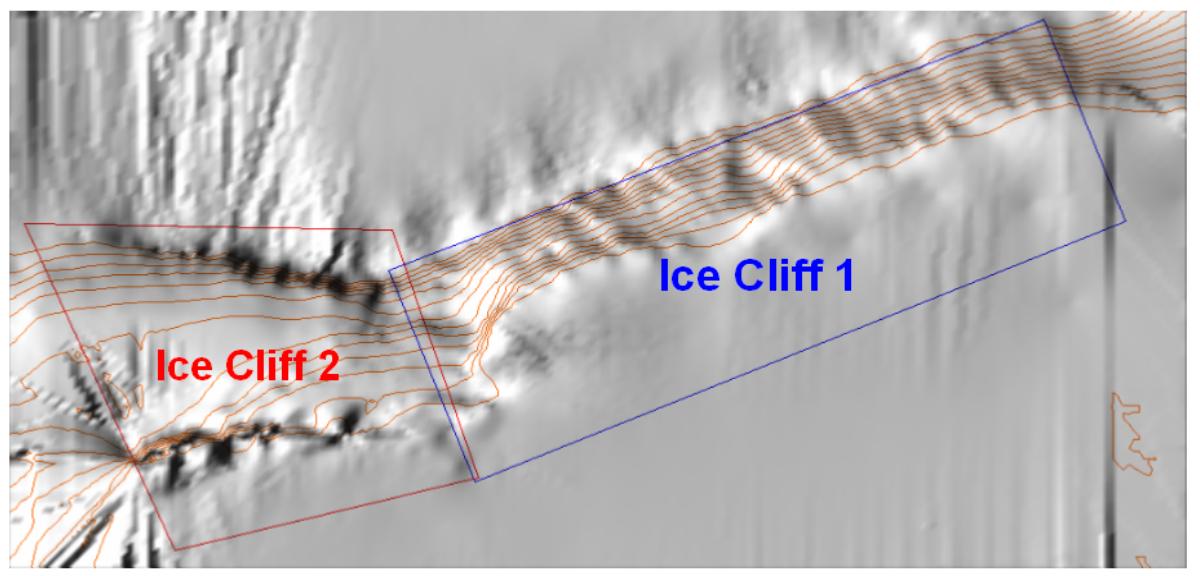
The second cliff, just to the west of the second cliff looked at a slightly different aspect and included some other features evident on the ice cliff. These comprise of ledge or step features and a large area of, what appears to be, 'blue ice'. For a comparison of the locations of the two cliffs and the difference in aspects see Figure 1 below. |
|
|
|
|
|
|
|
|
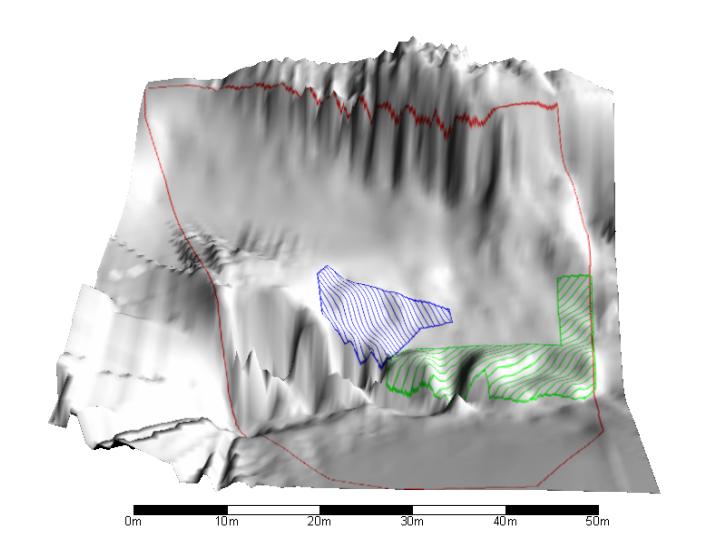
Initially the second cliff was scanned with a horizontal and vertical resolution of 1.0 metres. Using the default isotropic kriging interpolation algorithm, the surface shown in Figure 2 is produced from 1178 data points. There are, however, some visible anomalies in the data. The linear ridges on the flat area on the left hand side, halfway up the cliff, is an effect of the interpolation algorithm caused by a sparsity of data in this area. This is attributable to 'blind' areas caused by the relative elevations of the instrument and the surface. One way of eliminating this feature is to create supplementary 'dummy' data points to create a smoother surface. Alternatively, running other interpolation routines will give different solutions which may overcome this problem. The second anomaly can be seen at the bottom of the cliff where a number of deep gullys and sharp ridges are evident. This is caused by an overhang. Most terrain modelling runs into problems when a single X-Y coordinate can have multiple Z values, (which is essentially what defines an overhang). This is a difficult problem to overcome. One attempt has been made to rotate the digital elevation model through 90º so that the cliff appears to be lying on its 'back'. This is achieved by swapping the Y and Z coordinates, so the plan coordinates are now X and Z. However, in order to register a 'rise' in Y with an overhang the Y coordinates must be made negative, (a decrease in Y corresponds with a 'bulge' on a south-facing cliff). |
|
|
|
|
|
|
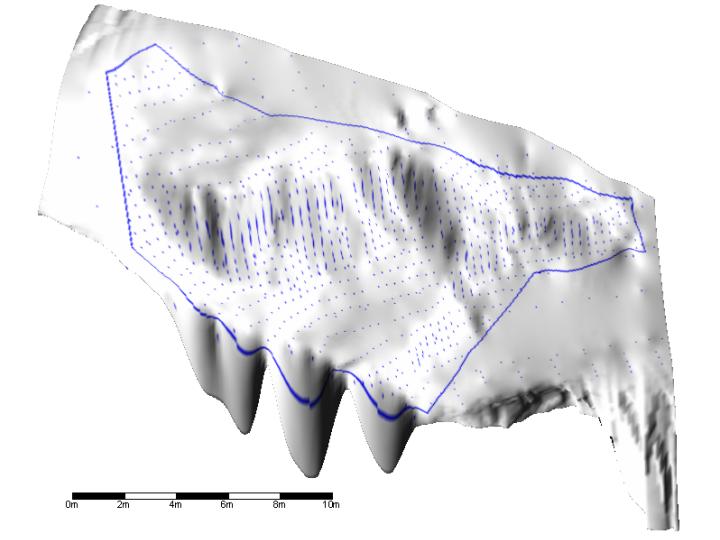
A second scan was made to examine a section of the ice cliff that had a smoother and 'bluer' appearance, indicated in blue in Figure 2. The hypothesis is that the response to ablation processes may be significantly different here to other sections of the cliff. The scan was taken at a horizontal and vertical resolution of 0.25 metres giving 866 data points. The surface derived from these points can be seen in Figure 3 along with the distribution of data points from which the surface was obtained. |
|
|
|
|
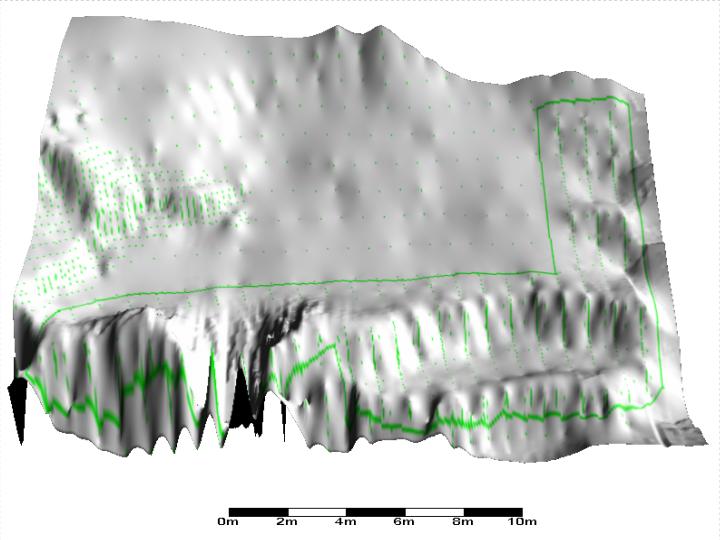
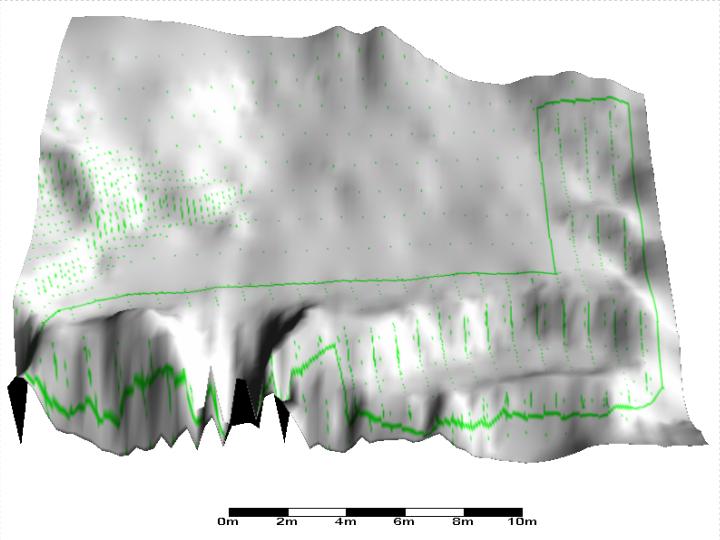
Finally a third scan was made to highlight a sequence of ledges or steps with a view to possibly separating out horizontal and vertical components of ablation or accretion. This scan was taken at a horizontal resolution of 1.0 metres and a vertical resolution of 0.1 metres. This was in attempt to highlight the change in elevation rather than change in the plane. The cluster of points on the centre left are from the scan used to obtain the blue ice model and are not used in this analysis. |
|
|
Further post-processing can improve the surface generated from this data. Firstly, it is thought that the resolution of the derived grid-based digital elevation model is too fine at 0.1 metres. This has been reduced to 0.3 metres in Figure 5, giving an overall smoother look to the surface. With a slightly coarser resolution the surface responds less to individual points as can be seen in the back wall of the model while still retaining the overall shape of the surface. There is obviously a trade-off between resolution and accuracy. Residuals calculated from the difference between the raw data elevation and the elevation from the model can be used as an indicator of accuracy, but inevitably some form of judgement must be used to obtain the optimum solution. |
|
|
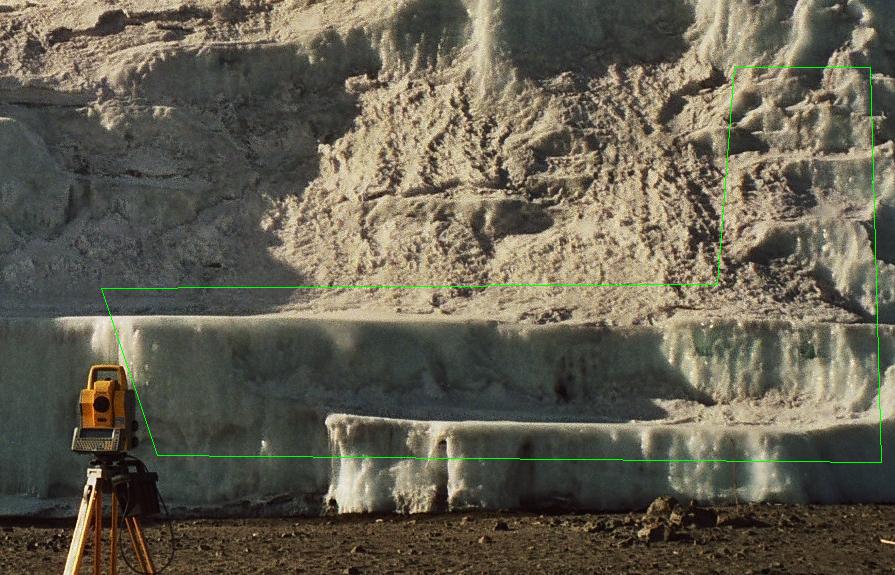
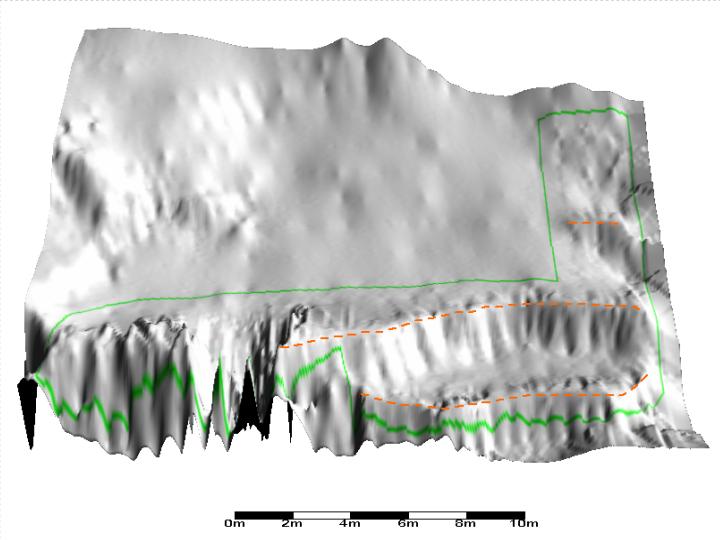
Secondly, on examination of Figure 4 it can be seen that the lip of the steps stand out at locations of observed data points. This gives a serrated appearance to the steps which does not conform to the real surface. As seen from the photograph in Figure 6 the edges are sharp and well-defined and some attempt should be made to replicate this form. The best solution is to define the edge of the steps in the raw data as breaklines. Ideally this should be done whilst taking observations, however they can be added at a later stage. This was achieved by assigning specific observed points, identified as being the nearest to the top of a vertical section, to each breakline. The output can be seen in Figure 7 which uses a gridded data with a 0.1 metre resolution where the defined breaklines can be seen as dashed brown lines. Comparison between models with and without breaklines can be seen by examining Figure 4 and Figure 7. |
|
|
|
|