The BattleMage campaign follows the adventures of a group of ‘wizards
in training’ as they work together to build both their magical skills
and small personal armies.
As required by law, the wizards work for the World Magic Council. The
council is a faction independent group that oversees all things magic.
When the warlords of the world require magical assistance they can rent
the services of the junior wizards through the council.
A junior wizard’s life is exciting (and generally short). They get
dropped into hot spots around the world to battle with the nastiest of
enemies. Depending on who bids highest on a contract they can end up
fighting for a faction one week and against the same faction the next.
Quick Start:
The whole campaign is card based and has mysteriously connection to the
number 3. :)
Every player starts out with the same stuff:
1 wizard
3 heroic points
3 troop points
First thing the players do is customize their wizard using their heroic
points. Each player draws a card and decided which of the 3 options on
the card the wish to purchase.
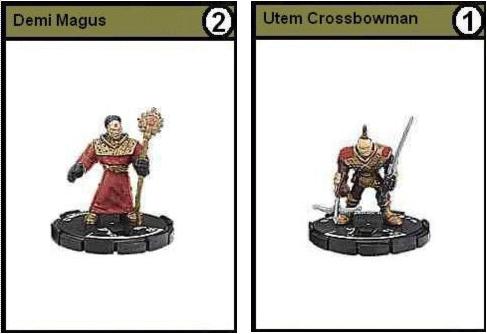
Next the player builds a small army to help him out using cards from
the hiring faction. Player decides which of the point costs 1,2 or 3 he
wishes to purchase. Player draws a card and has the option of adding a
yellow version of that to his army.
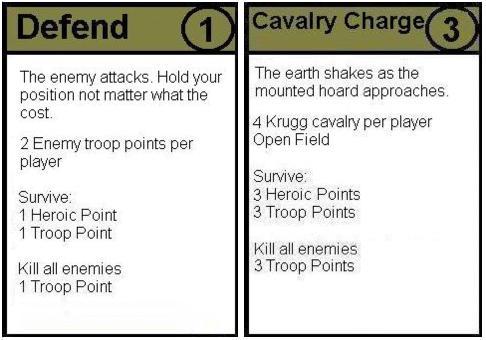
Finally the players select an adventure from one of the 3 adventure
piles. The higher the number of the adventure the greater the reward.
At the start of any adventure, if the players think they have enough
power they may opt to tackle the final scenario of the night. The final
adventure is uber powerful but it also provides the best rewards.
At the end of the night the players pull a card from the contract pile.
The next time the wizards take the field they will be working for the
faction on that card.
The Wizard: A magic user that can truly grow into
a monster over time.
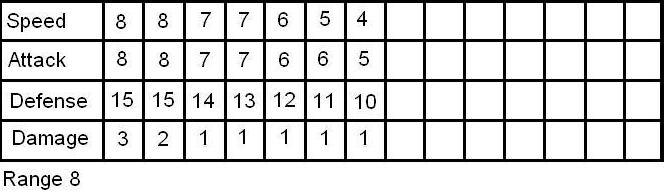
Every wizard starts with the same set of stats.
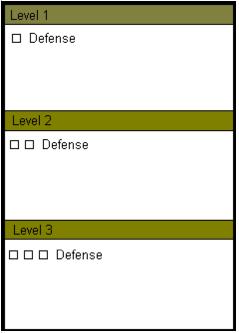
At the start of the game the players get to spend 3 Heroic Points to
power up their wizards. They draw a random card from the level deck and
decide whether to spend 1,2 or 3 points on the card depending on which
level he wishes to purchase. Once all the Heroic Points are gone or the
player opts not draw a card his build phase is over - his wizard is
ready to go to work.
As the Wizard completes assignments he’ll gain more Heroic points
through his heroic actions:
- successfully completing missions
- personally killing 10 enemies
....
A final note on wizards.
The laws of nature only allow for so much advancement. Stats are
limited to Speed 10, Attack 12, Defense 18, Damage 4 and range 12. In
the unlikely event a card is drawn that would force a stat to go above
this limit discard it, draw 2 more and spend your Heroic point on
either/both of them.
The Army: The people of the land hold the wizards
in the highest regard and consider it an honor to fight for them.
Each week a faction will employ the wizards. As part of the contract
the faction will allow some of it’s fighters to swear allegiance to the
wizard’s and fight alongside them. Once allegiance is sworn the fighter
will not leave the wizard’s side until released from his oath.
The wizard purchases fighters using troop points - each week the
employing faction gives each wizard 3 points as a down payment and the
wizard earns more as he completes tasks. Unfortunately you don’t get
much of a choice from the employing faction. The wizard either pays 1,
2 or 3 troop points and gets a weak, medium or strong card.
Player gets a yellow verison of that figure and tries to work that
figure into his army based on his army’s Command Size.
Command Size: As great as wizards are they can’t command an infinite
amount of troops. Each wizard starts a command ability of 101 points.
This means they can have a maximum of 101 points worth of troops in
their army, and since actions are generated 1 per any part of 100, they
will receive 2 action with which to control his troops. Command size
increases which each battle fought: 1 per enemy the hero personally
kills, 1 point per encounter level if the encounter is successfully
completed.
Reminder, at the end of the evening any unused troops cards are
worthless so it’s always wise to cash in all your cards just in case
you get that one figure you’ve been looking for. It’s often worth
releasing a few peons from their oath to make room for that uber
killing machine.
Nomination for advancement: After any successful battle a player may
nominate a single figure for advancement. Providing his Command
Size allows it, simply substitute the next highest color fighter for
the current one. Blue for yellow or Red for blue.
The Encounters: Each week the players will be
presented with a task to accomplish. The task is a real test of the
wizard’s skills. At any point during the evening the player may opt to
tackle the final task if they decide they are ready. Otherwise they may
opt to tackle a lesser encounter - these encounters have toughness
level ranging from 1-3. The higher the toughness level, the greater the
rewards.
Exiting battles:
Unlike regular games fighters can leave the tables during a battle if
the player has taken 25% or more in casualties. Simply walk off any
table edge. Fighters that leave in this manner can not be nominated for
advancement and heroes forfeit any Heroic Points they would have been
awarded.
Death of a Wizard:
Wizards aren’t nearly as mortal as the rest of us, death is only a
temporary setback for them. Should a wizard die the player removes a
click from the wizard’s stat sheet and starts the next battle as normal.
Games are played using the standard special abilities and rule set from
dungeons with a few exceptions described here.
Actions:
Players get 1 action per 100 points of command size or part thereof.
Players get 1 action to be spent on his wizard.
Players get 1 actions per unique to be spent on that figure (junior
wizards, uniques ......)
Players get 1 action per war machine to be spent on that war machine
** Wizards, junior wizards and uniques may use their action to control
a formation.
** Wizards are considered to be from the faction they are fighting for
that day plus any other default faction they possess. (It’s possible to
create multi-faction formations using a valid wizard)
Formations:
3 to 5 figures from the same faction can use a single action if they
all preform the same action type.
Movement Formation:
All figures must start in base contact and end in base contact.
No figure may move faster than the slowest figure’s speed value.
Ranged Formation:
All figures must be in base contact.
All figures must be able to see the target.
All figures are given a ranged combat action.
One figure is deemed the primary attacker - use his attack / damage as
the base.
All other figures contribute +1 the attack total.
Melee Formations:
All figures must be in base contact.
All figures are given a melee action.
One figure is deemed the primary attacker - use his attack / damage as
the base.
All other figures contribute +1 the attack total.
A single +1 is added to the attack total if a member has rear arc on
the target.
** Note mage spawn can’t make formations without having a shyft on the
field.
If this wasn’t clear enough. If you’re using a formation you can either
move OR attack If a fighter is acting alone it can move and then attack
using 4 speed points.