HALFMOONS
HALFMOONS
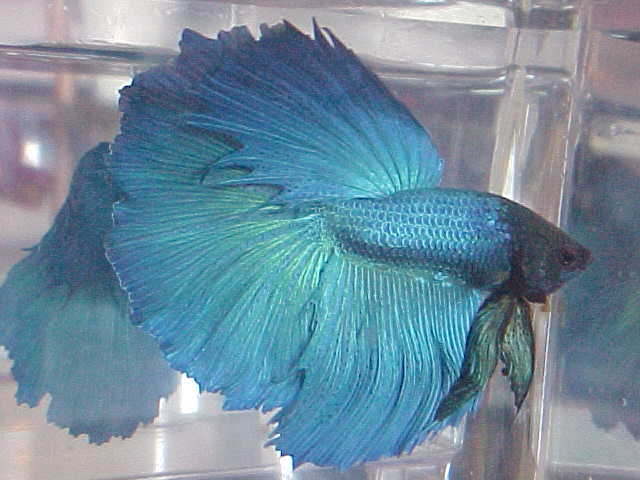
Todate, true halfmoons remain ever elusive, only appearing as a small percentage of spawns, that is, if they ever appear at all. So what are these HMs actually? Basically, they are an extreme form of deltas, where the caudal spreads to 180 degrees or more. These HMs have their dorsal, caudal and anal fins overlapping one another, giving rise to a huge volume of fins that portray a picture of stupendous majesty!
Okay, so how does one maintain a halfmoon line, or is it actually possible to cultivate a delta line to start throwing halfmoons in subsequent generations? The answer is "YES", and the means to it is through a vigorous selective breeding programme. Below are some methods for selective breeding which I personally use to maintain and improve my lines. They work for me, and hopefully, the infomation will be of use to you as well.
First of all, the initial breeding stock will be the basis for your line, so make sure that they are chosen under close scrutiny. Here are two possible "good" traits to look out for (only finnage related traits will discussed here):
1) Check the outermost rays of the caudal. Make sure that they are as straight as possible. For me, this trait is rated as the most important among all others in achieving the HM goal. (You will see the reason behind it in a short while) If those with curved outermost rays are chosen, it will take you at least a few generations to straighten them out, and trust me, it is not worth trying at all!
2) Try to get breeders with as much branching in their rays (in all three fins) as possible.
After selecting the breeders, and successfully spawning them, the selecting process gets tougher as you will be trying to spot all those potential fry from among their siblings which may number in the range of several hundreds! Here's a tip: I usually start selecting those fry that I think are already showing better potential and put them into a separate grow-up tank as young as 4 weeks old. However, that should not stop you from picking out anymore potentials from the main batch of fry should you spot any. In doing so, you narrow down the number of fish you need to observe closely.
The main characteristics used in choosing the breeders apply here as well. Definition in the caudal is especially important for raising HM lines, so make sure that only those with straight caudal edges are choosen. However, watch out for those which tend to lose the straight edge as they grow up. These fish should not be used as your prime breeders, but can be kept as spare breeders if neccessary.
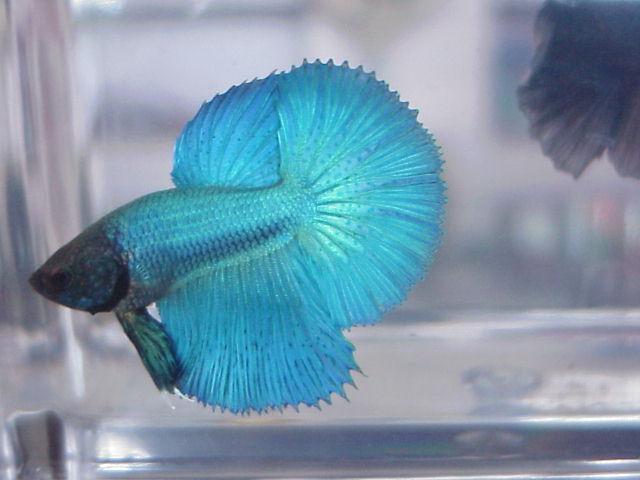
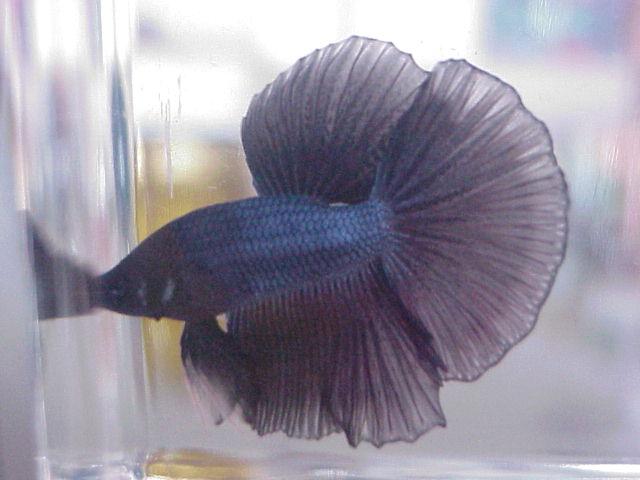
The above pictures are of two young males (abt. 2 months). The turquoise has very straight outermost caudal rays and sharp edges, while the melano has a slight curve to his outermost caudal rays and a slightly rounded edge, which is to be avoided. As you can see, the straight outermost rays allows the caudal to spread to its fullest, therefore it is vital in producing HMs. Imagine that you produced some bettas with an intitial spread of 180 degrees at the base of the caudal, however they have a slight curve to their outermost caudal rays. Then they will not be considered as HMs at all, as their caudals do not hit the minimum 180 degrees when considered from edge to edge!
With regards to branching of the rays, not only must you look out for those with as much branching as possible, try to look for those whose rays branch out as early as possible, that is, branching which starts as close to the base of the fins as possible. Those rays which branch earlier will naturally help them to literally fin out, providing them with a bigger spread, compared to those whose branching occurs later. Also, these fish will have huge spreads without flaring, and when they do flare, the rays which are "evenly distributed" throughout the caudal will help to support the full volume of fins, and prevent the caudal from drooping.
Aside from the caudal, look out for anal fins that spread outwards, and try to avoid those that come to a point. I'm currently seeing primary branching in the rays of the anal fins of some of my lines, and they definitely look fabulous as their anal fins resemble a drape and add to the fullness of their look. Dorsals can be increased in width by outcrossing the line to DTs and constantly doing a ST(male) X DT(female) cross. However watch out for those with deformed/shorter bodies or crooked spines, which usually comes from working with DT lines.
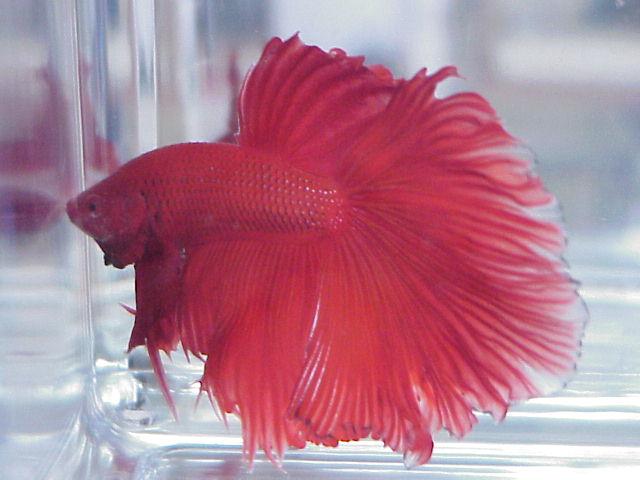
Last note: Actually deltas may look just as good as HMs do, if not better (depending on preference). I have noticed that HMs tend to have shorter caudals than deltas do, and may actually lose out in terms of volume, which adds to their beauty. Below is a picture of a red male, he may not be HM, but he sure is beautiful!
The above information were gathered from personal past experiences as well as from those of other breeders. It may not be the best solution in the world, but I hope that it will help us all in striving towards producing true HM lines! Kindly do not reproduce this article in any way, unless permission is first granted.