|
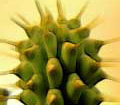
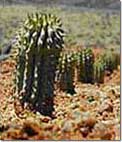
Hoodia gordonii, "Whoo De AH", is the botanical name for a leafless, spiky succulent plant that grows throughout the semi-arid areas of Southern Africa primarily the Kalahari desert. The San (local inhabitants) have rationally used Hoodia stems to stave off hunger and thirst when on long journeys, as it acts as an appetite suppressant. Hoodia Gordonii is a leafless spiny succulent plant ( not a cactus ) with fleshly finger-like stems. Rows of thorns are present along the stems, bearing flesh coloured flowers. Hoodia Gordonii grows naturally in the harsh desert conditions of South Africa. Now Hoodia Gordonii has been found in the semi-deserts of Zambia, Zimbabwe, Botswana, Namibia, Angola, the Republic of South Africa, and now found in some other arid regions of South American Nations such as Chili, Peru and some regions of West China including Gansu, Sichuan and Shanxi.
Hoodia pills are my life saver. I have a thyroid problem and this causes depression and weight gain. These pills take my hunger away so I can get back into shape and they make me happy, nice "side effect" ;-) Now my Doctor is taking them too! M S (Germany).
After years of careful research, scientists isolated several compounds in this all-natural food that was responsible for dramatic weight loss, P57, which has been widely reported, is but one of several chemical compounds found in the Hoodia succulent. Not only was it proven completely safe, it contains no stimulates that could contribute to the jittery feeling associated with weight loss products of the last decade. Independent tests conducted in Leicester, England on obese individuals from all walks of life have proved that over a 15-day period, food intake was reduced by 1000 calories a day. Laboratory experiments show animals automatically restrict their food intake when taking hoodia orally. Rats, a species that will eat anything from meat and plants to indigestible fiber, lowered their dietary calorie intake to a degree that made them get thin when fed comparative amounts of hoodia.
The pure Hoodia that contains appetite suppressant qualities is only grown in one specific region in South Africa. If the Hoodia is from China, USA or any other part of the world and is not accompanied by a South African Government Certificate of Authenticity, the product is inferior and ineffective. So buying hoodia is very difficult. It's expensive. And, naturally, there are a lot of fakes on the market. Even now, there are only a few hundred acres of hoodia growing on commercial farms, and the plant is highly susceptible to being wiped out by rather mysterious conditions. All this means that if hoodia really catches on with the public -- the supply will be even tighter for many years. Prices are going to go up, and eventually, only the wealthy may be able to afford the pills necessary to lose weight.
Hoodia is registered as a protected species to prevent Bio-Piracy but is allowed to be grown on a handful of commercial farms in South Africa owned by private farmers. The Hoodia Gordonii plant originated in the southwestern part of Africa and grows best in the semi-arid areas of South Africa primarily the Kalahari. In its native habitat it is extremely difficulty to identify because it looks similar to succulents of the same family of which there are many. Only an experienced botanist or as the case in South Africa with Hoodia Gordonii a San people can identify the plant prior to it's blooming.
|