Lancashire and the Republic
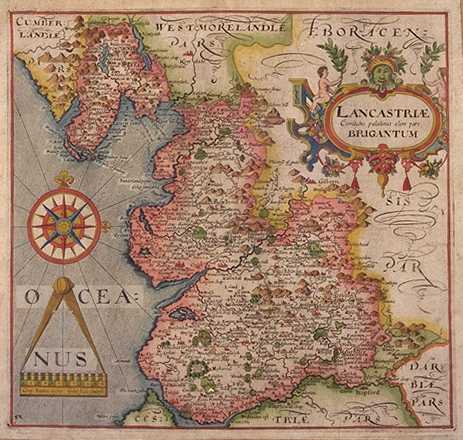 I am now almost a year into the study of this subject. I hope ultimately to show the processes through which the regicide government in London imposed itself upon the provinces, in a country that was still strongly monarchical. Lancashire is an interesting case-study for several reasons. Firstly, more so than many other counties it had strongly defined and mutually-antagonistic religious communities. The North-West, and Lancashire in particular, have always been reknowned for its retention of the old faith. In the seventeeth century, however, Lancashire also had a prominent and influential Puritan community, particularly in the eastern hundreds of Salford and Blackburn. Between both were men fixed in their loyalty to the Laudian Church of England, such as James, 7th Earl of Derby. This issue of religion, so critical in all matters in the seventeenth century, ensured that Lancashire society was divided politically (although often not socially), and also made Lancashire stand out at the start of the civil wars as one of the counties where no neutralist movement sprang up.
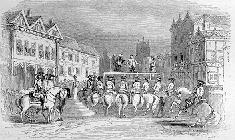 The execution of the Earl of Derby at Bolton, 1651. Following the end of hostilities in 1646, and in accordance with a Parliamentary Ordinance, a classical Presbyterian form of church government was established in Lancashire, and it probably had the best organised and most enthusiastic Presbyterian system outside of London, especially within the south-east of the county. The Presbyterians had been amongst the strongest supporters of Parliament, however they could not tolerate creation of a Republic (the Covenant had contained an Oath to protect the King's Person), nor could they accept the toleration of other Protestant sects. Given the strength of Presbyterianism within Lancashire, this produces an interesting tension to the relations between the centre and the localty. Both sides viewed each other with suspicion, yet both relied upon each other for their mutual benefit. Lancahire is also interesting because of its location. It is at a long distance from London, and so difficult to coerce, unlike (for instance) Berkshire or Kent. If central government wanted their orders to be carried out, they would have to rely upon well-affected men within the county. However, Lancashire also suffered military occupation for long periods of the Republic, and was invaded by Scottish and Royalist armies in the summer of 1648 (the second civil war, which culminated in the creation of the Commonwealth) and 1651. I hope by the end of my studies to reveal the processes that relations between central and local government underwent during the Commonwealth. The original question that I formulated in my mind when I first considered this work was: "How do you create a Republic in such a monarchical regime?" I hope to see by what means central government were able to force their will upon the Lancashire elite, how the Lancastrians were able to resist central government's wishes or, indeed, to force its own agenda upon London. Were compromises worked out whereby, in return for cooperation by one party, a reciprocal action was carried out by the other party? One would expect central government, with the heavy machinery of Whitehall and the very real armoury of the army behind it, to hold all of the cards but was this really true? A working settlement in the country would require genuine supoort for the Commonwealth, not cooperation at the end of a smoking barrel, so how was this achieved? Finally, to what extent did faction play a part? Were factions within the county able to exploit divisions between central and local government, or between groups with each of these, playing one against the other? Did seemingly local wrangles spill into the factionalised political warfare of Parliament or Council of State?
| |