Henry Ireton and the English Revolution
For my MA disertation, I chose to research into the influence of Henry Ireton over the events of the 1640s and 1650s. I have found Ireton intriguing for a long time; for me, he was the real motor of the revolution during the crucial 1647-9 period. I believe that, for such an important figure in the history of the revolution, he has not received the attention that is his due. Biography Ireton was born in the village of Attenborough, a few miles south of Nottingham, into a minor gentry family. The house believed to have been his family's still stands, and still has a small farm attached to it. Except for some conflict with the local minister over kneeling and other aspects of ceremony, little is known about Ireton's early life. He attended first Trinity College, Oxford, where he passed his BA, and then spent a year at the Middle Temple. We are told that, whilst at Ocford, Ireton "had the character in that house of a stubborn and sawcy fellow towards the seniors, and therefore his company was not much wanting." In 1642, he early on took a hard-line stance in favour of Parliament, and became a captain of the county horse. He was closely related to John Hutchinson, a leading member of Nottinghamshire society, future governor of Nottingham for Parliament, and a key figure for Parliament in the county. It is through John's wife, Lucy, author of the famous Memoirs, that we know something of Ireton's early days. In 1643, after the action at Gainsborough, Ireton "quite left Colonel Thornhagh's regiment, and began an inseperable league with Colonel Cromwell."
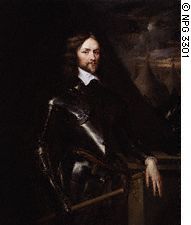 Henry Ireton (1611-1651), New Model Army general and political theoretician. From this point onwards, Ireton was acting upon the national stage. He became quarter-master of Manchester's Eastern Association forces, in which capacity he probably took part in Marston Moor, and then a colonel of a regiment upon the creation of the New Model Army. In 1645, on the eve of Naseby, and after a daring raid on the royalist camp, Cromwell persuaded Fairfax to appoint Ireton Commissary-General, second in command of the horse. Yet, despite his high rank, Ireton was probably more notable for his administrative prowess and his legal brain than his martial ability: whilst demonstrating great courage on the field of Naseby, he was no match for Rupert. 1646 was to be a good year for Henry: not only did it see the King's surrender but also Henry's marriage to Oliver's favourite daughter, Bridget. Ireton really rose to prominence in the post-war search for a lasting settlement. In 1647, with the aid of John Lambert and possibly Lords Wharton and Saye, Ireton drafted the Heads of the Proposals, the Army's plan for peace. The Heads were more lenient by far than Parliament's own proposals, but Charles sought to divide the Army from the two Houses in order to conquer them both. Consequently, he vaccilated and would accept neither plan, although he indicated his preference for the Heads. The quest for peace was threatened by a serious breach in the relations between Parliament and the Army. With the war finished, some in Parliament (often known as the "Presbyterians", descendants of the Peace party) sought to disband the soldiers speedily. With little provision made for a general indemnity, and a pittence of their massive arrears on offer, the soldiers resisted. After the Commons had passed the "Declaration of dislike", Ireton responded with the justly famous Representation of the Army, declaring that "We are not a mere mercenary army, hired to serve any arbitrary power of a state, but called forth and conjured by the several declarations of Parliament to the defence of our own and the people's just rights and liberties."
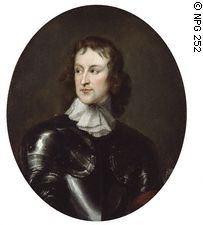 General John Lambert, co-author of the Heads and later author of the Instrument of Government As a Member of Parliament (having been elected for Appleby, in Westmoreland, in October 1645), Ireton might have felt in an ambiguous position. Yet it is clear that both he and Cromwell saw their first loyalties as to the Army. Whether this was from genuine idelogical zeal to defend "liberty", or a recognition that they might better tame the radical nature of the soldiery by remaining within the Army and dictating its political agenda, we shall never know. The seizure of the King demonstrates the confused nature of politics in that summer; speculation is rife, but it will never be established whether Cornet Joyce acted on his own initiative in securing the King in the Army's hands, or whether he was directed to do so secretly by Cromwell and Ireton. Certainly it benefitted the plans of the Grandees, and most historians believe that Joyce couldn't have acted alone. By this stage, the political heat was rising fast in London, and the Presbyterians and Royalists encouraged an "uprising" of apprentices and reformadoes (ex-soldiers from Parliaments provincial armies, many of whom were in London trying to secure their arrears). Fearful for their lives after attacks on Parliament and individual Members, many MPs and Lords fled to the Army. The Presbyterian's smug ascendancy was short-lived, however. The Army published an Impeachment of eleven members (headed by the infamous Denzil Holles), and marched on London. The 11 fled and the exiled Independents were restored with much pomp. The soldiery had during the summer elected Agitators (representatives) for each regiment. Whilst based in London, the Council of the Army (all officers above the rank of Captain, and all of the Agitators) and some civilians met in Putney Church to debate the Army's future role. Ireton and Cromwell were prominent in defending much of the existing social order; they resisted a dramatic widening of the franchise, fearing anarchic attacks on property would follow. Here, they showed themselves to be highly conservative members of the traditional governing elite. In matters of the constitution, Ireton and Cromwell sought no drastic changes. At this point they were both still seeking to restore Charles I, albeit with a reduced set of prerogative powers. Their radicalism lay in their desire for a less established Church, and for more tolerance of Protestant sects. Cromwell and Ireton have been accused of staling tactics, especially over the matter of the Army's previous Engagements. Yet concerns over the Army's honour at other times show that they saw their previous oaths as crucial; before they could act, they must first decide what they were still committed to do. The debates were quickly drawn to a close without any definite decisions being made, for the sake of Army unity, and in response to the King's signing of the Engagement with the Duke of Hamilton. As the prospect of a Scottish invasion of england loomed, order was quickly restored to the ranks. Charles' attempted escape failed, and he found himself incarcerated at Carisbrook Castle on the Isle of Wight. Nevertheless, the summer of 1648 saw a series of sporadic, ill-planed and uncoordinated risings around the country. Whilst Cromwell hurried to South Wales, Ireton joined Fairfax in the pacification of Kent and Essex. Ireton has been blamed for the execution of Lisle and Lucas at Colchester, shot after the fall of the town. Meanwhile, Cromwell defeated the disorganised Scots at Preston, before settling into a slow and insignificant siege of Pontefract. The second civil war was the turning point for many in teh Army; Charles has ignored God's judgement and tried to fight Parliament again. His defeat only confirmed the divine approbation bestowed upon Parliament's cause. Furthermore, by starting another round of conflict unjustly, he became "a man of blood". There were calls for justice, and Ireton lead those calls. After having his offer of resignation refused by Fairfax, he retired to Windsor, where he drafted the Army's Remonstrance, demanding the trial of the King. He was probably also the leading soldier behind Pride's Purge, Cromwell not arriving back from the north until after events had taken their course. We might speculate that Cromwell was directing his client from a distance, but moments of indecision at difficult times were characteristic of Cromwell. It seems more likely that he was hiding at Pontefract, awaiting the direction of Providence, whilst Ireton took the initiative. On 30th January 1649, Charles was executed outside the Banqueting Hall of Whitehall Palace for High Treason. In March, the monarchy was abolished and in May, a "Commonwealth or Free State" was created. Ireton was busy both before and after the creation of the republic, seeking to reform the nation's constitution. He as the moving figure in a series of meetings between leading officers, MPs & Levellers in December 1648, especially after John Lilburn had walked out in protest. These were convened in order to debate the Levellers' Agreement of the People. Lilburne's objection, however, was caused by Ireton's insistence that the Agreement be first handed to Parliament for ratification; Lilburne wished to offer it to every adult male for subscription. The Parliament made polite noises after the presentation of the Agreement but then promptly put it aside never to return to it. After the Regicide, Ireton suggested an Engagement, or oath, to be taken by all office-holders, approving of the revolution. This met heavy objection from many, and it was ultimately watered down merely to be faithful to the government as it now stood. Many historians see Ireton's failure to be elected to the new Council of State as a pointed attack by many moderate MPs upon the architect of the revolution. It certainly seems significant that he was one of only two nominees to fail to be appointed, the other being his fellow revolutionary Officer-MP, Thomas Harrison. Ireton's involvement in central politics was, however, drawing fast to a close. With England seemingly pacified (except for some petty Leveller-inspired Army mutinies which were easily quashed), attention turned to Ireland. Royalist armies were still on foot in Ireland, whilst the Confederation of Kilkenny was even trying to wrest their nation totally free of English subjection. The new government made their intentions with regards to British Union perfectly clear, however, by quickly adopting the English cross and Irish harp as their new arms. Scotland's attachment with England was merely a dynastic union, dissolved with the abolition of the monarchy. Ireland, however, was an English colony, and was needing to be restored to English sovreignty. Furthermore, many called for justice and revenge upon the entire Irish race, seem to carry the blood guilt for the massacres perceived to have taken place in 1641 (although, in fact, greatly exagerated). The last two years of Ireton's life were to be devoted to the issue of Ireland's annexation. Cromwell was created Lord Lieutenant, and he immediately made Ireton his Lord Deputy. Ireton took part in both the siege of Drogheda and that of Wexford, as well as many lesser actions. In 1650, Cromwell returned to England to prepare for an invasion of Scotland, which had declared Charles II King not just of Scotland, but also England and Ireland. Ireton was left in command of the campaign in Ireland. With most of the east coast firmly within English hands, he should have made short work of the task, but he became bogged down in a lengthy siege at Limerick. His eventual success was to be a hollow victory, because Ireton contracted either a fever or plague shortly after taking the town, and died in November 1651.
| |