A Passion for Military Scale Models

Last Update : June 2, 2007
I can be reached at the following email address : [email protected]
Johan Somers, Europe (EC)
Last Update : June 2, 2007
I can be reached at the following email address : [email protected]
Johan Somers, Europe (EC)
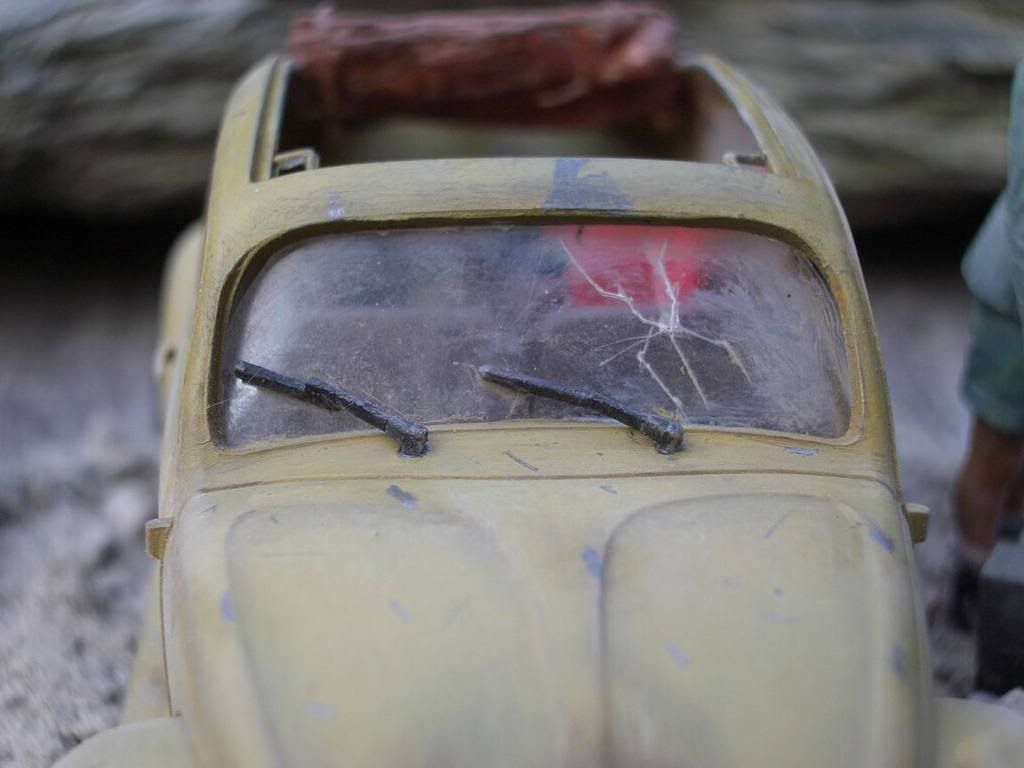
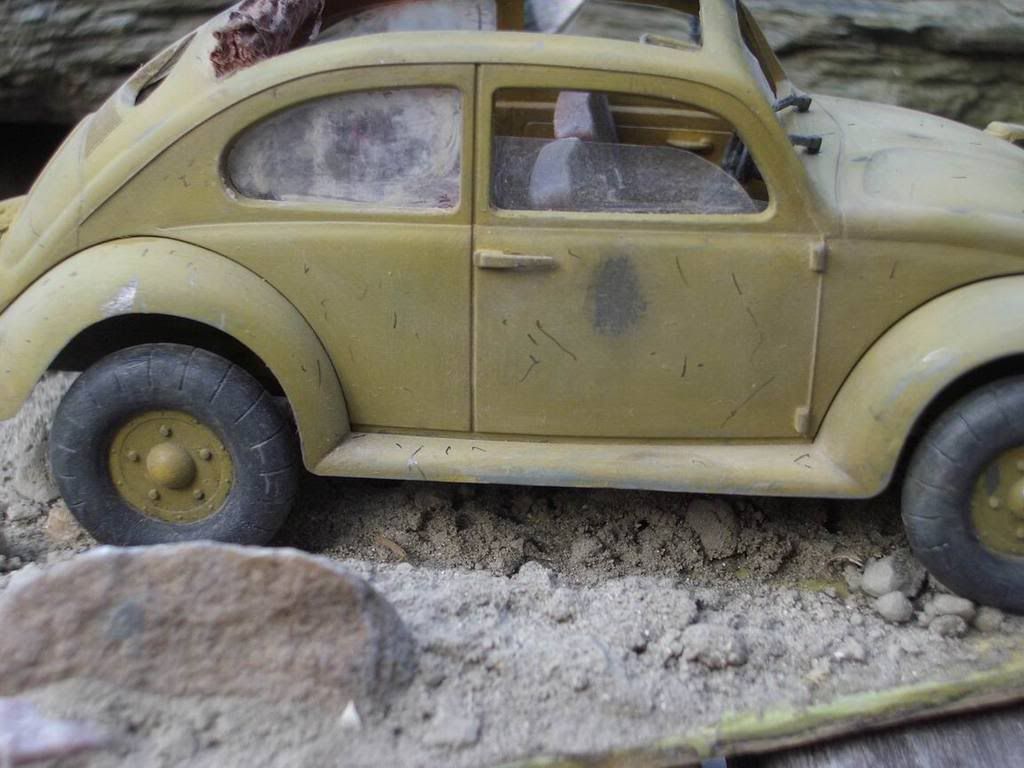
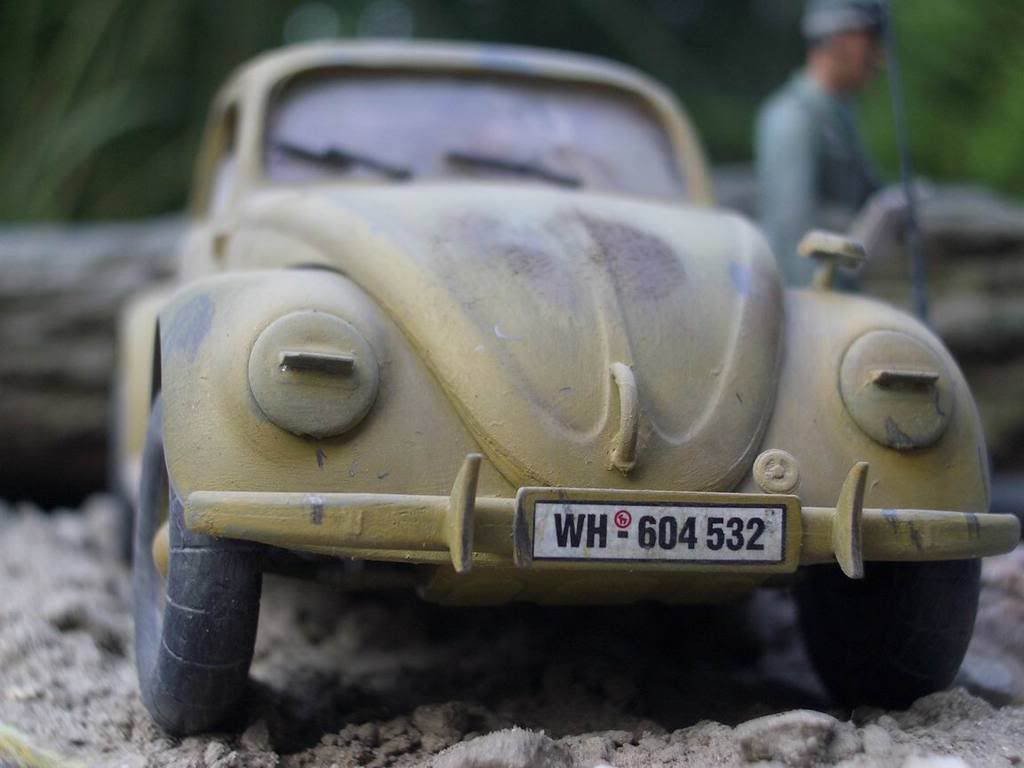
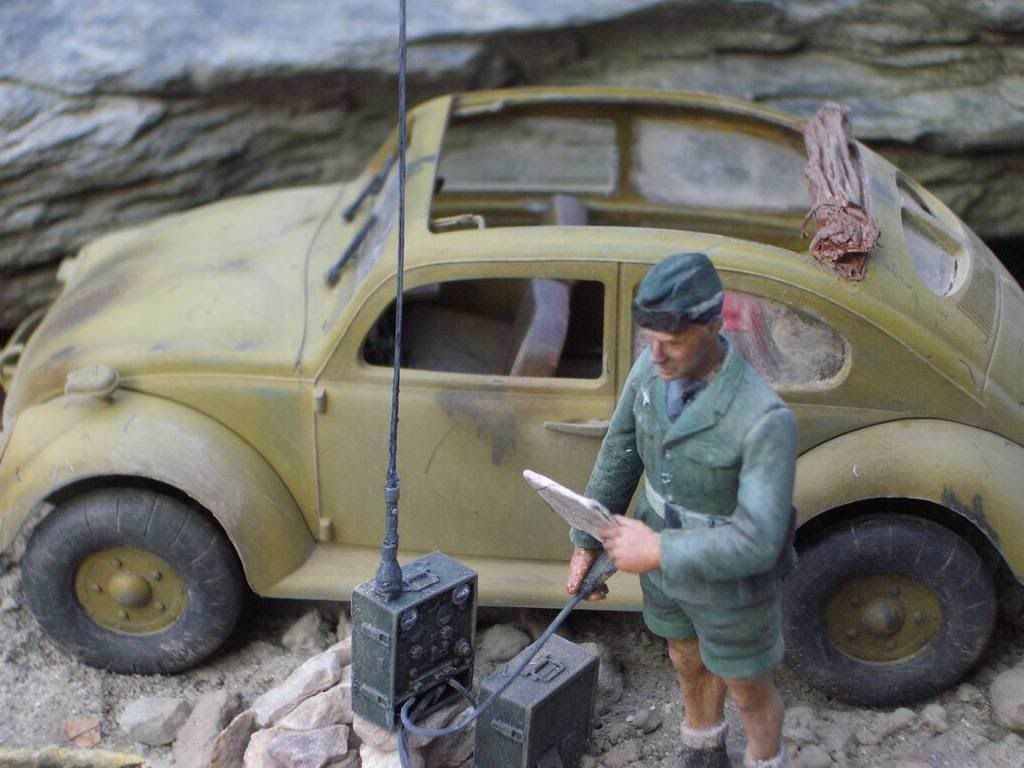
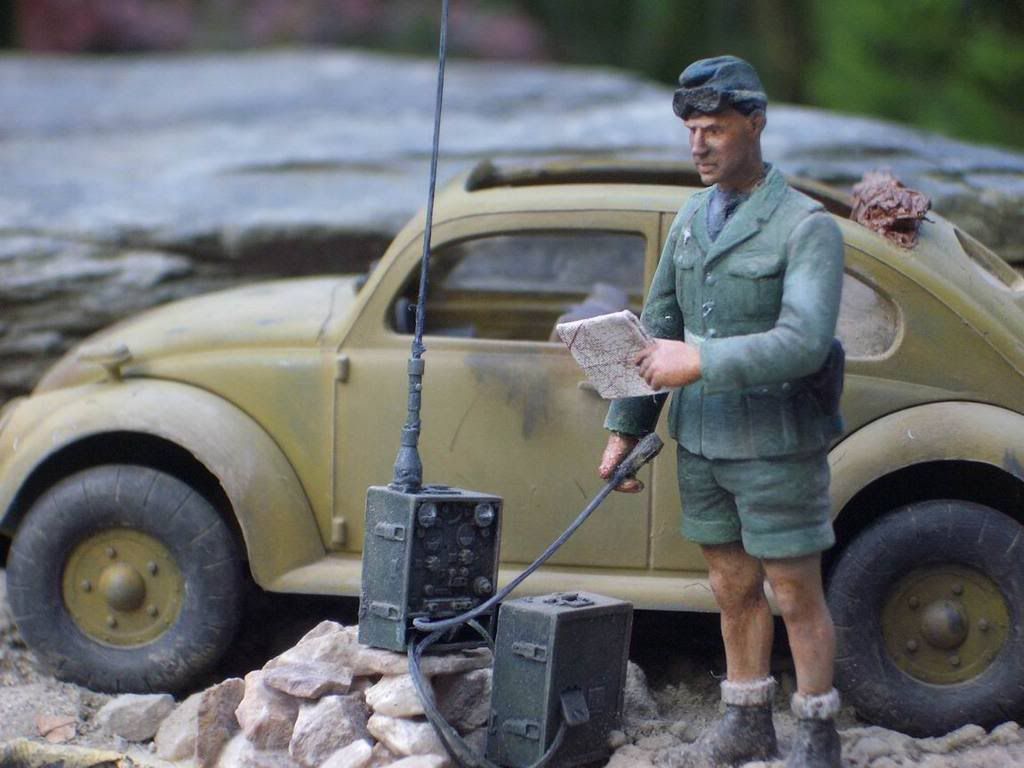
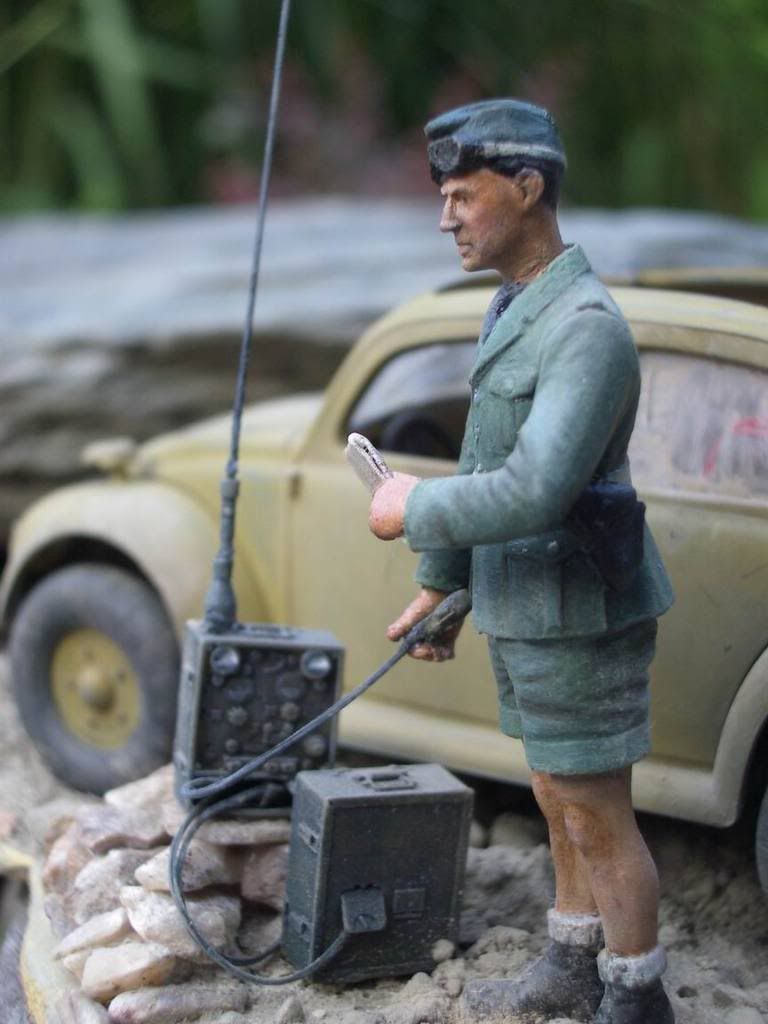
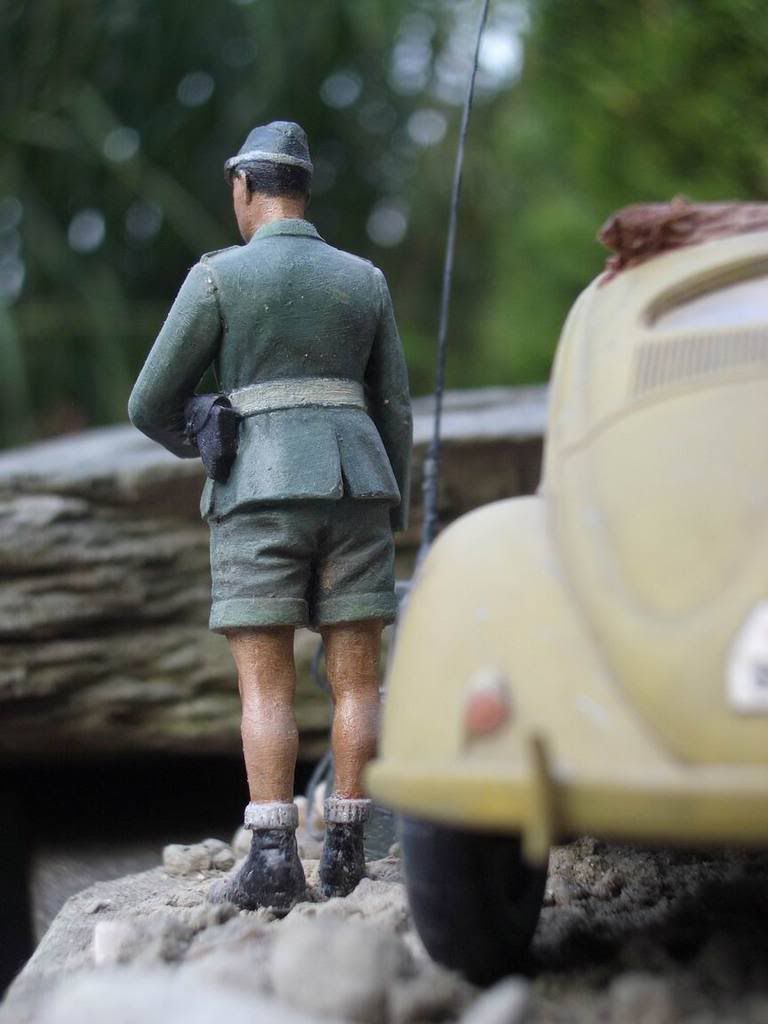
For officers and other higher ranking militaries the VW factory also produced military versions of the beetle called type 87 or kommendeurwagen (commander car). It was basically a beetle body on a four wheel drive Schwimmwagen chassis. Some were equipped with producer-gas units since there was a shortage of petrol towards the end of the war. About 580 vehicles were delivered and most of them were send to AFrica were it was a very popular car.

Other references :
http://www.waffenhq.de/panzer/kommandeurswagen.html
http://home.arcor.de/rik.hartl/Modellbau/Sonstige/VW87.htm
http://user.tninet.se/~xnf969f/htmlfiler/vwhistory.html
http://www.2iemeguerre.com/blindes/volks87.htm
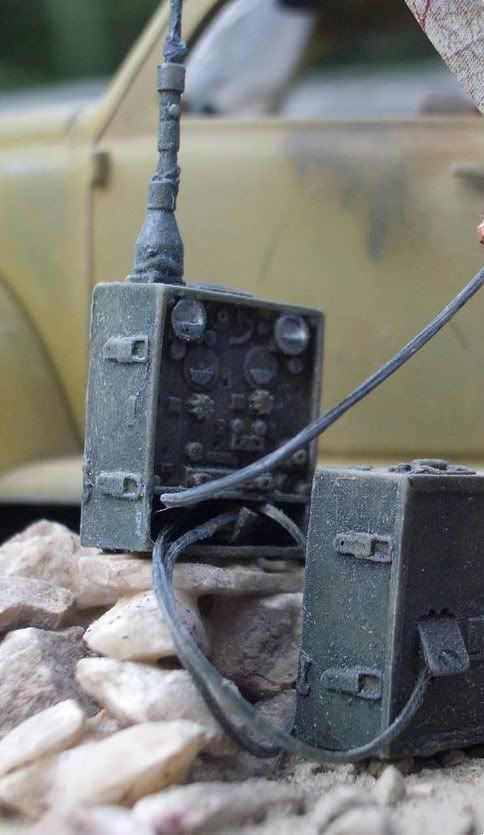
Model: VW from Tamiya.
Build :
The vehicle received a Humbroll gray undercoat, followed by 3-4 green-yellow oil paint coats.
Shadows andc highlight were againt applied with oil colors and the last finish with pastels.
A German cavalry soldier of the 1st Leib-Husaren-Regiment nr 1 with garrison in Danzig-Langfuhr, is enjoying a few minutes of his spare time in an idyllic corner of a garden. He is dressed in full parade uniform, with black trousers, a black tunic called Atilla having white cords and an impressive busby decorated with a death head and a red flap. The regiment was raised on August 9th 1741. The uniform is almost identical with those of the 2nd Leib-Husaren-Regiment K�nigin Viktoria von Preussen nr 2, but these had a white flap on the busby.
Model: Hussar from Andrea. Chicken from Tamiya, Pigouin and table scrath build.
Build : June 2007, oil paint
The vignette is approx 5,5 by 6 cm and is entirely scracth build.


Daylight photographs


German General Erich von Falkenhayn developed a battle plan for attacking Verdun, France, a city protected by a ring of underground forts. Begun in mid-February 1916, and ending in December, the battle of Verdun symbolized for the French the strength and fortitude of their armed forces and the solidarity of the entire nation. After a few short weeks, the battle took on a life of its own, with small groups of men on both sides fighting local battles in constant struggle for their lives, and protection of the territory they occupied. Verdun is still considered by many military historians as the 'greatest' and most demanding battle in history. In the end, the front lines were nearly the same as when the battles started while over 300,000 French and Germans were killed and over 750,000 were wounded. (Source: http://www.pbs.org/greatwar/maps/maps_verdun.html)
Model: Warrior
Build : June 2007, oil paint


Updated photographs :


The following small vignette represents an event which occurred during the morning of May 2th 1945 in Berlin and involves two figures: a member of the Volkssturm and a member of the National Committee for a Free Germany (NKFD)
What happened before :
The Volkssturm "uniform" was only a black armband with words Deutscher Volkssturm Wehrmacht with a series of silver collar pips pinned to the wearer's collar worn by senior members only.

With the German defeat at the Battle of Stalingrad, the number of German POWs rose and their belief that Germany shall be victorious was damaged, hence they were more open to the idea of a membership in an anti-Nazi organization.
The National Committee for a Free Germany (NKFD) was founded at Moscow on 12 July 1943; its president was the exiled German writer Erich Weinart. Its leadership consisted of 38 members, including 28 Wehrmacht POWs and 10 exiled communists.
After several failed attempts to recruit officers into the NKFD, it was suggested by Oberstleutant Alfred Brette to set up a special organization for officers so that they would not have to come in contact with communists and common soldiers.

|
Berliner!
Soll unsere Stadt restlos zerst�rt werden? Sollen wir alle verhungern? Nein! Es gibt einen Weg zur Rettung! Weg mit Hitler und seiner Nazibande!! Volkssturm! Kehrt die Waffen gegen Hitler! Einig in allen Schichten haben wir die Macht. Schluss mit dem Krieg! Nationalkomit� Freies Deutschland |
Two months after the founding of the NKFD, the League of German Officers (Bund Deutscher Offiziere, or BDO) was founded; its leader was General Walther von Seydlitz-Kurzbach. The main aim of the BDO was to specially deliver propaganda for the German armed forces. A number of highly ranking officers joined the BDO, the most prominent of them was Generalfeldmarschall Friedrich Paulus.
Although the NKFD operated in the Soviet Union and partly consisted of communists, it had a right wing-conservative ideology. The NKFD goal's was a retreat to the borders of 1937, the opening of negotiation for peace, and the deposing and punishing of Nazi leadership. It also called to preserve the power of the Wehrmacht. The NKFD believed that German civilians and soldiers had to place their true interests (anti-Nazism) above the interest of their Nazis leaders.
As the war progressed and it became clear than an anti-Nazi putsch would not occur and an occupation of Germany was inevitable, the ideological line began to be more leftist until it become identical to that of the Stalinist communist party.
The NKFD and BDO activity focused on propaganda. They had their own newspaper and radio station. They sent leaflets to the German soldiers at the front and the POWs in the Soviet camps. General Walther von Seydlitz-Kurzbach offered to raise an anti-Hitler army from the NKFD and BDO members to fight against their own country, but the Soviets did not accept this offer.
Some NKFD members were attached to front line Soviets units to interrogate German POWs and spread propaganda to the Germans units that the Soviets were fighting against. Other NKFD members fought behind the German lines alongside Soviet partisan units.
As the Red Army entered Germany, NKFD members were appointed as officials in the local government of the Soviet occupation zone, replacing Nazi officials and the ones who fled from fear of the Soviets.
On the morning of May 2nd, an older Volkssturm soldier is in a discussion with a member of the sovjet aligned Nationalkomitee Freies Deutschland (NKFD) to convince him to put down his weapons and instead fight against the Hitler bandits. The NKFD members wore an armband with the German colors and the letters NKFD. The Volksturm had an armband as well. A large pile of pamphlets is available and one being handed out!
Model: old Verlinden set of two Volkssturm member
Build : May 2007, oil paint
Diorama is very small, approx 6x5cm and resembles a street section. It is - apart
from the pedestrian zone, entirely scratchbuild.
The oil paint is still a bit wet and combined with the flash, the clothing is a bit shny, which will disappear over time. The Panzerfaust will still receive a yellow finish.


Updated photographs with yello colored panzerfaust :


Sector Chemin des Dames, Operation Bl�cher, May 28th 1918. After an initial bombardment on May 27th , the German Army crossed the river Aisne and destroyed a large part of the eight British and French divisions defending the area, while moving an astonishing 20km into enemy territory.
Model: Sparta
Build : May 2007, oil paint


Updated photographs with more staining at the legs:


The Afghan soldiers was a very old paint job, and should be re-done for todays standards. The vignette however is recently build and an experiment to model vegatation after a prolonged period of dry weather.


This soldier was a bit too confident during exercises of the winter of 1939.
It was a strong winter during the mobilisation period of the Dutch army in 1939. The first mobilisation day was on August 29th 1939 for men from the years 1924 to 1939. The winter was particular strong with on average very low temperatures between December 15th 1939 and February 20th 1940. (the Ice skating competition "Elf Stedentocht" was organised on January 30th 1940).
Model:
Build : May 2007, oil paint


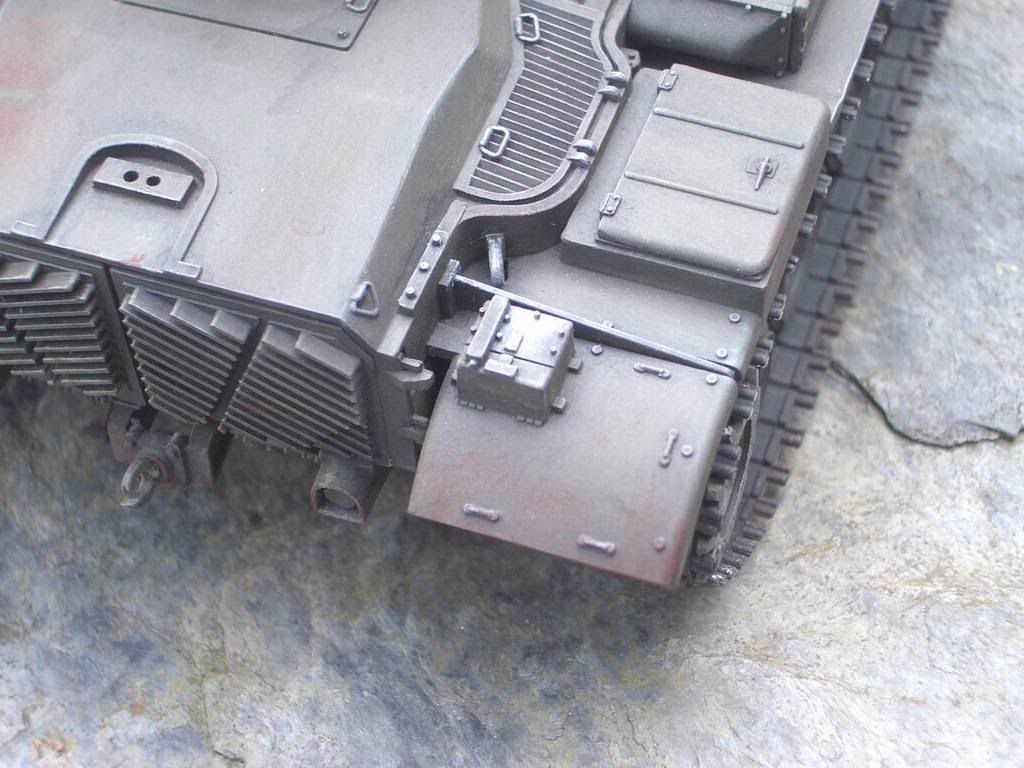
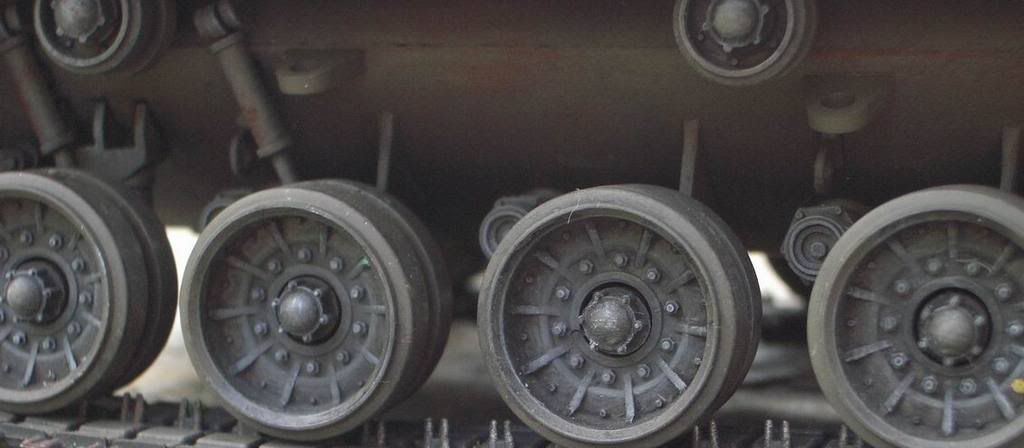
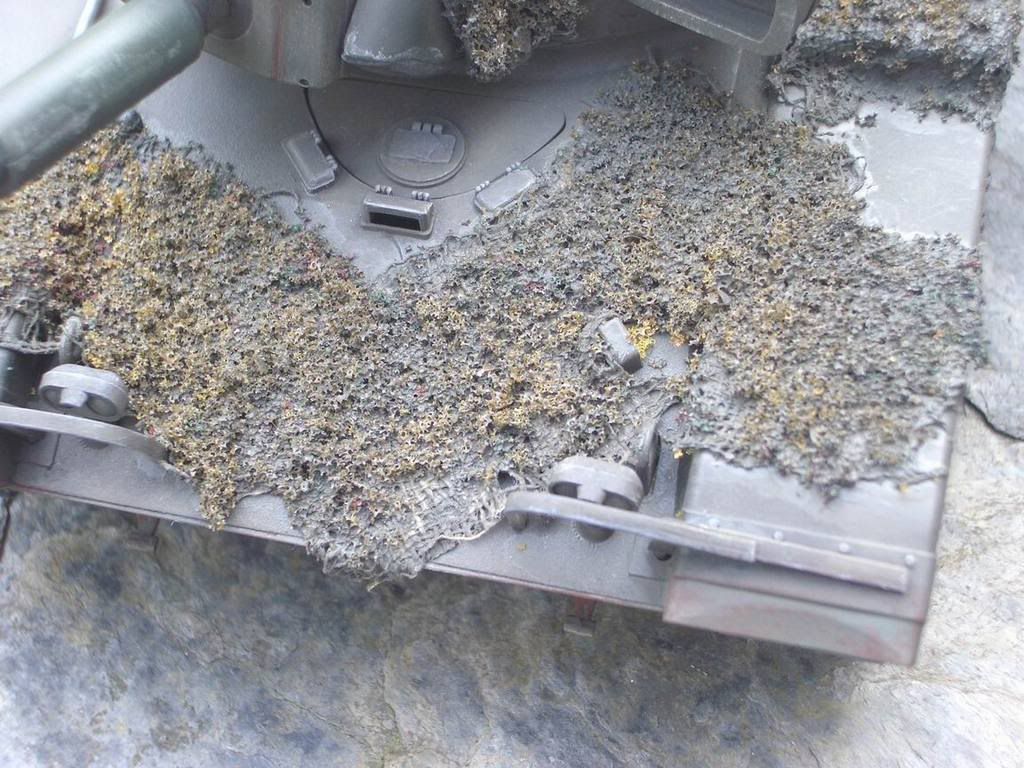
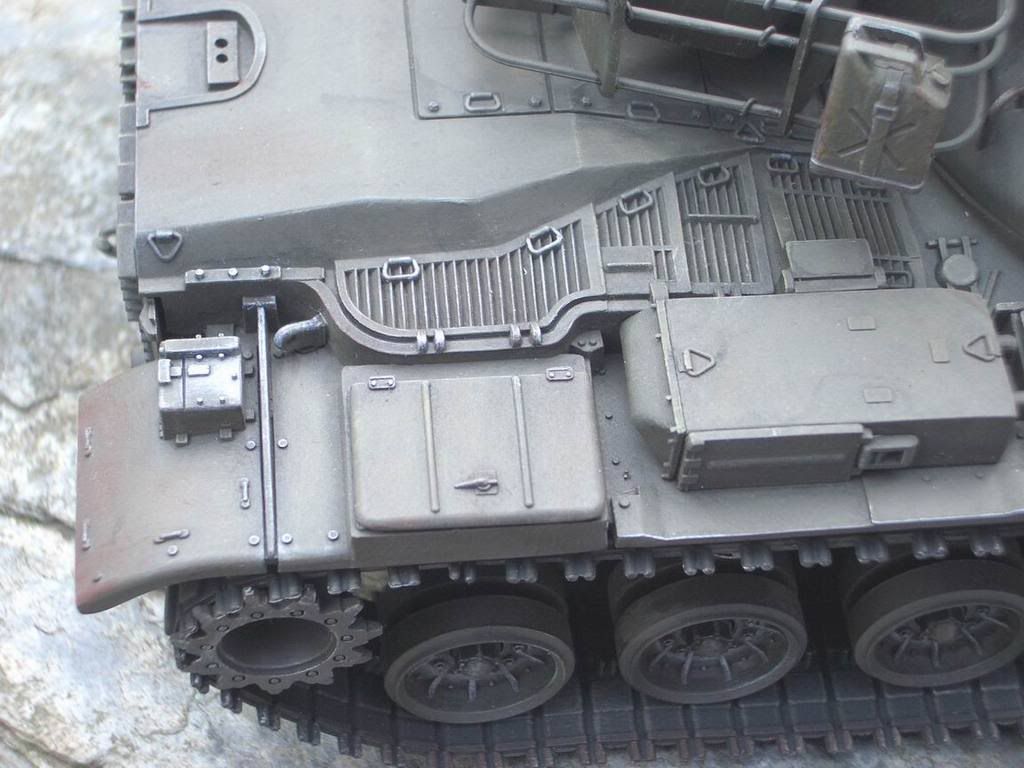
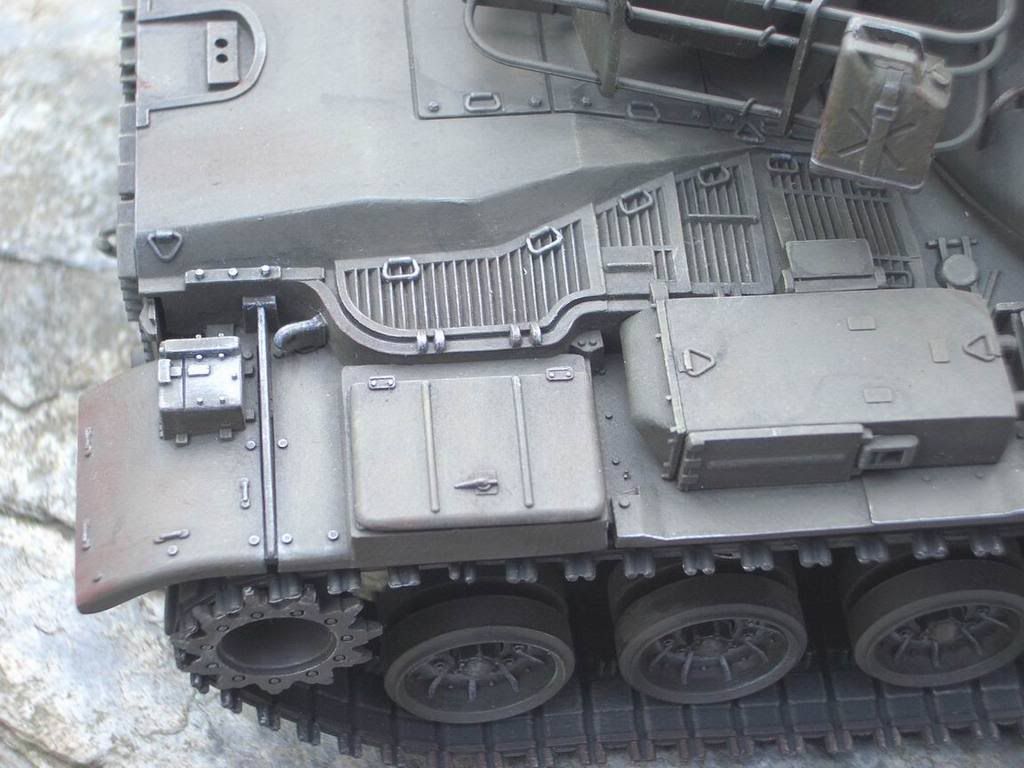
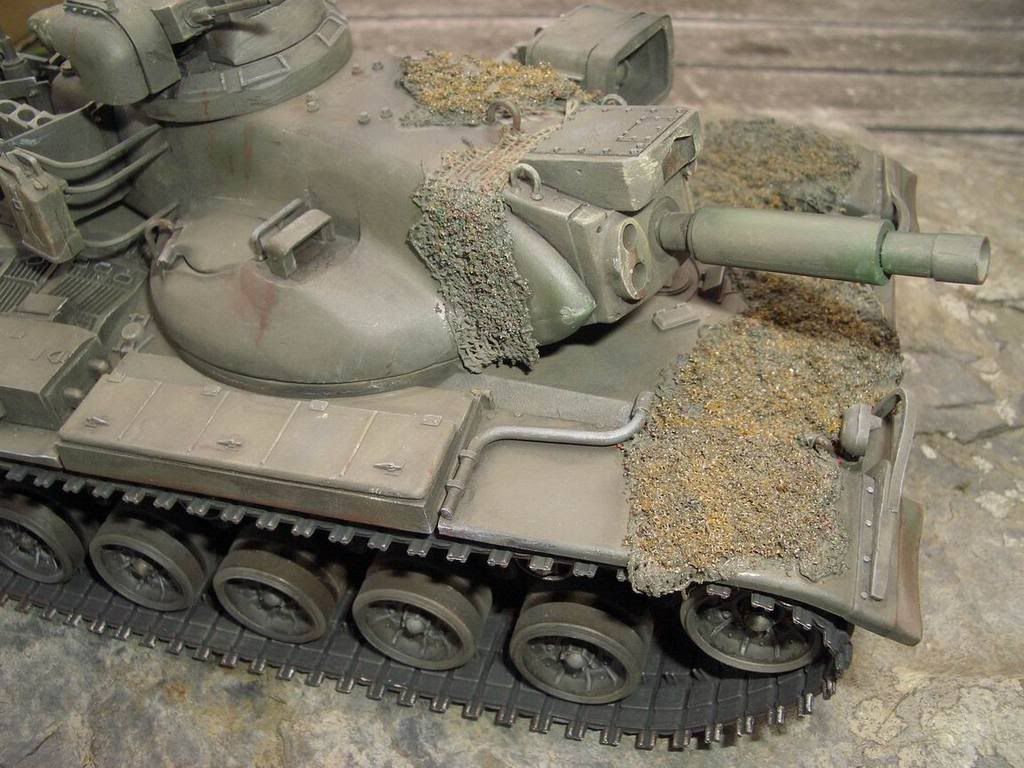
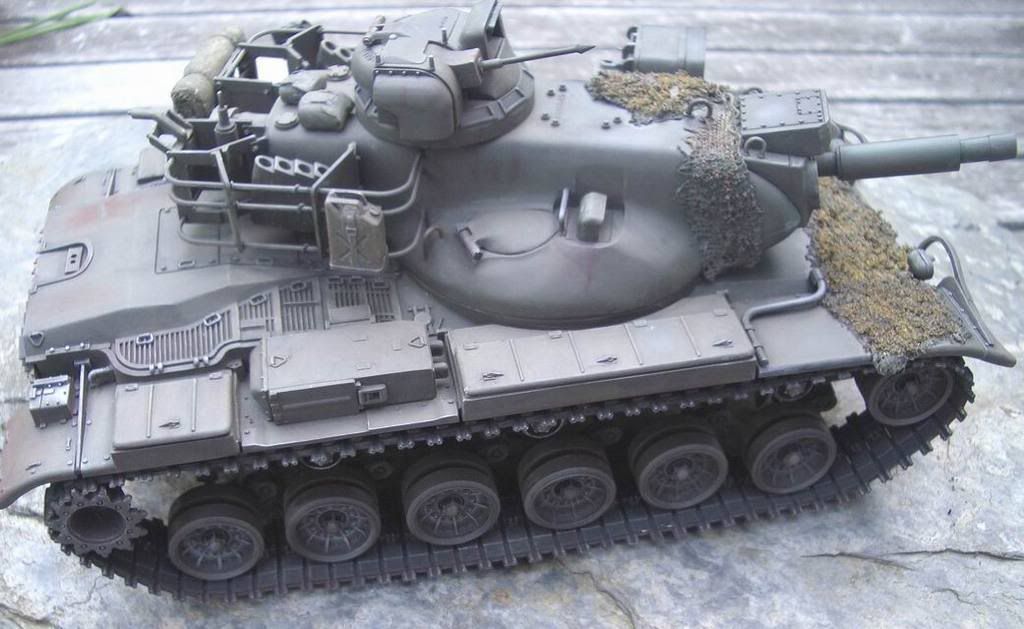
The M60A2, nicknamed the "Starship" due to its space-aged technology, featured an entirely new low-profile turret with a commander's machine-gun cupola on top, giving the commander a good view and field of fire while under armor but spoiling the low profile. It also featured a 152mm caliber main gun similar to that of the M551 Sheridan light tank, which fired regular rounds as well as the Shillelagh anti-tank guided missile (ATGM). There were a number of problems with the new gun (such as unburnt propellant from the missile fouling the barrel and pre-detonating subsequent rounds), most of which were solved to some extent, but after all the problems the A2 model was abandoned and the turret for the A3 would be based on that of the A1. Most of the M60A2 tanks were rebuilt as M60A3, or the hulls converted to Armored Vehicle Launched Bridge vehicles. Source: Wikepedia

Sources:
http://en.wikipedia.org/wiki/Image:M60A2-drives-off-LARC-60-198510513-2.JPG
http://www.primeportal.net/tanks/steve_crockett/m60a2_photos.htm
http://en.wikipedia.org/wiki/M60_Patton
Model: Tamiya M60 A2
Paint: Humbrol. Camo scratch build (gaze, wood glue, etc..)
The Tamiya model and the build have a few issues (explanation thanks to "crockett" on the FineScale forum)
The most glaring issue with all the Tamiya M60 based kits is the suspension. The roadarm index is too high, because the Tamiya people took measurements from a tank that did not have a powerpack, in short the hull needs to sit lower. The second big issue with the A2 is the lack of the "bulged" hull below the rear grille doors. This was a modification to accomodate a compressor and tanks...called the CBSS, or closed breech scavenger system. This system blew compressed air (1500psi) thru the breech and out the tube after every shot, to clear the burnt paper left from the combustible cartridge case on the 152mm ammunition.
Gino (heavy Arty) has built an excellent A2, do a forum search for some views on how he tackled this bulge situation.
The following shold should be done on the model :
Model: Tamiya vehicle with engraved Zimmerit, Verlinden house, scratchbuild nun
Build : Humbrol paint


The Seehund (Sea Dog), was developed in the second part of 1944. It was similar to a normal submarine and designed by the Mariniebaurat Grim in K-Amt.
As from January 1945, the boots operated from Ijmuiden in Holland until the end of the war. One trip took between 5 and 11 days. The boot has a maximum depth range of 30 meters, but during operation a depth of 60 to 70 was being reached.


Operation radius was approx 270 sea-miles. The boot could dive within 2 seconds and could reach 5 meter after 5-6 seconds. The diesel engine could run in emergency case up to a depth of 15-17 meters.
Around 285 ships were manufactured, of which 50 were in operation between February and April 1945 and caused Allied losses up to 90.000 BRT
Crew : 2 persons
Length: 11,86m, Width: 1,68m, Diameter: 1,28m
Armament: two torpedo's G7e
Engine: Diesel 60PS and E-Motor 25PS
Tank : 9,5t Diesel
Model: Seehund, Hecker & Goros
Build : around 1987, Humbrol emaille paint
Diorama : Seehund bunker workplace. I need to re-do all the figures, especailly to correct the eyes !


Model: Tamiya and verlinden
Build : around 1987, Humbrol emaille paint


