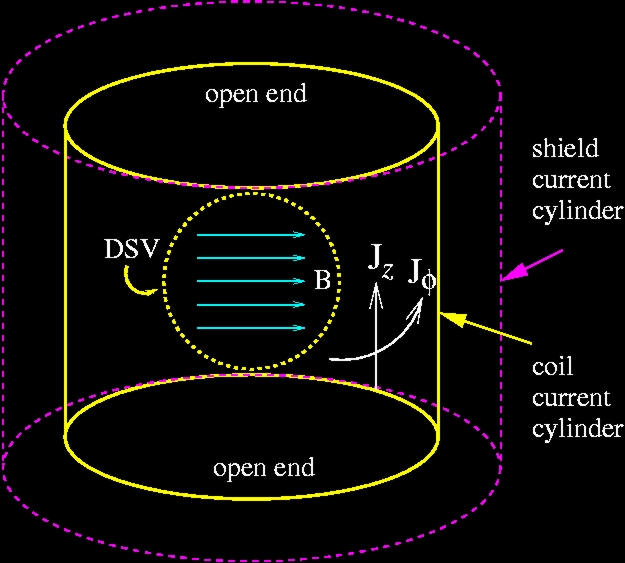
Figure 1 The problem geometry.
Recently quasi-static inverse techniques have successfully lead to RF coils operating at wavelengths considerably larger than device dimensions. However, as MRI technology improves, higher operating frequencies are being used such that the coil structure is an appreciable fraction of the operating wavelength. This means that a full-wave time harmonic analysis becomes necessary to correctly predict current density distributions for a desired geometry and a set of target constraints.
The technique begins with a specified field within a region of a cylinder (see figure 1). The time harmonic Green's function is then used to calculate the current density distribution on a cylinder necessary to generate such a field within the DSV. Shield currents are included to simulate the RF shield that is usually constructed from metal sheets. With the current density known, the stream-function can be calculated and the corresponding conductor patterns found. These patterns are used to design an RF coil that has approximately the same current density distributions as the original theoretical current distribution calculated from the inverse technique.
Figure 1 The problem geometry.
As a test of the methodology, an asymmetric shielded RF
coil was designed to operate at 190MHz with a specified diameter of 20cm
and length of 25cm with a shield 26cm in diameter. Designing the coil with
an asymmetry furthers the work in producing a complete asymmetric system
and is a difficult test for the methodology. The DSV was specified to be
a spherical region with a diameter of 10cm, offset along the z-axis by
2.5cm. The coil was designed for and tested in a Bruker 4.5T narrow-bore
(40cm) MRI machine. The resulting images indicate proof of the methodology.
The design objective was to produce an RF coil 20cm in diameter,
25cm in length with a DSV diameter of 10cm, offset by 2.5cm from the
z = 0 plane. (The z = 0 plane passes half-way along the length of
the coil). The coil was designed at the frequency of 190MHz such that it
could be tested in an available MRI machine.
The preceding technique was used with the constraint that J_z = at z= L/2. This constraint is a factor on how the resulting coil is excited because no current distribution flows out from the edge of the cylinder. Note that the birdcage current distribution can be thought of current flowing out of the ends of the cylinder when the end-rings are discounted.
After obtaining coefficients of the current density, the stream function \chi was calculated. The contours of the stream function \chi for half the coil are shown in figure 2. These are the preliminary patterns for conductor positions.
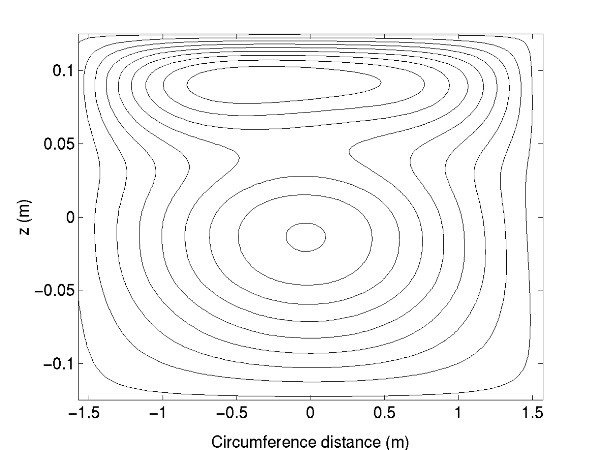
Figure 2 Contour plot of the stream function \chi
The resulting current density was tested using feko , a commercial
method of moments package. The coil current density is approximated by
Hertzian dipoles while the shield current density is ignored. Instead,
a metallic shield approximated by triangles as per the method of moments
is positioned where the shield should be.
The normalized magnetic field of the coil in the tangential plane is shown in figure 3. The field varies within 10% over a distance of 13cm in the x-direction and 12cm in the y-direction. The field variation along the z-axis is shown in figure 4 which shows a 10% variation over a distance of 11cm shifted along the z-axis by 2.5cm. These simulated results generated by Hertzian dipoles approximating coil currents and a metal cylinder for the shield agree with the original field specification and target volume specification in the inverse program.
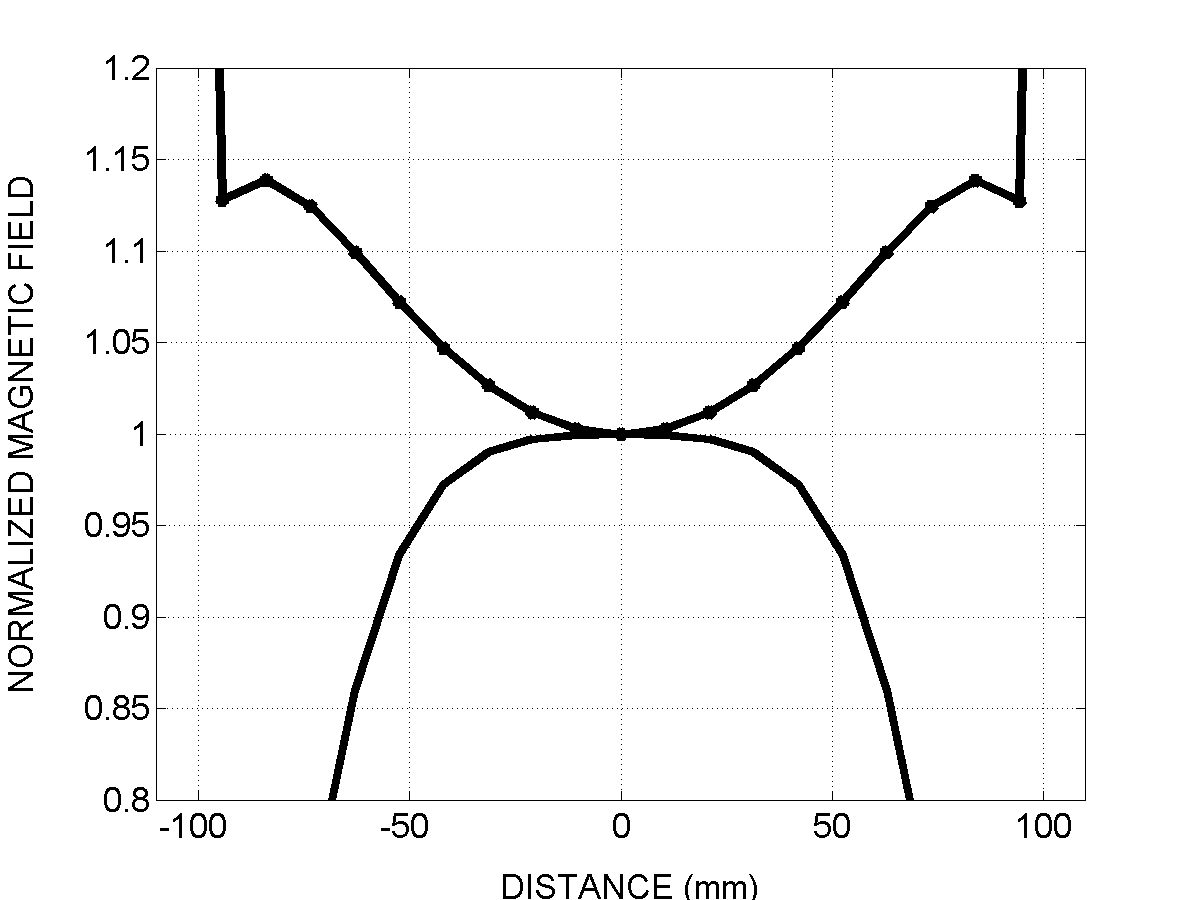
Figure 3 The magnetic field as a function of distance along the x-axis (-o-) and y-axis.
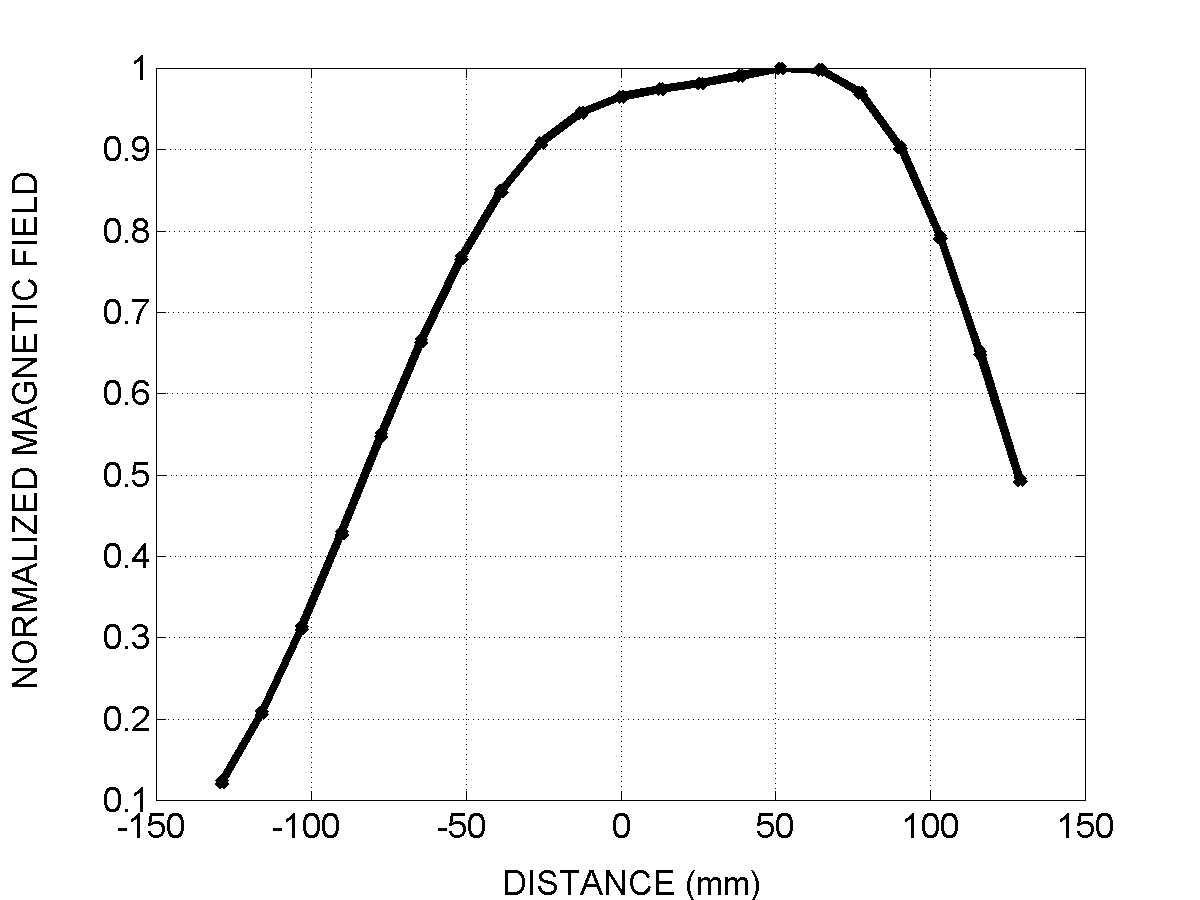
Figure 4 The magnetic field as a function of distance along the z-axis.
The coil patterns are then converted to conductor patterns and simulated in the MoM program . For this case, 2.2mm diameter wires were used for the conducting paths. Lumped elements were added to the model and adjusted such that the current distribution at the resonant frequency of 190MHz approximates the original calculated current distribution. The resulting coil is shown in figure 5.

Figure 5. The resulting RF coil with half the shield removed.
When the coil was constructed, it realized an unloaded Q of 139, measured from the 3dB down power points either side of the resonant frequency. Figure 6 shows one slice in the xy-plane from a spin-echo 3D data set of a rockmelon. The data set matrix was 256x256x32, the field of view was 25x25x16cm, the TR/TE were 350/22ms and 2 averages were acquired. As can be seen, the intensity increases in the x-axis and diminishes in the y-axis as does the simulated field result. The image is uniform within a 10cm DSV as was initially specified.

Figure 6. An MRI image of a rockmelon in the xy plane.
Using specifications such as coil radius and frequency, the current
can be calculated on a cylinder that will generate a specified magnetic
field. The methodology uses the free space time-harmonic Green's function
to calculate the currents on the coil cylinder and shield cylinder. Once
these are known, a stream function technique is used to generate the conductor
patterns. These patterns are then modeled in the method of moments program
and lumped elements are added to adjust the resonant frequency to the specified
frequency of operation. Once the model behaves satisfactory, the design
is then implemented and tested in an MRI machine. A novel asymmetric RF
coil was designed with this methodology and results prove the efficacy
of this procedure.