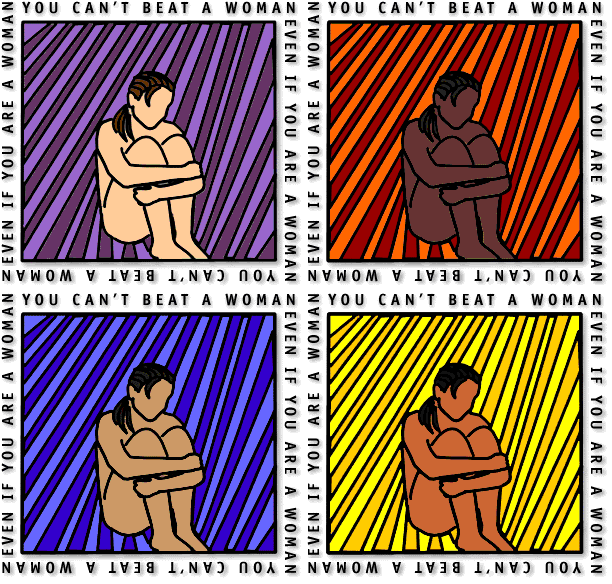
ISSUES ON GAY, LESBIAN AND BISEXUAL DOMESTIC VIOLENCE
Domestic violence is not limited to heterosexual relationships. Battering exists for lesbian, gay and bisexual relationships also.
Battered lesbians and gay men face additional issues such as:
- Accessing the legal system
- They presently do not have access to family court
- They have to face police and judicial biases that exist
- Oftentimes the legal system does not take claims of gay, lesbian and bisexual battering seriously
- Oftentimes service providers are not trained to work with the gay, lesbian and bisexual community
Lesbians face the assumption that if you are hit by a man it somehow hurts you more physically, emotionally and psychologically than if you are hit by a woman.
Lesbians face the assumption that their relationships are egalitarian because they are between women. There is an assumption that there are no power differentials.
When making a report a lesbian, gay man or bisexual person has the added burden of being "outed", the possibility of losing their children, not being treated fairly or believed because of their sexuality, the fear of homophobia from others and the fear of losing family and friends because of their sexuality.
A lesbian, gay man or bisexual may be hesitant to make a report because they fear that their community will be judged when reports are made. They may not report to protect the community.
IS LESBIAN BATTERING THE SAME AS STRAIGHT BATTERING
Similarities:
- No one deserves to be abused.
- Abuse can be physical, sexual, verbal behavior to coerce or humiliate, emotional or psychological.
- Abuse can be lethal.
- The purpose of the abuse is to maintain control and power over one's partner.
- The abused feels isolated, afraid and usually convinced that the abuse was somehow her fault or could have been avoided if only she had known what to do.
Differences:
- Lesbians who have been abused have much more difficulty in finding appropriate support than straight women.
- The myth prevails that lesbian abuse must be "mutual". No one assumes straight abuse is mutual.
- Utilizing existing services is tantamount to 'coming out' and a major decision.
- Support services and friends often minimize lesbian violence for several reasons--because the lesbian community doesn't want to destroy the myth of a 'lesbian utopia', because the battered women's movement doesn't want to destroy their myth of 'all violence is caused by men', because it is easy to fall into the trap of assuming that the size of a person has anything to do with battering.
- To complain about lesbian abuse is to reinforce the stereotype that lesbians are 'sick'. No one would claim straight relationships in general are mentally unhealthy because there is sometimes abuse.
- Lesbians have to face not only the sexist culture, but also a homophobic one as well. A woman of color must face sexism, homophobia, AND racism.
- Lesbian survivors may know few or no other lesbians; leaving the abuser could mean total isolation.
- Lesbians usually aren't as tied financially to their partners as are straight women.
- The lesbian community is small, and in all likelihood everyone the survivor knows will soon know of her abuse.
reproduced from the Minnesota Coalition for Battered Women: Confronting Lesbian Battering Manual.