MEASURE OF A NATION
"Show me the manner in which a nation or country cares
for its dead and I will measure with mathematical exactness the
tender sympathies of it's people, their respect for the laws
of the land and their loyalty to high ideals".
William Gladstone 1809-1898
O how small a portion of earth will hold us when we are dead,
who ambitiously seek after the whole world while we are
living.
Philip II

John Scott
12/6/1797 - 16/4/1877
The Scott Family
of
Delvine.
by Bruce Evans
Reflections
Underneath a gum tree at Delvine Park, midway
between Stratford and Bairnsdale, in East Gippsland, Victoria,
stands the old bullock dray used by John Scott on an epic journey
in 1845 from the Monaro tablelands of southern New South Wales to
the Bairnsdale district. Just to stand and look at it makes one
wonder how he could have brought this vehicle through the rugged
terrain of East Gippsland.
Even today, most of the route that he followed remains
forested and some is officially recognised as pristine
wilderness. A number of people have researched his background to
try to gain an insight into the reasons why he undertook such a
journey.
John Scott and his wife, Margaret, arrived in
Van Diemans Land in 1826, leaving behind in Scotland their infant
daughter Mary, who they were not to see again for 24 years.
During 6 years in Tasmania, Janet, James, Peter, Margaret and
John were born.
The family then moved to New South Wales, about 1834, to a
property near Camden called Denham Court for that is where Daniel
was born in 1835. It is likely they knew James Ruse who died at
Denham Court the same year as Daniel was born. James Ruse, a
convict, claimed to have been the first person in the First Fleet
to set foot in Australia as he carried the first officer ashore
on his back.
A couple of years later, he was awarded the first freehold title
to land in Australia. He was able to prove to Governor Phillip
that he could sustain himself on the land - the authorities in
England having neglected to ensure that the First Fleet included
anyone with knowledge of farming.
Scott was employed at Denham Court by Thomas Valentine
Blomfield who also owned the Coolamatong (Coolamating,
Coormaling) run, about 20 miles south west of Cooma on the banks
of the Snowy River. Scott was sent south during the late
1830's to manage this property.
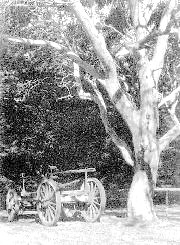
The bullock wagon used by the Scotts in 1845.
No doubt, he gained valuable experience manoeuvring his
bullock dray through rugged, trackless country on this journey of
almost 400 kms. Margaret had to look after six children aged
between 10 and 4 years and probably had to help her husband with
the yoking and unyoking of the team each day. The maximum speed a
bullock dray is likely to reach is about 4 k.p.h.
The bullock team had to be fed and watered, all meals had to
be prepared and shelter had to be erected and dismantled each
day, and there was the fear of attack by aborigines or escaped
convicts turned outlaw. This was a pioneering journey of epic
proportions.
Catherine, Ellen and Agnes, who died as an infant, were born
at Coolamatong.
By the 1840's, the Scotts were surely asking themselves
why they did not claim some land for themselves instead of always
working for someone else. In 1840, a fellow countryman of
Scott's, Angus McMillan, had blazed a trail through the very
rugged country south-west of the Monaro Tablelands discovering a
region he called "Caledonia Australis", later given the
name "Gipps Land".
No doubt, McMillan's enthusiasm for this new country was
conveyed to Scott but he had the problem of moving his large
family over the very difficult terrain that lay between the
Monaro and this newly discovered land. The year, 1845, was the
year of reckoning because the best land was being taken up
rapidly. One choice cattle run remained. Learning that a rival
had already left to claim this block, Scott decided on the
element of surprise and headed south to cross the Snowy River
nearer the coast instead of following the usual route, the one
blazed by McMillan, down the Deddick River and over Black
Mountain. One can only wonder what went through the minds of each
member of the family as they packed their wagon with all their
possessions and with sufficient supplies to get them established
on the property they hoped to acquire.
Janet 18, the eldest of the children born in Australia already
had a two-year-old son, "Jimboy". The others were
James, 17; Peter, 15; Margaret, 13; John, 11; Daniel, 9;
Catherine, 6 and Ellen, 4. The last two were reputed to have
travelled in a kerosene case on each side of a packhorse.
In his book, Providence Ponds, Stanley Porteus wrote that Scott's
rival for the prized block was Raymond. The late Dr. Clive
Disher, the last owner of Strathfieldsaye, who bequeathed the
property to the University of Melbourne, claimed that the prize
property was not Delvine but neighbouring Strathfieldsaye and
that Raymond won the race. In fact, Raymond,
who was a landowner in the Wellington district of New South
Wales, learning of Strzelecki's account of Gipps Land,
set out with a large mob of sheep. Loughnan and Taylor at Monaro
and Frederick Jones at Omeo joined him and the party arrived at
the Mitchell River crossing on June 20 1842. A sketch map
dated 1844, shows that Raymond was already in possession of
the run which he called Strathfieldsaye.
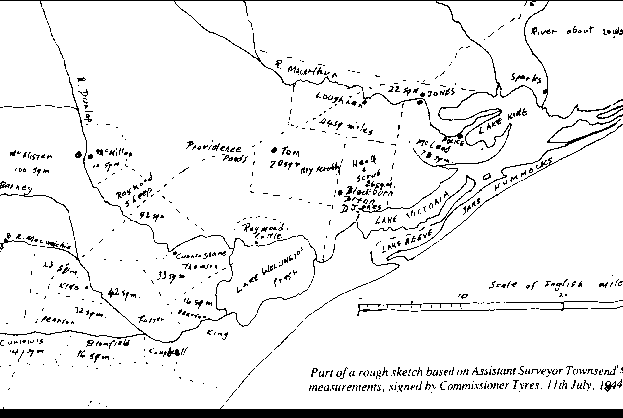
The area of land below the words "Providence Ponds" is the area taken up by John Scott.
It may be that John Scott chose a different route because he
needed a bullock dray to carry the necessities for his family.
The nearly 3,000 feet climb up the steep face of Black Mountain
would have been near impossible with a bullock team.
In any event, the Scotts settled on Tom's Creek and named
the property Delvine after one of the same name at his
birthplace, Caputh, in Scotland. Soon Margaret was pregnant again
but, unfortunately, the infant, died. This created the need for a
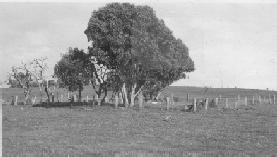
cemetery and a small plot was set aside about 400 yards from the
house. The unnamed infant was the first to be buried there.
Old Delvine Cemetery 1982
Later, Thomas's twin was also buried in the
little cemetery. It was only about seven years later that Margaret too passed
away and was buried at Delvine. In April 1877, 32 years after his epic journey
to occupy the run he called Delvine, John Scott was buried in the little
cemetery on the property.
Names and Places.
Early maps show names given to the rivers by Strzelecki who
travelled through Gippsland only four months after McMillan.
However, it was later decided to use the names given by McMillan.
The names the squatters gave their runs are not shown. North of
the river, Jones gave his run the name Lucknow and to the south
of the river in its lower reaches was McLoud's run,
Bairnsdale. Loughnan and Taylor's run, Lindenow, extended
along the south bank of the river to about Glenaladale and to a
line some 6 miles south. References to Bairnsdale, Lucknow and
Lindenow, prior to about 1860 referred to these runs, not the
communities that now bear the names.
The Electoral Roll prepared for the first election of the
Victorian Parliament in 1856 uses the name of the runs as the
place of abode for the great majority of the approx. 360 men
enrolled for the whole of Gippsland.
In the early 1860's, as the countryside was surveyed and
land was made available for closer settlement, names were needed
for districts and communities that developed. Some adopted the
name of the station from which they grew. The Post Office
Directory for 1868 lists residents of Lindenow Flat and the
surrounding area under Bairnsdale. In the 1884 - 1885 directory,
they were listed under Coongulmerang and Coongulmerang Upper. The
use of the names, Lindenow Flat and Lindenow South may have come
into general use with the advent of the railway in the late
1880's. In more recent years, the name Coongulmerang has
stuck with a small area several miles west of Lindenow and is now
almost redundant although it is the name of the parish. This
means that records mentioning Coongulmerang could be referring to
what is now Lindenow and Lindenow South. The cemetery at Lindenow
South still is known officially as the Coongulmerang
cemetery.
A family reunited......
Once the family had reached its final destination at Delvine,
Mary, the first born journeyed from Scotland to join them. The
infant they left behind in Scotland was a young woman in her
early twenties when the family was reunited. She married Edward
Saunders and after her death in 1889, was buried in Delvine
Cemetery. The inscription on her tombstone, which lies shattered
on the ground, reads;
Trusting in Jesus
Come away for life and thought
Here no longer dwell
But in a city glorious
A great and distant city have brought
A mansion incorruptible
Would she could have stayed with us.
The list of burials in Delvine Cemetery
indicates that the people of the surrounding area looked to the
Scott family for support in times of trouble. Although it was a
private cemetery, it was made available for general use. Margaret, in particular, would have understood the
feelings of the young mothers whose babies and small children are
buried there as she, too, endured the sorrow of losing three
infants. Family members who had moved on to
properties of their own were brought back to Delvine for burial
suggesting that there was a deep attachment to Delvine and what
it represented.
Obituary Gippsland Times 23 April, 1877
SCOTT, John
The late John Scott Sen., of Delvine,
whose decease was notified in our issue of the 18th., was (says
the Courier) a native of Dunkeld, Scotland, was born on the 11th.
of June 1796, and was in his 80th. year when he died. In 1826 he
emigrated to Tasmania, where he followed farming for a period of
six years. He then went to New South Wales as superintendent of
Captain Bloomfield's estate. Some time after, he removed to
Monaro and took full charge of the station known as Coolamating
belonging to Captain Bloomfield, where he remained for about six
years; and when Gippsland was discovered he removed with his
family and took up the station on Tom's Creek, on the 14
July, 1845, which he named Delvine, where he resided until his
death. He had a large family, his sons and daughters being all
present at his death, - his sons, Messrs. James Scott, Fernbank,
and John and Daniel Scott of Delvine, and his daughters, Mesdames
Saunders, Hall, Murphy, and Whitbourne, of Lindenow Flat, and
Mrs. Connolly of Dargo. He has left behind 80 grand and great
grand children. The deceased was a Master Mason in the
Freemason’s Lodge, Scone, Scotland, and was highly
respected by all who knew him
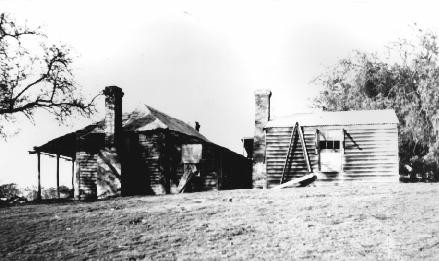
Delvine homestead
In his history of the Shire of Bairnsdale, Path Among The
Years, John Adams wrote
"The Scott family were
anxious to establish a home in Gippsland but the country they
chose was difficult to tame, and they never ran many more than
500 cattle on the area in the 1840's, reaching 1020 cattle in
1856.
John and Margaret Scott were earnest, brave
people whose stories have been told in a fine novel by Professor
Porteus, Providence Ponds.
The novel, though essentially fiction, is a
graphic account of the difficulties of the pioneers and the
hardships they had to face. Scott's determination made
Delvine Station one of of the most enduring in East
Gippsland."
Porteus intended to write an historically
accurate account of the Scott's journey into Gippsland and
visited Australia from his home in Honolulu in 1949 to do
research. He obtained records from the Mitchell library in Sydney
together with diaries and other material that he kept at the home
of Mr. and Mrs. J. R. Whitbourne, where he and his wife made
their base during their stay. Unfortunately, the house was
totally destroyed by fire during their absence and all this
valuable material lost. Despite this setback, he decided that h
should put on record the knowledge he had acquired, partly from
personal contact with his wife's grandmother, Catherine Scott
(Whitbourne, Murphy) and partly from the material he had
researched.
Closer Settlement.
In 1860, the Parliament of the Colony of Victoria passed the
first of a number of Acts to break up the large runs held by the
squatters and made blocks of land available for selection. The
land was made available under an Improvement Purchase Lease,
which required the successful applicants to fence, build a
residence, and to clear portion of their blocks during a
seven-year lease period. If they complied and paid a token rent
over the period, the selector was granted a freehold title.
The rich alluvial land along the Mitchell River, which was part
of the Lindenow run, was made available soon after the Act was
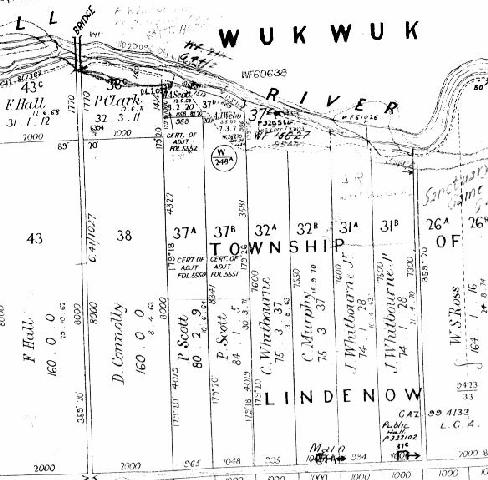
passed. The Parish Map shows how members of the Scott family
selected adjoining blocks. The map of portion of the Parish of
Coongulmerang shows the blocks of F. Hall, Janet's husband;
D. Connolly, Margaret's husband; P. Scott (Peter); C.
Whitbourne, (Catherine); C. Murphy (possibly also Catherine after
her remarriage): and J. Whitbourne, Ellen's husband. On the
other side of W. S. Ross was E. Saunders, Mary's husband.
A tragedy.
In January 1862, the family was shocked by
the untimely death of Catherine's husband, Henry (Tim)
Whitbourne. He was a brother of Peter's wife, Susan and of
Ellen's husband John. They were three of eight children who
had migrated with their parents to Tasmania in 1843. Their
mother, nee Jane Charter, died soon after and their father, John,
married a convict girl, Elizabeth Cross who bore him a further twelve children.
The Gippsland Guardian reported on 10 Jan 1862, that at the
Lucknow Races:-
"Timothy Whitburn
(Henry) was riding round the course with some friends for the
purpose of examining the leaps, when his horse suddenly stumbled
and fell, rolling over his rider, and causing severe concussion
of the brain of the latter. Dr. Simmons was immediately in
attendance, but the latest news I am in possession of says but
little hope is entertained of the unfortunate man's life
being saved."
In the edition of 17 Jan 1862, the Guardian reported
Henry's death.
Whatever happened to Peter Scott?
Mystery surrounds the disappearance of Peter Scott. His
father's death certificate in 1877 records Peter's age as
47 years although he was aged 34 years when he disappeared
suggesting that it was believed at that time he may be still
alive. Further complications arose from a death certificate for
"Phoebe, daughter of Peter Scott and Susan (nee Whitbourne),
born at Lindenow Flat" in 1868.
With the freeing up of access to indexes to
birth, death and marriages and other public documents in recent
years some of the facts have been established. There is no death
certificate for Peter. There was, however an application for
letters of administration for Peter's estate in 1880. Pruned
of its legalistic phraseology, it reads:
"I. Susan Simmons of
Greensborough, wife of James Simmons of the same place, farmer,
make oath and say:
1. That in April 1863, I was
residing and cohabiting with my then husband, Peter Scott of
Delvine, carrier, and had two children issue of my marriage with
Peter Scott who resided with us.
2. Peter Scott was a carrier and
on the first day of April 1864 left Delvine with a team of
bullocks and a dray carrying a load of wheat to Stratford. I am
informed and verily believe that on the third day of that month
he arrived at a place called Longford on his way to Port Albert
and camped near to the hotel there for about two days when he
suddenly disappeared leaving the bullocks and dray outside the
hotel without leaving any person in charge of them
3. Immediately upon the news of
the disappearance having been brought to me at Delvine a search
party consisting of James Scott and John Scott, two brothers of
Peter Scott, J. Scott, a nephew of Peter Scott, John Whitbourne
my brother, F. Hall, J.M. Murphy and Edward Saunders, three of my
brothers-in-law and Mr. Edward Scanlan the Sergeant of Police at
Sale and about twenty others started on horseback from the hotel
at Longford and searched the country for over seven days but no
trace whatever of Peter Scott could be found
4. In the commencement of 1866,
one Norman R. McLeod of Bairnsdale stated that he had seen Peter
Scott in Ballarat and I thereupon obtained from a Justice of the
Peace a warrant for the arrest for deserting me his wife and
family but although the warrant was at once forwarded to Ballarat
for execution no trace whatsoever of Peter Scott could be found
and the warrant still remains in the hands of the Police
unexecuted although photographs of Peter Scott have been sent to
nearly every Police Station in Victoria.
5. Save as aforesaid I have not
nor has any person to my knowledge seen or heard of Peter Scott
since the 5th. day of April, 1864 when he disappeared as
described.
6. At the time of the
disappearance Peter Scott lived and cohabited with me and our
children lived with us on the most friendly and affectionate
terms and on his departure from his home on his journey to Port
Albert he parted from me and bid me and our children
"good-bye" in a most affectionate manner and there was
no disagreement or quarrel or misunderstanding between me and my
husband or any of our children.
7. At the time of the
disappearance Peter Scott possessed considerable personal
property that is to say - cattle, working bullocks, drays,
furniture and other articles all of which he left in my
possession and he was also occupying under residence and
cultivation license from the Board of Land and Works one hundred
and sixty acres of land at Coongulmerang to the Crown Grant of
which Peter Scott if alive would be entitled.
8. That I am seeking to obtain
letters of administration to the estate of the above named
deceased
9. That the deceased left him
surviving myself this deponent the widow of the deceased and one
son Henry Scott and one daughter Margaret and a posthumous
daughter Peteretta was born about eight months after his
disappearance who are his only surviving next of kin entitled by
law to share in his property.
10. That I am the widow of the
said deceased and am as I am informed and believe entitled to
take out letters of administration to his estate and
effects.
11. That I have made careful
enquiry and search but am unable to find any will
12. That Peter Scott left
personal property to the value of pound;100 and real property not
exceeding value the sum of pound 400.
This affidavit was supported by one from James Scott and one
from James Simmons in which he describes himself as the husband
of Susan. The mystery still remains of Phoebe whose wedding and
death certificate state that she was a daughter of Peter and
Susan. In fact she was born some four years after Peter's
disappearance. Susan makes no mention of her in her declaration
of 1880.
Neither Henry Whitbourne nor Peter Scott had
fulfilled the requirements for obtaining the freehold of their
blocks. Their widows were left with very small children. The
plight of Susan was sad indeed. She could not prove that her
husband was dead and had to contend with all the complications
arising from his disappearance.
The mystery of what really happened to Peter
Scott still remains.
Research....
These are illustrations of the kind of interesting information
that can be found through research at the Public Records Office
or though Family History associations. Some people may feel that
they are facts which should remain buried but there is probably a
greater interest in family history than ever before and
governments all around the world are facilitating access to the
large amount of information which is in public records. It is
this kind of material that establishes a culture of our own.
Delvine cemetery is part of the heritage of Gippsland, which we
must preserve for generations of Scott descendants to come.
....by yon bonny banks.
In 1990, Lois Banks, great grand daughter of Catherine Scott,
researched family history in Scotland. With her son, Michael,
Lois spent three days searching records held in the General
Register Office, Edinburgh, Scotland.
They obtained copies of-
1 Birth extract of James Scott, son of James of the Boat of
Caputh - 26th February 1764
2 Marriage extract of James to Margaret Forbes - 26th April
1790
3 Birth extract of their son John Scott at the Boat of Caputh
- 12 June 1797
4 Marriage extract of John Scott {Innkeeper} and Margaret
Richardson at Perth, Scotland, 2nd. November, 1825.
Lois was also
armed with a sketch of a gravestone that had been in her family since the
1930's.
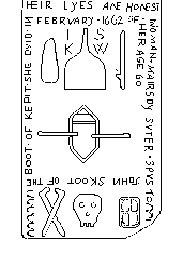
This sketch was reputed to have some family
connection. After much research, they found the same drawing in a
book, "Gravestones in Scotland" together with
directions on how to find it, in this case, the name of the
village, the graveyard and its location in the graveyard. The
inscription inscribed clockwise on the stone reads, in modern
English, "Here lies an honest woman Mary Suter Spouse to
John Scott of the boat of Caputh She died in February 1662 of her
age 60".
With her cousin, Mary MacInnes, who at that
time was residing in Scotland, and her three children, Lois
traveled to Caputh and found the stone, now incorporated in a
wall around the graveyard. It is very worn and hard to decipher
but unmistakable as the subject of the sketch. The spelling of
the name varied over time from Scoot, Skoot, Scot to
Scott.
It appears that for many generations, the
Scott family lived on the banks of the Tay River in Scotland and
operated a rowing boat as a ferry across the river. Like the
great majority of early settlers, their families had probably
never owned land and migration to a new country was the only way
their hopes to do so could be achieved.

The Ferry on the River Tay - from a painting.
Public Service.
A number of Scott descendants have served terms as Councillors
of the Shire of Bairnsdale. Daniel Scott was Shire President in
1880-81, and 1893-94. Thomas William Murphy was Shire President
in 1916-17, 1924-25, 1932-33, 1936-37 and 1941-42. Maxwell Joseph
Evans was Shire President in 1970-71 and 1975-76. Robert Hine was
Shire President in 1980-81. Graeme Bruce Evans was Shire
President in 1984-85.
State Parliament...
Bruce James Evans represented Gippsland East in the
Legislative Assembly from 1961 to 1992, successfully contesting
ten elections. For several years, he was "Father of the
House" and the second longest sitting Member in any
Parliament in Australia. He attended three Constitutional
Conventions representing the Victorian Parliament.
...and a State of the Union.
The following article appeared in a Hawaiian newspaper.
"Hebden Porteus
D. Hebden Porteus' last major
political act was to run for governor in 1970. He lost a bruising
Republican Primary to Samuel P. King, now a Federal Judge.
That contentious election was far
from typical of Porteus' three decades of political life as a
territorial and state legislator.
Urbane, coolly patrician in
appearance, Porteus was a man of firmly held political beliefs
that never got in the way of the larger mission of public
service. The best testament to that can be found in the years
when Porteus, by rights, should have been out of the sphere of
political influence.
When the Republicans dominated the
territorial Legislature in the 1940s and early
1950s, Hebden Porteus was a leader and key
policymaker.
But then in 1954, the Democrats took over
and Porteus, fortunate to hold on to his legislative seat, should
have moved to the back bench. Yet he remained an active player,
respected for his experience and relied on for his
advice.
In 1968, Porteus was elected to a
Constitutional Convention dominated by Democrats and was chosen
president. All factions in that convention recognized that
Porteus would lead with fairness and wisdom. He did.
Hebden Porteus' career spanned decades
of political change in Hawaii and never failed to leave its
mark.
An editorial about Porteus following that
1968 Constitutional Convention was headlined: :An Excellent
Servant."
No more need be said."