
Title Page
Table of Contents
References
Us & Them
by Team Horizon
Nobody has been able to prove that aliens exist for sure or that they have came to earth. Some people believe that they have had alien encounters and have seen flying spaceships. Most people think they are just a hoax, but there are some government agencies and trained professionals who go deep down to find out if these are U.F.O. sightings. The most well known alien sighting was in Roswell, New Mexico. The whole town supposedly saw a spaceship fly right over the city on many occasions, and also saw it land in the desert fifty years ago. Because of this, the town has become a true tourist attraction. I think that what people believe alien encounters to be is quite false. Alien encounters could be anything from seeing an alien from far, seeing a spaceship, or even just an alien trying to communicate with a human. People on earth have created a stereotype that aliens are only here to take over the world and only want to probe us. To some people, such destructive experiences are encounters. In Roswell, New Mexico, the UFO sightings were so popular they created a UFO festival. This goes to show that maybe people aren�t so scared of alien encounters and that events like festivals can be a very positive thing in for humans and all of mankind.
M.H.
Humans by nature learn and grow from one another. Assimilation of ideas and practices among the earth�s people today is a familiar and seemingly inevitable phenomenon. There was a time when humanity was more distant, separate cultures developed in relative isolation. And so science developed along various paths due to its cultural setting. �Geography isolated China from outside influences more than any other Old World civilization.� (McClellan & Dorn, 1999, p. 117) �Chinese �modes of thought� may have proved inimical to logical, objective scientific reasoning of the sort that developed in the West. � This style of thinking, it is said, strove to interpret the world in terms of analogies and metaphorical systems of paired correspondences between diverse things.� (McClellan & Dorn, 1999, p. 138) The Greeks, not so very far away developed a distinctly different way of explaining the world with their logic-based study of nature.
Knowing this, it is hard to imagine what an alien species developing on another planet might accomplish scientifically, technologically and culturally. By the same token, there are many similarities in the development of science among the pristine civilizations across the globe, as outlined in the section �Thinking and Doing among the World�s Peoples� in Science and Technology in World History (McClellan & Dorn, 1999, p. 99-176). Today, with a relative level of homogeny among the planet�s cultural and scientific achievements, the universe at large seems to be the setting for isolated cultural and scientific growth, among galactic races. One can only contemplate the impact of contact between humans and our distant neighbors, with regards to scientific achievement.
T.T.
People�s perception of physical reality has gone through innumerable changes during our evolution. Nations believed everything from the earth is flat like a table top, to a continent is a gigantic turtle in a great pond. �Heraclides of Pontus (fl. 330 B.C.) suggested that the apparent daily circling of the heavens could be accounted for by assuming that the heavens remained stationary as the earth spun on its axis once a day. The suggestion was generally considered implausible since it seemingly contradicted the direct sensory evidence that the earth is stationary.� (McClellan & Dorn, 1999, p. 82)
Most people are unwilling and slow to accept ways of perceiving that are new to them. Today the majority of the human population still maintains religious beliefs that are at the core of their perception of the world. Whether religious or not, people�s beliefs regarding the world around us, the cosmos and the purpose and boundaries of life itself, influence and shape their perceptions of reality.
With all of this in mind, imagine 2 races, alien to one another, coming in contact for the first time. With so many potential differences, including sensory organs, sense of space, elements, and dimensions, one or both parties could potentially be ignorant of the other�s sense of reality.
T.T.
Warning: The following does not reflect any personal beliefs about God. These are meant to be amusing; please do not take them seriously. J
It would seem that we have been interested in the aspect of aliens for quite some time. But how far back do these thoughts go?
In all religions there are stories of miracles, and heavenly beings. Could these stories simply stem from encounters with extraterrestrials? There is no way to find out for sure, but the speculation is fun none the less. With mysteries like Stonehenge and the Pyramids, which leave us wondering how they could have been built by mere humans, we look to the stars for answers. The following are some interesting ideas about this topic found on the Internet.
"Researchers believe the ancient mythical �gods� of our inherited legends, were not merely products of superstitious primitive minds, but were real flesh and blood visitors to Earth, whose �miracles� would surely have inspired awe in our ancient relatives. To witness 'flying craft', and technology which allowed the "Gods" to transform matter, would undoubtedly make these visitors worthy of respect! The "Gods" were both revered, and feared for such feats as their well-documented endeavors at 'genetic engineering'. Was their DNA technology responsible for what transpired in the Genesis "Garden of Eden"? Were we created by these beings? Could their escapades in DNA technology explain the missing 'X' factor involved in human evolution, which has eluded scientists for so long? Is seems entirely possible, we 'got it all wrong' right from the start!" (Timms)
(For interpretation see drawing 1 below)
Without trying to force any religious morals or go against any, could the magical, god-like beings from above that we have been worshiping been nothing more than visitors from another planet?
"If these really are aliens visiting us, they are goofy aliens. I'm not sure we have much to fear or much to learn from a culture that travels light years across the galaxy just to mess up our wheat fields and abduct guys named Bubba from Mississippi swamp lands. And if they are going to abduct people like this, why do they give them back?"
"And what is the deal with �crashed UFOs�? They somehow negotiated the cosmos only to be felled by a tricky cross wind in New Mexico? Where did they learn to drive? Utah?"(Anonymous, 1997)
I thought this to be a little thought provoking. If aliens are so smart, why do they do weird and useless things? If the roles were reversed would we do things differently?
I think there would be a difference if we were exploring space. It might be because all beings of this earth and maybe other planets, except humans, don�t have morals. We do. We know there are things one should and should not do, but in nature these morals do not exist.
Erich Von Daniken
"While working there, he began to write his first book, but he felt that he needed to see the sites about which he was writing, so he used 400,000 Swiss francs from the hotel to finance his travels to Egypt, Lebanon and North and South America. His first book entitled Chariots of the Gods?, was about Erich's theories that the �chariots� were actually flying saucers belonging to extraterrestrials."
"Erich felt that the Bible was full of references to flying saucers and that the God referred to in the Bible was an alien being. Chariots of the Gods? was all about his alien theories. In his book, he quoted parts of the Bible, although some of these were not correctly quoted. This book was published in 1967."
"One of his theories involved the Ark of the Covenant. In his book, Signs of the Gods, he questions what kind of object the ark really was. He points out that theologians not only disagree on the measurements of the ark, but also as to what it was used for. Erich suggests that the Ark of the Covenant was actually a container to hold a machine given to Moses by aliens. He further suggests that the machine stored up water from the night dew, then green algae (Chlorella) was added, and manna came out of the machine. The reaction for forming the manna was radiation. He says that this machine was a miniature nuclear reactor." (Von Daniken, 1994)
(See drawing 3 below)
This might be the reason why no can find this artifact any longer. The owners took it back.
In conclusion, would we as a species ever have thought of some of our earliest technological advances by ourselves, or were we inspired by things we have seen in the past?
A.T.
Warning: The following does not reflect any personal beliefs about God. These are meant to be amusing; please do not take them seriously. J
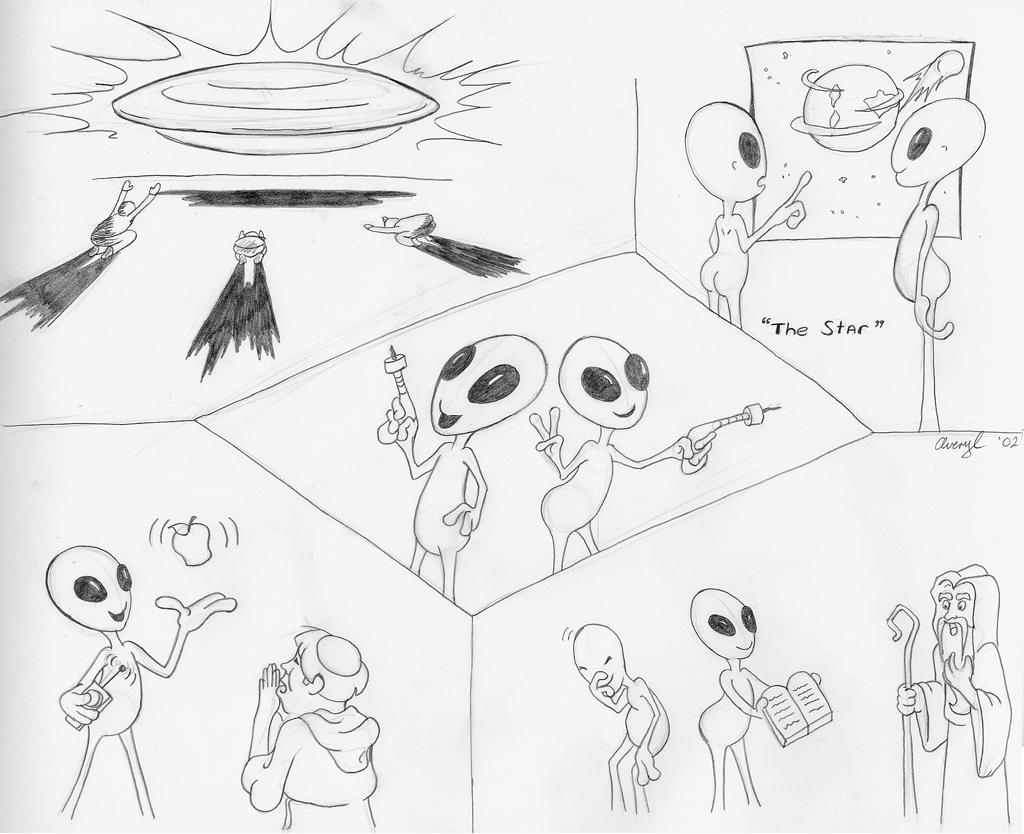

See legend for numbers.
A.T.
There are different ways we could meet aliens. They might come to earth, we might go to their planet and discover them, or we might meet somewhere in between. Another possibility is that we might be in radio contact (or some form of communication) with them long before we meet. Our long-distance communications technology can certainly travel farther than our manned spacecraft.
When we first meet people who speak a different language, we first have to learn to communicate. In A Martian Odyssey, Jarvis met a Martian. He tried to communicate with it by saying words and pointing to objects. He soon found that Tweel did not use the same word every time he described something. �We just couldn�t connect. I tried �rock,� and I tried �star,� and �tree,� and �fire,� and Lord knows what else, and try as I would, I couldn�t get a single word! Nothing was the same for two successive minutes�� (Weinbaum, 1934, p. 561) Maybe we will encounter some aliens like Tweel. Languages can be very different in the way they are used. Who knows, maybe some aliens don�t speak at all, but use sign language instead. We would need linguists and behavioural experts on the team that greets the aliens.
Once we are used to associating openly with aliens, there is still the possibility of meeting more aliens. We may have already formed alliances (or conflicts) with the first aliens we met. We would have to consider bringing the new aliens into our alliance, or try to avoid starting another conflict.
It has almost become a clich� in movies that aliens are warlike and we will have to fight them. We should not ignore this possibility. Humans have a great history of wars. If we have to fight aliens, there is no doubt that we will find ways to fight them. We are very innovative, and war is one of the biggest incentives that drive us to scientific discoveries. Arms races were happening in the fifteenth century, and earlier. �Probably because they became engaged in a more intense cycle of competition, European military engineers and foundrymen actively developed the technologies of cannon-making, and with a superiority of gun design, Europeans soon surpassed their Asian counterparts from whom they initially learned the technology.� (McClellan/Dorn, 1999, p. 194) With modern-day technology, the wars only become more technologically based. �The development and use of the atomic bomb by the United States during World War II marks a watershed in the history of modern science and technology.� (McClellan/Dorn, 1999, p. 360)
There may be times when it is necessary to refrain from making first contact with a species. If we have been observing a culture for some time, we may know a fair bit about their culture. If we discover a culture that has not even reached its industrial stage, we should consider leaving them in peace (Star Trek: First Contact, 1997). Imagine what a cultural shock it would have been for aliens to come to Earth in 500 B.C. Or 1750. Or even now!
It is also possible that we will never encounter aliens. We may travel to other planets, only to find that there is no life. Or we might find the remains of a civilization. In The Sentinel, there was life on the moon before there was life on Earth. �When life was beginning on Earth, it was already dying [on the moon].� (Clarke, 1951, p. 746)
I hope that when and if we meet some aliens that our civilization will be ready to accept it.
B.G.M.
From Invasion
"You came to invade Earth!" the mayor cried, almost beside himself with rage. "You came to make war! You came to kill and maim and destroy!"
Bowers� face turned savage. "Maybe I'm crazy to act as if you really could be from Mars! But I'd rather be crazy than dead."
"I am really from Mars," the youth said. "But you are putting words into my mouth. Why should I come to kill and maim? Am I not a man like yourself? Surely we have much in common. Surely only a wild beast would repay friendship with destruction."
�Friendship! You expect me to believe you came in friendship?"
"How could you believe otherwise?" the youth asked.
"Don't think you can disarm me with your talk!� Bowers cried, his face purpling. "I don't know what kind of trick you're pulling, but it won't work! Do you hear? It will get you nowhere!"
�
"All right now! Get moving!"
"I'm sorry, but I shall stay here with my friends!" the youth said.
�Ah!"
"I'm staying here. You had better go. If you only want to hurt people, Mayor Bowers, we can never be friends!"
Mayor Bowers squeezed the trigger of the rifle. The weapon leapt, roared.
The stranger fell forward to the floor. His right arm went spinning off. His head fell back, began to rock. His right eye rolled out on the floor. Wheels, cogs and gears spurted from his chest in a metallic shower. There was a great yawning hole in his chest.
...
Mayor Bowers stood blinking stupidly, too appalled to make a sound. But Tommy ran with a shriek to the shattered, crumpled form on the floor.
"You've killed him!" he sobbed, tears streaming down his face. "You've killed him! You've killed him!"
�
The voice seemed to be in the room, and yet to come from a great distance. Perhaps it was not an actual voice.
"This is but one of many cautious experiments we have been conducting all over Earth to determine the real nature of your intelligence and emotional equipment. We constructed an automaton in the likeness of yourselves, friendly and without guile.�
...
�He was like you and yet how quickly he was destroyed! ... We are not like you at all and if we showed ourselves to you as we are � do you not see? If you treat your own kind as you treated him how would you treat another type of life, completely alien to you?�
�
�We came in friendliness, bearing a gift well within our power to bestow. But that gift we must withhold.
�
�You will never know that you might have had � immortality under the stars!" (Long, 1950, pp. 726-727)
From A Princess of Mars
�[He] threw down his spear and small arms, and came around the end of the incubator toward me, entirely unarmed and naked as I, except for the ornaments strapped upon his head, limbs and breast.
When he was within about fifty feet of me he unclasped an enormous metal armlet, and holding it toward me in the open palm of his hand, addressed me in a clear, resonant voice, but in a language, it is needless to say, I could not understand. He then stopped as though waiting for my reply, pricking up his antennae-like ears and cocking his strange-looking eyes still further toward me.
As the silence became painful I concluded to hazard a little conversation on my own part, as I had guessed that he was making overtures of peace. The throwing down of his weapons and withdrawing of his troop before his advance toward me would have signified a peaceful mission anywhere on Earth, so why not, then, on Mars!
Placing my hand over my heart I bowed low to the Martian and explained to him that while I did not understand his language, his actions spoke for the peace and friendship that at the present moment were most dear to my heart. Of course I might have been a babbling brook for all the intelligence my speech carried to him, but he understood the action with which I immediately followed my words.
Stretching my hand toward him, I advanced and took the armlet from his open palm, clasping it about my arm above the elbow; smiled at him and stood waiting. His wide mouth spread into an answering smile, and locking one of his intermediary arms in mine we turned and walked back toward his mount.� (Burroughs, 1912, pp. 402-403)
From The Conquest of Gola
On recognizing our visitors for what they were, simple-minded males, Geble was chagrined at them for taking up her time, but they were strangers to our world and we Golans are always courteous. Geble began of course to try to communicate by thought transference, but strangely enough the fellows below did not catch a single thought. Instead, entirely unaware of Geble's overture to friendship, the leader commenced to speak to her in most outlandish manner, contorting the red lips of his mouth into various uncouth shapes and making sounds that fell upon our hearing so unpleasantly that we immediately closed our senses to them. (Stone, 1931, p. 518)
Geble caused to be brought her three of the ancient mechanical thought transformers... The two men were directed to place them on their heads while she donned the third. When this was done she ordered the creatures to depart immediately from Gola, telling them that she was tired of their play.
�
"We have no wish to leave your world as yet," the two had argued.
"You are disrupting the routine of our lives here," Geble told them, "and now that you've seen all that you can there is no need for you to stay longer. I insist that you leave immediately."
I saw one of the men smile, and thereupon he was the one who did all the talking�
"Listen here," he laughed, "I don't get the hang of you people at all. We came to Gola (here he used some outlandish name of his own, but I use our name of course) with the express purpose of exploration and exploitation. We come as friends. (Stone, 1931, p. 520-521)
T.T.
Is what we have imagined about an alien invasion for decades what really would happen? Can we really make statements about a life form that we have never met? Can we determine what the aliens will look like, or what their views will be on our planet? No matter what the mind thinks up, we will never know the truth until we meet another life form. Until that happens our imagination will have to do:
"The aliens are not quite human, but they do display humanoid characteristics. They claim to have come from a distant base to welcome Earth into what they call their united galaxy.� (Williamson, 1998, p. 1118)
"The changes may seem difficult at first, but they've come to save us from ourselves [the human race]." (Williamson, 1998, p. 1118)
"Our surveyors have found your planet utterly dysfunctional. You suffer from genocidal warfare. Terrorism unrestrained. Economic breakdowns. Famines and diseases. You've abandoned your religions and forgotten your ethics. You've lost faith even in your own primitive technologies. You've fallen close to race suicide." (Williamson, 1998, p. 1120)
"The Su'kyan carry malignant viruses and bacteria they've picked up on a hundred planets. Harmless to them, because they've developed immunities and vaccines. It's their nanoform vaccigenes that give us the golden tint." (Williamson, 1998, p. 1121)
The imagination is a great thing that the human mind can produce, but will these ideas that we have thought up in our heads appear in ten or a hundred years? Who's to know but the lucky people that will live on Earth at that moment? But will these humans be �lucky� to witness the first alien invasion or wish that they had never heard about other life forms?
D.B.
I�m sure everyone who has ever watched a science fiction movie involving aliens has witnessed an alien invasion. This is a pretty common topic when it comes to sci-fi. Usually, the "stereotype" for this type of film is a bunch of weird looking creatures from Mars that come down to earth speaking another language and try to take over the world by either destroying everything in sight or taking over political places. I think that if such a thing were to really happen, there would be many different possibilities. One possibility could be that the aliens would destroy every single life form on earth to start their own planet or colony. Another possibility is perhaps aliens wouldn�t come to earth to overtake us, but would simply try to live right beside us, adopting our behaviours, our everyday habits, and everything else that we do. That would be an amazing experience and they would learn just as much from us as we would from them. Also a possibility, and I�m sure everyone has heard about, is probing. We've all heard of it in movies or somewhere on the Discovery Channel. Nobody really knows if aliens really do probe. For me, when I hear the word probing, I think of aliens digging through our skull and analyzing our brains to fully understand how we think and how the human brain works, since it is the most important part of the human body. The possibilities are endless when it comes to alien coming to planet earth and just about anything could happen. One could sit here all day and think up of wild and fascinating stories related to this topic.
M.H.
The physical appearance of an alien life form has boggled the human mind for many years. The age old question, �Do aliens exist?� over the years, has become just a matter of time before we experience their presence. And when these life forms do travel to our earth or we to theirs what is it that the eye will see? Will we see what has been displayed through many science fiction movies concerning alien invasion? Where aliens have thin bodies, huge eyes that move independently from their head, and odd skin color. But who is to say that they will not look just like us, but maybe with different views of what is normal, what they feel is beautiful:
�But how envious they must have been of our beautiful golden coats, our movable eyes, our power to scent, hear and touch with any part of the body, to absorb food and drink through and part of the body�� (Stone, 1931, p. 518)
This reveals that even though, to us, their bodies sound foreign and ugly, to them their bodies are works of art and extremely efficient. Their appearance might seem normal to them as ours to us, but when two different life forms meet the perception that each other receive is totally different:
��coppery hue of his flesh that was not unlike that of an American Indian. His chest and shoulders seemed abnormally developed, his limbs and features extremely slender in proportion.� (Harris, 1927, p. 502)
This is a response of a human to an alien creature, which reveals that any difference in the body form is received as foreign. Humans over many years have always been comparing our �perfect bodies� to other life forms on this planet and what might also lie out there. But what happens when aliens do travel to our earth and we see them for the first time? Will we shy away from their foreign bodies, or will we learn to accept them. When the time comes that an alien life forms walks on this earth, will we be shocked at their physical appearance or just surprised that what we have pictured for decades is not at all the truth?
D.B.
Here are a few good passages that show different types of alien births.
From A princess of Mars
"Five or six had already hatched and the grotesque caricatures which sat blinking in the sunlight were enough to cause me to doubt my sanity. They seemed mostly head with little scrawny bodies, long necks and six legs� Their eyes were set at the extreme sides of their heads a trifle above the center and protruded in such a manner that they could be directed either forward or back and also independently of each other�"( Burroughs, 1912, p. 400)
From Bloodchild
"His body convulsed with the first cut. He almost tore himself away from me. The sounds he made... I had never heard such sounds come from anything human. T'Gatoi seemed to pay no attention as she lengthened and deepened the cut, now and then pausing to lick away the blood. His blood vessels contracted, reacting to the chemistry of her saliva, and the bleeding slowed.�
�She found the first grub. It was fat and deep red with his blood � both inside and out. It had already eaten its own egg case, but apparently had not yet begun to eat its host.�
�It was limbless and boneless at this stage, perhaps fifteen centimeters long and two thick, blind and slimy with blood."(Butler, 1984, p. 1041)
T.T.
We have enough trouble accepting other races and cultures within our own species. Imagine how much bias and controversy there would be if we tried to make peace with aliens! All the cultural problems we are used to seeing here on earth would be magnified. Even just a simple greeting could be difficult. Humans have so many cultures as it is; we have different customs for greeting someone (e.g. shaking hands, bowing). The people who make first contact with aliens would have to be extremely tolerant of strange customs, and so would the aliens. Even once we get to know each other�s languages, there is still the difficulty of saying something wrong that you didn�t realize means something other than what is in the dictionary. There is also the possibility that we might accidentally offend someone. For example, in some cultures, it may not be a compliment to tell someone that they have nice hair. Who knows, maybe aliens might be embarrassed if they even have hair. Table manners would be especially difficult. What do aliens eat? Even once we�ve figured out what to feed them, we�ll have to be careful of our mannerisms. For example, in some cultures, everyone waits until the host has started to eat before they begin. Other cultures may find it offensive to wait at all, thinking that we are afraid to eat their food. If we met in space, our cultural differences would not be so obvious. A spaceship is usually designed with one purpose in mind: spaceflight. The cultural differences would not become evident until we actually visited each other�s planets. But then, there is always the possibility that aliens could have similar cultures, or may adopt ours. In Shambleau, there was an Earth colony on Mars that was very much like our Old West. But it wasn�t just humans, Venusians and Martians had also adopted this type of society (Moore, 1933, pp. 525-530). We just don�t know what alien cultures we may find.
B.G.M.
The human body is a physically powerful form, but the amount of brainpower that the average human uses is extremely small. What would happen if we used our whole brain, would we be able to move things with our minds, or read others�? Aliens have always been illustrated as creatures that have powerful minds and know how to use them. It is true that humans have developed and created thousands of new technologies and scientific theories that have shaped the world we know today. But what would happen if aliens with special mind powers came to our earth and tried to live with us? Would our machinery and high-tech technology overpower their brainpower in case of a war? I believe that if aliens were in a war with humans, it would be a very interesting site to witness. Their mind powers could manipulate any movement that we try to make:
�Only the eyes of the creatures expressed their fright, poor things, unable to move so much as a hair � by the power of the beam because of the strength of our own minds.� (Stone, 1931, p. 522)
Aliens would be able to work together with their minds and control every aspect of the world we know. Even though their brainpower is the only advantage that these foreign creatures would have over us, could they dominate the human race? Besides their ability to use their minds, what else would aliens bring to our world? Would they bring technology similar to ours or would theirs be more advanced or less advanced? Would their technologies differ greatly from ours, as a result of different resources or just different views on how to use them? Only time will tell us if our technologies would overpower another life form. Many, with their visit to the human race, could learn something new about the universe and themselves.
D.B.