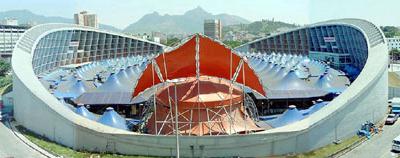
 "A bit of Brazilian Northeast in Rio.It is a way to define the Luiz Gonzaga Northeast Traditions Centre, where the traditional São Cristovão Fair is held. About 700 permanent tents offer a sample of Brazilian Northeast culture, such as tipical food, handcrafts, forró players, dance, singers and popular poets and also folk literature. The fair attracts visitors from all over the country and abroad. Every month about 450 thousand tourists and local people visit it. It is an intersting place , with a good substructure displaying places for dancing, stages for shows, 35 tipical Northeastern restaurants, handcraft shops, toilets and parking.
The fair is operated since 2003 inside the São Cristovão Pavillion, a Brazilian architectural landmark, rebuilt by the City Hall with the purpose of preserving this traditional place of the Brazilian Northeastern culture in Rio." (5min by car)
Quinta da Boa Vista
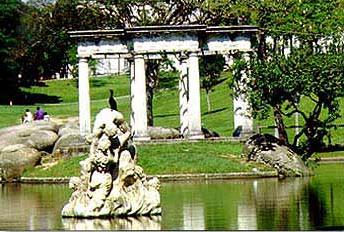
"The park is part of the Solar da Boa Vista, the royal residence of Brazilian emperors between 1822 and 1889 – the year the Republican Government was established in Brazil. It extends over an area of 155 thousand square meters, provided with a garden in 1869 according to a project designed by French landscape artist Auguste Glaziou. By entering through the side gates, visitors walk along Sapucaias Alameda and its romantic design, with the original lakes, grouts and nooks of such imperial gardens. The Quinta’s long gardens host the National Museum and city’s Zoo, including also playgrounds, sports courts, picnic hides and restaurants. It offers guided tours and free gardening lessons on weekend. Located in São Cristóvão, it opens daily, from 7 am to 6 pm."
(15min walking)
The Maracanã Soccer Stadium
"Maracanã, international symbol of soccer-land, preserves the history of the sport that looks just like Brazil
UERJ - Rio de Janeiro State University
(5min walking)
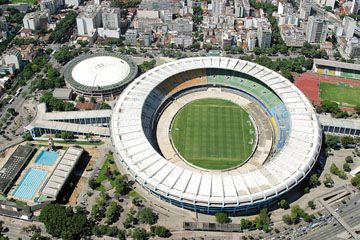
Among the wonders of Rio, Maracanã, largest stadium in the world, is one of the country’s major tourist and cultural patrimonies. In the land of soccer, where this sport is a religion, many consider it the Temple of the Gods. It was built in 1950 for the World Cup, and designed to hold 166,369 spectators. Currently, after reforms, it can hold up to 114,145.
Its official name, Stadium Journalist Mario Filho, is a tribute to one of the most important Brazilian journalists, founder of the newspaper “Jornal dos Esportes”. On 16 June 1950, Maracanã was inaugurated with a match between a team from Rio and one from São Paulo, with immortal Didi scoring the first goal in the history of the stadium. Since then it has been the stage of great triumphs of Brazilian soccer, including the decision of the world championship for clubs in 1963. Approximately 200 thousand people witnessed then the victory of Pelé’s Santos over Milan, the Italian team.
Passion, emotion and lots of adrenalin in the organized supporters shake the stadium and make the public delirious. A compulsory visit for national and international tourists, students and people of all ages, the giant has become internationally known and loses in popularity only to the statue of Christ and the Sugar Loaf.
Maracanã is not only about soccer shows. Great musical productions have taken place there with celebrated international idols such as Frank Sinatra, Madonna, the Rolling Stones, Tina Turner, Prince and Paul MacCarthney. The latter entered the book of records in 1991 as having the largest audience in history, up to that time, for a solo singer presentation. Other important events were the celebration of an open air mass in 1980 and the Meeting with Families in 1997, both under the leadership of Pope John Paul II."
(In front of us)
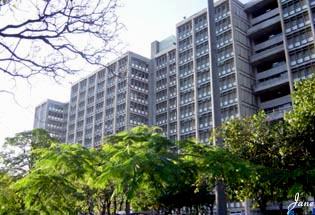 In 1950, four faculties of what was, in those days, the Brazilian capital, joined together to found the Rio de Janeiro State University (henceforth UERJ). Since then UERJ has flourished and established itself as one of the foremost universities in the country. UERJ’s importance on the Rio state and Brazilian academic scene in general may be witnessed by the quality of both its teaching staff, as well as its state-of-art scientific production. In addition, there are hundreds of extra-mural projects, which have been developed as part of the University’s mission involving people from the State of Rio de Janeiro.
As a state-owned institution, UERJ is concerned about its alumni and faculty as well as its surrounding community. Its mission is based on equality and plurality. Therefore, the University is always developing different programmes and services. For instance, UERJ was the first state university to offer an ombudsman office in Rio de Janeiro. Among the Brazilian universities, it was again a pioneer when it established racial quotas as a factor in admitting students to its undergraduate courses.
In 1950, four faculties of what was, in those days, the Brazilian capital, joined together to found the Rio de Janeiro State University (henceforth UERJ). Since then UERJ has flourished and established itself as one of the foremost universities in the country. UERJ’s importance on the Rio state and Brazilian academic scene in general may be witnessed by the quality of both its teaching staff, as well as its state-of-art scientific production. In addition, there are hundreds of extra-mural projects, which have been developed as part of the University’s mission involving people from the State of Rio de Janeiro.
As a state-owned institution, UERJ is concerned about its alumni and faculty as well as its surrounding community. Its mission is based on equality and plurality. Therefore, the University is always developing different programmes and services. For instance, UERJ was the first state university to offer an ombudsman office in Rio de Janeiro. Among the Brazilian universities, it was again a pioneer when it established racial quotas as a factor in admitting students to its undergraduate courses.