Article for Grip Magazine, Autumn 2002. The cartoon isn't by me.
This year, Manchester was host to the largest multi-sport event this country has ever seen, so more fool you if you stayed home for the summer. In the weeks surrounding the event, there was much more going on than just some people running in circles and swimming in lines. Ryan B reports on the Games and various elements of the associated hoo-haa.
The Build-up
The Commonwealth Games, as they approached,
inspired feelings in me that oscillated between cynicism and glowing civic
pride. I was proud to see the positive press coverage the city received;
I was cynical when the Queen’s Jubilee Baton was raised up on a crudely
Cadbury-sponsored podium on the opening day. I was proud to see Kenyans,
Australians and Namibians jogging past my bus stop; I was cynical of the
motivations for the odd spring-cleaning the city received in the weeks
prior to the opening ceremony.
 |
Holes in
the road which had remained unrepaired for months were suddenly fixed.
Graffiti was painted over, trees were planted and other trees were trimmed.
Banners appeared, with the dual purposes of proclaiming the arrival of
the Games and promoting various brands of chocolate, sugary drinks and
soap. Houses on the route from the town centre to the new stadium underwent
repairs and beautifications whilst their less visible neighbours were left
alone. There was a sense that elements of the city’s culture, as well as
any avoidable signs of gross inequality of income, were being hidden from
the scrutiny of the media.
And the media, when they came in their droves, liked what they saw. |
Manchester has never received such favourable press coverage, although the reports mysteriously focused on factors other than the lack of graffiti and the few extra trees. It is, I suppose, natural for the council to want to tidy up the place a little prior to its inspection, but these cosmetic changes were an unnecessary addition to the major architectural additions and alterations that have taken place in Manchester over the last five years or so. Piccadilly Gardens and Station, Salford Quays with its Imperial War Museum and Lowry Centre, the City of Manchester Stadium, the Aquatics Centre, the renovated Art Gallery, all these things were surely enough to get the broadsheets gushing with well-deserved praise for the city.
Commonwealth (kôm’en-welth’ )
What is the commonwealth anyway? Officially, it is a voluntary association of 52 nations, which since 1991 have been required to declare commitment to democracy and the rule of law. 72 nations competed in the 2002 Commonwealth Games, including Zimbabwe, who have been booted out of the commonwealth for dubious commitment to democracy. Culturally, the countries of the commonwealth have little in common, and many lack wealth. Those who have wealth seem to do their utmost to prevent it from becoming common wealth. Dictionary.com defines ‘commonwealth’ as follows:
“n. The people of a nation or state;
the body politic.
A nation or state governed by the
people; a republic.
The English state and government
from the death of Charles I in 1649 to the restoration of the monarchy
in 1660, including the Protectorate of 1653 to 1659.
Archaic. The public good; commonweal.”
The United Kingdom, having the Queen as head of state, is a Kingdom, and not a nation governed by the people, or a republic. The Queen is the head of the Commonwealth. So everything is quite clear, as you can see.
The Games
After the spectacular opening ceremony,
in which a man may have touched The Queen’s arse, the sun started to evaporate
my frankly tiring cynicism. The first weekend of the Games was fantastic.
The sun was blazing and town was packed with people milling about, shopping,
lazing in the sunshine and watching the athletics on large television screens
in Piccadilly Gardens and Exchange Square. There were people everywhere,
young and old, many wearing atrocious purple shellsuits; there were banners
and enormous wall coverings; there were newly planted plants and flowers;
the city had never looked so bustling and energetic.
The tickets for almost every ticketed
event had been snapped up long ago, and so I had planned to visit most
of the free events, such as the cycling, the triathlon and the walking.
Unfortunately most of these free events happened on a Sunday, and started
early. I really did intend to go and see the triathlon on Sunday 4th August,
right up until about 4am on the Saturday beforehand, when I decided that
perhaps I might need to be asleep. I have no excuse for missing the walking,
which is a shame because I was dying to try to spot and expose any cheats
who broke the ‘one foot on the ground at all times’ rule.
I did manage to go and see the Mountain
Biking in the picturesque surroundings of Rivington Pike, near Bolton,
on Monday 29th July, whilst the sun was still shining. I was expecting
to stand or sit somewhere and watch the cyclists at a vantage point from
which a fairly large segment of the track was visible, with commentary
filling in the gaps. In fact the day turned into a ramble through the woods
and fields around the course; a far more active and participatory (and
exhausting) event than I had imagined. We hiked up hills and across quarries
looking for sections of the course, and then waiting at appropriate points
for the cyclists to whiz by. There were an estimated 50,000 people doing
the same, crawling ant-like all around Rivington’s hills and moors, wandering
across the track until officials blew whistles and gesticulated at them
to shift or risk getting knocked down by a speeding Canadian. There was
no commentary unless you had been smart enough to bring along a radio,
and we hadn’t, so we had to wonder each time the winning few flew (or,
on the uphill, struggled) past us whether the guy or gal who was winning
was the same guy or gal who had been winning on the last lap. I heard from
somewhere that a Scottish competitor in the Women’s race had got a flat
tire; it wasn’t until I got home and watched the news that I realised she’s
been one of the favourites to win.
The Canadians took home four of
the six medals, although an Englishman took the Bronze in the Men’s race
and gave the crowd something extra to cheer about. The volunteers were
wonderfully helpful and despite the lack of continuity caused by having
very little idea what was going on it was a fine day out in the hills.
In the following days, England won
her best ever clutch of gold medals (54), and Manchester’s Darren Campbell
was one of the stars of the event, winning gold in the 4 x 100 metres relay
and bronze in the 200 metres.
Nobody I spoke to had any complaints
about the events of the Games themselves, and everyone agreed that the
event appeared to run remarkably smoothly. “Of course,” wrote one Mancunian
to the Guardian, “there will still be some miserable southerners who'll
find some way to criticise.”
The Bill
The above comment made me reflect
on my previous feelings that the event seemed to involve much sweeping
of issues under carpets and much cheapening corporate sponsorship. Especially
since I am a miserable southerner. It may just be the circles in which
I mix, but I really don’t thing these views are uncommon.
The organisers of the Blitz
festival certainly objected to the level of corporate sponsorship involved
in the Games, and billed their festival of arts, music and political activism
as an alternative to the merry-go-round of the Games, ensuring that Manchester
hung on to at least some of its vibrancy and supposed radicalism for the
period surrounding the event.
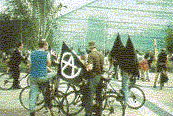 |
The festival involved music from Manchester bands like Steven Nancy and Desolation Angels as well as Ozomatli, an art exhibition in the Triangle and the Great Northern Warehouse, as well as a series of protests including a Critical Mass bike ride and Skate Attack, Anti-Sweatshop protests targeted at the Games’ sponsors and also a protest for capitalism (oh, the irony). |
There seemed to be a shroud of silence in the media about this issue. When City Life wrote “No-one can deny that Manchester 2002 were [sic] an unqualified success” it seemed more like an order than a statement. In an unconvincing article, the magazine listed a catalogue of commonwealth cock-ups (the City of Manchester Stadium fiasco, the gymnastics being staged in the too-small G-Mex and the total omission of cricket from the Games being the principal few) before concluding that critics of the event should ‘eat humble pie’.
An open debate was scheduled for July 20th for members of the public to come and discuss issues such as what the Games were costing the city, as it was felt that these issues were being under-reported. Publicity for the event, on Manchester’s Networking Newsletter website, suggested that this may be because BBC North West’s Political Editor Jim Hancock is married to the Manchester 2002 Chief Executive, Frances Done. Or perhaps because the BBC and the Manchester Evening News are both major sponsors of the Games. It seems we will never know, because the debate was cancelled by the City Council.
In the opinion of the Networking Newsletter (and there do not seem to be any other sources on the issue) the original plan for the Games to be funded by corporate sponsorship was a non-starter, especially when much of this sponsorship money failed to materialise. Upon requests by Manchester 2002, The Government ordered the Council to pay an extra £45 million on top of the £35 it had already pledged, and there is speculation that service cuts will be necessary to finance the extra cash. Sport England pledged £138 million of lottery money to the Games, and the organisation’s Chief Executive is quoted as saying “I find the situation staggering. The financial situation is beyond the worse case figures we have seen”.
G Percussion
Although the opening ceremony was
exorbitantly overpriced, the passing of the Queen’s Jubilee Baton by some
footballers to the large chocolate-box podium in Albert Square, complete
with music from 10cc, provided those of us without £140 or so in
our back pockets with some way of publicly celebrating the start of the
Games. Well, was never a big fan of 10cc, and from the TV coverage I don’t
think I missed a lot.
The equally wallet-numbing closing
ceremony, with its enormous fireworks which you could see from my house
(for free!), was paralleled by an enormous free party for everyone. Why
we need expensive and prestigious opening and closing ceremonies when we
could instead have enormous free parties at a much lower cost and with
much greater inclusiveness is another matter. The party in question was
GPercussion, which followed the RePercussion and the DPercussions of previous
years. It bought Mancunians and visitors together in the impressive post-industrial
landscape of Castlefield to party all through the day until midnight, when
there were a host of after-parties waiting to receive the attendees’ tired
dancing feet.
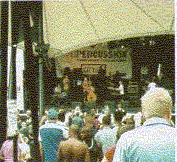 |
The monsoon-like
downpour that brought itself along to the closing ceremony the day before
had held off for the day and we were treated to a day of decent weather
and just a little sun. I spent most of the day sat on the grassy banks
in front of the main City Life stage, and was treated to a succession of
chilled performances from Homelife, RSL, A Certain Ratio and Crazy Penis
amongst others.
Homelife were particularly impressive, with squillions of musicians onstage (or at least eight) creating a deep and appropriately percussive noise. |
The beer queues were far too long, and the beer far too expensive, so by the time Mr. Scruff came along to keep the Green Stage dancing for the final three hours of the evening I remained stone cold sober. As the sun set redly behind a grassy hill lined with silhouetted dancers, a fight broke out. A semi-naked man with a monkeyish demeanour was punched in the face for behaving like a twat, and the crowd cleared a large circle around him for a while. The atmosphere turned slowly less pleasant due to the long day of drinking, and my girlfriend wouldn’t go anywhere on her own by the end of the night for fear of being grabbed in a manner that really would give the Queen something to complain about. Our chosen after-party, the normally fantastic Robodisco, was a disappointment as well, and the Alpinestars failed to show up for their club set. Boo!
The Bus Home
It will remain to be seen whether
the Games have indeed left the Council or Sport England (or both) cash
strapped, whether the money they have brought in will filter down to local
communities, whether the new stadium will help to regenerate East Manchester
and whether the old stadium will deprive Moss Side of a much-needed source
of cash. We cannot judge the event a success or a failure on these terms
just yet, although the low level of information and discussion about this
important aspect of the Commonwealth Games invites criticism. We can judge
the Games on the reception given the athletes by the city, on their organisation
and their effect on Manchester’s image as viewed both from outside and
in. On these terms, the Commonwealth Games were a resounding success, leaving
Manchester with an enhanced reputation and a legacy of great sporting facilities,
and leaving the city’s visitors with some great memories. It also left
a few of these visitors with some stories to tell.
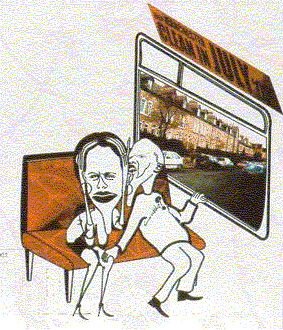 |
I sat on the late night number 42 bus thinking about the deterioration in atmosphere towards the end of the day’s GPercussion festival and its effect on the city’s visitors. Unlike the state of the council houses, it is one aspect of the city that can’t be hidden from view for ten days, and nor should it be. Some kids who were sat behind me, and looked like they’d been mixing their drink and drugs, put on some kind of accent that sounded vaguely Middle Eastern and started shouting “I laave Manchester! Ees very good city! Ees Beyootiful city! I liike the Dry Bar!”. It had the nearby thirty-something Commonwealth Games cardholders looking bemused, and had me in stitches until they started stroking the back of my head. |
Official Commonwealth Games Site (of course I don't have anything to do with them).