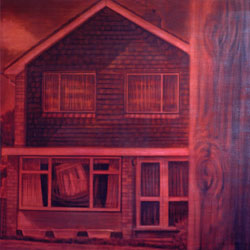
Cedar Avenue
|
A cow in a box, elephant dung on
canvas, a room with a light flashing on and off - the Turner Prize invites
almost as much bemused incomprehension from some commentators as it does
excitement and debate from within the art world. Now, thanks to the launch
this February of the Comme Ca Art Prize, the North of England will soon
be partaking in a larger share of that incomprehension and excitement.
“All this is part of the regeneration of the centres of the great Northern cities”, comments Claire Turner, Comme Ca’s co-director. “Artists have led the way in the rise of the North and the civic pride of its great cities. It is often artists who are the pathfinders, opening up studios and galleries in run-down districts.” The new prize, £10,000 for one lucky contemporary visual artist living and working in the North West, North East or Yorkshire, expected to attract some controversial work, and it will put the Comme Ca Art organisation in the spotlight as never before. With that in mind, Grip magazine went to have a look at two of their current exhibitions in Manchester. Many people will be most familiar with the Comme Ca agency through their use of the window of Debenhams on Tib Street as an exhibition space. This has been part of the ‘art in the department store’ initiative, along with a series of works commissioned by Selfridges for the opening of their Trafford Centre store. Placing art in consumerist settings such as these is a key element in Comme Ca’s success as an art agency; they are not bashful about placing the emphasis on selling the work they promote, rather than simply showing it and hoping that people will take out their wallets. The window of Debenhams is a conspicuously insalubrious exhibition venue, and viewers must contend with the twin distractions of the fresh meat and cheese market running down the middle of the street and the smell of pigeon shit that seems to run the length of the display. Despite these drawbacks, the shop window appears to be an effective way to get the work seen by people outside of an art gallery, and one can observe many shoppers turning away from the fancy meats of the market to look at the artworks behind them and mutter approvingly at one another. The current ‘Home Is Where The Art Is’ exhibition collects together the work of a dozen artists working in widely different forms and subject matters under the banner of ‘art for the home environment’, again pushing the message that they want you to buy these things and take them home. And it would be lovely to do so, because there is something to appeal to everyone here. Pieces range from Junko Mori’s metallic organisms made from multiple forged steel pieces, which resemble pregnant sea anemones and are designed to form a central talking piece for your stylishly minimalist apartment, to Kate Davies’ atmospheric landscape painting, in which a figure filmically stares out from in front of a bright focal point of light provided by a black and white photograph collaged onto the canvas. 2002 saw the opening of the Comme Ca Art Gallery, a more conventional space for the agency to display their wares. The gallery, located in a new development by Urban Splash on Worsley Street, on the edge of Castlefield, is a low-key affair, unlikely to benefit from passing trade, although the gentrification of the area will most likely change that within a couple of years. It took me about an hour to find the place, largely because it turns out that there are two Worsley Streets in Castlefield, and nobody seemed to have any idea where either of them were. The gallery’s current exhibition, ‘Cedar Avenue’ by Manchester-based painter David Gledhill, involves a series of landscapes adapted from photographs of the eponymous avenue on the Malvern Hills where the artist grew up. The paintings, in monochrome earth tones, are noticeably free from any human, or even automobile, presence. Many paintings show houses largely obscured by telegraph poles and lamp-posts, placing the viewer in a quite voyeuristic position, as if waiting for some kind of activity behind the net curtains. “The gradual unburdening of subject matter as the main vehicle of meaning,” David has said of his work, “has enabled me to turn from figure paintings, in which I wanted to involve the viewer in a sense of presence and drama, to landscapes in which the absence of the human image paradoxically invokes it even more powerfully.” Even so, there is an appealing suburban spookiness about these lived-in but deserted properties. The Comme Ca Art Gallery will exhibit the work of the short-listed artists for the 2003 prize from the 8th of October, the same day as the jury will decide and announce the winner. It is an ambitious prize, particularly because of the inevitable comparisons with its London rival, the Turner Prize, which has long been the highlight of the British arts calendar. Although Comme Ca has branched out from exhibiting in bars and restaurants to become, as if by stealth, the North’s leading art agency, the company is far from being a household name, and their launch of a major new arts prize is a sharp but audacious move. ‘Home Is Where The Art Is’ runs on Tib Street (off Market Street), from 10.01.03 – 11.05.03. ‘Cedar Avenue’ by David Gledhill runs at the Comme Ca Art Gallery, 24 Worsley Street, which is either in Hulme or Castlefield, depending on who you speak to, from 23.01.03 - 08.03.03. The deadline for entries for the
Comme Ca Art Prize North 2003 is 30.04.03 and the short list will be announced
in July. Artists can be nominated by members of the public.
|