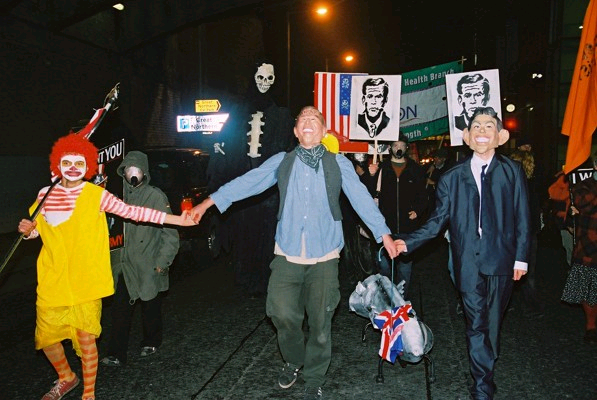
When the Confederation of British Industry came to Manchester and held their annual conference at the GMEX last November, peace protesters stormed the building. The CBI criticised the action as a media stunt, but should the protesters be making any apologies for that?
The protesters, as they yelled slogans in the miserable Sunday weather, were not about to assume that the delegates meeting at the conference inside could hear them. They wanted to get in. The crowd broke ranks as protesters rushed through barriers and police lines to charge the conference hall.
Numbers at an event like this are always difficult to estimate, as the police and the organisers give widely different accounts whenever people congregate in protest. To choose a figure halfway between the two parties’ estimates, around 50 protesters from the crowd of 250 succeeded in getting into the CBI conference hall. A full 20 minutes later they could be seen charging jubilantly back out again of their own accord.
The following Tuesday, on the final day of the conference, heightened security failed to keep out a smaller band of protesters, some of whom hurled fake blood at the BP stand and two of its staff. The members of staff involved were carted off to hospital just in case the substance (ink) was toxic, and the two activists concerned have been charged with more than six grand’s worth of criminal damage. “With all the ‘green-washed’ company executives chatting to smart suited environmentalists”, one protester commented, “its getting harder and harder to tell who's who. We hope this helps.”
The CBI was subjected to a battery of criticism at this year’s conference. It was the first time the institution had witnessed the clamour of street protesters outside the walls at one of its meetings, as first the Amicus trade union, then the Stop The War Coalition and then fire fighters spoke out noisily against the wealthy captains of industry inside.
The man from ANSWER, which helped organise the protest (it stands for Act Now Stop War End Racism, and is part of the Stop The War Coalition) said that the conference was “a rogue’s gallery. Businesses represented included BAE Systems [formerly British Aerospace] and BP, who will both benefit from a war with Iraq. The council,” he continued, “had also said before the event that Tony Blair would show up, but instead we had his second-in-command, Gordon Brown, the man who holds the purse strings.” He added that the crowd consisted both of anti-capitalist and anti-war protesters.
The debate around globalisation has helped to galvanise a new generation and encourage the joining together of movements previously seen as disparate. The CBI was chosen as a target because, the protesters argue, big business and the government share the same goals. They both want a war with Iraq to keep the American military machine going, to keep oil flooding into the US at low prices and to help ensure America’s continued economic dominance in the world, because what’s good for Uncle Sam is good for us.
I got on the phone to the CBI’s media people to see if they thought it was fair for a group of people who were just minding their own business trying to get rich should be targeted by the ink-throwing antics of vicious peaceniks. That’s not how I phrased it, of course. I actually just asked if they understood why they had been targeted by a demonstration against war in Iraq. Their spokesperson answered with a confident “Yes.”
It’s nice to hear such straight talking, but this was followed up with “Well, let me re-phrase that.” (Rephrase “yes”? It’s not even a phrase.) “The protesters came in,” he rephrased, “and they got their point across. They were using the protest as a platform to do that, due to the high level of media attention they knew it would attract.” His only comment about the CBI’s reaction to the protest was that it was “disappointing from the point of view of security,” referring to the mysterious red substance hurled at the BP stand.
Happily for the City Council, he denied that the protests would put the CBI off coming to Manchester again in the near future, insisting that the event was a marvellous success despite the protests.
The protests formed the most militant, if not the largest, example of a movement which is growing stronger as the threat of a war with Iraq (and North Korea, possibly Iran, the Sudan, maybe China, who knows?) draws nearer, and the movement is no longer confining itself to our capital city.
On Halloween night, protesters occupied the maths tower at Manchester University as part of a nation-wide occupation of students’ unions, and between 500 and 1000 students and activists (depending on whether the police or the organisers are consulted) occupied Oxford Road for over an hour before marching to Piccadilly. Despite being one of the largest protests the city has seen in the last five years, this received much less coverage than the far smaller but more spectacular CBI protest.
“In terms of numbers” said the Stop The War Coalition spokesperson, responding to charges from the CBI that the protest was merely a performance for the benefit of the media, “with three to four hundred people present, we needed to use any opportunity we could get to raise the profile of the anti-war message.”
Opinion polls have revealed that these protests represent the feelings of what is only a little shy of a majority of the British public. The Washington-based Pew Research Centre found at the start of December that although 75% of respondents thought Saddam Hussein must be toppled, opinion in Britain was split evenly on the issue of whether he should be removed by force, with 47% saying no, and 47% yes. An increasing number of political figures are also speaking out against war with Iraq for less doveish reasons, such as the fact that an attack is likely to both strengthen al Qa’eda and leave Saddam with little to lose by attacking whatever is within reach. Gaining the interest of the media, rather than the support of the public, has been the major problem for the peace activists so far.
When and if (or, more realistically, when) a new war is declared against Iraq, both Manchester and London are likely to see even larger numbers take to the streets. Stunts like the invasion of the most important date in the British business calendar and the symbolic bloodying of our largest oil company do help to get the anti-war cause into the news, although they can risk complicating the debate and alienating those supporters less eager to side with the anti-capitalists.
The anti-war groups are battling
against the government to convince people of the strength of their argument,
but the government has access to somewhat greater resources. Besides, Tony
Blair has made it clear that the ‘blood price’ is worth paying to uphold
our special relationship with our neighbours across the Atlantic. Even
if it succeeds in convincing the government that it represents a body of
opinion large enough to be a worry come polling day, the Stop The War Coalition
needs all the “media stunts” it can get if it is to succeed in stopping
the war.