![[Karibu Kenya, William]](KARIBU.jpg)
![[Pic of Fr. Dan in 1960]](FRDAN.jpg) Fr. Dan, 1960 |
![[Pic of Al White in 1960]](ALWHITE.jpg) Al White, 1960 |
![[Pic of Fr. Dan in 1960]](FRBILL.jpg) Fr. Bill, 1960 | The main purpose of my trip to Kenya in the summer of 1996 was to visit Daniel Wekessa and his family. In 1959, my high school friend Al White was teaching in the seminary in Kakamega, Kenya, where he met Daniel. Like me, Daniel was preparing for ordination to the Catholic priesthood. Al gave him my address and we began corresponding. I was ordained in May of 1960 and Dan in November. We corresponded until 1967, when Dan was studying in Oxford and I was raising cain with the Cardinal. We lost contact until 1995, when Al White sent a letter to Dan in care of the diocese of Kagamega, where Dan had been a priest. It took several months before the letter finally found him in Bungoma, his home town. Daniel, like me, had left the priesthood, married, and now has four children, the oldest in college. He insisted that I come and visit them. We began making plans. |
![[Pic of Dan and Bill in Nairobi]](REUNION.jpg) Dan and Bill at Nairobi's United Kenya Club (the once exclusive British male club integrated by Meryl Streep in "Out of Africa"). | I finally boarded a British Airways flight midnight of 19 July 1996. The trip involved a 9-hour flight to London, a six-hour lay-over, and then another 9-hour trip to Nairobi. Dan met me at the airport in Nairobi the afternoon of 21 July. During the 20-minute ride from the airport into town, we saw colorful Maasai guarding their herds in the fields, a frequent sight in Kenya. We spent the next day catching up on one another's life and seeing the sights of Nairobi (pop 1.5 million-a combination of L.A. and Timbuktu), On the morning of the 23rd, we boarded a double-decker Stagecoach bus for a 380-mile, eight-hour trip to Bungoma near the Uganda border. |
|
The road follows the western half of the 620-mile rail line built by the British in the 1890's from Mombasa to Uganda (the subject of the film "The Ghost and the Darkness"). During the first part of the trip, the bus bumped and banged furiously over the potholed pavement. Religious African or Dolly Parton music blared from loudspeakers, providing slight comfort. (Kenyans are crazy about music and soccer.) During occasional stops, a few would to do business with the merchants waiting at every bus stop. Once Daniel got off and brought back on board a big gunny sack of potatoes to take home.
Much of Kenya consists of a high plateau (3,000-10,000 feet) split through the middle by the Rift Valley. Nairobi sits on the edge of the eastern escarpment of the Valley. The road winding down into the valley gave us a good view of the flamingos that covered the distant Lake Nakuru like a pink carpet. In the middle of the valley, the bus turned into the colorful open market of Nakuru for a half-hour stop. I wanted to take pictures, but Dan said, "No, They will stone you." Merchants, mostly teenage boys, crowded the bus from every side, selling selling cookies, newspapers, roasted corn on the cob, boiled eggs, soft drinks, watches, bicycle parts, farm tools, appliances, whatever. Some boarded the bus to hawk their wares. They were quick to note the musungu (white man) on board and ply him with their English. Dan warned things were too expensive, and he kept his money in his pocket. I couldn't figure out how the bus would get through the dense tangle of vehicles, merchants, and customers jamming the market place. Amazingly, everyone was done with their business, we began to crawl through the crowd, with several young men running interference and clearing the way for the bus. Suddenly, we were once more on the open road. The condition of the highway soon improved, and we sailed on to Bungoma, Dolly Parton still singing "Only a Woman." |
![[Pic Plowing field with oxen]](OXEN.jpg) Plowing a corn field near the Wekessa home. | The road out of Nakuru continued up the other side of the valley onto the western plateau, with rolling hills covered as far as you can see with family farms and plantations growing corn and sugar cane. Dan told me about land settlement since Kenya's independence in 1963. These ancient farming communities recognized the danger to their property as soon as the railroad reached their lands. They were first to notify the British of their intention to protect their independence and freedom. In a sense, the railroad did not just open up the country but created it, by tying together 140 different tribes and creating a sense of national unity. |
![[Pic Dan and Aloisa]](DANALOIS.jpg) | Daniel's wife, Aloisa, was waiting for us at the bus stop at Kanduyi, the Bungoma suburb where the Wekessas live. To the astonishment of the crowd on the bus (Kenyans are very formal), Mama Aloisa and I embraced with tears and greetings. Karibu, karibu, William (Welcome, welcome, William) she crooned over and over again. We carried my luggage and Dan's potatoes to the house, ten minutes from the highway. The Wekessas were the soul of hospitality. Their Babukusu tradition includes a respect of others and carefully inquiring into a visitor's background to make sure that their conversation does not offend. I was always surprised by the cordiality and friendship that people extended to complete strangers. |
| As arrived at the Wekessa's home, their son Raphael (12) came out to greet us. I insisted on taking a picture of them in front of the house just as it started to rain. We hurried inside their sitting room for refreshments and dinner. They introduced me to the help, Peter 16, and David 19, who also live on the property. Daniel gave the blessing, including thanks for my safe journey. Peter approached each of us with a pitcher of water and a bowl for washing hands. We sat down to an unforgetable meal. The rain roared a welcome on the tin roof. | ![[Pic Wekessa sitting room]](FRONTRM.jpg) Wekessa Sitting Room |
|
![[Pic The Wekessa property]](YARDSHOT.jpg) Wekessa property, showing the edge of the bunk house on the left, the maize silo, the kitchen, and on the far right, the three-room out house, which also serves as the bath house, and the corner of the main house. | The next morning I woke up in paradise. The air was fresh and clean, not humid, but filled with the sweet aroma of flowers and fruit ripening on the tree. The Wekessa property, which Dan calls "Kanduyi Square" consists of 1.5 acres, on which they grow eucalyptus, bananas, maize, papayas, avocados the size of small footballs, guavas, passion fruit, berries, sunflowers, beans, loofa, and ginko, along with colorful beds including daisies, dahlias, bouganvilleas, gladiolus, and a jasmine-scented flower called queen of the night, which repels mosquitos. A neighbor told me that Daniel's use of flowers gave Kanduyi Square a "definite European character." |
![[Pic Dan and flowers]](FLOWERS.jpg) Dan with his flowers. | The people live out of doors during much of the day and the house was always open to the air. Guests are frequently entertained out on the lawn. Chores like dishes and laundry also take place outside. Although there were plenty of bugs, they seemed too busy with other things to bother humans. I rarely saw a mosquito, though the Wekessas fixed me up with a net over the bed at night. |
![[Pic David drying maize]](MAIZE.jpg) David drying maize. |
![[Pic Typical mud house with thatched roof]](HOUSES.jpg) Typical mud house with a thatched roof. |
The altitude at Bungoma is about 3,000 feet. Kenya sits right on the equator, which I crossed six times during my visit. The days are the same length all year long, with a rainy season May-August and a dry season December-January.It
rained several times during my stay but only at night.
When I first arrived, I thought the buildings were concrete, but learned they were built from wood-reinforced mud, plastered with concrete. Other homes were constructed of brick, fired from the same clay, or were made of plastered or unplastered mud. Many had thatched roofs. |
|
Dan and I had a lot in common. He got into trouble with his bishop for his minstry among the poor working class. Apparently, his bishop didn't like his working with non-Catholics. One day, he got fed up, packed his car, and drove over to tell the bishop he was quiting. His bishop and Cardinal Otunga pleaded with him over a number of weeks, but he wouldn't be budged. He moved to Nairobi where he got a job working for planned parenthood. He started seeing Aloisa, a childhood friend also from Bungoma, now a nun studying nursing in Nairobi. When she became pregnant, they married so she could continue studying nursing. He pursued a canonical hearing and got laicized and his marriage blessed. "Brother Bill," he said, "You came to see what we are, who we are, and how we live. Veni, vidi, vici." "Veni, vidi, victus," I responded ("I came, I saw, I was conquered.") He introduced me to his friends as his long-lost brother who stayed in America so long he turned white. Some times I felt that way. |
![[Pic Demetria and Aloisa]](DEMETRIA.jpg) |
Two years after his last child was born, Dan and Aloisa quit their jobs in Nairobi and moved back to Bungoma, to his current location. It was undeveloped land. Together, they built the buildings, cleared the land, and planted their flowers and crops. Aloisa works nearby in the Bungoma hospital. Dan works the land, and has started a business pressing sunflower seeds, selling the oil for cooking and the by-product sunflower cake for cattle feed. The Spectrum Guide to Kenya describes Bungoma as a "prosperous but dull administrative town," a comment that was always met with hoots of laughter. Prosperous it is and certainly prolific. Nearly everyone I met was either a corn or sugar-cane farmer with more than one wife (legal in Kenya), a teacher, or an adminstrator of some sort. One young friend of Johnny's was a member of a family of 36 children, all by the same father and three wives. They live in separate homes. He explained to me, "The only time we get together is Christmas. And, yes, we have a whopping good time!" Daniel wishes the Catholic Church would accept this ancient tradition. "There is so much pressure on people to enter plural marriages," he said. It seems to be popular, even with women. |
![[Pic John Camillus]](JOHNNY.jpg) |
![[Pic Raphael]](RAPHAEL.jpg) Raphael (12), with gifts from California. | In Kenya, both public and private schools are state-supported, but families also pay a fee, even for public schools. The high schools all seemed to be boy/girl segregated boarding schools, and they were everywhere. No matter where you travel in Kenya, the schools constitute a big part of the community life and the landscape. A few days after I arrived, Raphael started vacation, but the two older children, Johnny (17) and Demetria (16), were still at boarding school. Before school was out, we visited them at their schools, about 20 miles distant in opposite directions. A few days after those school visits, Johnny and Demetria came home for vacation, but the oldest, Elizabeth Lucy (19), a college student in Mombasa, arrived the day after my departure. |
![[Pic Elizabeth in Mombasa]](ELIZABET.jpg) Elizabeth Lucy (19). |
|
The only wildlife I saw besides Kenya's plumed Secretary birds and a Bateleur eagle was a group of zebras grazing beside the road. Most of the rest of the wildlife are confined to the national parks, which were too distant and
too expensive to visit (You need to hire a guide, rent a car, etc.).
What I enjoyed most were the meals at home with the family, the open African market places, and walking with Dan around his community, visiting neighbors and relatives, catching up on our histories, and talking about Kenya and Dan's people, the Babukusu. The Babukusu is one of the 17 sub-nations of the Baluyias, who have been in Kenya since the 14th century. Iron smelters, they combined agriculture and herding. Today, you often see adults and children herding cattle, goats, and sheep. |
![[Pic Demetria doing Agnes hair]](AGNES.jpg) cousin Agnes' hair |
![[Pic Cooking breakfast]](COOKINGE.jpg) Cooking breakfast. | The Wekessas eat pretty much what I do at home, with lots of tea and coffee sweetened with sugar and milk. Their staples include ugali, a cornmeal cake made by boiling cornmeal in water. You take a slice of it on your plate and either mix it with your food, or roll up a ball of it and use it to sop your plate (just like the Mexicans use tortillas). They also eat a lot of collards, called sukuma wiki ("every day of the week"), chopped and cooked with onions and tomatoes. Also lots of stews with meat or fish. A favorite dish was fried green bananas topped with a sauce made of ground peanuts, onions, and tomatoes (Hmmmm!). Sometimes we had spagetti or potatoes, served as french fries or mashed and mixed with peas and corn, a dish called irio. Like other traditional homes, the kitchen is in a separate building. The Wekessas have an electric range, but they prefer cooking the traditional way over an open wood stove on the floor. They also cooked over charcoal burners. |
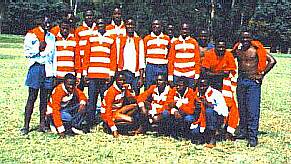 Johnny's rugby team at St. Peter's. I never saw Dan buy anything from an African merchant without haggling. He told me they would jack up the price when they saw him coming with a musungu. I never understood the conversation, but it always made passers-by smile and laugh. I acted very serious so as not to spoil Dan's position. |
![[Pic Fixing the boys' bike in town]](BIKE.jpg) Fixing the boys' bike in town
|
| There is real adventure travelling in the matatus, independently-owned conveyances. Sometimes they are vans, but mostly Japanese pickups with cabs on the back with two benches on each side, always overloaded. You never have to wait for more than a few minutes before a matatu comes along to take you where you want to go. They are often emblazoned with slogans such as Never Surrender, Engine Success. The inside of the cabs also display sentiments such as, Thank you for sharing your religion, but Jesus is the only way to Salvation. | ![[Pic Matatu picking up a load]](MATATU.jpg) A matatu leaving no one behind. Always room for one more. |
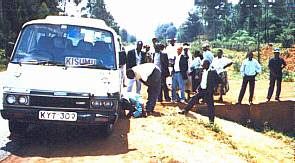 | Twelve people can sit comfortably. Once Dan and I were in a matatu with 17 squeezed on top on one another, some holding children, some holding large water pots and two small goats stuffed under the seat. The sign on the front of the cab said, Fear not! If God is for us, who can be against us? as we went speeding down one hill to gain enough momentum to take us to the top of the next one. A business man squeezed in next to me could not figure out what in the world I was doing there. "Are you some kind of missionary?" he asked. I told him I was visiting friends. Unconvinced, he asked, "What do you eat?" "Good country food," I smiled." He was astonished. |
| While I was there, the Babukusu were celebrating the circumcision of their 12-year olds in their ancient rite of passage. It is a most public event, and they insist that you participate. As far as I could gather, it is the biggest non-Christian celebration they have. The families all do it, but not in the same way. Some take their kids to the local hospital to be circumcised with anasthesia, the others are circumcized in the traditional way, which is a lot more public. They kill and roast a bull, drink corn beer, dance, and celebrate for several days. | ![[Pic Drinking corn beer]](BEER.jpg) Drinking pot beer |
![[Pic The invitation]](CALLING.jpg) The invitation | For a few days before the traditional circumcision, the boys run about the neighborhood, calling members of their clan to the celebration. With their bodies often painted, they gather a crowd of well-wishers to run with them, chanting, dancing, drumming, ringing bells, waving large banners, and blowing whistles. |
![[Pic Traditional circumcision]](CIRCUM.jpg) Traditional circumcision |
Daniel, Johnny, and I accompanied Raphael to
the local clinic for Raphael's circumcision. Two doctors on each side of
the examination table were operating on two boys at the same time.
Raphael didn't seem to be the least apprehensive and took it all very much in stride. The whole procedure did not take more than ten minutes. Johnny
rode Raphael home on the back of the bike. He spent the rest of the
day in bed receiving well-wishers. The next day he was out in the yard with his young friends. Tradition dictated that he not enter the main house for 2 months, for fear of that the sight of a women would cause discomfort. But in a couple of days, Raphael was in the sitting room eating with the rest of us.
For the traditional circumcision, the boys run down to the river, where they bathe and paint themselves with clay. They run back to their homes where they are circumcised outdoors in an assembly of friends, relatives and neighbors. |
![[Pic Fishermen on Lake Victoria]](LAKEVICT.jpg)
|
![[Pic Tea picker]](TEA.jpg) Tea Picker at the African Highlands Estate | Towards the end of my stay, Daniel, Demetria, and I rented a car and travelled to Kisumu on Lake Victoria, where Daniel's long-time friend, Father Morris, met us and drove to his beautiful rectory in Kericho. There we spent the night and the next day visited the African Highlands tea plantation. Kenya is the world's third largest producer of tea. The factory we visited produces 93,000 liters of tea daily (120 cubic yards). They ship the tea to Mombasa on the coast, where it is auctioned on the world market. |
|
Since my return home, I carry my photos around with me, showing them to everyone I meet, telling them about the people there and how they took me in like a member of the family. Daniel and his children have all written me. Daniel thanked me for coming, especially for being with them on the occasion of his 66th birthday. "Your presence with us was the centre of a curious attraction for many who saw us," he wrote. The kids are all back in school and they all wrote about their studies and their plans for their careers, which they take very seriously. Raphael is healed and playing soccer again. He asks me to find him a boy or girl pen pal (11-12) in America. Demetria wrote, "A boarding school gives us a chance to learn from each other and stay on our own without our parents." She asks me to find some pen pals for her, boys and girls (14-19). I have started collecting books and magazines to send to the secondary schools, which need them badly. I hope my trip to Kenya will be the beginning of new friendships for many others. Some times, the rewards of friendship are simply overwhelming. |