POO
A movie review by Balaji Balasubramaniam

| Cast: | Srikanth, Parvathy |
| Music: | Kumaran |
| Direction: | Sasi |
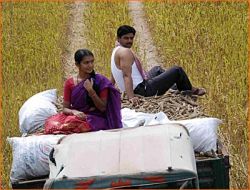
As Poo opens, Maari(Parvathy) is happily married to a store owner. One the occasion of a festival, she visits her mother's house in the village she was born and raised in. The visit triggers memories of her uncle Thangarasu(Srikanth), who she grew up wanting to marry.
As we can see above, Poo has a very simple story. But Sasi's directorial skills and penchant for creating powerful characters transform the story into a powerful, memorable movie. With his visual touches(like the way he shows us Parvathy remembering Srikanth's cellphone number), unexpected comic interludes(like the young goat-herd's cellphone incident) and character development(like the teashop owner who ends up playing a key role), Sasi delivers a soft, emotionally strong film.
Poo has a very unique, rather remarkable woman as its protagonist. It is difficult to define exactly what Parvathy feels for Srikanth but it is impossible to not see - or admire - the intensity with which she believes those feelings. Initially she comes across as someone who is naieve, always dreaming and setting herself up for disappointment. But as the film unfolds, it is clear that she is actually someone who knows exactly what she wants and is willing to go to any lengths to make that happen. So, while her character remains the same, our view of it undergoes a radical change.
With her frequent declarations about marrying Thangarasu and her anger at anyone who suggests otherwise, the film starts off by making us believe that Parvathy is in love with Srikanth. But as we understand her more, we realize that her feelings cannot be descibed by a simple term like 'love'. When she is unable to even dream of more intimacy than simply holding hands with Srikanth, we see that she is not in love with him. We understand that she is simply in love with the notion of spending the rest of her life with him. And when she sits down to write a letter to Srikanth, the final few lines of the letter exhilaratingly show us what is important to her. That's when we realize that she wants to marry Srikanth not because she would be happy but because she thinks that she would be able to make him happy.
It is not just Parvathy's character that surprises us with the path it traverses. The film is populated with wonderful characters and the way the character arcs of some of them are developed surprises us. For instance, Srikanth's father, with his penaakkaarar tag and self-pride, is a very likeable character and so his transformation, even though it is caused by valid reasons, isn't expected. At the other end of the scale is the lecherous foreman at the fireworks factory. His character is developed as a familiar, cliched villain but the way it ends is a pleasant surprise.
This is one of the movies where narrating the story as a flashback after showing us the present, actually helps. Sure the surprise element is lost since we know that Parvathy is not going to wed Srikanth. But in its place is a curiosity about how a woman who is thinking of her uncle every waking second finally ends up marrying someone else and living happily. This question is always at the back of our minds and keeps us engrossed in the proceedings. And the way the screenplay brings that about is very satisfactory. The decisions taken by all the characters are logical and understandable.
Parvathy is a fantastic find and lives the role of Maari. She is able to convey both the innocence and intensity of her feelings for her man. Her final scream is a perfect outpouring of her feelings at the way things have turned out. Srikanth graciously underplays the role of the village youth. All the other members of the cast fit their roles perfectly with the actor playing Srikanth's father being very natural. Debutant music director Kumaran gives a suitably rustic soundtrack with the slow Aavaarampoo... and the fun Choo Choo Maari... being the top picks of the album.
