 Interview with Negru /Negură Bunget.
1. Hails, Negru!!! Introduce the Negură Bunget history and philosophy to our readers.
Emerging from the spiritual emmanences of immortal lands, Negură Bunget began their journey through Black Metal at the beginning of 1995 as a duo, with Hupogrammos Disciple's on guitars/vocals/keyboards and Negru on drums. The first demo, From Transilvanian Forest was recorded at Magic Sound Studio in Bucharest in November 1995 and released at the end of the year, under the band's original name, Wiccan Rede. The first live performance took place at a festival in Buzau in June 1995, and was followed by concerts all around Romania.
Negură Bunget began their exploration of the world and spirituality of their ancestors with the debut album, Zîrnindu-să, released by newly founded Romanian label Bestial Records at the end of 1996. The album was recorded in October 1996, at Magic Sound Studio in Bucharest. The 8 tracks of the album display nothing but Pure Transilvanian Black Metal. Zîrnindu-să brought not just a change of name, but a whole new ideology and deeper personal involvement. The album was later released on CD by U.S. label Breath of Night Records. The release of the album was followed again by concerts all over Romania.
December 1998 brought Negură Bunget's second release, the Sala molksa mini-album, again on Bestial Records. The material was recorded during June-August 1998 at Show Factory Studio in Timisoara. With the addition of the third official member, Spurcatu, on guitars/bass, the 4 tracks of Sala molksa unveil a much more straight-forward sound, complex, aggressive, atmospheric, fast - simply The Music of Transilvanian Spirituality. The band played in July 1999 at the Open Hell Festival in Volyne (Czech Republic) beside Avenger, Silent Stream of Godless Elegy, Root, Maniac Butcher, in a live line-up featuring Vampir on bass and Daniel (Thy Veils) on keyboards.
Maiastru sfetnic is the third opus of Negură Bunget. The album was recorded at Bilutza Studio in Timisoara in June 2000 and is available on a special digipak format (designed and handmade by Negură Bunget) and tape. More than 56 minutes, yet only 6 epic tracks, united in haunts, evilness, descent, atmospheres, speed and aggression… displaying the band vision on how a Black Metal based world should have been look like. New gigs followed, in Belgrade (Serbia), Budapest (Hungary), Bucharest, Szombor (Serbia), with bands such as May Result, Stone to Flesh, Christian Epidemic, Land of Charon, Ahriman. The new live line-up featured Vampir on keyboards and Ursu on bass.
Măiastru sfetnic also led the band to sign a new 3 album contract with Italian label code666 Records. A new track was recorded specially for code666's compilation Better Undead than Alive, and the band's first video was shot for the same track (Văzduh) on the mountains of Transilvania.
In June 2002 Negură Bunget entered again the Magic Sound Studio to record their forth album, the first one for code666 Records. 'N crugu bradului can be seen as a spiritual endeavor though the essences of the Transilvanian traditional spirituality. Just 4 tracks, symbolically representing the 4 seasons through a year frame evolution, yet 54 minutes of the most conceptual Black Metal. The album was released by Code666 Records in February 2003, and got raving reviews all over the media, making a wider exposure to the band on the international scene.
With more than 150 live appearances so far, Negură Bunget feels ready to unleash the power of their Black Metal, promoting the new album and as always… The Transilvanian Spirituality.
2. What's your purpose with Negură Bunget? Individual realization? Do you think that your band can be a way to keep the Romanian folk & traditions survive among younger generations?
Our ultimate goal would be to change a bit the perception of the persons getting in contact with our music. To offer yet another chance for those ready to became aware of some more things… I wouldn’t dart u assume such a big role for Negura Bunget. I think we achieved our goal if we only start some interest in some people for the local folklore, history, spirituality… We are just doing what we more or less have to do. It’s as much for us personally, as for the individuals getting in contact with our work…
3. Let's talk about your new album, but first of all, what means "'N Crugu Bradului"?
‘N crugu bradului is more of a symbolical and metaphorical title. It would be in English something like “into the deepness of the fir trees heights”. It reflects the fact that, in our vision, at the core of the local spiritual traditions are the elements specific for these fir tree heights. These regions are usually inhabited by remote pastoral communities, where traditions are a lot stricter as opposed to the plain agricultural communities, who have a tendency of being more open to exterior influences.
4. Well, are you satisfied with the final result of "'N Crugu Bradului"? What has been the response on your newest album so far?
Yes, I’d say we’re pretty satisfied with the album so far. This time everything came out pretty close of our initial intentions. Of course we’ll try a lot more for the future, that always goes without saying. So far the response was also quite good. To tell you the truth I haven’t seen so far a bad review for it. We got some average ones, but mostly everybody seemed to enjoy it! It’s quite a nice feeling actually see so many getting in our music…
5. What elements are going to be different for this release as compared to the older material? How do you feel you've progressed so far from Negură Bunget older days?
I think ‘N crugu bradului is our most conceptual and Romanian influenced album so far. It’s an album we had in mind for a long time, and we just waited for the right moment to make it come in reality. Strictly musically compared with our previous albums I’d say it’s a bit more mature, more expressive and more fluid. But I don’t think I should be the judge of that… everybody can listen and do some thinking on its own. And that’s the only relevant thing in the end. I think we progressed a bit with reach of our releases, and I hope we’ll continue progressing from now on also… |
 |
6. What lyrical themes are followed on "'N Crugu Bradului"? Is there a common thread running between all of them? How this new lyrics differ from your past releases?
The lyrics of this last album, just like music, try to offer that “complete” view on the Romanian spirituality (at least our vision upon it). The lyrics are also based on the 4-season evolution, and along it there’s a disclosure of local rituals, spirituality, historical and cultural traditions. We also used a bit of a popular language/rhythm, and there’s not such a difference between our own creation and the use of popular anonym elements. We didn’t try to make the tradition sound like Negura Bunget, but rather integrate our elements into it.
7. A direct question... Why are your lyrics in Romanian? Do you prefer this language to express Negură Bunget philosophy better than English, which may give you a better recognition? Have you never thought to change this aspect and to propose English songs?
We based our whole Black Metal involvement on the reflection upon some local spiritual and historical contents. We used this more like a pretext, approaching something near you offers sometimes the key for a better understanding of things more distant… But dealing with such local matters there wasn’t actually but the option of doing Romanian lyrics.
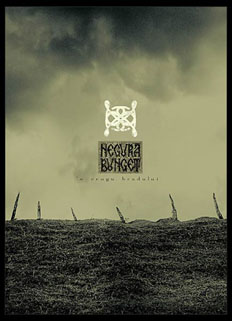
8. The cover artwork of "'N Crugu Bradului" is really exotic and very interesting. What does this cover art represent? How much of a connection do you feel it has to your lyrics?
That thing from the bottom is actually the roof of a local traditional house. It’s made out of straw and moss. The wooden sticks are also from the roof, and in the cover ensemble we feel they kindda stick out of time… What we sought bringing out in the end was the ultimate reality of the natural creation, crafted in time by nature itself. That you can see from the inside cover wooden inlays, which we also used on the multimedia menu background. We didn’t try to change anything, just to deliver it in its unveiled primordial form. For that thing we actually brought with use home a 5 meters long carved tree from the middle of the Apuseni Mountains.
9. Tell us more about the video-clip of 'Văzduh'', (track recorded solely for the Code666 comp. 'Better Undead than Alive')... How long did it take to conceive the video-clip?
We composed and recorded the track at code’s request, especially for the compilation Better Undead Than Alive. After doing that we had a chance to also do the clip, so we said why not. We shoot all the images with the help of our friend Marius Danci, edited the video also with him on Bilutza’s Records studio, and in the end our friend Andrei Nica did the final touch with some special effects and post-mastering. This being our first video experience I’d say we did a fine job. We chose ourselves all the places to film the things, and it was quite of an experience going in some remote hardly accessible places (like mountain tops, caves…) with all the equipments, only the 4 of us. Almost all the images were shot in Apuseni Mountains. We were on a very strict deadline with the track of the compilation, and as we decided to also do the clip only after we recorded it, there was obviously not a lot of time we had… But we came up with the whole screenplay for it quite easy and natural, so we managed to do everything quite fast! It was nothing pretentious, but we did had at our disposal some rather professional equipments (that was of course a nice context, and we grabbed it).
10. What about your side-project, Makrothumia. Give us more info about it. How it differ from Negura Bunget?
Makrothumia is dead for quite a while… We only released a tape album of it, back in 1997… We continued playing a bit, almost did another album, but in the end we decided to put an end to it about 3 years ago. It was quite different from Negura Bunget. It was more melodic, technical and also not at all into Black Metal. Was more like some kind of Techno Death Metal.
11. I don't know that much about Romanian history, what in your opinion was the greatest triumph and greatest tragedy in the history of your country?
I wouldn’t want to see our history is such antagonistic terms… For example I always feel proud to be descendent of the Dacians, which although were conquered by the Romans, put up such an amazing fight against them it can only makes you admire their strength. This would normally be a great defeat, but we wouldn’t have been what we are today without it… A great tragedy was on the other hand without any doubt the communist plague that came around the country after WWII. Between the two wars Romania was more or less equal to the European nations and I can only wonder what a decent evolution could have meant for Romania… But with the communist it fallowed a period which not only ruined economically the country, but also destroyed a lot of traditional spirituality and mentality.
12. So, what's the positive and the negative sides with running a band from Romania?
The positive this is of course the local natural and spiritual landscapes… which very few countries can top. As a negative side I’d say there’s certain image, which tends to change I have to admit, like coming from a second hand country. At the beginning was really difficult to get noted by the media, by labels and distributors. I can’t say that was a big problem for Negura Bunget, but for other Romanian bands it’s a really important thing.
| 13. What three books and movies would you consider essential? What Romanian books/movies could you recommend to us?
It’s not such an easy choice naming 3 essential books actually… it depends on what are they essential for. But to have a generic answer: I.P. Culianu – The Tree of Gnosis, C.G. Jung – Psychology & Alchemy, Mircea Eliade – History of Religion. For the movies it’s easy… there are 3 Lord of the Rings… he he. Other than that there’s also Baraka, which is also amazing! Two of the books I mentioned are of Romanian writers, though they were written for a larger audience. More for the Romanians I’d mention Ion Ghinoiu – The Romanian Pantheon, Ivan Evseesv – Dictionary of Magic, Demonology and Romanian Mythology, Gheorghe Pavalescu – The Magic in Romania. Of course all 3 are available only in Romanian language. Some nice Romanian movies are older ones, all historical: Dacii (The Dacians – an amazing visual document about our ancestors), Vlad Tepes (about the life of Vlad, of course, but featuring some amazing landscapes as well) and Morometii (done after a book of Marin Preda, a famous Romanian writer, about the beginning of the deconstruction process of the Romanian traditional peasantry under the communist regime). |
 |
14. How do you spend your spare time? Hobbies, interests?
We don’t have that much spare time lately… We have a lot of projects thorough Negura MUSIC: Negura Magazine, our small distribution, the studio now… But we always enjoy listening to some interesting music, going though some wild nature… nothing fancy!
15. Plans to Negură Bunget future? What are the news in your magazine and Bestial Rec.?
We are very busy these days working on a new album. We should have it ready very soon, so there’s a lot to work on. We’ll also record this album on our own now, so we are also setting up the last details on our studio. After that we’ll also record some other bands there, so you can find more details about it on www.negura.com. We are also working on the 5th issue of Negura Magazine these days. It should be ready at the beginning of next year. You can find more about it also on www.negura.com. As for Bestial Records… they are taking it a bit slow lately…
16. Thanks for answer my interview, Negru... Your final bullets...
Thanks very much for the support! Stay Black! And may the ZSALAMOLKXISA lead your path!
Negură Bunget site
|