|
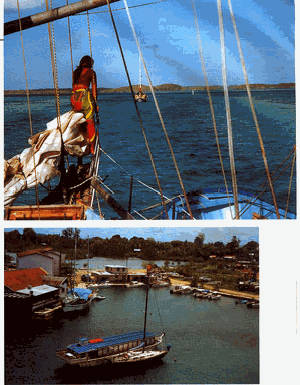
our Japanese
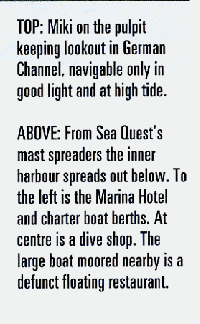
companion, 25 year old Miki, hopped into the dinghy. Following an artificially cut channel we were led to an inner harbor crowded with small dive and charter yachts.
At the Marina Hotel, over a beer we made friends with locals. Richard Brungard was a former cruiser, whose two daughters now skipper the local live-aboard dive ships. He kindly extended the use of his law office facilities for sending email and making long distance calls to track down the generator parts we required.
As we walked up the dusty road to town we studied faces. Belau's population seems to be a kaleidoscope of Malay and Melanesian races spliced into strong Polynesian stock. According to archeologists, Belau has been occupied for at least 3,000 years by seafarers that sailed and paddled their vessels out of the Indochina region. Then 1,000 years ago the islands were repopulated in a back-migration from the heart of Polynesia in the South Pacific.
Land rights in Belau, Richard had explained, are traditionally matrilineal. The elder women, he told us, are responsible for choosing the male chiefs. Today the country has just over 15,000 inhabitants divided into 16 states, each with their own legislature, court and local government bodies, the most over-governed country in the world. One state only has 200 people!
Imported Chinese and Filipino workers do the manual work here. Many Belauans hold cushy well-paying government jobs currently supported by largess from the USA.
But Richard told us, "Belauans, despite the western trappings, live by the old rules. Their income and free time are all absorbed in obligatory support of their extended families."
We stopped to photograph a new concrete meeting house. Traditional thatched Bai once graced every village. Used originally as Men's Houses, unmarried girls lived in them as concubines. The men gifted them with bits of sought-after Belauan custom money. Understandably, the custom of keeping concubines has died out, but the Belauan 'money', which has an almost mystic value, is still in use.
"The money is ancient," venerable Belauan lady I met in the park told me. "No one knows where it comes from, but each piece has its own history."
Modern researchers, I read, think sea-faring traders may have brought heavy pottery and glass bangles. Eventually these were deliberately cut to form short crescents, drilled with holes.
"Families are secretive about what pieces they possess but extremely proud of them." the lady continued. "A young girl offered a gold chain or a
|
|