|
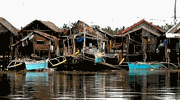
river mouth. This river is a highway winding into the heart of Samar, and its wide waters were filled with canoes.
Our skipper and crew were strangers here and had to ask for directions but eventually, after breaking their propeller on rock shallows, we landed. We left them to fit their spare prop and went with a guide along jungle paths to the caves. An Austrian discovered the caves in 1964 after noticing an small animal emerge. The entrance is accessed along a cantilevered planked path way over the gorge below. The caverns are many chambered. The guide assured us that the pythons and black cobras had been cleared out, a happy thought as we stumbled along behind the kerosene torch.
25 Oct. Bakkhaw is located east of Cablagna Point. We had stopped well offshore for a rest overnight but a town official paddled out to suggest we move closer in. Good naturedly we did. The next morning a different local official accompanied by a police officer stepped uninvited aboard. He demanded P700 for the use of the wharf. We pointed out that we were not using the wharf. He then demanded to 'inspect' Sea Quest for customs. He carried no I.D. We turned on the engine and began hauling up the anchor. We suggested he leave or he would come with us to the next port and explain to authorities there about his problems. He hurriedly left.
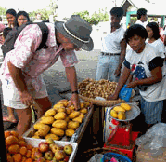
The next weeks are telescoped as we were in Guiuan doing research in the old church archives. It proved to be a delightful town made doubly so by the kindness of Susan Tan and her generous family, owner of Tanghay View. We anchored just off shore of this hotel adjacent to the town wharf. Our only frustration was the fact that the town had no email, but hook ups are expected in the near future. Electrical 'Brown outs' a couple of hours a day are usual. Sometimes there is no electricity for days after a storm. Guiuan has a wonderful fresh food and fish market. People are friendly. We found even the little lanes safe to walk at night.
We sailed to Suluan Island to continue our investigations and eventually photographed over a hundred descendants of Caroline islanders, most of whom carry the sir name 'Dagsa' which loosely defined means castaway or floatsam tossed from the sea.
When we finally left Guiuan we set out to explore the Visayas which is the name for the islands of the Central Philippines. We set a course for the pass between Leyte and Panoan Island. When we got there we discovered that a new bridge had been built. So we had to tack around this 20 mile long island. At a cove on its tip we anchored for the night where a huge fleet of fishing bancas steamed off over the horizon at dusk to fish for squid.
The next day we reached Limasawa, a raised coral island with pretty cliffs and white sand beaches known for good diving. We anchored on the south side in flat calm conditions and scuba dived on the lovely corals, but saw no fish bigger than your hand. Cyanide and dynamite fishing have seriously depleted stocks here. Limasawa was the site of Magellan's celebratory Mass in 1521 to commemorate his long voyage across the Pacific. We hired a motorcycle on a rainy day to take us sliding over muddy roads to the opposite side of the island to find the
|
|