|
THE PHILIPPINES - 14 October 2003
This was our second voyage to the Philippines. Because we were interested in investigating stories we had heard about Carolinian inter-island voyagers being blown off course, We chose to enter the archipelago through the Surigao Straits rather than through the more northerly San Bernadino Straits. The drift voyagers supposedly landed on the east coast of Samar and the islands straddling the Surigao Straits. It is said that before dominant western people arrived that Carolinian navigators had deliberated sailed to the Philippines seas. They came to trade for pig, to dive for shell and gather other materials to use as tools for carving. They knew that gold was to be found in mountains of the Philippines and referred to the archipelago with a native word that had the connotation of a net that 'caught' canoes blown far from their home islands.
As we entered Surigao Straits near Suluan, an island we would later return to, several 15 foot motorized banca canoes with double outriggers approached, one of them closing quite near. The only response to my wave was a hand-to-mouth gesture. It seemed we had reached a land of hunger where population had outstripped nature's ability to provide. We were soon to discover that for many Filipinos, their most treasured fantasy was to become like Americans, to always have plenty to eat and live in continuous prosperity.
Beyond Suluan the island of Homonhon loomed. It was about ten miles long and narrowed in the middle. After completing his epic voyage from Spain this was Magellan's first landing place in the Philippine Archipelago. We dipped in close to shore on the south side of the island where a large cross and a white rock splashed with thee word 'Magellan' marked the spot.
Montoconan, off Homonhon is an islet at the NW end. A reef joined to the larger island creates a pretty bay where we dropped anchor for the night, our own first landing place after a trip from Yap had lasted five days. The people here were shy. Very likely no one spoke English. We turned the clocks back two hours and made a bed on deck for the night. As the slightly lopsided moon rose high one banca after the other arrived in the cove, by the sound of excited chattering, expressing amazement at our presence. Soon a dozen had fanned out around us, kerosene flares lit to attract fish in the warm night.
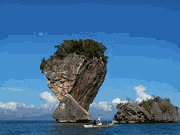
Wed. 15 Oct. We made a very early start for Tacloban and would have made it there in a day had we not first caught sight of an amazing looking rock towering from the sea. So we made a detour. Tooth Rock in the early morning light was just glorious. Michael set me adrift in the dinghy to make photographs. Further along the coast pretty limestone islets lured us to their anchorage.
Earlier that day we passed the infamous town of Balangiga. In 1901, 44 American soldiers were massacred here in a plot instigated by Filipino revolutionaries in cahoots with the local town mayor and the Catholic priest. The American's were asked to come on a ruse of being required to defend the villagers against Moro Muslim's who raided the town for booty and women. The Mayor allowed the guerilla forces to infiltrate the town as manpower to help in a civic project the American's had instigated, and hid them in the church. Only a handful of American's escaped the massacre, but among them were leaders who regrouped and returned to revenge their comrades by killing every male in the town over the age of 11. They
|
|