|
stationary lows, skipping along easily on the rising winds until we charged at six knots across barely ruffled seas. The lows merged into one, then slid eastward, while we continued to enjoy winds of 10-15 knots.
By noon on the 18th the storm had changed course to move west towards us. Overnight the distance between us and the center of the depression had halved. It was time to find some shelter! Fortunately Yap lay on our horizon: a land of small hilly bumps like the undulating back of a sea monster.
Yap, 18th May 2003
The Federated State of Yap comprises a group of islands that stretches 1,000 miles to the east and includes Lamotrek, Ifalik and Woleai, the islands we had recently visited. Yap itself is comprised of four large islands grouped closely together behind a barrier reef. Three of these are accessible by bridges---a forth only by boat.
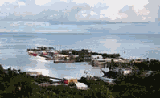
We entered Tomil Harbor through a narrow, but well marked reef passage. Many large "transfer" ships lay anchored in the harbor, some with their trawlers tied up next to them. A small container ship was alongside the main wharf. At the back of the commercial wharf area is a small bay, location of the so-called "marina" and 30 ton slipway, which could come in mighty handy for yachts if it had cradles. There we anchored in about 10 fathoms in water
The Yapese people are mellow. We were happy to discover that the music they enjoy is also mellow and is played quietly. We still had dreadful memories of Pohnpei, enduring night after night the blaring noise issuing from the waterfront bar. We thought that because of the SARs epidemic, and the restriction of travel notice for Philippines, that we might have to spend many weeks or even months in Yap. To have to put up with another perpetual din would have been intolerable!
Ashore we headed to the nearby supermarket. Imagine our surprise as we turned up aisle three and met face to face with an barefoot couple wearing only a loin cloth and lava lava as in the outer islands! Younger Yapese islanders have recently abandoned traditional nakedness. The out islanders have not and are often seen about town.
We walked up the hill to check out an attractive new hotel. Traider's Ridge, is a triumph of good taste. Wandering its premises we met Michael and Christina, the current managers of this four million dollar Colonial replica, who when they discovered we were cruisers off the boat in the harbor they had already admired, became very friendly, inviting us for dinner later that week and offering the use of the hotel pool where we soon got to know a few of the local expatriates including a group of nuns.
On Tuesday the tropical depression, now classified as a typhoon, we had been running from threatened. "Chan-Hon' was located about 700 miles to the southeast. Tthe harbor master ordered all commercial ships out of the harbor before dusk. A freighter had recently glanced the reef and tore out a piece of its hull on the coral spilling 40,000 liters of fuel. The clean-up operation had stretched the island's resources. Now the harbor office would take no chances. All ships must go outside. By late that afternoon however, the typhoon moved off in a less threatening direction. The edict was rescinded.
A month passed. Michael and I spent relaxed days catching up on correspondence, writing articles, and doing a few light boat jobs. We had ordered a new outboard through a local dealer. The SARS epidemic and now the onset of the typhoon season had put Philippines off limits for awhile. We applied to extend our visa for another three months.
At a birthday party hosted by expatiates, we met BB Nery and
|
|