|
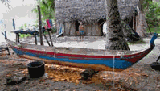
fiberglassing damaged longboats---especially when he supplied his own materials. I was free to wander as I liked shadowed by young Estelle. Her bright oval face and slim body was evocative of Indonesia. Futu mungo, mungo, mungo---or words to that effect were called out to me as I walked through the village. Many women who wished to show their approval for our visit would invite me to eat hot grilled fish or freshly pounded taro. Taro and coconut is the staple diet. When there is no taro, such as after a cyclone, there may only be coconut to eat!
Old Chief Joe, Dr. Joe's father took a special liking to my sunglasses. The next day I presented him with a spare pair kept for just such a situation. He was as proud as Punch.
Michael visited the school. It was incongruous, he said, to see the portly head teacher occupying the principal's office dressed only in a blue loincloth seated before his transparent, space-age Apple I-Mac computer. This tiny elementary school has 12 government provided I-Mac's networked to the teacher's desk--- running off solar power!
On Lamotrek Atoll about ten men, mostly teachers receive government salaries. On their shoulders rests the burden of finding the cash the atoll dwellers require to pay for repairs and petrol for their boats, and to finance summer visits to other islands. Few have luxuries like VCRs because in a thatched house environment electronic equipment seldom lasts more than a year at best. A few 12-volt electric lights are powered by solar cells through car batteries are about the best people can do. New economies threaten to cut government jobs by half.
Turtles are a main source of food in May on Lamotrek. Now with the aid of fast motorized boats, instead of one or two each expedition, more than a dozen can be picked up. People also eat the buried eggs if they find them.
Ifalik
Paradise does not get much better than Lamotrek. It was with reluctance that we made to leave. The wind was at first favorable for the 117 mile run to Ifalik. But by the early hours of the morning, the wind had died out altogether. We had been skirting rainsqualls under gloomy skies for some hours and the light was poor as we entered Ifalik's coral obstructed channel. Despite Michael's position perched on the bowsprit we inadvertently grazed the coral head we were looking out for!
Chief Pakalimar sat beneath the eves of his sleeping house when we arrived after hiking across the island past taro pits and staked pigs. He accepted our gift of 40 pounds of rice, a quart of soy sauce and some sugar.
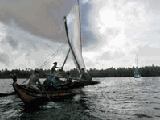
Next morning we were hardly out of the bunk when Michael shouted, "The fleets on the way it!" Into the dinghy we leap, camera in hand, to photograph the unique sailing outrigger canoes of these islands as they skimmed one by one through the channel from the open sea to the placid lagoon. Their crews perched fore and aft, with one on the rack on the outboard side.
One afternoon after the obligatory tuba drinking session Michael brought John Y home. John entertained us with island myths. He also explained that the carvings, phallus, dolphin, gecko, and eel, on the Paramount Chief's canoe house were all considered symbols of male potency and power.
Ifalik is not democratic. Chiefly edicts are relayed to the commoners. In many ways the men who paddled out in canoes seemed as demanding as crusty old Chief Pakalimar who daily sent someone to demand packs of cigarettes from us.
I wondered how John saw the future for Ifalik.
|
|