|
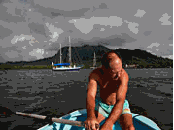
Tosie's three girls passed a battered ukulele between coastline with its narrow fringe of shallow lagoon. Cars hooted as we passed and people waved. Mountains rose up in steep ridges and spires. A rampant vine blanketed even large trees in a heavy green shroud. Mists rose from valleys. Behind the coast areas of mangrove swamp supported magnificent hundred foot trees.
Kosrae people are rather demure. Perhaps the Protestant teachings just reinforced something that was already there in their character, for the early accounts say that they were "meek, mild, honest, and hospitable". Only the chiefs were considered "greedy, insatiable, deficient in noble feelings, envious and jealous of their prerogatives."
We had heard that Kosrae was buttoned-up and conservative. But we found even the religious side wasn't too bad. The sermon was short; the songs were long.
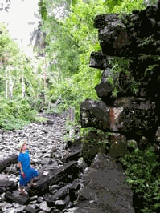
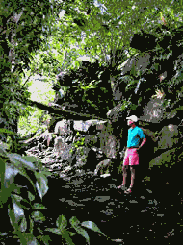
Kosrae has megalithic ruins similar to those at Nan Madol in Pohnpei. Moses, a great grandson of King John, Kosrae's last King, led us into the Lelu ruins. He slashed at a vines that threatened to bar our way. In 1978 the ruins were extensively cleared by archeologists and restored where possible. Little has been done since to preserve the site --- which made the experience of hacking our way through the myriad streets and chiefly enclosures all the more exciting.
It was in 1400 AD when the Lelu chief conquered and for the first time united the entire island of warring factions leading to the construction of the high walled compounds for the ruling elite. For the next 400 years Lelu was continuously added to. An earlier people however, occupied the site from about 100 BC.
Cyclopean walls of heavy basalt logs and large boulders rose around us in 20 foot high walls 12 foot wide at their base. The natural polygonal basalt "crystals" were laid in courses at right angle to each other like logs. Each section was divided into public and private areas divided by fences. The chief and his friends would spend most of their time idling, attending to affairs of state as required, while drinking the sacred seka., a mildly narcotic drink made from kava root.
Heavy bombing by Allied forces during the war destroyed some of Lelu's finest walls. Fortunately enough good examples still remain to glimpse the past glory.
We set sail on Sunday, March 30, 2003. On Saturday afternoon we had said our farewells. Maud, Tosie's daughter was in tears. We set sail to run on a broad reach around the south west end of Kosrae after which we set a course of 285° which would take us close to Pingelap, and atoll we passed by the next day so close that we could see canoes drawn up on the shore and houses amongst the coconut palms. That night we sailed near Mokil Atoll but could not see it in the darkness.
Pohnpei
We entered through the reef just before dusk. No one could fail to be inspired by lofty Sohke's Rock standing sentinel high above Kolonia's harbor, flashing gold in the last rays of the dying sun. The next morning we entered customs and immigrations as usual. TheHealth officer was careful because of the SARS epidemic, then just beginning. For the FSM a cruising permit is required.. As in our previous visits, we had received no reply to our application but were granted a permit after we
|
|