|
with sniffer dogs trained for drugs and bombs who got a little over excited over our cat. Afterwards we had to head up to the airport on our bikes with our sponsor, being trailed by a police van. There we were issued with a laminated card bearing our photograph. There had been a little hitch. U.S. passport holders had to wait 14 days before coming to Kwajalein after getting permission, but other foreign nationals were supposed to wait 21 days. The authorities chose to not worry about our week early arrival and issued Michael his card without comment.
Because of Bush's impending war on Iraq, the base was on "Bravo" alert. Security was greater than normal. We had to wear our cards when ever we left the boat, just like everyone else on Kwajalein. We were barred only from personally using the big supermarket and the post office. The smaller supermarket into which we could go had most of what we needed anyway. The base also had a small Macy's including a hardware store.
They hospitality of the locals made our visit a lot of fun. Nighttime we partied or watched free movies. Daytimes we dove the lagoon or explored. On one dive we were accompanied by a large manta ray at a 100 feet that came so close I was able to reach out to stroke his slippery skin. On another we swam through schools of fish being herded by sharks. The Prinz Eugen, a German heavy cruiser was scuttled in the lagoon after the war. It was a ship of some fame, having been dubbed the "Lucky Ship". It survived the attacks that sank the Battleship Bismarck, and was instrumental in sinking the H.M.S. Hood in the North Atlantic. It sank upside down canted on to her starboard side. One of her propellers is out of the water. Our dive took us along one side where we could still see the big guns and round fire control positions and much more.
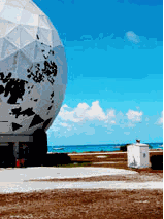
Kwajalein, 441 km northwest of Majuro, is the largest atoll in the world. Its boomerang-shaped lagoon encloses 2,173.8 square km. Since 4 Feb. 1944, after the atoll was seized form the Japanese, it has been a U.S. military installation. Until 1958 it was the main support facility for its nuclear-testing program. After 1963, when nuclear testing was driven underground, Kwajalein became a testing range for missile accuracy. In 1964 the US Army took over from the navy to set up the Kwajalein Missile Range now called USAKA. Two-thirds of the lagoon is used a a target for intercontinental ballistic missiles test - fired from Vandenberg Air Force Base in California.
Kwajalein, according to the Moon Publication guide I read, still continues to play a key role in the development of the
|
|