|
formally annexed the group in 1937. For 50 years the two islands were placed under joint British and American administration.
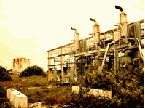
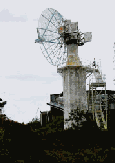
Saline wells, drought and the declining strategic value of the islands led to the resettlement of their populations to the British Solomon Island Protectorate or to other Gilbert and Ellice Islands, in 1952. During WWII the U.S. Air force built a new airstrip at the island's northwest end, later abandoned in the 1960's. NASA located a satellite tracking station here for two years from 1965-67. The abandoned facilities are now in the hands of the Kiribati government and are looked after by I-Kiribati "caretakers" paid by the government to keep an eye on the place and do a bit of maintenance. The "caretakers" have enriched themselves by dismantling sheds and storage buildings, shipping off the corrugated iron to their own home islands for "personal" recycling. Large unused fuel storage tanks painted white remain, conspicuous from miles off shore, along with abandoned vehicles, motors, a bunker hospital, a shed full of leaking insecticide containers, and much else.
Michael combed every inch of island for useful scrap while I fought a sense of revulsion at the loss and ruin. Why had the U.S. Air Force and later the N.A.S.A. group just handed everything over to the newly independent Kiribati government? Was it to avoid paying the cost of cleaning up the island? The "gift" not only has cost the government to maintain its caretakers, but has also deferred the day when men will have to come in with dynamite and bulldozers to flatten and bury what is left. Today the three Fairchild engines of the power plant stand idle, the metal stripped from the shed around it. Battery acid, and a host of other chemical pollutants seep into the coarse soil. Insulation materials lie about in sodden heaps along with glass and rusting metal. Old trucks, refrigerator carcasses, filing cabinets, and 55-gallon drums lie rotting. One building is entirely carpeted in torn manuals!
Michael was especially interested in the vintage trucks sagging against their flat tires. CGM, Chevys, and a Bedford Fire engine. I returned the next day to rephotograph a truck with "U.S. Airforce" stenciled on its door, but found that the steel girder roof had collapsed over it in the night.
The airport landing field still looks to be in excellent shape. It serves as an emergency landing facility for flights between Tarawa and Christmas Island. However, there are no scheduled flights here. Kiribati supply ships stop in about every two months to deliver fuel and food ordered by the islanders.
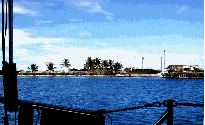
Yachtsmen, who wish to flee the cyclone zone for a few months, but remain close enough to the South Pacific Islands for a quick return, use Kanton, 650 miles north of Samoa, as a summer haven. Officials are relaxed. There are no stores, no water, and no fuel --- but plenty of fish, coconut crab and crayfish. Natives told me there is no ciguatera here. The "caretakers" starved for company, welcome yachtsmen.
Near the entrance, the "villagers" have built rough sheds as alternative homes. "Its cooler out here" they say, "and the fishing is better!"
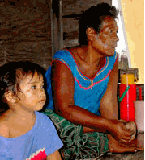
The island has very few coconuts, as there has never been sufficient native population to care for them. "People planted coconut trees on the far side of the lagoon, but they all dead," Cantarawa, the resident nurse told me. "We think it important people live near coconuts. Otherwise the crabs eat the young trees".
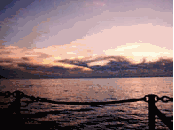
On the fifth day the normally blue skies became overcast. Squalls rolled in. Breakers closed off the passage in and out of the lagoon. Twenty four-hours later we were bracing for regular 40-knot squalls. A Tropical Depression that had
|
|