|
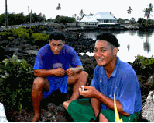
church hailed us and said "welcome!" A group of boys, out for a half hour together after spending the late afternoon cooking the food for the evening meal, as tradition dictates, grinned shyly. A 12 year old girl followed us a ways, carrying a three month old baby who was her sole charge. Maternal duties come early for children, as both boys and girls are given responsibility to look after their younger siblings. Someone waved from a tiny open-sided thatched fare set back across a field of black volcanic stone. I picked my way around the buildings the woman waved us inside where she served us some freshly baked breadfruit to dip into coconut cream. It was getting late. On the road young men --- the village wardens --- were wrapping red sarongs over their shorts. Hurriedly we said good bye to our hosts, promising to take them out to Sea Quest the next day, and set off down the road. The village has "sa", like the Pago Pago curfew, originally intended to stop unwholesome sexual liaisons between unwed people at dusk. Where ever people are they must stop what they are doing and pray. In this village "sa" only lasted about five minutes and was announced by a long drawn out wail of a horn, with another following to signal the end.
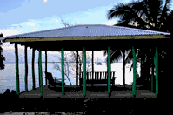
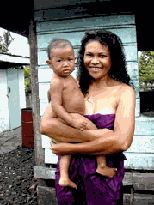
The next day we returned and were greeted on the water's edge by AliiTali, daughter of the former chief, a fine looking woman, who said that her three sisters had all married "palagis" and lived overseas. She was designated to stay home to look after the old people, and had married a Samoan man, now working as an electrician in Apia. The old folks had passed away, so now there was only her and the children. We sat on a bench in her breezy shack. The raised floor was made from salvaged short planks. Bush poles supported the tin roof. The family's main house and all its fares were destroyed in a major cyclone about ten years ago. This year forecasters were saying that Samoa could be hit again. In light of this fact, there really is not much point in building expensive homes!
"Where did everyone go during the last cyclone," I asked.
"We made a big hole in the water tanks and went in with our most precious things."
Imagine!
As we looked about we were astounded to see that not everyone had something so basic as running water to the house. One group of women actually took their clothes to the sea to wash and then rinsed them later from a hole they had made in the main supply, plastic water pipe. Even the better houses seemed just to have water to an up-stand outside that doubled as a shower. Michael and I seriously wondered about the lopsided priorities, knowing as we do, that the churches manage to elicit enormous sums from congregations that may be living in what we would term hovels! Only the oval fares are beautiful. Their inner roof structures are a marvel of basketry and are sometimes decorated with tapa strips or carving. In this climate they are a healthy living choice, particularly if sleepers have mosquito nets. But most people now live in semi enclosed homes.
The weather had, by this time in late November, become ominously summer like. On the reef we found cowries brooding their egg sacks. Mango season was over. The
|
|