|
After two weeks in Pago Pago it was difficult to find many redeeming qualities. The town is a stinky, noisy, dirty hole! Litter lies everywhere. Concrete paths are so overlaid in dirt that you walk in mud. Garbage piles up in disused corners. Dead dogs disintegrate where they lie. Every sort of litter floats past the boat: truck tires, telephone poles, refrigerators….
What a place to celebrate my 59th birthday!
Western Samoa
15 November 2002
We left in the mid afternoon, after a whirlwind three of days, loading on fuel, food stores, and getting the web page updated on the Internet. In a light but steady wind, under a full moon, we made the 82-mile passage to Western Samoa. At 2:00 AM , Fanautapu Lighthouse on the Eastern tip of Upolu, was sighted. Sleepy-eyed in the early morning, I looked down the coast at a line of sloping headlands. Unlike American Samoa, where there is little land for cultivation or homes, except hard up against the mountain, Western Samoa has valleys and gentle hillsides. The heavy cloud, that even in the early morning obscured the higher peaks, opened up enough to send bright sunlight streaming down on coconut plantations and massive churches.
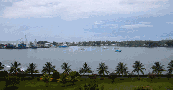
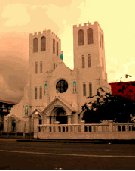
Apia, even from the sea, looked like an inviting sort of town. The bay is not big and is open to the north, protected mainly by barrier reef. But there are commercial docks for a container ship, a roll-on local trading ship and a government patrol boat. Dominating the waterfront is the new Samoan Government building which looks like a 60's style Miami hotel capped with a golden-brown representation of a local "fale" house. At a glance we counted five churches. The waterside, which has all been reinforced with stone to prevent damage from the big swells that must roll in during storms, is shaded by enormous fig trees. Three other yachts were moored in the bay.
The Samoan Tala (rhymes with dalla) trades three to one with the American dollar, making local goods very cheap. The town has big fruit, craft, and fish markets along with large Chinese owned department stores and even a couple of small supermarkets stuffed with familiar NZ imported foods. The average weekly wage is about 100 Tala, so most goods are designed for the cheaper end of the market. Apia is a more cohesive town, but Pago Pago did have more in the engineering line.
We made our way to Aggie Grey's Hotel, now run by her granddaughter of the same name. Although the hotel has been rebuilt to accommodate the luxury that modern day travelers expect, the back of the hotel, with its tiny guest cottages, colorful tropical garden, pool and a large round thatched-roofed native "fare" built in the traditional manner, have been retained. We drank a cold beer there and examined the collection of antique black and white pictures.
Aggie Grey's father was a Scottish chemist who married a beautiful Samoan woman. Aggie married a part Samoan man, who abandoned her and the four children, leaving her destitute. When WWII began Aggie cooked hamburgers
|
|