|
he was a "drinking man" (on a dry island). He wanted us to give him a bottle of spirits, reminding us several times that he expected us to the "Scotch" to him along with the fees when we came ashore!
While still aboard he also outlined all the do's, but mostly the don'ts of the place. There would be a special service Saturday morning to commemorate the bringing of Christianity to Raratonga in 1888 by Rev. John Williams of the London Evangelical Society. We would not be able to move the boat anywhere until the service was over after 11:00 AM. On Sunday there would be services held at 6:00 AM, 11:00 AM and at 5:00 PM. The entire community would attend all three services. There would be no swimming that day, or going about in canoes. Everyone must stay soberly at home. We would be expected to stay aboard the boat unless we attended services.
"We are the most sacred island in the Pacific," the custom's officer told us. "I told the last yacht here, to get out immediately after they had gone off in their little boat on Sunday to dive!" I think the word to use should have been "strict" rather than "sacred". Could he not see the hyprocracy of touting all this "Christian" behavior while putting his hand out for some illegal liquor?
Despite the income islanders derive from pearl diving for natural pearls, and the presence also of a few black pearl farms, the strict discipline and lack of liquor has taken its toll. More than half of the Penrhyn islanders live in New Zealand.
One of the hanger's on to the boarding party was a newly ordained minister, now waiting to be assigned a mission in another country. He dives the lagoon reefs collecting shell, and at the end of the day opens the "pipi" oysters to retrieve any pearls that might have formed. The diver showed us little zip-lock packages containing each days collection, but the pearls were so tiny and misshapened, that for the life of me, I wondered what they might be good for. The diver said a dealer from NZ had flown in and paid NZ$100 a carat! I doubt those pearls resembled these.
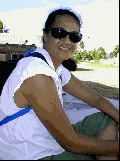
Late that afternoon we headed ashore to find the Kiwi at the airport who would change some money for us. Instead we met Sheryl and Kimi, two school teachers, each with interesting stories to tell.
Beryl is Maori but married a Cook Islander in New Zealand. When the family on the atoll needed help with their pearl farm they asked their son and wife to come over and help. Beryl, however, mainly busies herself with teaching the grammar school. She had just returned from Raratonga where she had been training to trouble shoot the computers that the school will soon be receiving.
Kimi is a young widow with three children, who survived neglectful parents, a brother joining Black Power, an abusive husband killed in a car accident 12 years ago, and being the mother of an intellectually handicapped child who she has insisted on keeping with her. Although born in NZ, she decided to return to her country and the experience is keeping her on her toes.
Because Penrhyn has no high school, but her daughter is 14, Kimi was determined to teach her daughter and the younger son from NZ's excellent correspondence school.
|
|